Michael Jordan: Career, Six Titles, Records and Life Today
- Michael Jordan was born on February 17, 1963, is 63 years old and turns 64 in February 2027.
- He won six NBA championships with the Chicago Bulls in 1991-93 and 1996-98 and was Finals MVP in all six.
- His 30.1 points per game is the highest career average in NBA history, with 5 MVP awards and 10 scoring titles.
- He won Olympic gold in 1984 and with the 1992 Dream Team, and entered the Hall of Fame in 2009.
- Forbes estimated his net worth at $4.7 billion as of October 19, 2026; Jordan Brand brought Nike $7.03 billion in fiscal 2026.
- Early life: Brooklyn, Wilmington and the varsity cut
- The 1984 draft and the making of the Bulls
- Michael Jordan's championships: the two three-peats
- The baseball break, 1993-1995
- The Washington Wizards comeback, 2001-2003
- Michael Jordan stats: the career numbers
- Olympic gold: 1984 and the 1992 Dream Team
- Air Jordan, Nike and the Jordan Brand business
- Charlotte Hornets ownership and the 2023 sale
- NASCAR: 23XI Racing
- Michael Jordan's net worth, according to Forbes
- How old is Michael Jordan? Age and family
- The Last Dance and the Jordan legacy
Michael Jordan is the former Chicago Bulls guard who won six NBA championships (1991, 1992, 1993, 1996, 1997 and 1998), was named Finals MVP in all six series and retired with the highest scoring average in league history, 30.1 points per game, according to NBA.com. Born on February 17, 1963, he is 63 years old and turns 64 in February 2027. Forbes put his net worth at $4.7 billion as of October 19, 2026, most of it earned after his playing days through the Air Jordan line and the 2023 sale of the Charlotte Hornets.
This profile covers the whole arc: the 1982 title-winning shot at North Carolina, the two Bulls three-peats, the baseball detour, the Wizards comeback, the full career statistics, two Olympic gold medals, the Nike partnership that became a multibillion-dollar brand, team ownership in the NBA and NASCAR, his family, and the documentary that introduced him to a new generation. Every figure comes from NBA.com, the Basketball Hall of Fame, Olympics.com, Nike's investor filings, Forbes or top-tier news reporting.
Early life: Brooklyn, Wilmington and the varsity cut
Michael Jeffrey Jordan was born in Brooklyn, New York, and grew up in Wilmington, North Carolina, the son of James and Deloris Jordan. NBA.com's official profile notes that baseball, not basketball, was the first love he shared with his father, and that he took up basketball by following his older brother Larry, a gifted athlete in his own right.
The most repeated story of his youth is true: as a 5-foot-11 sophomore at Laney High School he was left off the varsity roster. He grew to 6-foot-3 before his junior year, made the team, and left Laney as a high school All-American headed for the University of North Carolina.
North Carolina and the 1982 championship shot
At North Carolina he played as a freshman alongside James Worthy and Sam Perkins. In the 1982 NCAA championship game against Georgetown and fellow freshman Patrick Ewing, he scored 16 points, grabbed nine rebounds and hit the deciding 16-foot jumper with 18 seconds left for a 63-62 win. He was named College Player of the Year as a sophomore and a junior, adding the Naismith and Wooden awards in 1984, then left for the NBA Draft; he later completed his UNC degree, as Forbes records.
The 1984 draft and the making of the Bulls
The Houston Rockets took Hakeem Olajuwon first and the Portland Trail Blazers, already stocked with guard Clyde Drexler, chose center Sam Bowie second. The Chicago Bulls selected Jordan third. He averaged 28.2 points, 6.5 rebounds and 5.9 assists as a rookie, won Rookie of the Year and lifted the Bulls into the playoffs with 11 more wins than the year before.
His second season nearly ended before it began: he broke a bone in his left foot three games in and missed 64 games. He returned for the playoffs and scored 63 points in a double-overtime loss to the Boston Celtics, still the NBA playoff single-game record. From 1986-87 he led the league in scoring for seven consecutive seasons, starting with a 37.1-point average, and in 1987-88 he swept the MVP, Defensive Player of the Year and All-Star Game MVP awards.
- 1987: the Bulls draft Horace Grant and trade for Scottie Pippen, the core of the first title team.
- 1988-90: three straight playoff eliminations by the Detroit Pistons, whose double- and triple-teaming scheme became known as the "Jordan Rules."
- 1989: "The Shot," a buzzer-beater over Cleveland's Craig Ehlo to win a deciding Game 5; that season he averaged 32.5 points, 8.0 rebounds and 8.0 assists.
- 1989: Phil Jackson replaces Doug Collins as head coach and installs the triangle offense.
- March 28, 1990: a career-high 69 points in an overtime win at Cleveland.
Michael Jordan's championships: the two three-peats
After the third straight loss to Detroit in 1990, critics argued that a scoring champion could not lead a team to a title. The following spring the Bulls swept the Pistons in the conference finals, dropped Game 1 of the Finals at home to the Los Angeles Lakers and then won four straight. Jordan averaged 31.4 points, 6.4 rebounds and 8.4 assists in that series and collected the first of his six Finals MVP awards.
| Year | Opponent | Result | Finals MVP | Note |
|---|---|---|---|---|
| 1991 | Los Angeles Lakers | Bulls win 4-1 | Michael Jordan | First title; Magic Johnson's last Finals |
| 1992 | Portland Trail Blazers | Bulls win 4-2 | Michael Jordan | 35-point first half in Game 1, "the shrug" |
| 1993 | Phoenix Suns | Bulls win 4-2 | Michael Jordan | Finals-record 41.0 points per game |
| 1996 | Seattle SuperSonics | Bulls win 4-2 | Michael Jordan | After a record 72-10 regular season |
| 1997 | Utah Jazz | Bulls win 4-2 | Michael Jordan | 38 points in the Game 5 "flu game" |
| 1998 | Utah Jazz | Bulls win 4-2 | Michael Jordan | Series-winning jumper in Game 6, his last shot as a Bull |
1991-1993: the first three-peat
The 1992 Finals against Drexler's Trail Blazers opened with a record 35-point first half from Jordan, capped by his famous shrug after another 3-pointer. In 1993 the Bulls beat Patrick Ewing's Knicks without home-court advantage, and Jordan then averaged 41.0 points against Charles Barkley's Phoenix Suns, still a Finals record, with John Paxson's 3-pointer sealing Game 6.
1996-1998: the second three-peat
The 1995-96 Bulls, rebuilt around Jordan, Pippen and rebounder Dennis Rodman, went 72-10, the best regular-season record in league history at the time, then went 15-3 through the playoffs. Jordan led the league with 30.4 points per game and, as NBA.com notes, joined Willis Reed as the only player to win the regular-season, All-Star Game and Finals MVP awards in the same year. The title was clinched on Father's Day, three years after his father's death. In Game 5 of the 1997 Finals he scored 38 points through a severe stomach illness, and in Game 6 of the 1998 Finals his pull-up jumper over Utah's Bryon Russell with seconds left gave Chicago an 87-86 win and a sixth banner. He was named Finals MVP each time.
The baseball break, 1993-1995
In the summer of 1993 Jordan's father was murdered during an armed robbery. That October, one day before training camp, Jordan announced his retirement at 30. In 1994 he signed with the Chicago White Sox organization and spent the season with the Class AA Birmingham Barons. According to MLB.com's minor league records he played 127 games, hit .202 with three home runs and 51 RBIs, and stole 30 bases. NBA.com describes him as a competent if unspectacular performer whose path to the majors looked long, and the 1994-95 baseball labor dispute helped push him back toward basketball.
On March 18, 1995, he released a two-word statement, "I'm back," and rejoined the Bulls wearing No. 45. He averaged 26.9 points in 17 regular-season games, scored 55 at Madison Square Garden in his fifth game back, and the playoff run ended against Shaquille O'Neal's Orlando Magic. The following season he returned to No. 23 and the Bulls returned to the top.
The Washington Wizards comeback, 2001-2003
Jordan retired a second time in January 1999, after the Bulls dynasty was broken up, and later moved into the Washington Wizards' front office. He returned to the court for Washington in 2001, at 38. NBA.com's statistics show 22.9 points per game in 60 games in 2001-02 and 20.0 points in all 82 games in 2002-03, when he was 40. He was an All-Star in both seasons; in 2003 Vince Carter gave up his starting spot so Jordan could start his final All-Star Game. He played his last game in April 2003.
Michael Jordan stats: the career numbers
These are the official career figures from NBA.com's statistics database. The regular-season scoring average remains the highest in league history, and so does the playoff average.
| Category | Regular season | Playoffs |
|---|---|---|
| Games | 1,072 | 179 |
| Points per game | 30.1 | 33.4 |
| Rebounds per game | 6.2 | 6.4 |
| Assists per game | 5.3 | 5.7 |
| Steals per game | 2.3 | 2.1 |
| Field-goal percentage | 49.7 | 48.7 |
| Free-throw percentage | 83.5 | 82.8 |
| Single-game high | 69 vs. Cleveland, March 28, 1990 | 63 vs. Boston, April 20, 1986 |
His honors, as listed by NBA.com and the Naismith Memorial Basketball Hall of Fame:
- 6 NBA championships and 6 Finals MVP awards
- 5 regular-season MVP awards (1988, 1991, 1992, 1996, 1998)
- 10 scoring titles, an NBA record, including seven in a row from 1987 to 1993
- 14 All-Star selections and 3 All-Star Game MVP awards
- 11 All-NBA teams (10 First Team), 9 All-Defensive First Team selections, 1988 Defensive Player of the Year
- 1985 Rookie of the Year; 2 Olympic gold medals; Hall of Fame class of 2009
He scored more than 32,000 regular-season points in those 1,072 games. In a survey of media, athletes and sports figures at the turn of the century, ESPN ranked him the greatest North American athlete of the 20th century, ahead of Babe Ruth and Muhammad Ali. The debate about whether LeBron James has since overtaken him is the longest-running argument in basketball.
Six, all with the Chicago Bulls: 1991, 1992, 1993, 1996, 1997 and 1998. He was named Finals MVP in every one of those series and never played a Game 7 in the Finals. He also won the 1982 NCAA title with North Carolina and Olympic gold medals in 1984 and 1992.
Olympic gold: 1984 and the 1992 Dream Team
Jordan won his first gold medal at the Los Angeles 1984 Games as a college player, leading the United States in scoring at 17 points per game according to Olympics.com. Eight years later in Barcelona he led the "Dream Team," the first US Olympic squad built from NBA players, to a second gold as its second-leading scorer at 14.9 points per game. The 1992 team was enshrined in the Basketball Hall of Fame as a unit in 2010, a year after Jordan's own induction.
Air Jordan, Nike and the Jordan Brand business
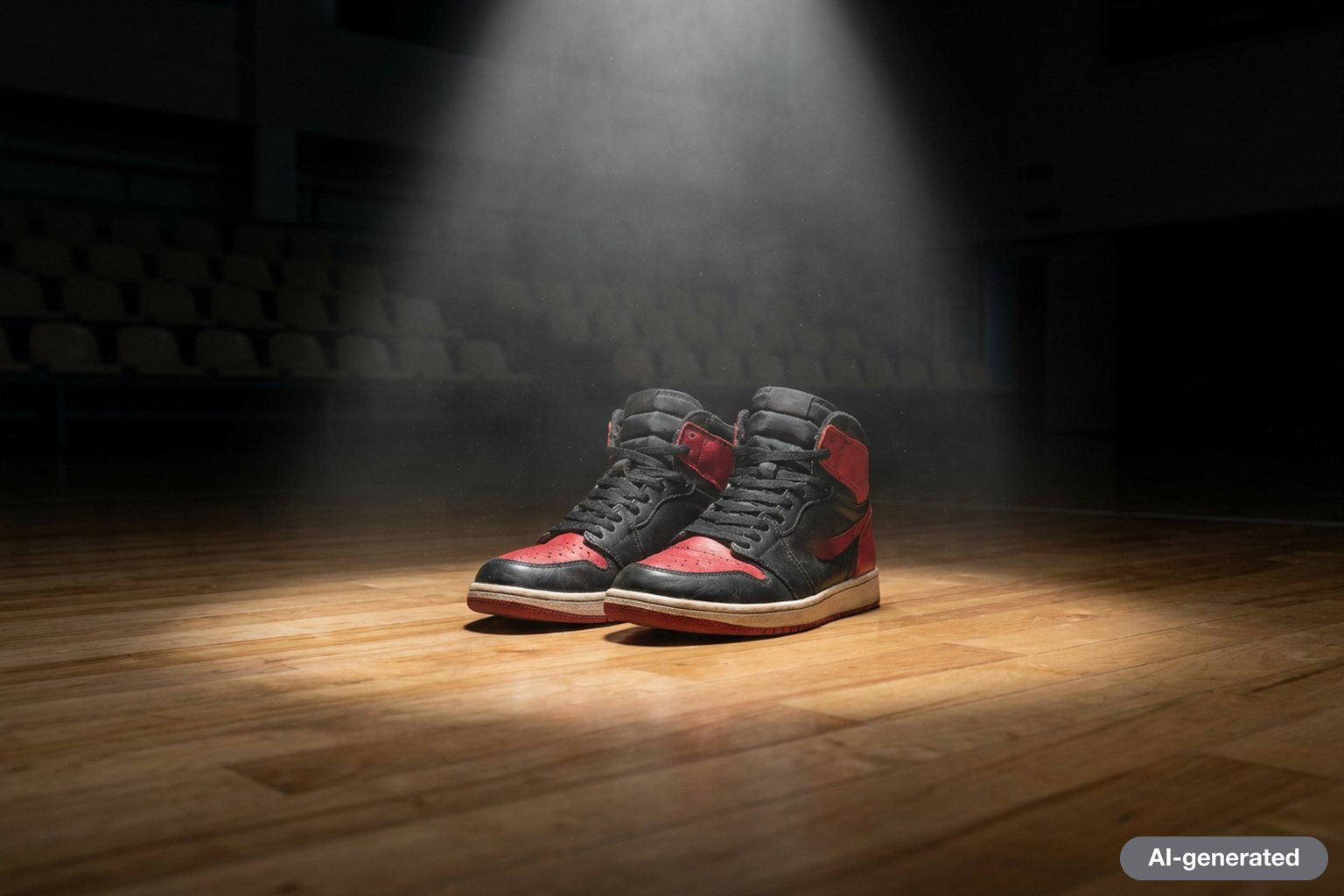
Nike signed Jordan before his rookie season in 1984. The first Air Jordan, designed by Peter Moore, was released in 1985 in a black-and-red colorway that, Nike's own history records, was banned under the league's uniform policy with the threat of a $5,000 fine each time it was worn. NBA.com notes the sneakers broke the league's "uniformity of uniform" rule and that demand for the line became unprecedented. Jordan's deal also gave him royalties on products carrying his name, a structure that signature-athlete and celebrity sneaker deals have followed ever since, from LeBron James to Kanye West's partnerships with Nike and later Adidas.
Today the sneakers, apparel and the Jumpman logo sit under Jordan Brand, a division of Nike, and Nike reports its revenue each fiscal year (ending May 31). The figures below come from Nike's own earnings releases and annual report and can be refreshed each August.
| Nike fiscal year | Jordan Brand revenue | Change (reported) |
|---|---|---|
| FY2024 (to May 31, 2024) | $8.70 billion | +3% |
| FY2025 (to May 31, 2025) | $7.27 billion | -16% |
| FY2026 (to May 31, 2026) | $7.03 billion | -3% |
Forbes notes that his playing salary over 15 seasons totaled about $90 million, while his earnings from Nike and other partners such as Gatorade and Hanes have run into ten figures.

Charlotte Hornets ownership and the 2023 sale
Jordan bought a minority stake in the Charlotte Bobcats in 2006 and in 2010 became majority owner, buying out founder Bob Johnson for $275 million, according to ESPN. He restored the Hornets name from the 2014-15 season and, NBA.com notes, funded Novant Health family medical clinics in the city.
On August 3, 2023, the team announced that the sale of his majority stake to a group led by Gabe Plotkin and Rick Schnall had closed, after a 29-1 approval vote by the league's owners. ESPN put the deal at an approximate $3 billion valuation. Jordan kept a minority share and the title of alternate governor, ending 13 years as the only former player to be majority owner of an NBA franchise.
NASCAR: 23XI Racing
In 2020 Jordan and driver Denny Hamlin founded a NASCAR Cup Series team, 23XI Racing, whose name combines Jordan's No. 23 with Hamlin's car number, 11, written as a Roman numeral. Bubba Wallace drove the No. 23 Toyota from the team's first season in 2021. By 2026 the team listed four Cup Series drivers: Wallace (No. 23), Riley Herbst (No. 35), Tyler Reddick (No. 45) and Corey Heim (No. 67), and in February 2026 Reddick gave the organization its first Daytona 500 victory. Forbes also lists Jordan as a special adviser and investor at DraftKings since September 2020.
Michael Jordan's net worth, according to Forbes
Only Forbes and Bloomberg publish independently researched estimates, and the numbers move with Nike's share price and private valuations, so the date matters:
- October 2, 2023: Forbes announced that Jordan had become the first professional athlete to make the Forbes 400 list of the richest Americans, with an estimated $3 billion, lifted by the Hornets sale.
- September 15, 2026: the last editorial update of his Forbes profile.
- October 19, 2026: Forbes' real-time estimate stood at $4.7 billion, ranking him No. 367 on the 2026 Forbes 400 and No. 984 among the world's billionaires.
Forbes lists his source of wealth as the Charlotte Hornets and endorsements, scores him 8 out of 10 on its self-made scale and gives his residence as Jupiter, Florida. For comparison, Forbes estimated LeBron James at $1.4 billion on the same date.
How old is Michael Jordan? Age and family
Michael Jordan was born on February 17, 1963. He is 63 years old in the 2026-27 NBA season and turns 64 on February 17, 2027. He was 21 when drafted, 28 when he won his first title and 40 in his final season with Washington.
He has five children. His first marriage, to Juanita Vanoy, ended in divorce in 2006; they have two sons, Jeffrey and Marcus, and a daughter, Jasmine. He married former model Yvette Prieto on April 27, 2013, in Palm Beach, Florida, and the couple's identical twin daughters, Victoria and Ysabel, were born in February 2014, as his spokeswoman confirmed to The Associated Press at the time.
The Last Dance and the Jordan legacy
"The Last Dance," a 10-part documentary built around footage from the 1997-98 Bulls season, premiered on ESPN on April 19, 2020, when live sports were shut down. Variety reported that it averaged 5.6 million viewers an episode, making it the most-watched documentary in ESPN's history. He also starred in the 1996 film "Space Jam."
NBA.com credits him with driving the league's global expansion in the 1990s, and his personal style, from the shaved head to the longer game shorts, was copied across the sport. His business model, a signature line with royalties, team ownership and equity stakes instead of appearance fees, is now the template for athletes such as Lionel Messi and Cristiano Ronaldo, whose brands are measured in the hundreds of millions rather than billions. More life stories are in the celebrities and biographies hub.

Frequently asked questions
How many championships did Michael Jordan win?
Six NBA championships, all with the Chicago Bulls: 1991, 1992, 1993, 1996, 1997 and 1998. He was named Finals MVP in each of those series, a record, and the Bulls never needed a Game 7 in any of them. He also won the 1982 NCAA title at North Carolina and two Olympic gold medals, in 1984 and 1992.
How old is Michael Jordan?
Michael Jordan was born on February 17, 1963, in Brooklyn, New York. He is 63 years old during the 2026-27 season and turns 64 on February 17, 2027. He played his last NBA game in April 2003 at age 40, after two seasons with the Washington Wizards that followed his years with the Chicago Bulls.
What is Michael Jordan's net worth?
Forbes' real-time estimate was $4.7 billion as of October 19, 2026, placing him No. 367 on the 2026 Forbes 400. Forbes first listed him on the Forbes 400 in October 2023 at $3 billion, the first professional athlete to make the list, after he sold his majority stake in the Charlotte Hornets. Most of his wealth comes from Jordan Brand royalties and that sale.
What are Michael Jordan's career stats?
According to NBA.com he played 1,072 regular-season games and averaged 30.1 points, 6.2 rebounds, 5.3 assists and 2.3 steals, shooting 49.7 percent from the field. In 179 playoff games he averaged 33.4 points. Both scoring averages are the highest in league history. His career high was 69 points against Cleveland in March 1990.
How many MVPs does Michael Jordan have?
Five regular-season MVP awards, in 1988, 1991, 1992, 1996 and 1998, plus six Finals MVP awards and three All-Star Game MVPs. In 1987-88 he won MVP and Defensive Player of the Year in the same season, and in 1995-96 he became the second player after Willis Reed to win the regular-season, All-Star and Finals MVPs in one year.
Why did Michael Jordan retire in 1993 and play baseball?
His father, James Jordan, was murdered in the summer of 1993, and Jordan announced his retirement that October, the day before training camp. He pursued a baseball dream he had shared with his father, playing the 1994 season for the Birmingham Barons, a Chicago White Sox Class AA affiliate, where he hit .202 with 30 stolen bases. He returned to the Bulls in March 1995.
How much money does Nike make from Jordan Brand?
Nike reports Jordan Brand revenue in its annual results. The figures were $8.70 billion in fiscal 2024, $7.27 billion in fiscal 2025 and $7.03 billion in fiscal 2026, the year that ended May 31, 2026. The first Air Jordan was released in 1985, a year after Jordan signed with Nike as a rookie.
Does Michael Jordan still own the Charlotte Hornets?
No longer as majority owner. He bought control of the franchise in 2010 for $275 million, according to ESPN, and completed the sale of his majority stake to a group led by Gabe Plotkin and Rick Schnall on August 3, 2023, at an approximate $3 billion valuation. He kept a minority share and remains an alternate governor.
Who is Michael Jordan's wife and how many children does he have?
He married former model Yvette Prieto on April 27, 2013, in Palm Beach, Florida. They have identical twin daughters, Victoria and Ysabel, born in February 2014. From his first marriage to Juanita Vanoy, which ended in 2006, he has sons Jeffrey and Marcus and a daughter, Jasmine, for five children in total.
What is 23XI Racing?
23XI Racing is the NASCAR Cup Series team Jordan co-founded with driver Denny Hamlin in 2020. The name joins Jordan's No. 23 with Hamlin's No. 11 in Roman numerals. Bubba Wallace has driven the No. 23 car since 2021, and in February 2026 Tyler Reddick won the Daytona 500 for the team. By 2026 the team fielded four Cup Series cars.
Sources
- NBA.com: Legends profile: Michael Jordan
- NBA.com Stats: Michael Jordan career stats
- Naismith Memorial Basketball Hall of Fame: Michael Jordan
- Olympics.com: Michael Jordan athlete biography
- Nike Investor Relations: NIKE, Inc. Reports Fiscal 2026 Fourth Quarter and Full Year Results
- Nike: The History of the Air Jordan 1
- Forbes: Michael Jordan profile (real-time net worth)
- Forbes: Michael Jordan Is Now Worth $3 Billion And Joins The Forbes 400
- ESPN: Hornets sale from Michael Jordan to Gabe Plotkin, Rick Schnall finalized
- ESPN / Associated Press: Michael Jordan welcomes twin girls
- MLB.com: Michael Jordan's time in Minor League Baseball
- Variety: 'Last Dance' finishes as most-viewed ESPN documentary


Log in to comment
No comments yet. Be the first.