Charlie Chaplin: Biography, Movies, the Tramp, Exile and Death
- Charlie Chaplin was born in London on April 16, 1889, and grew up in poverty, spending time in a workhouse.
- He created the Little Tramp at Keystone in 1914 and was the screen's biggest star within months.
- He co-founded United Artists in 1919 and made The Kid, The Gold Rush, City Lights, Modern Times and The Great Dictator.
- In 1952 the US revoked his re-entry permit, and he settled in Switzerland for the rest of his life.
- He received an honorary Oscar in 1972, was knighted in 1975 and died on December 25, 1977, aged 88.
- Charlie Chaplin's childhood in London
- Keystone and the birth of the Tramp
- Charlie Chaplin's movies: the key films and years
- The Great Dictator and the famous final speech
- Scandal, politics and Charlie Chaplin's exile
- Charlie Chaplin in old age: the honorary Oscar and a knighthood
- How did Charlie Chaplin die?
- Charlie Chaplin's family
- Legacy: why Charlie Chaplin still matters
- Charlie Chaplin facts
Charlie Chaplin (born Charles Spencer Chaplin in London on April 16, 1889; died in Corsier-sur-Vevey, Switzerland, on December 25, 1977) was the British comic actor, director, writer and composer who created the Little Tramp and became the most famous film star of the silent era. He made The Kid (1921), The Gold Rush (1925), City Lights (1931), Modern Times (1936) and The Great Dictator (1940), co-founded United Artists in 1919, and spent his last 25 years in Europe after the United States blocked his return in 1952.
His life reads like one of his own films: a workhouse childhood, a sudden rise to world fame, scandal, political persecution and a tearful late reconciliation with the country that had pushed him out. Below is a complete Charlie Chaplin biography, with his key movies and years, how the Tramp was born, why he went into exile, how he died, and what he left behind. Dates are checked against the official Chaplin archive, Britannica and contemporary reporting in The New York Times.
Charlie Chaplin's childhood in London
Chaplin's parents were both music-hall performers. His father, Charles Chaplin Sr., was a singer and actor; his mother, Hannah, sang under the stage name Lily Harley. The couple separated when Charlie was small, and the official Chaplin archive notes that his father's early death and his mother's illness left Charlie and his older half-brother Sydney to fend for themselves before Charlie reached the age of ten.
The poverty was severe. The New York Times obituary, drawing on Chaplin's own memoir, describes how Hannah and the two boys had to enter the Lambeth workhouse, after which the boys were sent to an institution for poor children outside London. "Although we were well looked after, it was a forlorn existence," Chaplin later wrote. Hannah's mental health collapsed, and she was eventually confined to an asylum.
His first time on stage came at age five, filling in for his mother when her voice failed during a performance. He became a professional at about eight with a clog-dancing troupe, the Eight Lancashire Lads.
From the stage to America
- At about age 12: played Billy the page boy in stage productions of Sherlock Holmes, including one starring William Gillette.
- 1908: joined Fred Karno's pantomime company, one of Britain's leading comedy troupes, and became its star as the Drunk in the sketch A Night in an English Music Hall.
- 1910 and 1912: toured the United States with Karno. On the second tour he received an offer to work in motion pictures.
Keystone and the birth of the Tramp
In November 1913 Chaplin joined Mack Sennett's Keystone Film Company at $150 a week, according to the official Chaplin archive. His first film, Making a Living (1914), cast him as a fast-talking swindler in a frock coat, and the character did not suit him. Sennett asked for something funnier.
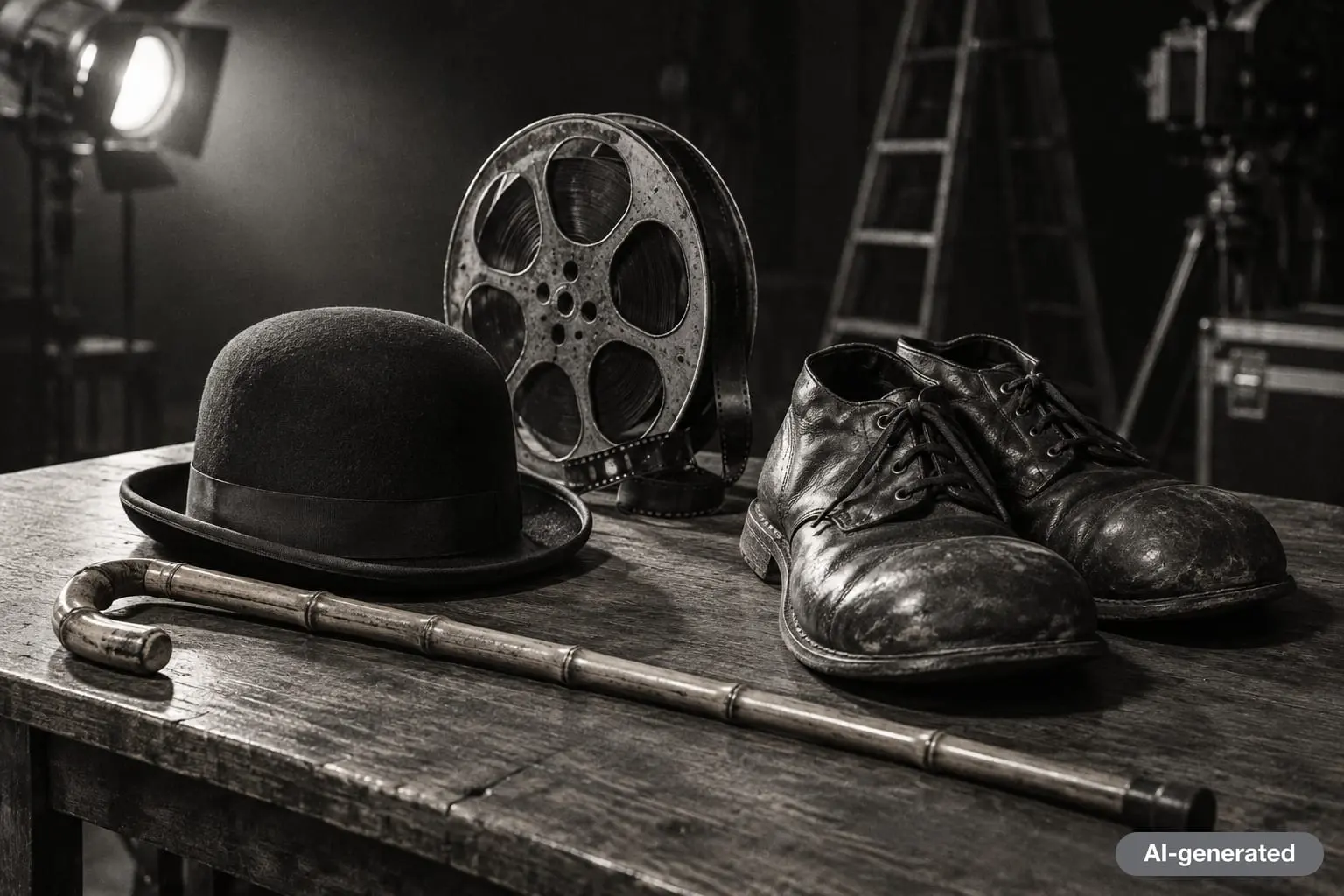
What Chaplin put together became one of the most recognizable outfits in history: a too-tight coat, baggy trousers, oversized shoes, a battered derby hat, a cane and a small pasted-on mustache. The first film released with the costume was Kid Auto Races at Venice (1914). The New York Times later reported that the pieces were borrowed from other members of the company more or less at random, including trousers belonging to Roscoe "Fatty" Arbuckle.
Britannica points out that the "Tramp" was not always a tramp. In many films he plays a waiter, a clerk, a stagehand or a fireman. What stays constant is the character: a gallant misfit, shunned by polite society and unlucky in love, who picks himself up and shuffles off toward the next adventure. Within months of his screen debut he was the biggest star in movies. Chaplin made 35 Keystone comedies in 1914 and soon began directing them himself.
Charlie Chaplin's movies: the key films and years
Chaplin moved between studios quickly in the 1910s, and each move brought a bigger salary and more creative freedom. Britannica gives the figures: $1,250 a week at Essanay in 1915, a $670,000-a-year contract at Mutual in 1916, and a $1 million deal with First National in 1918 for eight films. At Mutual he made 12 two-reel comedies, including The Vagabond, One A.M., The Rink, Easy Street and The Immigrant, which many critics rank among his finest work.
In April 1919 Chaplin joined Mary Pickford, Douglas Fairbanks and D. W. Griffith to found United Artists. The company was a distributor owned by the artists themselves, which meant each founder controlled his or her own productions and kept the producer's share of the profits.
| Year | Film | Why it matters |
|---|---|---|
| 1914 | Kid Auto Races at Venice | First release with the Tramp costume |
| 1915 | The Tramp | Essanay short that added pathos to the character |
| 1917 | Easy Street and The Immigrant | Mutual shorts often cited as his best short films |
| 1918 | Shoulder Arms | World War I comedy and a huge box-office hit |
| 1921 | The Kid | His first starring feature, with child actor Jackie Coogan |
| 1923 | A Woman of Paris | A drama he directed but barely appeared in |
| 1925 | The Gold Rush | Klondike epic with the famous boiled-shoe dinner |
| 1928 | The Circus | Earned him a special award at the first Academy Awards in 1929 |
| 1931 | City Lights | A silent film released in the sound era, with his own score |
| 1936 | Modern Times | Satire of the assembly line and the Tramp's last appearance |
| 1940 | The Great Dictator | His first true talkie and a direct parody of Hitler |
| 1947 | Monsieur Verdoux | Dark "comedy of murders"; screenplay Oscar nomination |
| 1952 | Limelight | Music-hall drama with Buster Keaton; score won an Oscar in 1973 |
| 1957 | A King in New York | British-made satire of Cold War America |
| 1967 | A Countess from Hong Kong | His last film and only one in color, with Marlon Brando and Sophia Loren |
City Lights and Modern Times: holding out against sound
The arrival of talking pictures in the late 1920s posed a special problem for Chaplin. His pantomime was understood everywhere; if the Tramp spoke English, his worldwide audience would shrink. So he made City Lights as a silent film, adding only music and sound effects. The official archive says the film took two years and eight months, with almost 190 days of actual shooting. Chaplin composed the entire score himself. Albert Einstein was his guest at the Los Angeles premiere.
Modern Times took the same approach in 1936, with brief dialogue heard through machines and a song in which the Tramp finally speaks, in made-up gibberish. It was the last time Chaplin played the character.
The Great Dictator and the famous final speech
In 1939 Chaplin began writing a satire of Adolf Hitler, whose mustache matched the Tramp's. In The Great Dictator (1940) he plays two roles: a Jewish barber and Adenoid Hynkel, the ranting dictator of "Tomania." The film was his first full sound picture, a box-office success and the source of his only Academy Award nomination for best actor.
It ends with the barber, mistaken for the dictator, giving a speech in Chaplin's own words. The official Chaplin archive publishes the full text, which includes these lines:
"We think too much and feel too little. More than machinery we need humanity."
"We think too much and feel too little. More than machinery we need humanity." (The Great Dictator, 1940, per the official Chaplin archive). "Although we were well looked after, it was a forlorn existence." (on his childhood institution, from his memoir, quoted by The New York Times). "I am not a communist. I am a peacemonger." (his response in 1947 to the prospect of a House committee summons, quoted by Britannica). Many quotes shared online under his name have no reliable source.
Scandal, politics and Charlie Chaplin's exile
Chaplin's private life generated headlines for decades. He married four times: Mildred Harris (1918), Lita Grey (1924), Paulette Goddard (1936) and Oona O'Neill (1943), the daughter of playwright Eugene O'Neill. The first two were teenagers, and both divorces were bitter and public. In 1943 a young actress, Joan Barry, brought a paternity suit against him, and in 1944 the court named him the child's father, although he was cleared of more serious federal charges, Britannica reports.
Politics added to the pressure. Chaplin had kept his British citizenship through nearly 40 years in America, and he held liberal views at the start of the Cold War. In 1947 he was under threat of being summoned before the House Un-American Activities Committee, which was investigating his ties to left-wing friends such as the composer Hanns Eisler. The appearance never happened.
The 1952 re-entry permit
In September 1952 Chaplin sailed for London with Oona and their children for the premiere of Limelight. While he was at sea, US Attorney General James McGranery announced that Chaplin's permit to re-enter the United States had been revoked and that he would have to answer charges of a political nature and of moral turpitude before he could return. The New York Times reported the decision on September 20, 1952.
Chaplin decided not to fight it. Oona went back to the United States to settle their affairs, and the family settled at the Manoir de Ban in Corsier-sur-Vevey, Switzerland, overlooking Lake Geneva. He sold his stake in United Artists. From Europe he made A King in New York (1957), a satire of McCarthy-era America that was not released in the United States until 1973.
Charlie Chaplin in old age: the honorary Oscar and a knighthood
The 1960s and 1970s brought a reconciliation. His book My Autobiography appeared in 1964. In April 1972 he returned to the United States for the first time in 20 years to accept an honorary Academy Award for "the incalculable effect he has had on making motion pictures the art form of this century." Britannica describes a 12-minute standing ovation that visibly moved him. A year later Limelight, which had finally played in Los Angeles in 1972, won the Oscar for best original dramatic score.
In 1975 Queen Elizabeth II knighted him, and he became Sir Charles Chaplin. By then his health was failing. The New York Times reported that in his last years he used a wheelchair and his speech, hearing and sight were impaired.
What did Charlie Chaplin really look like?
Searches for "Charlie Chaplin real face" reflect how completely the costume defined him. Offscreen he had no mustache, since the Tramp's was glued on, and he dressed in well-tailored suits. The New York Times put his height at 5 feet 4 inches and his weight around 130 pounds in his prime. His hair turned white early, which surprised audiences who knew him only as the dark-haired Tramp.
How did Charlie Chaplin die?
Charlie Chaplin died at about 4 a.m. on December 25, 1977, at his home in Corsier-sur-Vevey, a few hours before his family's Christmas celebration was to begin. He was 88. His wife Oona and seven of their children were at his bedside, according to The New York Times. The family physician, Dr. Henri Perrier, told reporters that "he died of old age" and that his death was "peaceful and calm." He had been in poor health for years.
He was buried in the village cemetery. Several months later his body was briefly stolen from the grave by a pair of thieves before it was recovered. Britannica calls it a macabre coda that Chaplin might have written for one of his own two-reelers.
Charlie Chaplin's family
With Lita Grey he had two sons, Charles Jr. and Sydney. With Oona O'Neill, whom he married in 1943 when she was 18, he had eight children, including the actress Geraldine Chaplin. The official archive notes that he was survived by those eight children and by Sydney from his marriage to Lita Grey. His half-brother Sydney Chaplin, who had looked out for him as a boy, followed him into films and took his place as Keystone's leading comedian in 1915.
Legacy: why Charlie Chaplin still matters
Chaplin was more than a performer. He wrote, directed, produced and edited his films, and from City Lights onward he composed their music. Songs from his scores became standards, most famously "Smile," written as an instrumental theme for Modern Times. The official archive adds that he was self-taught on several instruments and played violin and cello left-handed.
His influence runs through physical comedy, from Jacques Tati to Rowan Atkinson's Mr. Bean, and through filmmakers who mix laughter with social criticism. He fought for creative control at a time when studios owned their stars, and United Artists showed that artists could own the business. His films, preserved and restored by the family's archive, still play in cinemas around the world. For more profiles of famous lives, visit our celebrities hub; for the science side of the same era, see the science section.
Charlie Chaplin facts
- He was born in London on April 16, 1889, by his own account; no birth certificate has ever been found.
- He remained a British citizen throughout his decades in Hollywood.
- His first Academy Award, a special award for The Circus, came at the very first ceremony in 1929.
- Modern Times (1936) was the Tramp's final film.
- A Countess from Hong Kong (1967) was his only color film and the only one he did not finance himself; it was made for Universal Pictures.
- He was knighted in 1975 and died on Christmas Day 1977.
Frequently asked questions
What are Charlie Chaplin's most famous movies?
The Kid (1921), The Gold Rush (1925), The Circus (1928), City Lights (1931), Modern Times (1936), The Great Dictator (1940), Monsieur Verdoux (1947) and Limelight (1952).
When and how did Charlie Chaplin die?
He died peacefully at about 4 a.m. on December 25, 1977, at his home in Corsier-sur-Vevey, Switzerland, aged 88. His family doctor said he died of old age after years of declining health.
Why was Charlie Chaplin exiled from the United States?
In September 1952, while he sailed to London for the Limelight premiere, US Attorney General James McGranery revoked his re-entry permit, citing political and moral charges. Chaplin chose not to return and settled in Switzerland.
When did Charlie Chaplin create the Tramp?
In early 1914 at Mack Sennett's Keystone studio. The first film released with the Tramp costume was Kid Auto Races at Venice (1914).
Did Charlie Chaplin win an Oscar?
Yes. He received a special award for The Circus at the first Academy Awards in 1929, an honorary Oscar in 1972, and a competitive Oscar in 1973 for the score of Limelight.
How many times was Charlie Chaplin married?
Four times: Mildred Harris, Lita Grey, Paulette Goddard and Oona O'Neill, with whom he had eight children and stayed until his death.
Sources
- Charlie Chaplin Official Site: Overview of His Life
- Charlie Chaplin Official Site: The Final Speech from The Great Dictator
- Encyclopaedia Britannica: Charlie Chaplin
- Encyclopaedia Britannica: Charlie Chaplin, Final works
- The New York Times: Charlie Chaplin Dead at 88 (December 26, 1977)
- The New York Times: Chaplin Is Facing Barriers to Re-entry From Abroad (September 20, 1952)
Log in to comment
No comments yet. Be the first.