Nikola Tesla: Biography, Inventions, AC Power, Myths and Death
- Nikola Tesla was born on July 10, 1856, in Smiljan, now in Croatia, and moved to New York in 1884.
- His rotating magnetic field and induction motor became the basis of the AC power system Westinghouse bought in 1888.
- Tesla's AC system lit the 1893 Chicago World's Fair and powered Niagara Falls, reaching Buffalo in 1896.
- He held 112 US patents and at least 311 worldwide, but his Wardenclyffe wireless tower failed.
- He died alone at the Hotel New Yorker on January 7, 1943, aged 86; the SI unit of magnetic flux density bears his name.
- Nikola Tesla's early life and education
- Tesla and Edison: what really happened
- The AC system, Westinghouse and the "war of the currents"
- Chicago 1893 and Niagara Falls
- Nikola Tesla's inventions: the complete short list
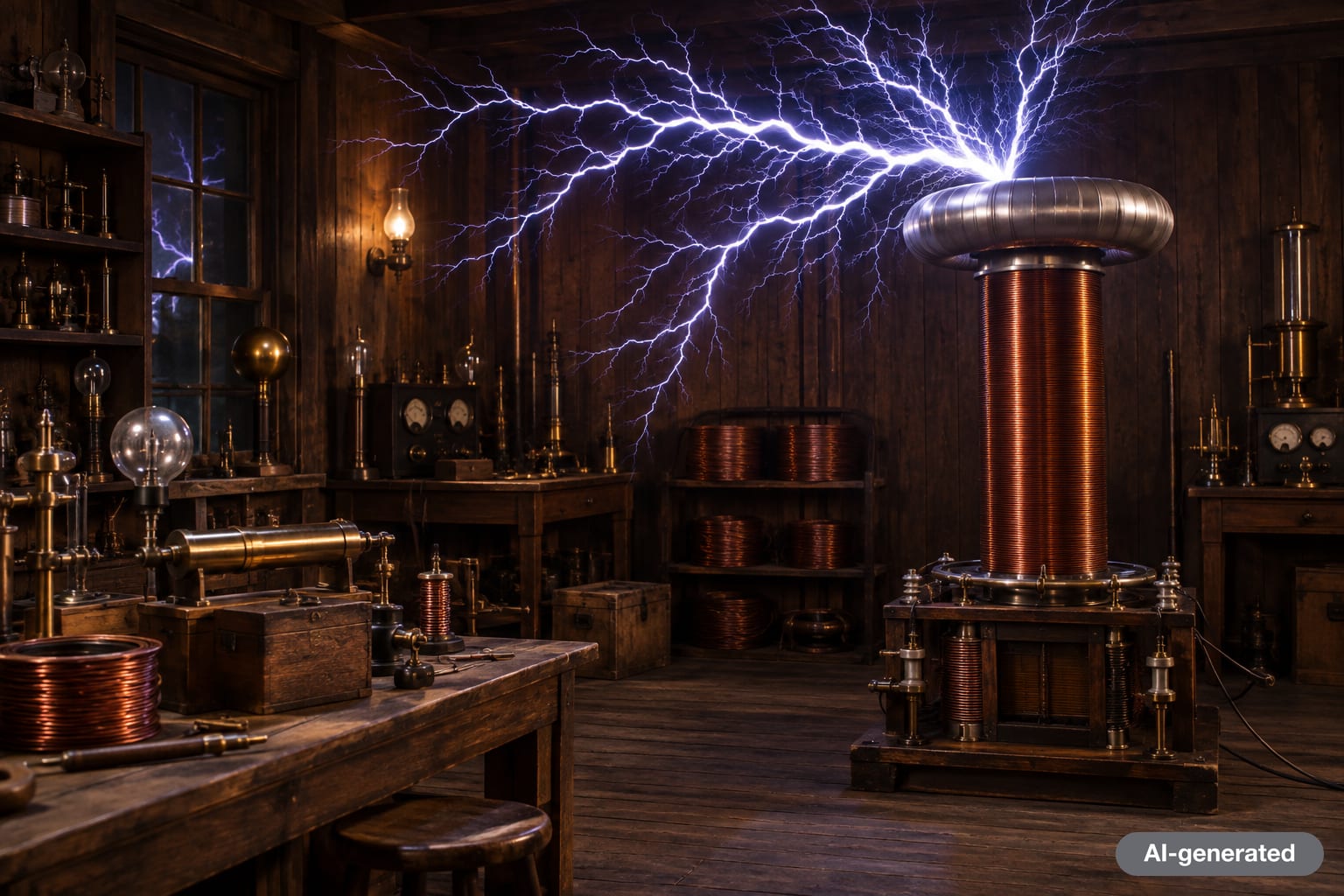
- Colorado Springs: artificial lightning
- Wardenclyffe: Tesla's greatest defeat
- Nikola Tesla myths vs facts
- How did Nikola Tesla die?
- Nikola Tesla's legacy
- Verified Nikola Tesla quotes
Nikola Tesla (born July 10, 1856, in Smiljan, then part of the Austrian Empire and now in Croatia; died January 7, 1943, in New York City) was the Serbian American inventor and electrical engineer who discovered the rotating magnetic field and developed the alternating-current (AC) induction motor and polyphase power system that still run the world's electric grids. George Westinghouse bought his AC patents in 1888, Tesla's system lit the 1893 Chicago World's Fair, and it powered the first large hydroelectric plant at Niagara Falls.
He also invented the Tesla coil, demonstrated a radio-controlled boat in 1898 and dreamed of sending power around the planet without wires, a dream that ended with the demolition of his Wardenclyffe tower. He held 112 US patents, yet he died alone in a New York hotel room with little money. This guide covers his early life, his rivalry with Thomas Edison, his inventions, the myths that surround him, his death and his legacy, checked against the Nikola Tesla Museum in Belgrade, Britannica, the US Department of Energy and contemporary reporting.
Nikola Tesla's early life and education
Tesla was born to Serbian parents in the village of Smiljan, in the Lika region of the Austrian Empire's military frontier. Britannica records that his father was an Orthodox priest and his mother, though unschooled, was highly intelligent. The US Department of Energy notes that he was the fourth of five children. Tesla credited his mother for his inventive streak. In his own words, quoted by the Department of Energy: "My mother was an inventor of the first order and would, I believe, have achieved great things had she not been so remote from modern life and its multi fold opportunities."
As a boy he was often ill, but he had a remarkable memory and a vivid imagination, and he loved poetry. He trained as an engineer at the Technical University in Graz, Austria, and later attended the University of Prague. At Graz he saw a Gramme dynamo, a machine that worked as a generator and, run in reverse, as a motor. It sparked an idea that would occupy him for years: a motor that used alternating current directly, without the sparking commutator that DC machines needed.
Budapest, Paris and the rotating magnetic field
In 1881 and 1882 Tesla worked at the Central Telegraph Office in Budapest. There, according to Britannica, he visualized the principle of the rotating magnetic field: by feeding two or more alternating currents out of step with each other into a motor's coils, he could create a magnetic field that spun on its own and dragged the rotor around with it. It was the key to a practical AC motor.
In 1882 he moved to Paris to work for the Continental Edison Company, and while on assignment in Strasbourg in 1883 he built his first induction motor after working hours. In 1884 he sailed for New York. Britannica says he arrived with four cents in his pocket, a few of his own poems and calculations for a flying machine.
Tesla and Edison: what really happened
Tesla's first American job was with Thomas Edison, whose company built direct-current (DC) power systems. The two men were far apart in background and method: Edison was a relentless experimenter who tested idea after idea, while Tesla worked out designs in his head before building them. Their partnership did not last. Tesla left in early 1885.
Tesla later told a story, now widely repeated, that Edison had promised him $50,000 to redesign his dynamos and then dismissed the offer as a joke. The account comes from Tesla himself and cannot be independently confirmed. What is documented is what came next. After leaving Edison, Tesla founded Tesla Electric Light and Manufacturing, and on March 30, 1885, he applied for his first US patent, for an electric arc lamp, according to the Nikola Tesla Museum. His first granted US patent, No. 334,823, covered a commutator for dynamo-electric machines.
The AC system, Westinghouse and the "war of the currents"
By 1887 Tesla had backers and his own laboratory, and he filed a series of patents on his polyphase AC system: generators, transformers, transmission lines and induction motors designed to work together. In May 1888 he presented the system in a lecture to the American Institute of Electrical Engineers. The Tesla Museum notes that 1889 was his peak year for filings, with 37 applications relating to the polyphase system.
George Westinghouse, head of the Westinghouse Electric Company in Pittsburgh, bought the patent rights in 1888. That deal set off the so-called war of the currents between Edison's DC and the Tesla-Westinghouse AC approach. The stakes were enormous: whichever system won would become the basis of the national grid.
AC had a decisive technical advantage. Its voltage can be raised with transformers for long-distance transmission, which cuts losses, and then lowered for safe use in homes. DC systems of the day could not change voltage easily, so they needed power stations every mile or so. Edison's side campaigned that AC was dangerous. According to the Department of Energy, Tesla answered by letting high-voltage, high-frequency current pass through his own body in public demonstrations to show it could be handled safely.
Alternating current periodically reverses direction, typically 60 times a second in North America. Tesla's contribution was not AC itself, which others had used for lighting, but a complete system built on the rotating magnetic field, above all a rugged, brushless induction motor that ran directly on multi-phase AC. Most electric motors in factories and household appliances today are descendants of that design.
Chicago 1893 and Niagara Falls
Westinghouse won the contract to light the World's Columbian Exposition in Chicago in 1893, and Tesla's system was on full display. Britannica notes that this success helped Westinghouse win the contract for the first power machinery at Niagara Falls, which bore Tesla's name and patent numbers.
The Niagara project was the proof of concept for long-distance AC. According to the US Department of Energy, construction took three years, and power first flowed to homes in nearby Buffalo on November 16, 1896. A statue of Tesla now stands on Goat Island, overlooking the falls.
Nikola Tesla's inventions: the complete short list
Tesla's notebooks are full of ideas, but his most important inventions are well documented in patents and contemporary demonstrations.
| Year | Invention or achievement | Significance |
|---|---|---|
| 1882–1883 | Rotating magnetic field; first induction motor | Basis of most AC machinery |
| 1885 | First patent application (arc lamp) | Start of a 43-year patent career |
| 1887–1889 | Polyphase AC system patents | Licensed to Westinghouse in 1888 |
| 1891 | Tesla coil | Resonant transformer for very high voltages; used in early radio |
| 1893 | AC lighting of the Chicago World's Fair | Public showcase that helped win Niagara |
| 1895–1896 | Niagara Falls power system | First large-scale AC hydroelectric transmission |
| 1898 | Radio-controlled boat ("teleautomaton") | Demonstrated at Madison Square Garden; ancestor of remote control |
| 1899–1900 | Colorado Springs experiments | Huge artificial lightning and wireless power tests |
| 1901–1917 | Wardenclyffe tower | Planned world wireless system; never completed |
| 1913 | Bladeless turbine (US patents 1,061,142 and 1,061,206) | His most widely patented invention: 23 patents in 22 countries |
| 1928 | Last US patent, No. 1,655,114 | An apparatus for aerial transport |
The Tesla Museum's patent count is precise: 112 US patents and at least 199 more from 26 other countries, for a total of at least 311 patents in 27 countries on five continents. Many are equivalents of the same invention filed in different countries; the museum counts about 125 distinct inventions. The museum's archive also holds about 33 failed US applications, and Tesla never patented some ideas at all, such as medical uses of high-frequency current.
Colorado Springs: artificial lightning
From May 1899 to early 1900 Tesla worked at a laboratory in Colorado Springs, Colorado, chosen for its high altitude and dry air. Britannica describes what he regarded as his most important discovery there: terrestrial stationary waves, which he believed proved the Earth itself could be used as a conductor and made to resonate at a certain frequency. He produced artificial lightning with flashes measuring 41 meters (135 feet), and he reported lighting 200 lamps without wires from a distance of about 40 kilometers (25 miles).
He also became convinced he had received signals from another planet, a claim that was met with derision in some scientific journals. The source of what he heard has never been established.
Wardenclyffe: Tesla's greatest defeat
Back in New York in 1900, Tesla persuaded the financier J. Pierpont Morgan to invest $150,000 in a wireless world broadcasting system. He built a laboratory and tower at Wardenclyffe, in Shoreham on Long Island. The Department of Energy describes the tower as 185 feet high, topped by a 65-foot copper dome. Tesla imagined it sending messages, pictures, weather warnings and stock reports around the world, and eventually transmitting power without wires.
Guglielmo Marconi sent a radio signal across the Atlantic in December 1901 with far simpler equipment. A financial panic, labor troubles and Morgan's withdrawal of support followed, and the project stalled. Britannica calls Wardenclyffe Tesla's greatest defeat. The partially completed tower was demolished in 1917. The site is now home to the Tesla Science Center at Wardenclyffe.
Nikola Tesla myths vs facts
Few scientists attract as much legend as Tesla. Here is what the record supports.
Nikola Tesla's IQ
Claims that Tesla had an IQ of 160, 195 or higher circulate widely, but there is no record that he ever took an IQ test. Modern intelligence tests were only developed in the early 1900s, when Tesla was already about 50. Any number is a guess.
Did Tesla invent radio?
Tesla's high-frequency and tuned-circuit work was fundamental to radio, and in June 1943, months after his death, the US Supreme Court invalidated key claims of Marconi's US patent on radio tuning, citing earlier work including Tesla's (Marconi Wireless Telegraph Co. of America v. United States). That ruling did not declare Tesla the sole inventor of radio; it settled a patent dispute. Radio grew out of the work of many people.
The "death ray"
In his later years Tesla told reporters he had invented a beam weapon that could destroy 10,000 airplanes at a distance of 400 kilometers (250 miles), according to Britannica. No working device or detailed design was ever found.
Nikola Tesla's wife
Tesla never married. He kept only a few close friends, among them the writers Mark Twain and Robert Underwood Johnson, and he believed marriage would distract from his work. In old age he fed pigeons in Bryant Park, near his former laboratory.
Nikola Tesla's net worth
Despite his patents, Tesla was impractical with money, and by the end of his life he had little. Wardenclyffe was lost to foreclosure, and he lived for decades in hotel rooms. There is no reliable figure for his net worth at death, and estimates online are guesswork.
How did Nikola Tesla die?
Nikola Tesla died on January 7, 1943, in his suite at the Hotel New Yorker in Manhattan, where he had lived for the last decade of his life. He was 86 and lived alone. The New York Times reported the next day that he had been found dead in his hotel suite. The medical examiner attributed the death to coronary thrombosis, a blood clot in an artery supplying the heart. The Tesla Memorial Society of New York identifies his rooms as suite 3327 on the 33rd floor.
Because the United States was at war, the federal custodian of alien property impounded his trunks of papers. Britannica notes that they were eventually inherited by his nephew Sava Kosanović and are now held at the Nikola Tesla Museum in Belgrade, where UNESCO has inscribed the archive on its Memory of the World register. Hundreds attended his funeral at the Cathedral of St. John the Divine in New York. His ashes are kept at the museum in Belgrade.
Nikola Tesla's legacy
Tesla's most lasting legacy is invisible: the alternating current flowing through nearly every power line and wall socket. His name lives on in several forms.
- The tesla (T), the SI unit of magnetic flux density, adopted by the General Conference on Weights and Measures in 1960. A typical hospital MRI scanner works at 1.5 or 3 teslas.
- The IEEE Nikola Tesla Award, given for outstanding contributions to the generation and use of electric power.
- Tesla, Inc., the electric car company founded in 2003 by Martin Eberhard and Marc Tarpenning, which Britannica notes was named in his honor.
- Nikola Tesla Corner at 40th Street and Sixth Avenue in Manhattan, near his old laboratory at 8 West 40th Street, according to the Department of Energy.
- Belgrade's airport and the Nikola Tesla Museum, founded in 1952.
In 1917 he received the Edison Medal, the highest honor of the American Institute of Electrical Engineers, named after his former employer and rival. His autobiography, My Inventions, first appeared as a series of articles in Electrical Experimenter magazine in 1919 and remains the best starting point among Nikola Tesla books. For more scientist profiles, explore our science section and the tech hub, and find more life stories in celebrities and biographies.
Verified Nikola Tesla quotes
The Nikola Tesla Museum publishes quotations with their original newspaper sources. A few of them:
- "We have to begin with little things before we can accomplish great ones." (Bloomington Leader, 1896)
- "Doubt is not disturbing. People doubted that the power of Niagara could be harnessed." (Enquirer, 1901)
- "A great problem cannot be solved by one man. A solution will come as the result of the cooperation of many." (Times, 1908)
- "The economic transmission of power without wires is of all-surpassing importance to man." (Popular Electricity, 1911)
Frequently asked questions
What did Nikola Tesla invent?
His key inventions include the rotating magnetic field and AC induction motor, the polyphase AC power system, the Tesla coil (1891), a radio-controlled boat (1898) and a bladeless turbine. He held 112 US patents.
How did Nikola Tesla die?
He died on January 7, 1943, in his suite at the Hotel New Yorker in Manhattan, aged 86. The medical examiner attributed his death to coronary thrombosis.
Was Nikola Tesla married?
No. Tesla never married and had no children. He kept a small circle of friends, including Mark Twain.
What was Nikola Tesla's IQ?
Unknown. There is no record that Tesla ever took an IQ test, so figures quoted online are speculation.
Did Tesla work for Edison?
Yes, briefly. Tesla joined Edison's company in New York in 1884 and left in early 1885. The two later backed rival systems, Edison's DC and Tesla's AC.
What is named after Nikola Tesla?
The tesla, the SI unit of magnetic flux density adopted in 1960; the IEEE Nikola Tesla Award; Belgrade's airport and museum; and Tesla, Inc., the electric car maker.
Sources
- Nikola Tesla Museum, Belgrade: Tesla's Patents
- Nikola Tesla Museum, Belgrade
- Encyclopaedia Britannica: Nikola Tesla
- US Department of Energy: Top 11 Things You Didn't Know About Nikola Tesla
- The New York Times: Nikola Tesla Dies; Prolific Inventor (January 8, 1943)
- Tesla Memorial Society of New York: Hotel New Yorker
- BIPM: The International System of Units (SI Brochure)
Log in to comment
No comments yet. Be the first.