Gas Prices Today: U.S. Average $4.331 as Diesel Hits $6.179
- The EIA's national average for regular gasoline was $4.331 per gallon on October 12, 2026, $1.270 higher than a year earlier ($3.061).
- AAA's daily average was $4.2988 on October 18, down 16.99 cents from $4.4687 a month earlier after a record-setting September.
- California ($6.104 in the EIA survey) is the most expensive state; the Gulf Coast ($3.851) is the cheapest region.
- Diesel averages $6.179 (EIA, Oct. 12) and $6.3224 (AAA, Oct. 18); AAA's all-time record is $6.5276, set on September 22, 2026.
- The EIA's October outlook forecasts gasoline at $3.91 a gallon for 2026 on average and $3.56 in 2027.

- Gas prices today: the latest national average
- Gas prices by region: where fuel costs the most and least
- Why are gas prices so high in October 2026?
- Diesel prices: $6.179 a gallon after a September record
- Gas price forecast for the rest of 2026 and 2027
- Gas prices in the UK, Canada and Australia
- How to pay less for gas
- How 2026 compares with past gas price spikes
Gas prices in the United States are holding above $4 a gallon in mid-October 2026. The U.S. Energy Information Administration (EIA) put the national average for regular gasoline at $4.331 per gallon on Monday, October 12, $1.270 more than a year earlier, and AAA's daily survey showed $4.2988 on Sunday, October 18. Diesel is far more painful, averaging $6.179 in the EIA survey and $6.3224 at AAA.
The reason is the war involving Iran that began on February 28, which has kept oil shipments through the Strait of Hormuz constrained for most of the year. Below: the latest numbers by region, why autumn has not brought the usual relief, the EIA's forecast for 2026 and 2027, prices in the UK, Canada and Australia, and practical ways to cut your fuel bill.
Gas prices today: the latest national average
There are two national averages worth knowing. The EIA publishes an official weekly figure from a Monday survey of stations, released midweek; the next is due October 20. AAA publishes a daily average.
In the EIA series, the national average climbed from $4.157 on September 7 to a peak of $4.478 on September 21, then eased for three straight weeks. On October 12 it stood at $4.331, 1.2 cents above its level a month earlier ($4.319 on September 14) and 2.3 cents lower than the week before. AAA's daily figure of $4.2988 on October 18 is down 16.99 cents from $4.4687 a month ago and 5.97 cents from $4.3585 a week ago, but still $1.258 above the $3.0408 drivers paid a year earlier.
| Measure | Date | Regular gasoline (per gallon) |
|---|---|---|
| EIA weekly average | Oct. 12, 2026 | $4.331 |
| EIA weekly average | Oct. 5, 2026 | $4.354 |
| EIA weekly average (2026 autumn peak) | Sept. 21, 2026 | $4.478 |
| EIA weekly average, one month earlier | Sept. 14, 2026 | $4.319 |
| EIA weekly average, one year earlier | mid-Oct. 2025 | $3.061 |
| AAA daily average | Oct. 18, 2026 | $4.2988 |
| AAA daily average, one month earlier | mid-Sept. 2026 | $4.4687 |
| AAA daily average, one year earlier | mid-Oct. 2025 | $3.0408 |
| AAA all-time record (regular) | June 14, 2022 | $5.0165 |
AAA's other grades on October 18 were $4.8151 for mid-grade, $5.2049 for premium and $3.3168 for E85. The national average has stayed above $4 since late July, and AAA called September record-setting: prices hit seasonal record highs instead of sliding after Labor Day.
Gas prices by region: where fuel costs the most and least
The EIA splits the country into five Petroleum Administration for Defense Districts, or PADDs, plus sub-regions and a handful of states and cities. The spread between them is wide this autumn: drivers on the West Coast are paying $1.788 a gallon more than drivers along the Gulf Coast ($5.639 versus $3.851 in the EIA survey).
| EIA region | Regular, Oct. 12, 2026 | Change vs. a year ago |
|---|---|---|
| U.S. average | $4.331 | +$1.270 |
| East Coast (PADD 1) | $4.118 | +$1.166 |
| New England (PADD 1A) | $4.291 | +$1.311 |
| Central Atlantic (PADD 1B) | $4.347 | +$1.243 |
| Lower Atlantic (PADD 1C) | $3.929 | +$1.080 |
| Midwest (PADD 2) | $4.145 | +$1.333 |
| Gulf Coast (PADD 3) | $3.851 | +$1.228 |
| Rocky Mountain (PADD 4) | $4.439 | +$1.390 |
| West Coast (PADD 5) | $5.639 | +$1.426 |
| West Coast less California | $5.071 | +$1.122 |
| California | $6.104 | +$1.647 |
California is the most expensive state, as usual. It requires its own cleaner-burning gasoline blend, sits far from the Gulf Coast refining hub and adds higher fuel taxes and program costs. The EIA's city figures show Los Angeles at $6.082 and San Francisco at $6.154, while Seattle was $5.606. AAA's October 15 ranking of the ten priciest markets read: California ($6.23), Hawaii ($5.63), Washington ($5.42), Nevada ($5.42), Oregon ($4.97), Alaska ($4.96), Idaho ($4.85), Utah ($4.82), Illinois ($4.69) and Arizona ($4.66).
The cheapest gas is concentrated in the Southeast and along the Gulf, close to the refineries of Texas and Louisiana. AAA's ten least expensive markets on October 15 were North Carolina ($3.70), Georgia ($3.77), Texas ($3.83), Tennessee ($3.88), Indiana ($3.89), Louisiana ($3.90), South Carolina ($3.90), Mississippi ($3.91), Arkansas ($3.93) and Alabama ($3.94). In the EIA's city survey Houston was the cheapest at $3.762, with Cleveland at $3.851. Even the cheapest EIA region, the Gulf Coast, is up $1.228 from a year earlier.
Why are gas prices so high in October 2026?
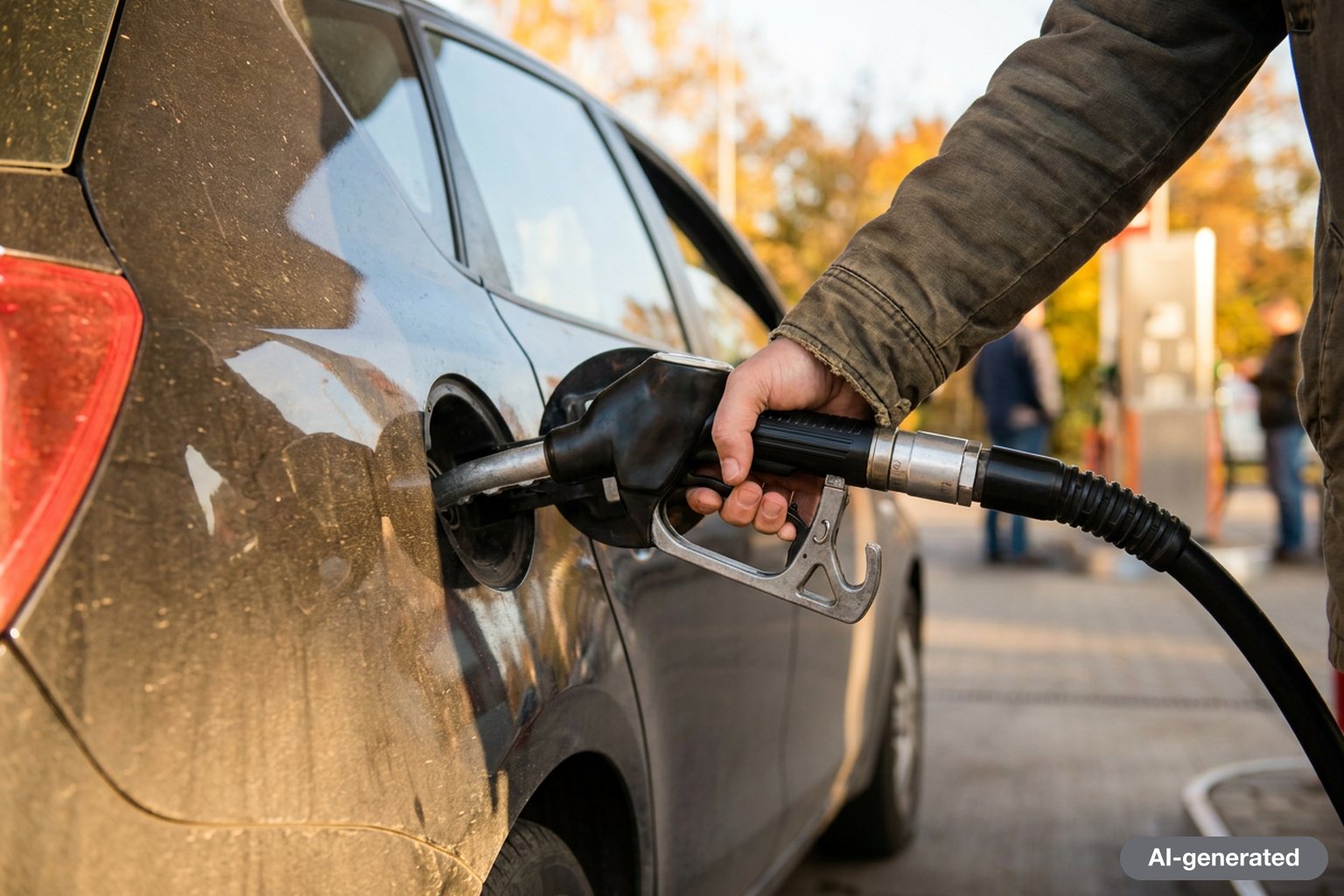
According to the EIA's breakdown for May 2026, when regular averaged $4.48, crude oil made up 52% of the price of a gallon, refining costs and margins 22%, distribution and marketing 15% and taxes 12%. For diesel at $5.60 the shares were 42% crude, 25% refining, 23% distribution and marketing and 11% taxes. When the pump price moves, crude oil is almost always the main reason.
The Iran war and the Strait of Hormuz
Fuel prices started rising after the war began on February 28. As CBS News and the Associated Press have reported, AAA's national average reached a high of $4.56 in May, eased after the United States and Iran reached an interim deal in June, then climbed again as fighting resumed over control of the Strait of Hormuz, the narrow waterway that normally carries a large share of the world's seaborne oil. In its October outlook the EIA assumes Middle East oil flows stay constrained through the end of 2026, even as convoys, bypass pipelines and ship-to-ship transfers slowly lift exports. It also cited attacks on Saudi Arabia's East-West pipeline as a source of volatility.
Crude prices reflect that. AAA reported that the U.S. benchmark, West Texas Intermediate, settled at $95.09 per barrel on October 14, and the CBS News energy tracker showed WTI at $101.40 and international Brent at $109.87 on October 16.
OPEC+ is not adding barrels
On October 4 the seven core OPEC+ members (Saudi Arabia, Russia, Iraq, Kuwait, Kazakhstan, Algeria and Oman) agreed to keep production targets for November unchanged, Reuters reported, noting that announced output increases this year have largely existed on paper because of the supply disruptions. The group's next meeting is set for November 1.
Refining margins and very tight diesel
The EIA says September's jump was driven both by crude and by rising "crack spreads", the gap between the price of crude and the wholesale price of gasoline and diesel. Distillate fuel, which includes diesel and heating oil, is the tightest market of all: East Coast inventories were 32% below their five-year seasonal average in September. Refiners running harder to make diesel also bid up crude. On the government side, the Department of Energy announced exchanges of 40 million barrels from the Strategic Petroleum Reserve on September 29, and G7 leaders issued a statement on energy security on October 2.
Winter-blend gasoline and the autumn driving lull
In a normal year, autumn is the cheapest season for gasoline. Federal summer volatility rules, which apply at retail stations from June 1 to September 15, require a lower-evaporation blend that costs more to make. After mid-September stations switch to winter-blend gasoline, which can contain more inexpensive butane, and driving demand drops after the summer travel season. AAA's data show U.S. gasoline demand slipped to 8.40 million barrels a day in the week to October 10. Those seasonal forces explain the modest dip since September 21, but they are small next to the jump in crude.

Diesel prices: $6.179 a gallon after a September record
Diesel is where the 2026 shock hits hardest. The EIA's weekly on-highway diesel average was $6.179 on October 12, up $2.514 from a year earlier. AAA's diesel average of $6.32 on October 18 is 20.52 cents below its all-time record of $6.5276, set on September 22, 2026. Because trucks carry most U.S. freight, expensive diesel feeds into the cost of groceries and other goods, one reason food staples such as egg prices and beef remain a household worry.
| EIA region | Diesel, Oct. 12, 2026 | Change vs. a year ago |
|---|---|---|
| U.S. average | $6.179 | +$2.514 |
| New England | $6.441 | +$2.492 |
| Central Atlantic | $6.471 | +$2.594 |
| Lower Atlantic | $5.645 | +$2.006 |
| Midwest | $6.259 | +$2.653 |
| Gulf Coast | $5.809 | +$2.510 |
| Rocky Mountain | $6.302 | +$2.644 |
| West Coast | $7.240 | +$2.776 |
| California | $8.091 | +$3.151 |
The EIA expects retail diesel to stay above $6 a gallon in October and then come down gradually, but to remain above $4 through 2027 because distillate inventories will stay below normal. Households that heat with oil, mostly in the Northeast, face heating oil prices more than 30% above last winter, according to the agency's Winter Fuels Outlook.
Gas price forecast for the rest of 2026 and 2027
The EIA's Short-Term Energy Outlook (STEO), released October 6 and based on data through October 1, raised its oil and fuel forecasts from September. It now expects Brent crude to average $105 a barrel in the fourth quarter of 2026, $14 higher than a month earlier, before falling to an average of $84 in 2027 as Middle East exports recover.
| EIA STEO (Oct. 6, 2026) | 2024 | 2025 | 2026 forecast | 2027 forecast |
|---|---|---|---|---|
| Retail regular gasoline ($/gal, annual average) | $3.31 | $3.10 | $3.91 | $3.56 |
| Retail diesel ($/gal, annual average) | $3.76 | $3.66 | $5.19 | $4.49 |
| Brent crude ($/barrel) | $81 | $69 | $96 | $84 |
| WTI crude ($/barrel) | $77 | $65 | $88 | $80 |
For gasoline, the EIA expects October to average about the same as September (when regular averaged $4.35) and prices to decline slowly after that, following crude oil. The 2026 annual average of $3.91 looks low next to today's pump price because it includes the cheaper months before the war, when the national average sat below $3. The agency's 2027 projection is $3.56 a gallon, up from $3.35 in its September outlook.
Two caveats matter. The EIA notes that falling wholesale prices will not reach the pump right away, because retail margins squeezed in 2026 are expected to recover in 2027. And the forecast does not include extra supply from the October 2 G7 announcement or any events after October 1.
Three dates will shape gas prices into November: the EIA's weekly survey every Monday (published midweek, next on October 20), the OPEC+ meeting on November 1 and the EIA's next outlook on November 10. Any lasting reopening of the Strait of Hormuz would move crude, and pump prices, faster than any seasonal factor.
Gas prices in the UK, Canada and Australia
| Country | Latest official or national figure | Earlier comparison |
|---|---|---|
| United Kingdom | Petrol 175.28p/litre, diesel 200.04p/litre (week of Oct. 12, 2026) | 134.81p and 142.99p a year earlier (Oct. 13, 2025) |
| Canada | 173.9 cents/litre regular, CAA national average (Oct. 18, 2026) | 129.0 cents a year earlier; 183.4 cents a month earlier |
| Australia | Petrol 241.9 cents/litre, diesel 278.5 cents/litre, five largest cities (Oct. 14, 2026) | Petrol up 71.0 cents and diesel up 101.9 cents since Feb. 20, 2026 |
United Kingdom. The Department for Energy Security and Net Zero's weekly road fuel prices show UK unleaded at 175.28 pence a litre and diesel at 200.04 pence for the week starting October 12. That diesel price is above the July 2022 weekly peak of 199.22 pence. Fuel duty is unchanged at 52.95 pence a litre, with 20% VAT on top. Before the war, in the week of February 23, petrol cost 131.71 pence and diesel 141.46 pence.
Canada. The Canadian Automobile Association's national average for regular was 173.9 cents a litre on October 18, down from 183.4 cents a month earlier but far above 129.0 cents a year ago. The past-year high was 190.4 cents on May 6, 2026.
Australia. The Australian Competition and Consumer Commission, which publishes weekly monitoring reports during the conflict, found average petrol in Sydney, Melbourne, Brisbane, Adelaide and Perth at 241.9 cents a litre on October 14, up 2.9 cents in a week. Petrol is 15.3 cents below its level on March 31, which the ACCC identifies as the post-escalation high point, while diesel, at 278.5 cents, is 43.9 cents below its March high.
How to pay less for gas
You cannot control crude oil, but you can control where you buy, how you pay and how you drive. With regular above $4, every 10 cents saved on a 15-gallon fill-up is $1.50.
Shop for price
- Use a price app or map. Free price apps and AAA's TripTik planner show current prices along a route, so check before the warning light comes on.
- Look at warehouse clubs. Costco, Sam's Club and BJ's usually price fuel below nearby stations for members. Whether it pays depends on how much you drive; our guide to the Costco membership price breaks down the fees, and Costco hours lists when its gas stations open.
Pay the smart way
- Pay cash or debit where there is a card surcharge. Many independent stations post a lower cash price.
- Use fuel rewards. Grocery loyalty programs, station apps and gas-category credit cards return a few cents per gallon or a percentage back. Stacking a grocery discount with a rewards card can add up, but only if you pay the card balance in full.
- Buy the grade your owner's manual requires. Premium cost 90.61 cents more than regular in AAA's survey on October 18 ($5.2049 versus $4.2988). If your car only recommends premium, regular is usually fine.
Drive and maintain for mileage
The Department of Energy and EPA's fueleconomy.gov site lists the habits that matter most:
| Habit | Effect on fuel use (fueleconomy.gov) |
|---|---|
| Aggressive driving (speeding, rapid acceleration, hard braking) | Can lower mileage 15% to 30% at highway speeds and 10% to 40% in stop-and-go traffic |
| Large roof-top cargo box | Can cut fuel economy 6% to 17% on the highway and 10% to 25% at 65 to 75 mph |
| Extra weight | 1% lower mileage per extra 100 pounds |
| Idling | Uses a quarter to a half gallon of fuel per hour |
| Cruise control on the highway | Helps hold a steady speed and save fuel |
Keep tires inflated to the pressure on the driver's door sticker, combine errands into one loop and take the roof box off when you are not using it. For a longer-term fix, an electric or plug-in hybrid car changes the math entirely; AAA's survey puts public charging at 41 cents per kilowatt hour, and EV news such as the Tesla Roadster shows how quickly the market is moving. If high fuel costs are squeezing the household budget, our list of realistic side hustles covers ways to bring in extra income.
How 2026 compares with past gas price spikes
Today's national average is high, but it is not a record. AAA's all-time high for regular is $5.017, set on June 14, 2022, after Russia's invasion of Ukraine. What makes 2026 unusual is timing and diesel: prices normally fall through autumn, yet September brought record seasonal highs and an all-time diesel record of $6.5276. Regular averaged $3.31 in 2024 and $3.10 in 2025, against a projected $3.91 this year.
The strain is real: CBS News reported a recent Gallup poll in which two-thirds of Americans said fuel costs had caused financial hardship for their household. Until shipping through the Strait of Hormuz returns to normal, official forecasts point to a slow decline rather than a quick return to $3 gasoline.
Frequently asked questions
What is the national average gas price right now?
The EIA's official weekly average for regular gasoline was $4.331 per gallon on Monday, October 12, 2026. AAA's daily average was $4.2988 on October 18. The two surveys use different methods, so they differ slightly, but both show prices far above a year ago: up $1.270 in the EIA series and $1.258 at AAA. The EIA publishes its next weekly figure on October 20.
Why are gas prices so high right now?
The main cause is the war involving Iran that began on February 28, 2026, which has constrained oil shipments through the Strait of Hormuz. WTI crude settled at $95.09 a barrel on October 14, according to AAA, and in May 2026 crude made up 52% of the price of a gallon of gasoline, according to the EIA. Tight refining margins, low fuel inventories and OPEC+ keeping output targets flat add to the pressure.
Will gas prices go down soon?
The EIA expects gasoline in October to average about the same as September, when regular averaged $4.35, and then to decline slowly with crude oil prices. Its October outlook projects an average of $3.56 a gallon in 2027. Any lasting reopening of the Strait of Hormuz would likely bring prices down faster, while new attacks on oil infrastructure could push them back up.
Which state has the highest gas prices?
California has the highest gas prices in the country. The EIA's weekly survey put the state at $6.104 a gallon on October 12, 2026, and AAA listed it at $6.23 on October 15, followed by Hawaii, Washington, Nevada and Oregon. California requires its own cleaner-burning blend, has limited refining capacity and higher fuel taxes, which keep its prices well above the national average.
Which state has the cheapest gas?
In AAA's October 15, 2026 ranking, North Carolina had the cheapest gas at $3.70 a gallon, followed by Georgia ($3.77), Texas ($3.83), Tennessee ($3.88) and Indiana ($3.89). Among EIA regions, the Gulf Coast was cheapest at $3.851. States near the large refineries in Texas and Louisiana and those with lower fuel taxes tend to have the lowest prices.
Why is diesel so much more expensive than gasoline?
Diesel and heating oil come from the same distillate fuel stream, and distillate supplies are extremely tight worldwide. East Coast distillate inventories were 32% below their five-year seasonal average in September, according to the EIA. Refining margins for diesel are high, and demand from trucking and home heating rises into winter. That is why diesel averaged $6.179 on October 12 while gasoline averaged $4.331.
Does winter-blend gasoline make gas cheaper?
Usually, yes. Federal summer volatility rules apply at retail stations from June 1 to September 15. After that, stations sell winter-blend gasoline, which can include more inexpensive butane and costs less to produce. Combined with lower driving demand after summer, that typically pulls prices down in autumn. In 2026 the effect has been overwhelmed by high crude oil prices, so prices fell only modestly.
Is Costco gas cheaper?
Warehouse clubs such as Costco, Sam's Club and BJ's generally sell fuel below the prices of nearby stations, but you need a paid membership to buy it. Whether it saves money depends on how much you drive and whether you already shop there. A driver filling a 15-gallon tank weekly who saves 20 cents a gallon would save $156 a year (15 x $0.20 x 52 weeks) before membership costs.
How much does driving style affect gas mileage?
A lot. According to fueleconomy.gov, run by the Department of Energy and the EPA, aggressive driving with speeding, rapid acceleration and hard braking can lower gas mileage by 15% to 30% at highway speeds and 10% to 40% in stop-and-go traffic. Removing a roof cargo box, extra weight and unnecessary idling also saves fuel.
How much are gas prices in the UK, Canada and Australia?
Official UK figures for the week of October 12, 2026 show petrol at 175.28 pence a litre and diesel at 200.04 pence. In Canada, the CAA national average for regular was 173.9 cents a litre on October 18. In Australia, the ACCC found petrol averaging 241.9 cents a litre across the five largest cities on October 14, with diesel at 278.5 cents.
Sources
- U.S. Energy Information Administration: Gasoline and Diesel Fuel Update
- U.S. Energy Information Administration: Short-Term Energy Outlook, October 2026
- U.S. Energy Information Administration: STEO U.S. Petroleum Products
- AAA: National average gas prices
- AAA: Gas Prices Not Budging Much as Crude Oil Remains High (Oct. 15, 2026)
- CBS News: Gas prices top $4 a gallon again as U.S.-Iran conflict escalates
- Reuters: OPEC+ agrees to keep November oil output targets steady
- GOV.UK (DESNZ): Weekly road fuel prices
- CAA: Gas Prices, daily national average
- ACCC: Weekly fuel price monitoring update, 16 October 2026
- FuelEconomy.gov: Gas Mileage Tips, Driving More Efficiently




Log in to comment
No comments yet. Be the first.