Tesla Roadster 2017 Prototype: Every Promise Musk Made
- Revealed November 16, 2017, at the Tesla Semi event in Hawthorne, California.
- Promised 1.9 s 0–60 mph, 250+ mph, 620 miles and a 200 kWh battery.
- Base price $200,000; 1,000 Founders Series cars at $250,000 paid up front.
- In 2018 Musk added a 'SpaceX package' with about 10 cold-gas thrusters.
- The 2026 car beats the acceleration targets on paper but promises less range and speed.
- Early hints before 2017
- The surprise reveal: November 16, 2017
- The 2017 Tesla Roadster specs as promised
- Price, Founders Series and the $50,000 reservation
- The SpaceX package: thrusters first promised in 2018
- How the numbers drifted between 2019 and 2024
- Why critics doubted the 2017 claims
- How to read the 2017 spec sheet today
- If you hold a 2017 reservation
- 2017 promises vs. the 2026 Roadster
This article is part of the 77.today Tesla Roadster guide, prepared by the 77.today editors from the sources listed at the end.
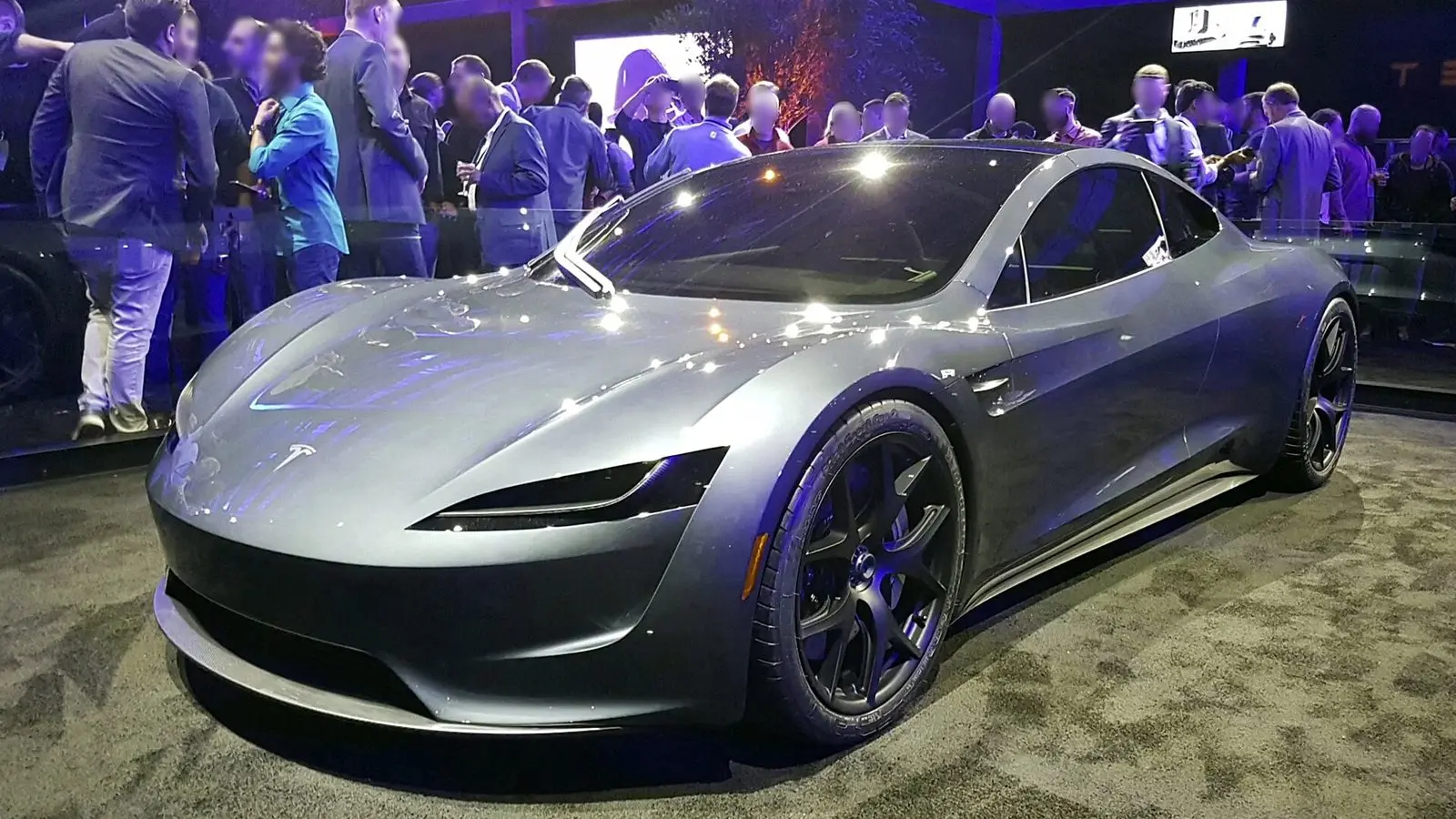
On a November night in 2017, at the end of an event that was supposed to be about trucks, a bright red sports car rolled out of the trailer of a Tesla Semi and stole the show. The 2017 Tesla Roadster – often called the Tesla Roadster 2 or Roadster 2.0 – promised numbers no production car had ever reached: 0 to 60 mph in 1.9 seconds, a top speed over 250 mph and a 620-mile range, all for $200,000. Buyers lined up with $50,000 deposits. Then the wait began. This part of our Tesla Roadster guide documents exactly what Tesla promised in 2017 and in the years that followed, so you can compare those claims with the car Tesla finally showed in 2026.
Early hints before 2017
The idea of a second Roadster was floating around long before the reveal. In October 2011, as The Verge reported, Musk suggested a new Roadster without the Lotus Elise chassis of the original Tesla Roadster could return around 2014. In July 2015 he teased a much faster future Roadster on social media, and in December 2016 he described the car as still "some years away." None of those comments came with specs or a date, but they kept the name alive while Tesla focused on the Model S, Model X and Model 3.
The surprise reveal: November 16, 2017
The reveal took place on the evening of November 16, 2017, in Hawthorne, California, at the launch event for the Tesla Semi electric truck. After the truck presentation, a Roadster drove out of a Semi trailer to loud cheers. Media outlets including GQ and The Washington Post described it as a deliberate surprise designed to grab headlines from a truck launch.
What made the moment so powerful was the spec sheet. Tesla published the numbers on its own website, which the Internet Archive still preserves, and outlets such as Car and Driver reported them the same night.
The 2017 Tesla Roadster specs as promised
| Spec | 2017 promise | Source |
|---|---|---|
| 0–60 mph | 1.9 seconds | Tesla website (archived), Car and Driver |
| 0–100 mph | 4.2 seconds | Tesla website (archived) |
| Quarter mile | 8.8 seconds | Tesla website (archived) |
| Top speed | Over 250 mph (over 400 km/h) | Tesla website (archived) |
| Range | 620 miles (about 1,000 km) at highway speed | Tesla website (archived) |
| Battery | 200 kWh (stated by Musk) | Car and Driver |
| Wheel torque | 10,000 N·m (7,376 lb-ft) at the wheels | Tesla website (archived) |
| Drivetrain | Three motors (one front, two rear), all-wheel drive, torque vectoring | Tesla website (archived) |
| Body | 2+2 coupe with removable glass roof | Tesla website (archived), Jalopnik |
| Production | 2020 | Car and Driver |
Two details are worth clarifying because they are often misquoted. First, the 10,000 N·m figure is wheel torque – the force at the wheels after gearing – not motor torque, which is why it looks so much higher than numbers quoted for other cars. Second, the 2017 car was not really a roadster in the classic sense. As Jalopnik pointed out, it was a 2+2 coupe with a removable glass roof panel, meaning two adults in front and two small rear seats.
Every 2017 performance number was a Tesla target, not an independent test result. No customer car was ever delivered with those specs, and the 2026 production plan uses different numbers for each version.
Price, Founders Series and the $50,000 reservation
Tesla announced a base price of $200,000. It also created a Founders Series limited to 1,000 cars at $250,000 each, with the full amount paid up front. For the standard car, the reservation was $50,000: $5,000 by card immediately and $45,000 within 10 days, according to The Washington Post and Australian outlet Drive. Those reservation terms matter today because Tesla's 2026 reservation uses the same $5,000 + $45,000 structure; see our Tesla Roadster price and reservation guide.
| Option | 2017 price | Payment |
|---|---|---|
| Roadster (base) | $200,000 | $50,000 reservation ($5,000 now + $45,000 within 10 days) |
| Founders Series (1,000 cars) | $250,000 | Full $250,000 paid up front |
Tesla also used the Roadster as a reward in its referral program. Between 2017 and 2019, top referrers could earn a free Founders Series Roadster, as Jalopnik reported; Electrek's founder has written that he earned two of them. What exactly those referral winners and paying reservation holders will receive under the 2026 plan has not been explained by Tesla.
The SpaceX package: thrusters first promised in 2018
The wildest promise came months after the reveal. On June 9, 2018, Musk wrote on X that the Roadster would offer a "SpaceX option package" with about 10 small rocket thrusters arranged around the car. He said they would improve acceleration, top speed, braking and cornering. The next day he added that the "rocket" would actually be ultra-high-pressure air stored in a COPV – a composite overwrapped pressure vessel, the carbon-wrapped tank SpaceX uses on its rockets – refilled by an electric pump. He also said the package would replace the small rear seats, making the car a two-seater.
Many people assumed it was a joke. Musk told CNET Roadshow he was "very serious," and in a September 2018 Joe Rogan podcast appearance he mentioned a pressure of 10,000 psi (about 690 bar). Those 2018 statements are the direct ancestor of the Thrust and Rocket versions Tesla showed in 2026, described in detail in our 2026 Tesla Roadster specs article.
| Date | Musk's claim | Reported by |
|---|---|---|
| June 9, 2018 | SpaceX option package with about 10 small thrusters | Autoblog, Fortune |
| June 10, 2018 | Thrusters use high-pressure air in a COPV tank, refilled electrically | Musk on X, Electrek |
| June 10, 2018 | Package replaces the rear seats | Musk on X |
| June 2018 | “Very serious” about the idea | CNET Roadshow |
| June 27, 2019 | Base car 0–60 mph in 2.1 s; 1.9 s was the figure before thrusters | Musk on X, Electrek |
| May 20, 2021 | About 1.1 s acceleration claim with the SpaceX package | Musk on X, Electrek |
| February 28, 2024 | Design goals “radically increased”; 0–60 mph under 1 second | Musk on X, Bloomberg |
How the numbers drifted between 2019 and 2024
The spec sheet did not stay fixed. In June 2019, Musk said the base Roadster would hit 60 mph in 2.1 seconds, and that 1.9 seconds referred to the car before adding the rocket thrusters, which Electrek read as a quiet downgrade of the base car. In May 2021, he claimed the SpaceX package would cut the sprint to about 1.1 seconds, a figure also shown on the prototype's display at the Petersen Automotive Museum in Los Angeles. In February 2024, he said the design goals had been "radically increased" and that the car would reach 60 mph in under a second.
The prototype did make public appearances along the way. In August 2018, Jay Leno drove it on "Jay Leno's Garage," and the car later went on display at the Petersen museum. Those appearances proved a drivable prototype existed, but not that the promised specs were achievable in a production car.
Why critics doubted the 2017 claims
Some of the skepticism was technical. A week after the reveal, analysts at BloombergNEF argued that a 200 kWh battery would be difficult to fit into a small sports car using the battery technology of the time; their piece ran under the headline that Tesla's promises "break the laws of batteries." Others questioned whether a road car could combine a 620-mile range with hypercar acceleration without becoming very heavy.
The other reason for doubt was Tesla's track record on timelines. The 2017 announcement said production would start in 2020. As our Tesla Roadster release date and delay timeline shows, that date moved again and again until Musk said in October 2026 that production would begin in 2028.
How to read the 2017 spec sheet today
Hypercar spec sheets are easy to misread, and the 2017 Roadster's was no exception. Three habits help when you compare those numbers with anything else you see online.
- Check how 0–60 mph was measured. American magazines often subtract a "one-foot rollout," the first foot of travel, as drag strips do. A rollout time can be a tenth of a second or more quicker than a time measured from a true standstill. Tesla did not specify the method for the 2017 figure, so comparisons with independently tested cars are approximate at best. Our Roadster vs. Rimac Nevera comparison explains why this matters.
- Separate wheel torque from motor torque. The 10,000 N·m figure is measured at the wheels after gear reduction. Most manufacturers quote motor or engine torque, which is a much smaller number for the same car.
- Look at the conditions behind range. Tesla's 620-mile claim was "at highway speed," but it was never tested on the EPA cycle, which is the basis of the range number on a U.S. window sticker. The 2026 car does not have an EPA rating either.
None of this means the 2017 figures were invented; they were targets for a car that had not yet been engineered for production. But it is a reminder that a target published nine years before production is a statement of ambition, not a measured result.
If you hold a 2017 reservation
Thousands of people paid $50,000 for a base reservation or $250,000 for a Founders Series car, and many have now waited longer than the life of some car models. As of October 16, 2026, Tesla had not published any explanation of how those reservations map onto the new Performance, Thrust and Rocket versions, and Jalopnik and Electrek both noted the open question after the reveal. Electrek did report in November 2025 that Founders Series holders were invited to the unveiling event. If you hold an old reservation, the practical steps are simple: keep your original confirmation and payment records, check your Tesla account for updates, and do not place a second reservation for the same car without first asking Tesla in writing how the old one will be treated. Tesla's current US reservation page states that refunds for modifications will not be issued, so the details of any change matter.
2017 promises vs. the 2026 Roadster
When Tesla revealed the production-intent Roadster on October 15, 2026, several of the 2017 headline promises changed. The comparison below uses Tesla's 2017 figures and the 2026 figures Tesla published on its website and social media. Neither set has been independently tested.
| 2017 promise | 2026 Tesla figures | |
|---|---|---|
| 0–60 mph | 1.9 s (later 2.1 s base, ~1.1 s with SpaceX package) | Under 1.6 s (Performance), under 0.9 s (Thrust), under 0.59 s (Rocket) |
| Top speed | Over 250 mph (400 km/h) | Over 230 mph (370 km/h) |
| Range | 620 miles (998 km) | Over 300 miles (483 km) |
| Seats | 2+2 | 2 (Performance, Thrust) or 1 (Rocket) |
| Thrusters | Optional SpaceX package (2018 claim) | Thrust and Rocket versions |
| Base price | $200,000 | Not announced |
| Production | 2020 | 2028 |
In short, acceleration targets got far more aggressive while range, top speed and seating went backward. Whether that trade makes the 2026 car more believable or simply different is the question owners and critics will be asking until the first deliveries. For the bigger picture, including the full 2006–2028 timeline, visit the Tesla Roadster hub.
Frequently asked questions
When was the 2017 Tesla Roadster unveiled?
On the evening of November 16, 2017, in Hawthorne, California, as a surprise at the end of the Tesla Semi launch event.
What did Tesla promise for the Roadster 2.0?
Tesla's 2017 website listed 0–60 mph in 1.9 seconds, 0–100 mph in 4.2 seconds, a quarter mile in 8.8 seconds, a top speed over 250 mph and 620 miles of range. Musk added a 200 kWh battery.
How much was the Tesla Roadster in 2017?
The base price was $200,000 with a $50,000 reservation. The Founders Series of 1,000 cars cost $250,000, paid in full up front.
What is the Tesla Roadster SpaceX package?
A 2018 Musk idea for about 10 cold-gas thrusters fed by a high-pressure COPV tank, replacing the rear seats. It evolved into the Thrust and Rocket versions shown in 2026.
Was the 2017 Roadster ever delivered?
No. The 2017 prototype appeared at events and in a museum, but no customer car was delivered. Tesla now says production will start in 2028.
Why did people doubt the 2017 Roadster specs?
Analysts at BloombergNEF questioned whether a 200 kWh battery could fit in a small sports car, and Tesla's repeated delays made the timeline hard to trust.
What happened to 2017 Roadster reservations?
As of October 2026, Tesla has not publicly explained how 2017 reservation and Founders Series holders will be handled under the new three-version lineup.
Sources
- Tesla Roadster page, 2020 archive (Wayback Machine)
- Electrek – Roadster demo moved to April 1, production 2027-28
- Car and Driver – New Tesla Roadster first look (2017)
- Washington Post – For $200,000, Tesla will sell you the world's fastest consumer car (2017)
- Jalopnik – The new Tesla Roadster isn't actually a roadster
- Bloomberg – Tesla's newest promises break the laws of batteries (2017)
- Jalopnik – Tesla offers a free next-generation Roadster for referrals
- Autoblog – Tesla Roadster SpaceX option package (2018)
- Electrek – Roadster thrusters will replace the back seats (2018)
- CNET Roadshow – Musk is ‘very serious’ about Roadster thrusters
- Electrek – Roadster 0-60 mph downgraded without thrusters (2019)
- Electrek – Roadster design and SpaceX package (2021)
- CleanTechnica – New Tesla Roadster on Jay Leno's Garage (2018)
- Bloomberg – Musk aims to ship Roadster next year (2024)
- Tesla – Roadster
Log in to comment
No comments yet. Be the first.