Are Crosswords Good for Your Brain? What the Research Really Shows
- People who do word and number puzzles more often score better on attention, reasoning and memory tests, but observational studies show a link, not a cause.
- In a 2022 Columbia–Duke trial of 107 adults with mild cognitive impairment, home crosswords beat computerized brain games at 12 and 78 weeks.
- The 2024 Lancet Commission lists 14 modifiable dementia risk factors, such as hearing loss, high blood pressure and inactivity; crosswords are not on the list.
- Where the idea that puzzles protect memory comes from
- What the large observational studies show
- Correlation is not causation: the biggest trap
- The Bronx Aging Study: a delay with a catch
- The 2022 trial: crosswords vs. computer brain games
- Do sudoku and crossword gains carry over to daily life?
- What the big reviews say about preventing dementia
- How to use puzzles wisely
- When memory changes are worth a doctor's visit
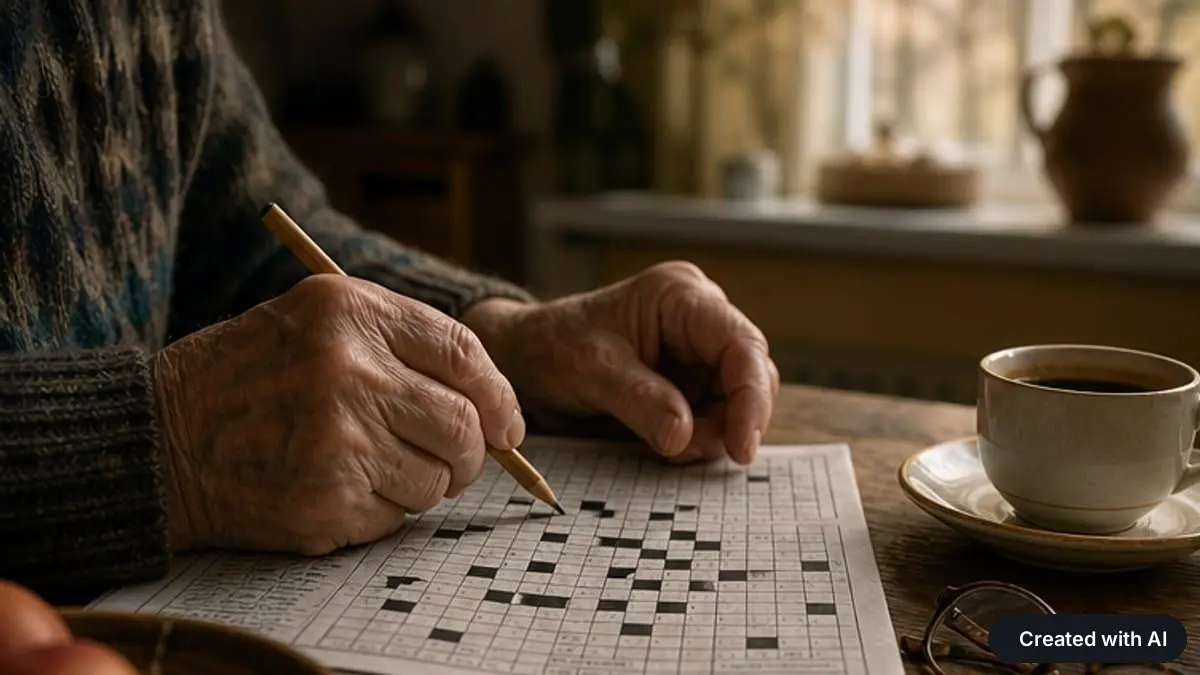
Morning coffee, the newspaper folded to the puzzle page, a pencil behind the ear: for millions of Americans that ritual is defended like a prescription. "As long as I'm doing the crossword, my mind stays sharp." Crosswords, sudoku and brain games come wrapped in promises that they protect memory and even ward off dementia. So are crosswords good for your brain, or is that just a comforting story? Researchers have been testing the idea for decades, and the honest answer is more interesting than a simple yes or no.
Short version: people who do word and number puzzles tend to score better on memory and thinking tests, and one small clinical trial found crosswords beat computer brain games for people with mild memory problems. But there is no solid proof that puzzles on their own prevent dementia. Below is what the main studies actually found, where the traps are, and how to use puzzles in a way that is most likely to help.
Where the idea that puzzles protect memory comes from
The idea is simple and intuitive: the brain works like a muscle, and training should keep it stronger. Scientists call this the cognitive reserve hypothesis. People who keep learning, reading, solving problems and socializing throughout life seem to build up a kind of buffer. When age- or disease-related changes start in the brain, that buffer lets them keep good memory and thinking for longer, even though the changes themselves don't go away.
Crosswords and sudoku became the poster children for this idea because they are cheap, everywhere and obviously make you think. A crossword sends you searching your memory for words and juggling clues and letters. Sudoku works logic, attention and working memory, the ability to hold a few numbers in your head for a moment. But there is a long road between "seems useful" and "proven to protect."
What the large observational studies show
Most of the data on puzzles comes from observational studies. Researchers ask thousands of people how often they do crosswords or other mental activities, then compare their scores on memory tests or track who develops dementia over the following years.
The PROTECT study in the United Kingdom
A 2019 analysis by Helen Brooker and colleagues in the International Journal of Geriatric Psychiatry looked at 19,078 cognitively healthy adults aged 50 to 93 taking part in the online PROTECT study. Participants reported how often they did word puzzles, from "more than once a day" to "never," and took a battery of thinking tests. The more often people did word puzzles, the better they scored on attention, reasoning and memory. A companion paper from the same team on number puzzles such as sudoku found a similar link.
The ASPREE study in Australia
A 2023 study from Monash University researchers in JAMA Network Open followed 10,318 Australians who were 70 or older and free of dementia at the start, for about a decade. Those who regularly did literacy and active mental activities, such as taking classes, writing letters or journals, doing crosswords, quizzes or playing board games, were 9 to 11 percent less likely to develop dementia than their peers. Creative hobbies like knitting or painting were linked to a 7 percent lower risk. Interestingly, the size of a person's social network was not linked to dementia risk in this study.
The authors themselves point out that the results cannot fully rule out that people who enjoy these activities simply have other advantages or healthier habits.
Correlation is not causation: the biggest trap
This is the single most important point. Observational studies show a link, not a cause. The fact that crossword fans have better memories doesn't mean crosswords gave them those memories. There are several other explanations:
- Reverse causation. People whose memory is already slipping often give up puzzles because they become frustrating. That makes it look as though non-solvers decline faster, when the cause and effect actually run the other way.
- Education and income. Crossword solvers tend to have more schooling, and more education on its own is linked to lower dementia risk. Researchers try to adjust for this, but it can't be separated out completely.
- Overall lifestyle. Someone who does sudoku every day often also walks more, reads more and is less likely to smoke. Which habit is doing the work is hard to say.
- Natural ability. People who are naturally good with words and logic are more likely to enjoy puzzles in the first place. Good test scores may reflect what was there all along, not the effect of training.
Think of runners: we notice they rarely get certain illnesses. But does running protect them, or do sick people simply not run? Puzzles raise exactly the same question.
The Bronx Aging Study: a delay with a catch
One of the most intriguing crossword findings comes from a 2011 analysis by Jagan Pillai and colleagues, drawn from the long-running Bronx Aging Study in New York. The researchers looked at 101 people who eventually developed dementia and asked when their memory began to decline faster.
For people who did crosswords, the accelerated memory decline started on average 2.54 years later than for those who didn't. That sounds great, but there is a flip side: once the decline began, the crossword solvers' memory dropped faster. That fits the cognitive reserve idea perfectly. The buffer lets you hold out longer, but it doesn't stop the disease. When the reserve runs out, symptoms show up more abruptly.
In other words, puzzles may help "buy time," and a few extra years of good memory is a lot. But they are not a shield that protects you from disease forever.
The 2022 trial: crosswords vs. computer brain games
Because observational studies have limits, randomized controlled trials, in which people are randomly assigned to groups, carry more weight. One of these was run by researchers at Columbia University and Duke University, led by psychiatrist Davangere Devanand, and published in NEJM Evidence in 2022.
The trial included 107 people with an average age of 71 who had mild cognitive impairment, meaning their memory had slipped more than is typical for their age but daily life was still largely intact. Half did crossword puzzles on a computer at home for 12 weeks; the other half played specially designed computerized cognitive games aimed at memory and attention. Both groups then continued with booster sessions through 78 weeks.
The results surprised even the researchers:
- On the main test of cognitive function (ADAS-Cog), the crossword group did better at both 12 and 78 weeks.
- At 78 weeks, the crossword group also held on better to everyday functioning.
- MRI scans showed less brain shrinkage in the crossword group.
- The difference was clearest in people whose impairment was further along; at an earlier stage the two approaches worked about the same.
It matters what this study did not show. There was no group that did nothing, so we can't say exactly how much crosswords helped compared with no activity at all. The study was also fairly small, and the authors say the findings need to be confirmed in a larger trial. One possible explanation is engagement: older adults know and like crosswords, so they stick with them more willingly than with unfamiliar computer games.
If someone you love has been diagnosed with mild cognitive impairment, crosswords can be a pleasant and meaningful daily activity, but they don't replace a doctor's care, prescribed treatment or other recommendations.
Do sudoku and crossword gains carry over to daily life?
Here is another key question: even if you get faster at sudoku with practice, will you remember where you left your keys? Scientists call this transfer, and it is where many brain-training promises fall apart.
The biggest study in this area is the US ACTIVE trial, which enrolled 2,832 older adults. They did a short course of 10 to 14 training sessions in memory, reasoning or speed of processing. Ten-year results published in 2014 showed that reasoning and speed training improved the specific abilities that were trained, and that effect lasted a decade. Memory training no longer showed a lasting benefit for the targeted memory skills after ten years.
Earlier work discussed by psychologist Timothy Salthouse also found no evidence that experienced crossword solvers lose thinking skills more slowly with age than anyone else. The takeaway is simple: the brain gets good at what it practices. Do the same kind of crossword every day and you'll become an excellent solver of that crossword, but that won't necessarily improve other kinds of memory.
The research at a glance
Here are the main studies in one place. Pay attention to the "Type" column: observational studies show what goes along with what, while randomized trials allow firmer conclusions about cause and effect. There are still very few of the latter on crosswords, which is why headlines claiming "crosswords prevent dementia" are a lot bolder than the data.
| Study | Type | Participants | Main finding | Limitation |
|---|---|---|---|---|
| PROTECT, Brooker et al., 2019 | Observational | 19,078, ages 50–93 | More frequent word and number puzzles linked to better cognitive scores | Shows a link, not a cause |
| ASPREE, Wu et al., 2023 | Observational, ~10 years | 10,318, ages 70+ | Active mental activities linked to 9–11% lower dementia risk | Habits and personality may play a role |
| Bronx Aging Study, Pillai et al., 2011 | Observational | 101 who developed dementia | Memory decline started 2.54 years later but then ran faster | Small sample, activity measured once |
| Devanand et al., 2022 | Randomized | 107 with mild cognitive impairment | Crosswords beat cognitive games at 12 and 78 weeks | No do-nothing control group |
| ACTIVE, Rebok et al., 2014 | Randomized | 2,832 older adults | Reasoning and speed training effects lasted 10 years | Benefits mostly limited to the trained skills |
What the big reviews say about preventing dementia
The clearest big-picture view comes from the 2024 report of the Lancet Commission on dementia prevention. It lists 14 modifiable risk factors and estimates that together they account for nearly half of dementia cases worldwide. They include less education, hearing loss, vision loss, high blood pressure, high LDL ("bad") cholesterol, smoking, obesity, depression, physical inactivity, diabetes, excessive alcohol use, head injury, air pollution and social isolation.
Notice what's missing: crosswords. The commission stresses staying mentally active throughout life, but alongside exercise, not smoking and drinking in moderation. Puzzles are one piece of the picture, not a magic pill. A daily walk, a timely hearing test or well-controlled blood pressure probably protects your memory at least as much as a daily sudoku.
How to use puzzles wisely
Does this mean you should give up crosswords? Not at all. They're enjoyable, free or cheap, calming, and based on the research they're unlikely to hurt and may well help. It just pays to use them wisely.
- Mix it up. Novelty is good for the brain. Do a crossword today, a sudoku tomorrow and something new the day after. Variety works different parts of the brain.
- Raise the difficulty. If you finish a sudoku in five minutes without thinking, it's a habit, not a workout. Move from easy sudoku up to hard sudoku.
- Solve together. Sharing a crossword with a spouse, grandkids or friends adds social contact, which is valuable in itself. With grandchildren, start with our crosswords for kids.
- Learn something new. A foreign language, a musical instrument, dancing or a new app challenges the brain more than a familiar puzzle does.
- Don't forget your body. Physical activity is one of the best-supported ways to protect the brain. Walking to the corner store for the Sunday paper is a great combination.
- Enjoy it. If a puzzle only brings stress and frustration, find another one. The research suggests engagement matters, and engagement comes from doing something you like.
Curious where sudoku came from in the first place? Read our explainer on who invented sudoku, from an American architect to a Tokyo puzzle magazine.
Try a "one new thing a week" rule: a new type of puzzle, a new recipe or a new route for your walk. The brain lights up most when it meets something it can't do yet.
When memory changes are worth a doctor's visit
Forgetting where you put your glasses or blanking on a familiar name now and then is normal at any age. Some signs, though, are worth bringing up with your primary care doctor:
- repeating the same questions or stories without noticing;
- getting lost in familiar places;
- trouble with routine tasks, such as paying bills or cooking a well-known recipe;
- family members noticing changes in personality or mood;
- crosswords you used to love suddenly feeling too hard or no longer interesting.
That last point matters because it echoes reverse causation. If someone who has done crosswords all their life suddenly stops, it may not be laziness but an early sign worth discussing with a doctor. Some causes of memory problems, such as vitamin B12 deficiency, thyroid problems or medication side effects, are treatable.
So, are crosswords good for your brain? The honest answer: they probably help a little, especially as part of an active, social and physically active life, but there is no solid evidence that they alone prevent dementia. Keep the pencil, just remember to take a walk after the puzzle.
Frequently asked questions
Are crosswords good for your brain?
They probably help a little. Large studies link regular puzzle solving with better scores on thinking tests, and a 2022 trial found crosswords outperformed computer brain games in people with mild cognitive impairment. There is no solid proof that crosswords alone prevent dementia.
Do crosswords help memory?
Puzzle fans tend to have better memory scores, but that may be because people with strong memories enjoy puzzles, not because puzzles built the memory. In the Bronx Aging Study, crossword solvers who developed dementia started declining about 2.5 years later, though their decline was faster once it began.
Is sudoku good for your brain?
A 2019 UK analysis linked frequent number puzzles such as sudoku with better attention, reasoning and memory scores. As with crosswords, the evidence shows an association rather than proof that sudoku protects the brain.
Can crosswords prevent dementia?
No study has shown that crosswords alone prevent dementia. The strongest evidence points to a mix of factors: staying mentally and socially active, exercising, controlling blood pressure and diabetes, treating hearing loss and not smoking.
Are crosswords better than brain-training apps?
In the 2022 NEJM Evidence trial led by Davangere Devanand, crosswords did better than computerized cognitive games on the main cognitive test and on daily functioning at 78 weeks. The study was small and had no do-nothing group, so it needs confirmation.
How can I get the most brain benefit from puzzles?
Vary the puzzle type, keep raising the difficulty, solve with other people, keep learning new skills and stay physically active. Enjoyment matters, because people stick with activities they like.
Sources
- Devanand et al., Computerized Games versus Crosswords Training in Mild Cognitive Impairment, NEJM Evidence, 2022
- NewYork-Presbyterian – Crossword Puzzles Beat Computerized Games in Slowing Memory Loss
- Brooker et al., word puzzle use and cognitive function (PROTECT), International Journal of Geriatric Psychiatry, 2019 (PubMed)
- Brooker et al., number puzzle use and cognitive function, International Journal of Geriatric Psychiatry, 2019
- Wu et al., Lifestyle Enrichment in Later Life and Its Association With Dementia Risk, JAMA Network Open, 2023
- ASPREE – Leisure activities that may reduce dementia risk
- Pillai et al., Association of Crossword Puzzle Participation with Memory Decline in Persons Who Develop Dementia, 2011 (PMC)
- Rebok et al., Ten-Year Effects of the ACTIVE Cognitive Training Trial, 2014 (PMC)
- The Lancet – Dementia prevention, intervention, and care: 2024 report of the Lancet Commission
Log in to comment
No comments yet. Be the first.