Tesla Roadster in Space: Where Is Starman Now?
- Launched February 6, 2018, on the first Falcon Heavy from Kennedy Space Center.
- The car orbits the Sun every ~557 days on a path crossing the orbit of Mars.
- Closest pass by Mars: October 7, 2020; next close pass by Earth: predicted for 2047.
- On October 16, 2026, trackers put it about 61.6 million miles from Earth.
- A 2018 study gives roughly a 6% chance of hitting Earth within ~3 million years.
- Why SpaceX launched a Tesla Roadster
- Launch day: February 6, 2018
- What is on board the Roadster
- Mars orbit vs. the orbit it actually reached
- Where is Starman now?
- Starman timeline, from tweet to today
- How to track the Tesla Roadster in space yourself
- Will the Roadster crash into Earth?
- The old Roadster and the new one
- Why Starman still matters
This article is part of the 77.today Tesla Roadster guide, prepared by the 77.today editors from the sources listed at the end.
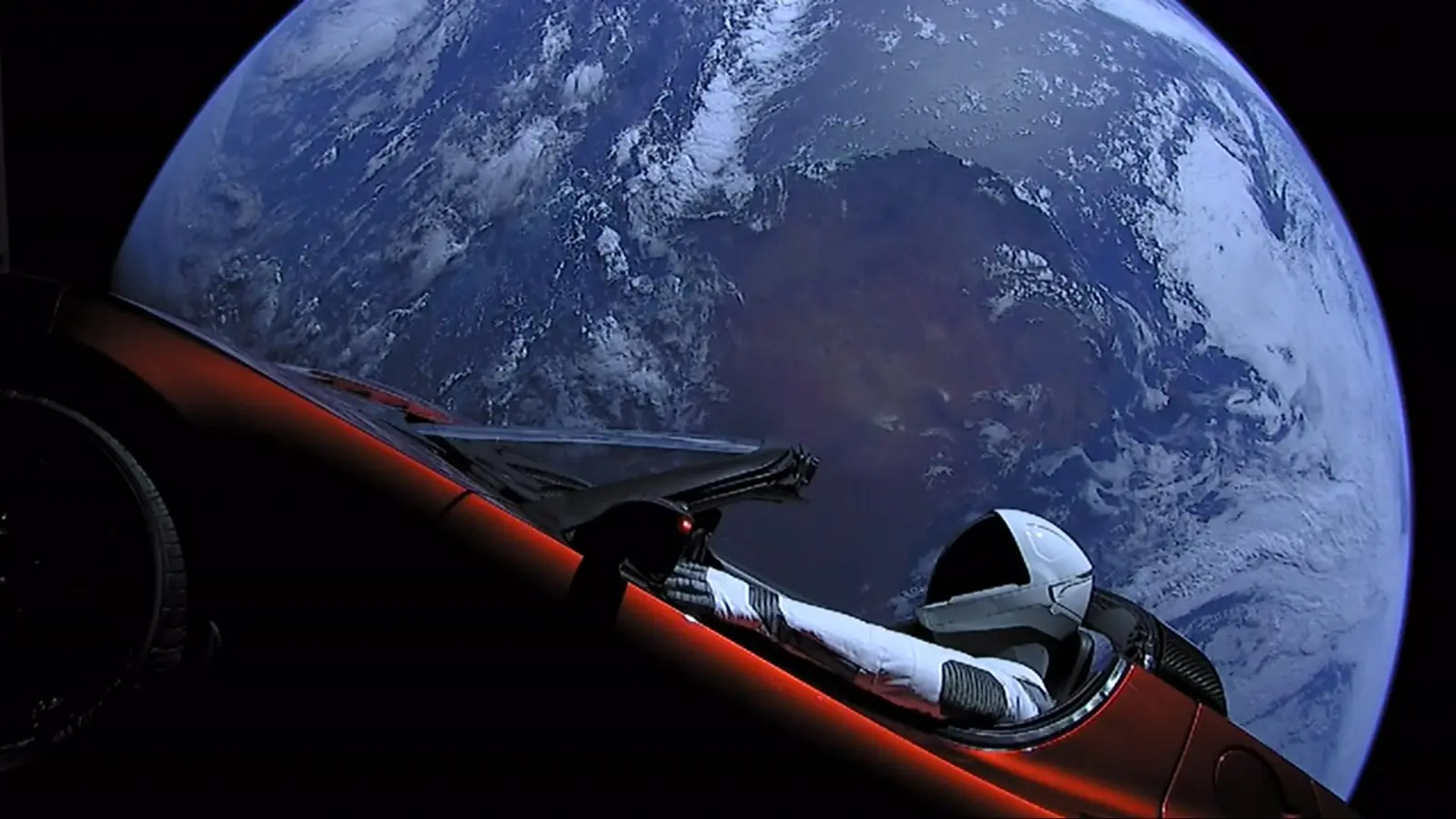
Somewhere between the orbits of Earth and Mars, a cherry-red electric sports car is still coasting around the Sun with a mannequin in a spacesuit behind the wheel. Elon Musk's own Tesla Roadster in space, piloted by "Starman," has been out there since February 2018, when it rode the first SpaceX Falcon Heavy rocket out of Florida. It has no engine running, no radio contact and no way to steer, yet people still search every month for one question: where is the Tesla Roadster in space right now? This part of our Tesla Roadster guide explains why the car was launched, what is on board, what orbit it actually reached, where it is today and how you can track it yourself.
Why SpaceX launched a Tesla Roadster
New rockets usually carry a dummy payload on their first flight: blocks of concrete or steel that simulate the mass of a real satellite without risking one. Elon Musk, who ran both Tesla and SpaceX, decided the maiden Falcon Heavy flight should carry something more memorable. He chose his personal 2010 Tesla Roadster, an original first-generation car (you can read its full history in our guide to the original Tesla Roadster). Musk explained the choice on X with a now-famous line: it was the "silliest thing we can imagine."
The joke had a serious marketing edge. The first launch of any new heavy rocket is risky, and a payload with sentimental value was more interesting to watch than a block of concrete. If the flight worked, the image of a car floating above Earth would be seen around the world. It was.
Launch day: February 6, 2018
Falcon Heavy lifted off at 3:45 p.m. Eastern time on February 6, 2018, from Launch Complex 39A at NASA's Kennedy Space Center in Florida, the same pad that launched Apollo missions. The Orlando Sentinel, among many others, covered the launch live.
SpaceX streamed live video from cameras mounted on the payload adapter for a little over four hours. Those feeds showed Starman, arm resting on the door, with Earth turning below. After the stream ended, the Roadster was seen only through telescopes; observatories photographed the upper stage and car as a faint moving dot in the days after launch. No new close-up images exist, and none are possible without another spacecraft going to find it.
What is on board the Roadster
The car was dressed with references that turned the payload into a pop-culture time capsule. Musk shared photos of several details before launch, and Mashable later documented the more hidden items.
| Item | Where | Reference |
|---|---|---|
| Starman mannequin in a SpaceX spacesuit | Driver's seat | Named after the David Bowie song |
| “Space Oddity” on the sound system | Audio | David Bowie |
| “Don't Panic!” message | Center display | The Hitchhiker's Guide to the Galaxy |
| A copy of The Hitchhiker's Guide and a towel | Glovebox | Douglas Adams fans' running joke |
| Hot Wheels Tesla Roadster with a tiny Starman | Dashboard | A car within a car |
| “Made on Earth by humans” plaque | Circuit board | A note to whoever finds it |
| Arch Mission Foundation quartz disc | On board | Isaac Asimov's Foundation trilogy stored in quartz |
The Hot Wheels Tesla Roadster on the dashboard explains why toy versions of the car became popular collectibles after the launch. The quartz "Arch" disc is designed to store data for an extremely long time, which fits a car that may orbit the Sun for millions of years.
Mars orbit vs. the orbit it actually reached
Before launch, Musk said the goal was to send the Roadster toward Mars. What it actually reached was a heliocentric orbit – an elliptical path around the Sun – that crosses the orbit of Mars rather than circling the planet. That is not a failure in the usual sense; the car was never going to stop at Mars.
The orbital data published through NASA's Jet Propulsion Laboratory Horizons system, where the object is listed as -143205, gives the following approximate parameters:
| Parameter | Value | Plain English |
|---|---|---|
| Perihelion | About 0.986 AU (about 91.7 million miles / 147.5 million km) | Closest point to the Sun, just inside Earth's orbit |
| Aphelion | About 1.664 AU (about 154.7 million miles / 248.9 million km) | Farthest point, beyond the orbit of Mars |
| Inclination | About 1.08° | Almost in the same plane as Earth's orbit |
| Orbital period | About 557 days (about 1.53 years) | One lap around the Sun |
| International designator | COSPAR 2018-017A, SATCAT 43205 | How space catalogs identify it |
Space.com reported that the Roadster finished its first full lap around the Sun in roughly August 2019. Since then it has kept circling on a path that brings it close to Mars and close to Earth only occasionally.
Where is Starman now?
The best public answer to "where is Starman" is the fan-run tracker whereisroadster.com, which uses JPL data to calculate the car's position. When we checked on October 16, 2026, the tracker showed the Roadster about 61.6 million miles (99.1 million km) from Earth and moving away from us, about 203 million miles (327 million km) from Mars and approaching it, and roughly 5.7 completed orbits around the Sun since launch. Those numbers change every minute, so treat them as a snapshot; the tracker itself is the place to check the live position.
Tracker figures are calculations, not live observations. No telescope is following the car, and SpaceX lost contact with the onboard cameras within hours of launch. The position is predicted from the orbit, which is extremely precise for an object coasting without propulsion.
Two milestones stand out. On October 7, 2020, the Roadster made its closest approach to Mars, passing within roughly 4.3 to 5 million miles (7 to 8 million km), as CNN reported. The next close approach to Earth is predicted for 2047, at a distance of about 3.1 million miles (5 million km). Neither pass is close enough for anyone to see the car with the naked eye.
Starman timeline, from tweet to today
The whole story fits on one page, but it spans almost a decade. Musk first described the plan on X in December 2017, saying the payload would be his "midnight cherry" Roadster and that the target was an orbit around Mars. A few weeks later he posted photos of the car being fitted to the payload adapter. Everything after launch has been driven purely by orbital mechanics.
| Date | What happened |
|---|---|
| December 2017 | Musk announces that his Roadster will fly on the first Falcon Heavy and shares photos of the car mounted on the payload adapter |
| February 6, 2018 | Launch from Kennedy Space Center; live video from the car for a little over four hours |
| February 2018 | Telescopes photograph the upper stage and car as a faint moving point of light |
| About August 2019 | First full lap around the Sun completed, per Space.com |
| October 7, 2020 | Closest approach to Mars, roughly 4.3–5 million miles (7–8 million km) |
| October 15, 2026 | Tesla reveals the new Roadster with the line “Now we put a rocket in Roadster” |
| October 16, 2026 | Tracker shows about 5.7 orbits completed and ~61.6 million miles from Earth |
| 2047 (predicted) | Next close approach to Earth, about 3.1 million miles (5 million km) |
How fast is it going? Speed in space depends on what you measure it against. On October 16, 2026, the whereisroadster.com tracker listed the car moving away from Earth at roughly 17,600 mph (about 28,300 km/h) and closing on Mars at about 4,560 mph (7,340 km/h). Relative to the Sun, the car speeds up when it swings closest to the Sun and slows down near the far end of its orbit, exactly as Kepler's laws predict for any object on an elliptical path. That is also why the distance to Earth changes so dramatically: for long stretches the car and our planet are on opposite sides of the Sun.
How to track the Tesla Roadster in space yourself
You do not need special software to follow the car. Here are the main options, from simplest to most technical:
- whereisroadster.com. Shows distance from Earth and Mars, speed and orbit count in miles and kilometers, plus a chart of the inner solar system.
- NASA JPL Horizons. The professional tool. Search for object -143205 to generate an ephemeris – a table of positions over any time period you choose.
- Orbit simulators. Several free planetarium apps can display the Roadster once its orbital elements are entered; Horizons supplies them.
If you are a teacher or a parent, Horizons is a great way to show students that a famous object can be followed with real NASA data, while the fan tracker is easier for a quick look.
Will the Roadster crash into Earth?
Not anytime soon. In 2018, researchers Hanno Rein, Daniel Tamayo and David Vokrouhlický modeled the car's long-term path and published the results in the journal Aerospace. They estimated about a 6 percent chance that the Roadster collides with Earth over roughly 3 million years. In other words, any such encounter is a question for the very distant future, not for anyone alive today.
You may also see claims that radiation has already destroyed Starman and the car's interior. Scientists have speculated that organic materials such as leather, rubber and plastics would degrade under ultraviolet light and cosmic radiation, but there is no observation of the car's current condition. We treat any description of its present state as a guess, not a fact.
The old Roadster and the new one
When Tesla finally revealed the next-generation Roadster on October 15, 2026, it leaned directly on Starman's legacy. The new car's page on tesla.com carries the line: "We already put Roadster in a rocket. Now we put a rocket in Roadster." The joke refers to the cold-gas thrusters built with SpaceX technology that Tesla says let the top Rocket version hop and briefly fly. You can read exactly what was shown and what remains unproven in our 2026 Tesla Roadster specs and SpaceX thrusters article, and how the thruster idea first appeared back in 2018 in the 2017 prototype promises.
| Starman's Roadster | 2026 Roadster Rocket | |
|---|---|---|
| Year | 2010 car, launched 2018 | Unveiled October 15, 2026 |
| Where it flies | Around the Sun, permanently | Short hops at a test site, per demonstrations |
| Propulsion | None after launch | Electric motors plus cold-gas thrusters, per Tesla |
| Driver | Mannequin | One seat; demo cars were remotely controlled |
| Public road use | Not applicable | Tesla says the Rocket version is not approved for public road use |
Why Starman still matters
Few marketing stunts have aged as well. Starman turned the first flight of a new rocket into a global media event, gave Tesla a piece of space history and created an object that will outlast every car on Earth. It also set up the narrative that Tesla used in 2026, linking a rocket company and a car company through a single model name. For the full story – from the 2006 unveiling to production planned for 2028 – return to the Tesla Roadster hub, and if you want to know how the original Roadster compares to a modern collector car, see our used Tesla Roadster buying guide.
Frequently asked questions
Where is the Tesla Roadster in space now?
It is orbiting the Sun on an elliptical path that crosses the orbit of Mars. When we checked whereisroadster.com on October 16, 2026, it was about 61.6 million miles (99.1 million km) from Earth. The tracker updates the position continuously.
When was the Tesla Roadster launched into space?
On February 6, 2018, at 3:45 p.m. Eastern time, aboard the first SpaceX Falcon Heavy from Launch Complex 39A at Kennedy Space Center in Florida.
Is Starman still in the car?
As far as anyone knows, yes. Nothing has visited the car since launch, so its exact condition is unknown. Claims that the mannequin or car has been destroyed by radiation are speculation.
Why did Elon Musk send a Tesla into space?
New rockets usually fly a dummy payload on their first launch. Musk chose his own 2010 Roadster, calling it the 'silliest thing we can imagine,' which also turned the launch into a worldwide media event.
Did the Tesla Roadster reach Mars?
No. It reached an orbit around the Sun that crosses the orbit of Mars. Its closest pass by Mars came on October 7, 2020, at roughly 4.3 to 5 million miles (7 to 8 million km).
Will the Tesla Roadster hit Earth?
A 2018 study estimated about a 6 percent chance of a collision with Earth over roughly 3 million years. The next close approach to Earth is predicted for 2047, at about 3.1 million miles (5 million km).
What song was playing in the Roadster?
David Bowie's 'Space Oddity' was set to play on the car's sound system, and the mannequin's name, Starman, also comes from a Bowie song.
How can I track Starman myself?
Use whereisroadster.com for a quick view or NASA JPL Horizons, where the Roadster is listed as object -143205, to generate precise positions for any date.
Sources
- Orlando Sentinel – Falcon Heavy launch (archived)
- Wikipedia – Elon Musk's Tesla Roadster
- Mashable – The library riding in Musk's Roadster (2018)
- NASA JPL Horizons System
- Where is Starman? (whereisroadster.com)
- Space.com – Starman completes first orbit around the Sun
- CNN – Starman's closest approach to Mars (2020)
- Rein, Tamayo, Vokrouhlický – The random walk of cars and their collision probabilities (Aerospace, 2018)
- Tesla – Roadster
Log in to comment
No comments yet. Be the first.