2026 Tesla Roadster Specs: 0–60, Top Speed, Versions, Thrusters and Street Legality
- Three versions: Performance (road ready), Thrust (race ready) and Rocket (air ready, one seat).
- Tesla targets: 0–60 mph under 1.6 s, 0.9 s and 0.59 s; over 230 mph; over 300 miles.
- Thrusters use compressed air from a ~158-gallon COPV tank; suction fans add 2 g of grip.
- Tesla says the Rocket version is not approved for public road use.
- NHTSA does not pre-approve cars; no NHTSA or FAA position on the thrusters has been published.
- What Tesla showed on October 15, 2026
- Tesla Roadster versions: Performance, Thrust and Rocket
- Tesla Roadster 0–60, top speed and range
- How the SpaceX thrusters work
- Suction fans, aero and Track Mode
- Design and Tesla Roadster interior
- Can the Tesla Roadster really fly?
- Is the Tesla Roadster street legal in the US?
- Performance, Thrust or Rocket: which version makes sense?
- What Tesla did not say
This article is part of the 77.today Tesla Roadster guide, prepared by the 77.today editors from the sources listed at the end.
After nine years of delays, Tesla finally showed the new Roadster on October 15, 2026 – and it was not the car anyone expected in 2017. The 2026 Tesla Roadster comes in three versions, two of them fitted with cold-gas thrusters developed with SpaceX, and Tesla says the top version can fly. Remote-controlled demo cars jumped a ramp, flipped in mid-air and hopped over parked Teslas. This part of our Tesla Roadster guide collects every confirmed Tesla Roadster spec: 0–60 mph times, top speed, range, how the thrusters and suction fans work, what the interior looks like, what Tesla did not say, and the question everyone is asking in the United States – is a car with rocket thrusters even street legal?
What Tesla showed on October 15, 2026
The event took place in the evening, Central time, at SpaceX's test site in McGregor, near Waco, Texas, and was streamed live on X and tesla.com. It had been scheduled for October 1 but was moved because of a storm forecast; the demonstrations could only be done outdoors (see our release date and delay timeline).
For safety, the demonstration cars were driven by remote control with nobody inside, according to Investing.com and Jalopnik. Before the runs, Musk warned that success was not guaranteed and promised "the most exciting, whether it works or not, demo ever."
- The ramp flip. A Roadster drove up a curved ramp, launched off the end, rotated in the air and used its thrusters to stabilize and land on all four wheels, as Investing.com and TechCrunch described.
- Hops over other Teslas. Cars made short jumps or "flights" over a parked Cybercab, Cybertruck, Tesla Semi, Model Y and Model 3, according to TechCrunch. Jalopnik observed that the thrusters seemed to provide short hops rather than sustained flight, and no long flight was shown.
- The 0–60 mph run. Investing.com and Jalopnik reported a 0.81-second run; Jalopnik noted that no timer was visible on screen, so the figure could not be checked. TechCrunch described it as about one second, and Reuters as under a second. None of these were independent measurements.
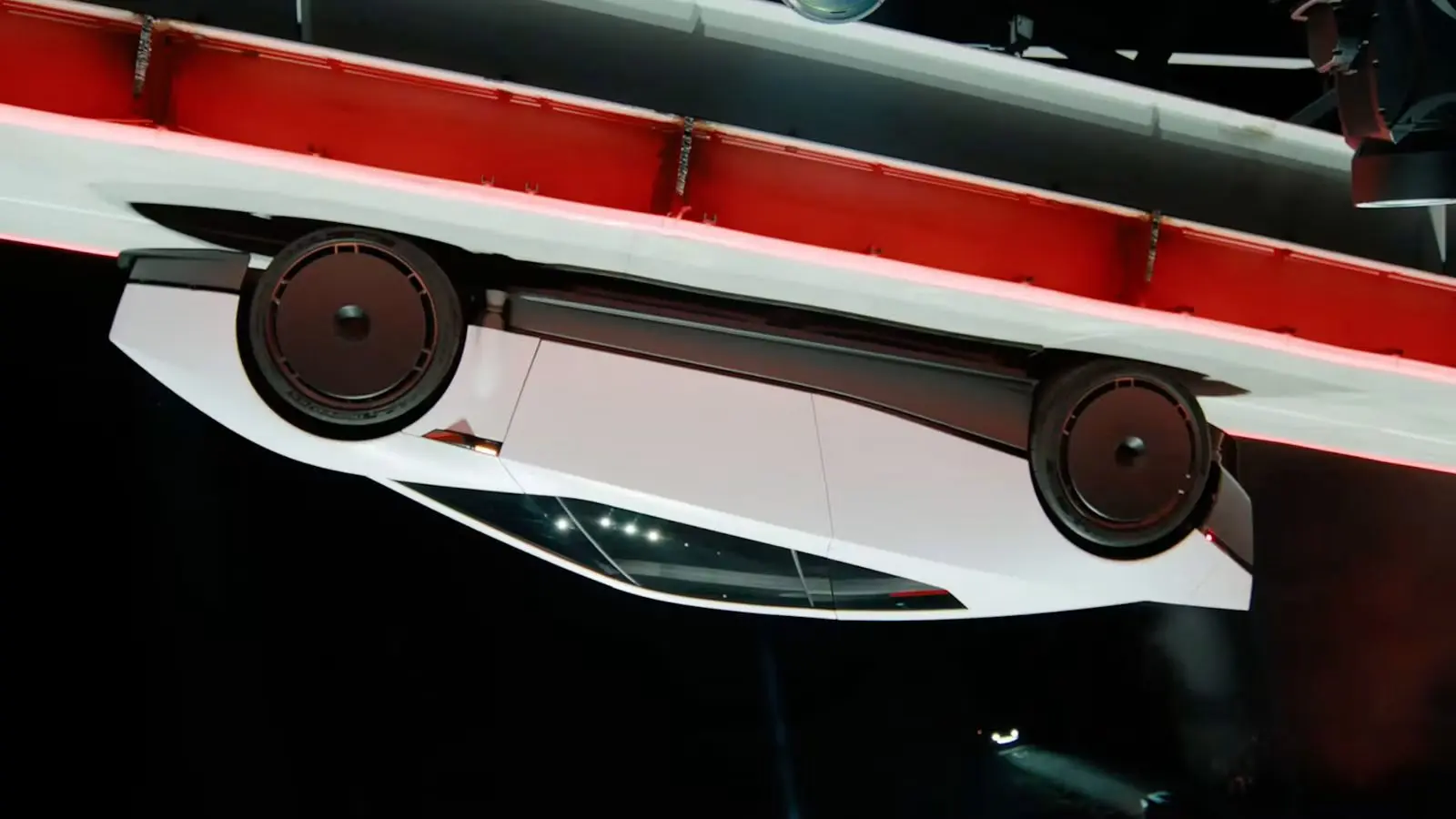
- The suction demo. Tesla said its fan-based suction system can hold the car upside down, even when stationary. Reuters reported a figure of 2 g of suction-generated grip. Musk joked: "This car really sucks."
Tesla Roadster versions: Performance, Thrust and Rocket
Tesla's Roadster page and US reservation page list three versions. The descriptions below are Tesla's own; the 0–60 mph targets come from Tesla's posts on X as reported by Electrek and Teslarati.
| Version | Tesla's description | Seats | 0–60 mph (Tesla target) | Availability |
|---|---|---|---|---|
| Performance | “Road ready” – active aero and a multi-mode suction system; no thrusters | 2 | Under 1.6 s | Reserve now |
| Thrust | “Race ready” – Performance features plus acceleration thrusters | 2 | Under 0.9 s (tesla.com: under 1 second) | Limited |
| Rocket | “Air ready” – Performance and Thrust plus a full flight system | 1 | Under 0.59 s | Invite only; not approved for public road use; not available in all regions |
The key distinction for American buyers: Performance is the car Tesla describes as ready for the road. Thrust is described as "race ready," and Tesla has not said whether it can be registered for street use. Rocket is the flying showpiece, and Tesla itself states it is not approved for public roads. Tesla's page sums up the concept with a nod to Starman: "We already put Roadster in a rocket. Now we put a rocket in Roadster." (The story of the original rocket ride is in Tesla Roadster in space.)
Tesla Roadster 0–60, top speed and range
Search interest in the Tesla Roadster 0–60 time is enormous, so it is worth being precise about what is a target and what was shown.
| Metric | Tesla's figure | Notes |
|---|---|---|
| 0–60 mph, Performance | Under 1.6 s | Tesla target, via Electrek and Teslarati |
| 0–60 mph, Thrust | Under 0.9 s | tesla.com says “under 1 second” |
| 0–60 mph, Rocket | Under 0.59 s | Tesla target |
| 0–60 mph in the demo | 0.81 s reported | Investing.com, Jalopnik; no visible timer, not independently measured |
| Top speed | Over 230 mph (over 370 km/h) | Tesla, via TechCrunch, Reuters and Electrek |
| Musk's spoken claim | “Mach 0.5, maybe higher” | Roughly 380 mph (about 610 km/h) at sea level; a verbal claim, not a specification |
| Range | Over 300 miles (over 483 km) | Tesla, via TechCrunch, Electrek and Teslarati; no EPA rating |
| Battery capacity | Not disclosed | — |
| Weight | Not disclosed by Tesla | A ~4,000 lb figure circulated from a reviewer's post; unconfirmed |
Note that Tesla quotes 0–60 mph, not 0–100 km/h. Sixty miles per hour is about 96.6 km/h, so a 0–100 km/h time would be slightly longer. Musk also said Tesla expects to "do better than that" on acceleration, according to Investing.com. For context on how those numbers compare with the fastest cars actually tested, see Tesla Roadster vs. Rimac Nevera and the fastest EVs.
The Tesla Roadster top speed of "over 230 mph" is lower than the "over 250 mph" promised in 2017, and the 300-mile range is less than half of the 620 miles promised then. Our 2017 promises article tracks every change.
How the SpaceX thrusters work
The Tesla Roadster thrusters are not rocket engines in the usual sense. Nothing burns. According to Tesla and the reporting of Jalopnik, TechCrunch and Electrek, they are cold-gas thrusters: they release very high-pressure air through nozzles, and the reaction pushes the car in the opposite direction. An onboard electric compressor refills the tank, so the car does not need to be filled with a special gas.
| Component | What we know | Reported by |
|---|---|---|
| Thruster type | Cold gas (compressed air), no combustion, electrically driven | Jalopnik, TechCrunch, Electrek |
| Nozzle layout (Rocket) | 10 outlets: 4 at the corners pointing up, 2 in the front fenders pointing sideways, 4 at the rear | Jalopnik |
| Thrust | Thrusters produce 4–5 times more force than the tires, per Tesla; rear thrust over 80 kN | Tesla on X via Electrek and Teslarati; Jalopnik citing Tesla |
| Air tank | About 158 gallons (about 600 liters) in a carbon-overwrapped pressure vessel (COPV) behind the seats | Jalopnik, TechCrunch |
| Air mass | About 260 kg (roughly 570 lb) of air, refilled by an onboard compressor | Investing.com |
| Packaging | COPV tanks fill “every available cavity” | Electrek, TechCrunch |
The idea is not new. Musk first described a "SpaceX option package" with about 10 thrusters in June 2018, saying it would use air stored in a COPV tank at around 10,000 psi. A COPV is the same type of carbon-wrapped tank SpaceX uses on its rockets. Tesla also published a patent in August 2025 related to ground-effect downforce, which Electrek covered at the time.
The thrusters explain the headline numbers. Without them, the Performance version targets under 1.6 seconds to 60 mph – still extraordinary, but in the same broad territory as the quickest cars already tested. The sub-1-second claims belong to the Thrust and Rocket versions, which use stored air for a short, violent push that no tire could deliver alone.
Suction fans, aero and Track Mode
Every version has what Tesla calls a multi-mode suction system: fans that pull air from under the car to suck it toward the ground, a principle also used by the British McMurtry Spéirling track car. Tesla says the system can hold the car upside down even when it is standing still. Reuters reported a figure of 2 g, and Jalopnik reported lateral grip of more than 2 g.
On top of the fans, the car has active aerodynamics and a Track Mode that lowers the body and deploys an active wing. Electrek reported that Tesla describes Track Mode downforce as "approaching F1 levels." In practical terms, suction lets the car generate grip without the drag of large wings and, unlike wings, it works even at low speed.
Design and Tesla Roadster interior
Tesla's page describes a car built from magnesium, titanium and carbon fiber with hidden headlights and a full-width taillight. The launch paint is "Ano White," inspired by rocket coatings, and the windows are gold-tinted like the visor of a spacesuit helmet. Jalopnik reported that Tesla cited the F-35 fighter, the SR-71 spy plane and the Lotus "Wet Nellie" submarine car from a James Bond film as inspirations.
The Tesla Roadster interior is finished in "Ultrawhite" with microsuede. The steering is steer-by-wire – there is no mechanical link between the yoke-style wheel and the front wheels – a feature Musk first previewed in a March 2024 interview reported by Teslarati. There is a central display plus two smaller screens, a fixed seat and manual controls. The Rocket version has a single seat.
| Feature | Tesla Roadster 2026 |
|---|---|
| Materials | Magnesium, titanium, carbon fiber |
| Lights | Hidden headlights, full-width taillight |
| Paint and glass | “Ano White” paint; gold-tinted windows |
| Steering | Steer-by-wire yoke |
| Screens | Center display plus two small screens |
| Interior | “Ultrawhite” with microsuede; fixed seat |
| Aero | Active aero, multi-mode suction, Track Mode with active wing |
Can the Tesla Roadster really fly?
Tesla's own wording for the Rocket version is "full flight system," and its page adds: "So yes, it can fly." What the public saw on October 15 were short, thruster-assisted hops and a mid-air flip followed by a landing. Jalopnik's assessment was that the thrusters appear to provide short jumps rather than sustained flight. Tesla has not said how long a Roadster can stay airborne, how high it can go or how many hops one tank of air supports.
That matters because "flying car" covers everything from a few seconds of controlled hopping to real aircraft. Musk hinted at an ambitious stunt involving the Snake River Canyon, TechCrunch reported, but no such plan has been confirmed. Before the event, Musk had told Joe Rogan in 2025 that people should wait for the demo to see whether the car would fly, and that if a billionaire like Peter Thiel wanted a flying car, "we should be able to buy one," Electrek reported.
Is the Tesla Roadster street legal in the US?
This is the question with the least settled answer, so we will separate what is known from what is not.
What Tesla says. The Rocket version is "not approved for public road use," and the flight system is "not available in all regions," according to tesla.com. Tesla calls the Performance version "road ready." It has not said whether the Thrust version can be registered for public roads.
What Musk says. Asked whether the car is street legal, Musk replied: "Depends on your street. But it'll be a viable car." He also said he was "not necessarily sure it's legal in all jurisdictions. But there will be such a car that someone can own," as InsideEVs reported. Reuters wrote that it was "not clear whether some of the vehicle's more astounding features will be street legal."
How US approval works. The United States does not have a type-approval system in which a regulator signs off on a car before sale. NHTSA says plainly that it "does not pre-approve new motor vehicles or new motor vehicle technologies." Instead, manufacturers self-certify that each vehicle complies with all applicable Federal Motor Vehicle Safety Standards (FMVSS) and attach a certification label, as required by 49 CFR Part 567. NHTSA can later test vehicles, investigate and order recalls. NHTSA has also opened an audit query into the data and processes Tesla relied on to self-certify the Cybercab, which shows the agency does scrutinize Tesla's certifications after the fact.
Exemptions. A manufacturer that cannot meet a standard can ask NHTSA for a temporary exemption under 49 CFR Part 555. According to NHTSA's own guide, most categories allow up to 2,500 exempted vehicles per year for up to two years, while the economic-hardship category is limited to manufacturers producing fewer than 10,000 vehicles a year – which Tesla is not. We have found no public record that Tesla has applied for any exemption for the Roadster.
The FAA question. Federal aviation rules define an aircraft as a device "used or intended to be used for flight in the air" (14 CFR 1.1). Whether a car that makes thruster-powered hops falls under that definition and FAA oversight has not been addressed publicly. We found no public evidence that Tesla has sought FAA certification or an exemption for the Rocket version.
| Question | Status as of October 16, 2026 |
|---|---|
| Rocket version on public roads | Not approved, per Tesla |
| Performance version | Described by Tesla as “road ready” |
| Thrust version on public roads | Not stated by Tesla |
| NHTSA statement on Roadster thrusters | None found |
| FAA certification or exemption | None found |
| State registration rules for thrusters | No state guidance found; claims about specific states are unverified |
We also saw social media claims that one US state's governor promised the flying Roadster would be legal there. We could not find an official source for that, so we are not repeating it as fact.
Performance, Thrust or Rocket: which version makes sense?
Tesla has not priced the versions, so any buying advice is provisional. Still, the official descriptions point to clear roles. The Performance version is the only one Tesla describes as road ready, it keeps two seats, and it skips the thrusters and their large air tank. For anyone who wants to drive a Roadster on public roads, register it like a normal car and use it on weekends, it is the logical choice – and with a sub-1.6-second target, it would still be among the quickest cars ever sold.
The Thrust version is aimed at track days and drag strips. Tesla calls it "race ready" and lists it as "limited," which suggests a smaller run. Until Tesla says otherwise, buyers should assume its thrusters may not be usable on public roads. The Rocket version is invite-only, seats one person and is, in Tesla's own words, not approved for public road use. It is best understood as a showpiece for a handful of collectors and for Tesla's marketing, not as a car most reservation holders will be offered. That is our reading of Tesla's published descriptions, not guidance from Tesla.
2017 Roadster vs. 2026 Roadster at a glance
| 2017 promise | 2026 Tesla figures | |
|---|---|---|
| 0–60 mph | 1.9 s | Under 1.6 / 0.9 / 0.59 s by version |
| Top speed | Over 250 mph (402 km/h) | Over 230 mph (370 km/h) |
| Range | 620 miles (998 km) | Over 300 miles (483 km) |
| Seats | 2+2 | 2 or 1 |
| Thrusters | Optional package (2018 claim) | Thrust and Rocket versions |
| Price | $200,000 base | Not announced |
| Production | 2020 | 2028 |
What Tesla did not say
For all the spectacle, important details are still missing. As of October 16, 2026, Tesla had not disclosed:
- A price for any version (reservations are $50,000 in the US; see Tesla Roadster price and reservation).
- Battery capacity, curb weight, or an EPA-rated range.
- Whether the demo cars were close to production specification – Jalopnik raised doubts.
- How long the Rocket can stay airborne and what "full flight system" includes.
- What happens to 2017 reservations and Founders Series orders.
- Independent 0–60 mph measurements.
- A confirmed production site; Gigafactory Texas is the stated plan, per Teslarati.
Musk was also frank about the car's business role. He said it is "not necessarily a safety optimized car" but an "actual car that's on roads," that Tesla will "aspire not to kill anyone in this car," and that he is "not sure it moves the needle massively from a revenue standpoint," as TechCrunch and Investing.com reported. He called it "the best of the last of the human-driven cars." Tesla stock rose more than 3 percent in after-hours trading, according to Investing.com.
For the full story – from the original 2008 Roadster to the 2028 production target – go back to the Tesla Roadster hub.
Frequently asked questions
What is the 0–60 time of the 2026 Tesla Roadster?
Tesla's targets are under 1.6 seconds for Performance, under 0.9 seconds for Thrust and under 0.59 seconds for Rocket. A 0.81-second run was reported at the demo, but no independent measurement exists.
What is the Tesla Roadster top speed?
Tesla says over 230 mph (over 370 km/h). Musk said on stage it could reach 'Mach 0.5, maybe higher,' but that is a verbal claim, not a published specification.
What is the range of the new Tesla Roadster?
Tesla says over 300 miles (over 483 km). There is no EPA rating yet, and battery capacity has not been disclosed.
Can the Tesla Roadster fly?
Tesla says the Rocket version has a 'full flight system' and 'can fly.' The demo showed short thruster-assisted hops and a mid-air flip, not sustained flight.
Is the Tesla Roadster street legal?
Tesla says the Rocket version is not approved for public road use and calls the Performance version 'road ready.' It has not said whether Thrust is street legal, and no NHTSA or FAA position has been published.
How do the Tesla Roadster thrusters work?
They are cold-gas thrusters that release high-pressure air stored in a carbon-overwrapped tank behind the seats. An onboard compressor refills the tank; nothing is burned.
What are the Tesla Roadster versions?
Performance (road ready, two seats, no thrusters), Thrust (race ready, two seats, acceleration thrusters) and Rocket (air ready, one seat, full flight system, invite only).
Does NHTSA approve new cars like the Roadster?
No. NHTSA does not pre-approve vehicles. Manufacturers self-certify compliance with Federal Motor Vehicle Safety Standards, and NHTSA can test, investigate and order recalls afterward.
Sources
- Tesla – Roadster
- Tesla – Reserve your Roadster (US)
- Reuters via NewsNation – Tesla Roadster flies
- Investing.com – Tesla unveils new Roadster, production set for 2028
- Jalopnik – Tesla Roadster re-reveal and production plans
- TechCrunch – Tesla reveals SpaceX-powered Roadster
- Electrek – Tesla unveils new Roadster
- Teslarati – Tesla Roadster specs and configurations
- InsideEVs via Yahoo Autos – Is the flying Roadster street legal?
- NHTSA – Understanding NHTSA's Regulatory Tools
- Federal Register – Applicability of NHTSA FMVSS test procedures to certifying manufacturers
- eCFR – 49 CFR Part 567, Certification
- eCFR – 14 CFR 1.1, General definitions
- Electrek – Tesla's new Roadster patent (2025)
- Teslarati – Roadster steer-by-wire and yoke (2024)
- Autoblog – Tesla Roadster SpaceX option package (2018)
- Electrek – Roadster thrusters will replace the back seats (2018)
Log in to comment
No comments yet. Be the first.