Tesla Roadster vs. Rimac Nevera: How It Stacks Up Against the Fastest Electric Cars
- Roadster figures are Tesla targets; rivals have tested or record-certified results.
- Rimac Nevera R: 0–60 mph in 1.66 s and about 268 mph; Nevera: 1.74 s.
- Yangwang U9 Track Edition holds the EV top-speed mark at 293.5 mph.
- The thruster Roadster would lead on acceleration, but not on top speed.
- Nevera prices start around $2.2 million; Tesla hasn't priced the Roadster.
- The big caveat: targets vs. measured results
- Tesla Roadster vs. Rimac Nevera: head to head
- The fastest electric cars, compared
- Why acceleration numbers are so hard to compare
- What a sub-second 0–60 mph would feel like
- Beyond 0–60: quarter mile and full-run records
- Where the Roadster would be first
- Where the Roadster would not be first
- The fan-car connection: Roadster vs. McMurtry Spéirling
- So which is the fastest electric car?
This article is part of the 77.today Tesla Roadster guide, prepared by the 77.today editors from the sources listed at the end.
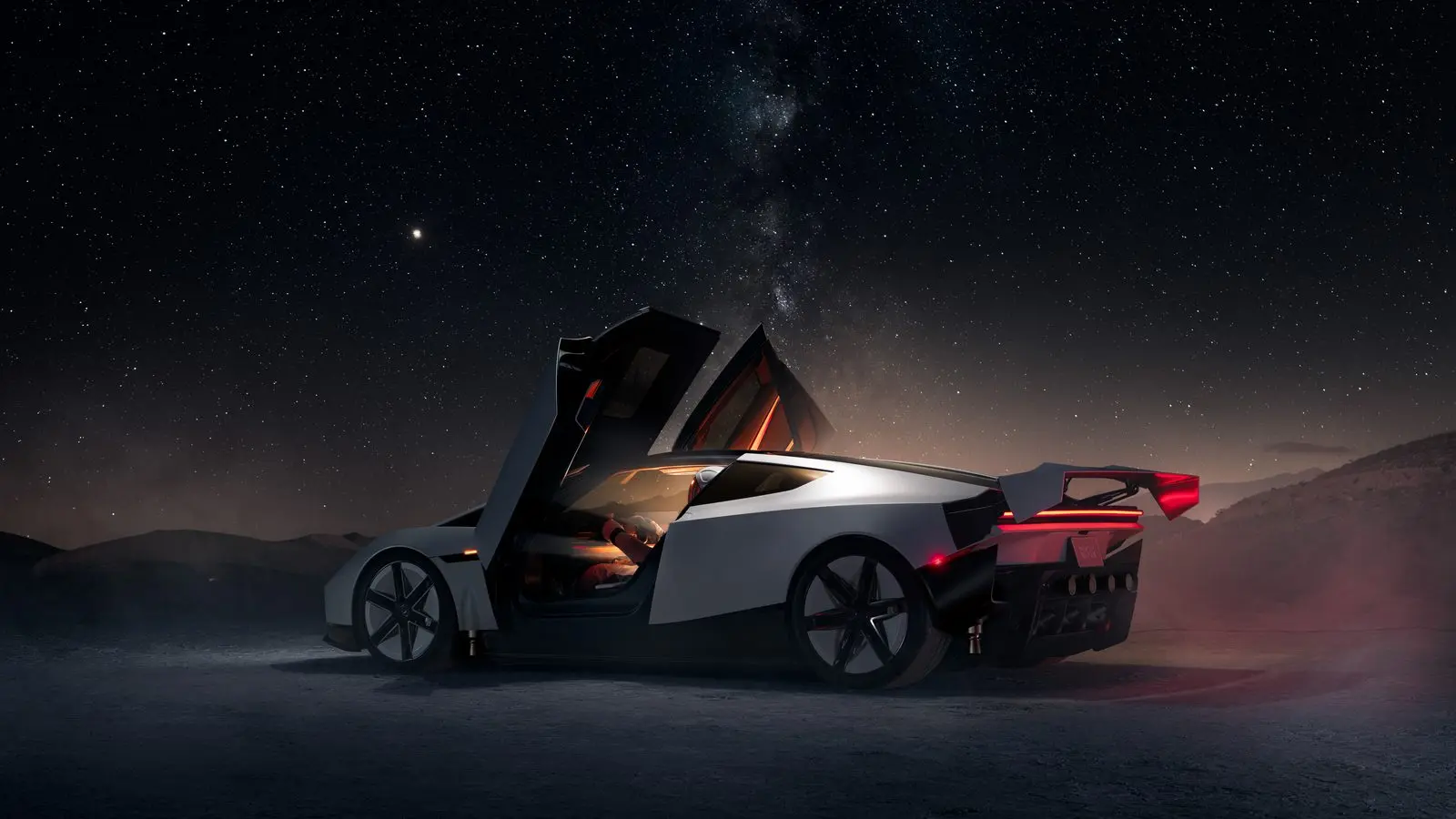
Tesla calls the new Roadster "the quickest car in the world." The Rimac Nevera, a Croatian electric hypercar, has spent years collecting records that back up a similar claim. So how does the Tesla Roadster vs. Rimac Nevera matchup actually look, and where do the Porsche Taycan Turbo GT, Lucid Air Sapphire, Yangwang U9 and McMurtry Spéirling fit in the race for the title of fastest electric car? This part of our Tesla Roadster guide compares only verified numbers, explains why acceleration figures are so often apples-to-oranges, and shows where the Roadster would be first – and where it would not.
The big caveat: targets vs. measured results
Every Tesla Roadster number in this article is a manufacturer target. Tesla says the Performance version will reach 60 mph in under 1.6 seconds, Thrust in under 0.9 seconds and Rocket in under 0.59 seconds. At the October 15, 2026 demo, Investing.com and Jalopnik reported a 0.81-second run, but Jalopnik noted that no timer was visible and no independent measurement was made. The competitors below, by contrast, have figures from manufacturer-run record attempts or magazine testing. Until a production Roadster is tested, any head-to-head is a comparison between a promise and a result. Details on how Tesla says it will hit those numbers are in our 2026 Tesla Roadster specs article.
Tesla Roadster vs. Rimac Nevera: head to head
| Tesla Roadster (2026) | Rimac Nevera | Rimac Nevera R | |
|---|---|---|---|
| Power | Not disclosed | 1,914 hp (1,408 kW) | 2,107 hp |
| Torque | Not disclosed | 2,340 N·m (about 1,726 lb-ft) | — |
| 0–60 mph | Under 1.6 / 0.9 / 0.59 s (Tesla targets by version) | 1.74 s (with one-foot rollout) | 1.66 s |
| 0–100 km/h (62 mph) | Not published | 1.81 s | — |
| Top speed | Over 230 mph (370 km/h), Tesla | About 256 mph (412 km/h) | About 268 mph (431 km/h) |
| Battery / range | Not disclosed / over 300 miles (483 km), Tesla | 120 kWh / about 304 miles (489 km) WLTP | — |
| Production | Planned from 2028 | 150 units | — |
| Price | Not announced; $50,000 reservation | About $2.2 million (Car and Driver estimate) | From about $2.5 million (TechCrunch) |
On paper, the Roadster's thruster versions would demolish the Nevera's acceleration. Even the thruster-free Performance version targets a time close to the Nevera's 1.74 seconds. But the Nevera R has a measured 0–60 mph time of 1.66 seconds and the car set 24 records, including 0–400–0 km/h in 25.79 seconds, according to Motor1. And on top speed, both Rimacs exceed the Roadster's stated "over 230 mph."
The comparison flips depending on the metric. On claimed acceleration, the thruster Roadster would be first. On verified top speed, the Rimac Nevera R and Yangwang U9 are well ahead of Tesla's stated figure. On price, the Rimacs cost roughly ten times the Roadster's 2017 base price.
The fastest electric cars, compared
Here is how the Roadster's targets compare with the quickest and fastest electric cars that have published, verifiable figures.
| Car | 0–60 mph | Top speed | Notes | Source |
|---|---|---|---|---|
| Tesla Roadster Rocket (2026) | Under 0.59 s (target) | Over 230 mph (target) | Cold-gas thrusters; not approved for public roads | Tesla |
| Tesla Roadster Performance (2026) | Under 1.6 s (target) | Over 230 mph (target) | Suction fans, no thrusters | Tesla |
| McMurtry Spéirling | 1.40 s (Carwow test) | — | Fan downforce; Goodwood hill climb record 39.08 s | Motor1, Autocar |
| Rimac Nevera R | 1.66 s | About 268 mph (431 km/h) | 24 records; 0–400–0 km/h in 25.79 s | Motor1 |
| Rimac Nevera | 1.74 s (with rollout) | About 256 mph (412 km/h) | 1,914 hp; 150 built | Rimac |
| Porsche Taycan Turbo GT Weissach | 1.89 s (with rollout); 2.10 s without | — | Quickest car MotorTrend had ever tested at the time | CarScoops, citing MotorTrend |
| Lucid Air Sapphire | 2.16 s | — | Quarter mile 9.21 s at 157.1 mph | CarScoops, citing MotorTrend |
| Yangwang U9 Track Edition (BYD) | — | 293.5 mph (472.41 km/h) | Over 3,000 hp, 1,200-volt system | BYD |
Why acceleration numbers are so hard to compare
Two cars with "1.8-second" 0–60 times may not be equally quick, because the measurement method varies:
- One-foot rollout. American magazines often start the clock after the car has already moved one foot, the way drag strips time runs. MotorTrend's Taycan Turbo GT test shows the effect: 1.89 seconds with rollout, 2.10 seconds without.
- 0–60 mph vs. 0–100 km/h. 100 km/h is about 62 mph, so a 0–100 km/h time is slightly longer. The Nevera's 1.74 s (0–60 mph) and 1.81 s (0–100 km/h) illustrate the difference.
- Surface and conditions. Prepared drag strips, tire temperature and weather all affect results.
- Who measured it. A manufacturer's record attempt, a magazine test and a demo with no visible timer are three very different levels of evidence.
Tesla has not said how it measures its Roadster targets. The fair way to compare is like with like: rollout with rollout, magazine test with magazine test. Until then, the Roadster's sub-second numbers belong in a separate column.
What a sub-second 0–60 mph would feel like
Acceleration times are easier to grasp as g-forces. Sixty miles per hour is about 26.8 meters per second. Dividing by the time gives the average acceleration, and dividing that by Earth's gravity (9.81 m/s²) gives the average g-force the driver would feel pushing them into the seat. The figures below are our own arithmetic based on the published times; real acceleration is never perfectly even, so peak forces would be higher than these averages.
| Car and time to 60 mph | Average acceleration | Average g-force |
|---|---|---|
| Tesla Roadster Rocket target, 0.59 s | About 45 m/s² | About 4.6 g |
| Tesla Roadster Thrust target, 0.9 s | About 30 m/s² | About 3.0 g |
| Tesla Roadster Performance target, 1.6 s | About 17 m/s² | About 1.7 g |
| Rimac Nevera R, 1.66 s | About 16 m/s² | About 1.6 g |
| Porsche Taycan Turbo GT, 1.89 s | About 14 m/s² | About 1.4 g |
| Original Tesla Roadster Sport (2009), 3.7 s | About 7 m/s² | About 0.7 g |
An average of more than 4 g for the Rocket would be far beyond anything a production road car has delivered. It also helps explain Musk's remark that the Roadster is "not necessarily a safety optimized car," and why Tesla ran the demonstrations by remote control with nobody inside, as Investing.com and TechCrunch reported. For comparison, the original 2008 Roadster – itself considered shockingly quick in its day – averaged well under 1 g.
Beyond 0–60: quarter mile and full-run records
Sprint times are only one way to rank fast cars. Quarter-mile times reward sustained power, and full acceleration-and-braking runs test everything at once. Tesla's 2017 target for the Roadster was a quarter mile in 8.8 seconds; it has not published a quarter-mile figure for the 2026 versions. MotorTrend measured the Lucid Air Sapphire at 9.21 seconds at 157.1 mph, and Rimac's Nevera R went from 0 to 400 km/h (about 249 mph) and back to a stop in 25.79 seconds, according to Motor1. Those are the kinds of figures the Roadster will need to post, under independent timing, before its "quickest car in the world" claim can be checked.
Where the Roadster would be first
If the production car meets its targets, the Roadster Thrust and Rocket would beat every car on this list from 0 to 60 mph by a wide margin – something no tire-only car can match, because tires can only transmit so much force before they slip. Tesla says its thrusters produce four to five times more force than the tires, as Electrek and Teslarati reported, and Jalopnik cited a rear thrust figure above 80 kN. That is the trick that makes sub-second times plausible: the car is pushed by air, not only pulled by rubber.
The Roadster could also undercut its rivals on price by a huge margin if Tesla stays anywhere near its original $200,000 base. The Nevera is estimated at $2.2 million and the Nevera R at about $2.5 million. See our Tesla Roadster price and reservation guide for what is known.
Where the Roadster would not be first
Top speed. Tesla's stated figure is "over 230 mph." The Nevera R has reached about 268 mph (431 km/h), and BYD says the Yangwang U9 Track Edition hit 293.5 mph (472.41 km/h) on August 8, 2025, at the ATP Papenburg test track in Germany with driver Marc Basseng. Musk said on stage the Roadster could reach "Mach 0.5, maybe higher" – roughly 380 mph at sea level – but that is a verbal claim, not a published specification.
Proven records. The Nevera R has 24 records. The McMurtry Spéirling holds the Goodwood Festival of Speed hill climb record at 39.08 seconds, according to Autocar. The Roadster has no independently verified figure yet.
Range. Tesla's over-300-mile target is roughly comparable to the Nevera's 489 km (about 304 miles) WLTP figure, and far below the 620 miles promised in 2017 (see what Tesla promised in 2017).
The fan-car connection: Roadster vs. McMurtry Spéirling
The closest technical cousin to the Roadster is not the Nevera but the McMurtry Spéirling, a British single-seat electric track car. Like the Roadster's suction system, the Spéirling uses fans to suck the car to the ground, creating grip independent of speed. It has about 1,000 hp, ran 0–60 mph in 1.40 seconds in a Carwow test, and is sold as the Spéirling PURE from just under £1 million before taxes in the UK. Tesla says the Roadster's fans can hold it upside down even when stationary, and Reuters reported 2 g of suction grip. The difference is that the Spéirling is a track car, while Tesla's Performance Roadster is meant to be road legal.
Tesla has been working on the idea for a while. In August 2025, Electrek covered a newly published Tesla patent on ground-effect downforce technology, noting that it did not match some of Musk's earlier flying-car talk. The production car combines both approaches: fans for grip on the ground and, on the Thrust and Rocket versions, compressed-air thrusters for acceleration and hops. No other car on this list uses both.
So which is the fastest electric car?
It depends on what "fastest" means. By top speed, the Yangwang U9 Track Edition holds the published EV record at 293.5 mph. By measured 0–60 mph among cars you can buy for the road, the Rimac Nevera R leads at 1.66 seconds, with the Nevera close behind. On a track or hill climb, the fan-assisted McMurtry Spéirling is in a class of its own. The Tesla Roadster's claim is the most extreme of all – under 0.59 seconds for the Rocket – but it is the only one on this list without a production car or independent test behind it.
We will update this comparison when production Roadsters are tested. Meanwhile, see the full story – from the original 2008 Roadster to the 2028 production target – on the Tesla Roadster hub.
Frequently asked questions
Is the Tesla Roadster faster than the Rimac Nevera?
On paper, in acceleration: Tesla's targets for the Thrust and Rocket versions are under 0.9 and 0.59 seconds to 60 mph, versus 1.74 seconds for the Nevera. But the Roadster figures are unverified targets, and both Rimac Neveras have higher top speeds than Tesla's stated 230+ mph.
What is the fastest electric car in the world?
By top speed, BYD's Yangwang U9 Track Edition, at 293.5 mph (472.41 km/h) on August 8, 2025. By measured 0–60 mph among road cars, the Rimac Nevera R at 1.66 seconds.
How fast is the Rimac Nevera?
Rimac quotes 0–60 mph in 1.74 seconds (with one-foot rollout), 0–100 km/h in 1.81 seconds and a top speed of 412 km/h (about 256 mph).
How much does a Rimac Nevera cost compared with a Tesla Roadster?
Car and Driver estimates the Nevera at $2.2 million, and TechCrunch reported the Nevera R starts at about $2.5 million. Tesla has not priced the 2026 Roadster; its 2017 base price was $200,000.
What is the quickest car MotorTrend has tested?
The Porsche Taycan Turbo GT with Weissach package ran 0–60 mph in 1.89 seconds with rollout (2.10 seconds without), the quickest MotorTrend had recorded at the time.
Why are 0–60 times different between sources?
Methods differ: some use a one-foot rollout, some quote 0–100 km/h instead of 0–60 mph, and some numbers are manufacturer targets rather than independent tests.
Is the Tesla Roadster faster than the Lucid Air Sapphire?
On Tesla's targets, yes. MotorTrend measured the Lucid Air Sapphire at 2.16 seconds to 60 mph; Tesla targets under 1.6 seconds even for the thruster-free Roadster Performance.
Sources
- Rimac Automobili – Nevera
- Car and Driver – Rimac Nevera pricing and specs
- Electrek – Tesla's new Roadster patent (2025)
- Motor1 – Rimac Nevera R world speed records
- TechCrunch – Rimac Nevera R starts at $2.5 million
- BYD – Yangwang U9 Track Edition sets EV top speed record
- CarScoops – Porsche Taycan Turbo GT runs 1.89-second 0-60
- Motor1 – McMurtry Spéirling PURE debut and specs
- Autocar – McMurtry Spéirling Goodwood record
- Tesla – Roadster
- Electrek – Tesla unveils new Roadster
- Teslarati – Tesla Roadster specs and configurations
- Jalopnik – Tesla Roadster re-reveal and production plans
- Investing.com – Tesla unveils new Roadster, production set for 2028
- Reuters via NewsNation – Tesla Roadster flies
Log in to comment
No comments yet. Be the first.