Original Tesla Roadster (2008–2012): History, Specs, Versions and Price
- Unveiled July 19, 2006, in Santa Monica; production ran from 2008 to January 2012.
- Tesla sold about 2,500 Roadsters in more than 30 countries.
- EPA range of 245 miles (394 km) and 0–60 mph in as little as 3.7 seconds.
- Base price started around $98,000; the Roadster Sport began at $128,500.
- The Roadster 3.0 battery upgrade (about 70 kWh) cost $29,000 from 2015.
- How the Tesla Roadster was born
- Lotus underneath, Tesla inside
- Battery, motor and performance
- Every version: 1.5, 2.0, Sport, 2.5 and 3.0
- How much did the original Tesla Roadster cost?
- Recalls and early problems
- Famous owners and the cultural moment
- Why the first Roadster mattered to Tesla
- Open-source documents and factory support today
- Original Roadster vs. the 2026 Roadster
This article is part of the 77.today Tesla Roadster guide, prepared by the 77.today editors from the sources listed at the end.
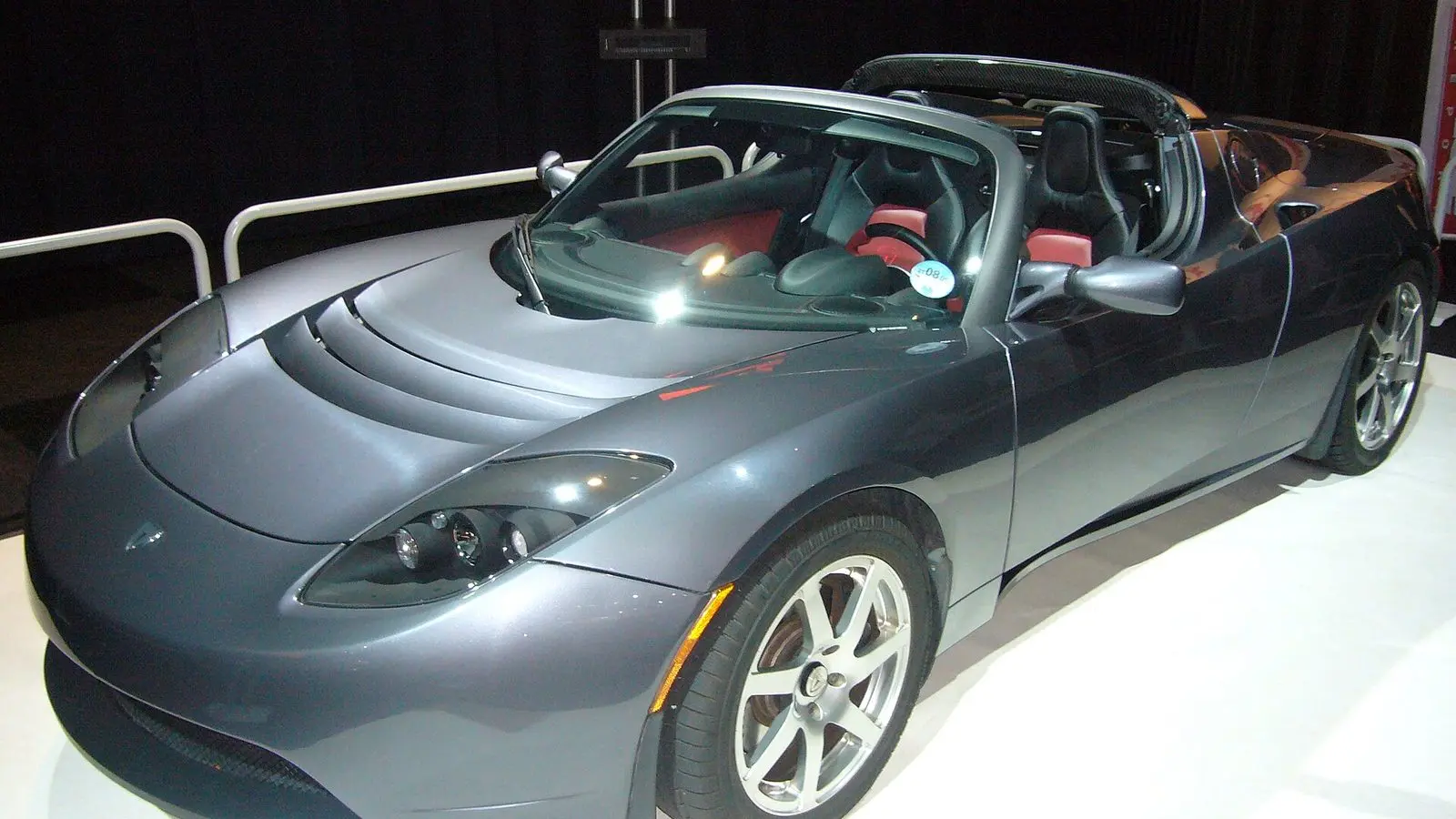
Long before it carried a mannequin past Mars or promised to fly, the Tesla Roadster was a small, low, surprisingly loud-looking two-seater that convinced a skeptical car world an electric vehicle could be fast, desirable and usable every day. The original Tesla Roadster was unveiled in 2006, built from 2008 to early 2012 and sold in roughly 2,500 copies. It was Tesla's first production car, the vehicle that paid for the lessons behind the Model S, and today it is a collectible with its own specialist repair shops and auction market. This part of our Tesla Roadster guide covers the full story of the first-generation car: where it came from, how it was built, every version, what it cost new, what went wrong and why it still matters.
How the Tesla Roadster was born
Tesla Motors was a small Silicon Valley startup when it decided that its first car would not be an econobox. The logic, repeated many times by the company's founders and early investors, was simple: batteries were expensive, so the first electric car would have to be expensive too, and an expensive car had better be exciting. A lightweight sports car that could out-accelerate gasoline exotics was the most persuasive possible argument for the technology.
The car was shown to the public on July 19, 2006, at a private event in the Barker Hangar at Santa Monica Airport in California. More than 350 invited guests attended. The launch was tied to the first batch of customer cars, the "Signature One Hundred" series: the first 100 buyers got a numbered Signature car, and the batch sold out in about three weeks. George Clooney was among those early buyers, according to Australian outlet GoAuto, which covered the later charity auction of his car.
Behind the scenes, the Roadster leaned on outside expertise. Widely cited histories of the car say Tesla licensed drivetrain technology and a charging patent from AC Propulsion, the California company behind the "tzero" electric sports car prototype, before redesigning much of the powertrain itself. We have not found a primary Tesla document that spells out the terms of that deal, so treat it as the commonly told version of the story rather than a confirmed contract detail.
Lotus underneath, Tesla inside
The Roadster's body and chassis came from an unlikely partner: Lotus Cars in Hethel, England. Tesla's own annual report filed with the U.S. Securities and Exchange Commission describes the arrangement plainly. Lotus built a "glider" – essentially a complete car without its powertrain – and Tesla installed the electric drive system. The design was based on the Lotus Elise, but the two cars shared far less than people assume. The share of common parts is usually quoted at only around 6 to 7 percent, because so much of the car had to change to package a large battery pack and an electric motor where a gasoline engine used to sit.
That partnership explains a lot about the Roadster's character. It is tiny, low to the ground and hard to climb into, with thin seats and minimal storage. It is also light and direct in a way few modern EVs are. Owners still talk about the steering feel and the instant shove of torque from a standstill, and those traits were exactly what Tesla wanted reviewers to experience.
Battery, motor and performance
The heart of the car was its battery, which Tesla called the Energy Storage System, or ESS. It is commonly described as a pack of roughly 53 kWh built from 6,831 small cylindrical lithium-ion cells of the 18650 format – the same basic cell size used in laptop batteries at the time. Using thousands of commodity cells rather than a few large custom ones was a key Tesla idea, and it carried over to the Model S.
The numbers that mattered to buyers were range and acceleration. Tesla's SEC filing gives the Roadster an EPA combined range of 245 miles (394 km), a figure that was remarkable for an electric car in 2008 and is sometimes quoted as 244 miles. The same filing says the car could reach 60 mph in as little as 3.7 seconds. Top speed was electronically limited at around 120 mph (193 km/h) according to the filing, while other sources list 125 mph (201 km/h).
| Spec | Original Tesla Roadster | Source note |
|---|---|---|
| Production | March 2008 – January 2012 | Tesla SEC 10-K (end date) |
| Units sold | About 2,500, in more than 30 countries | Tesla SEC 10-K |
| Battery | About 53 kWh, 6,831 lithium-ion cells (18650) | Widely cited; no Tesla primary document found |
| EPA range | 245 miles (394 km) | Tesla SEC 10-K |
| 0–60 mph | 3.9 s standard, 3.7 s Sport | Tesla SEC 10-K, Tesla press release |
| Top speed | About 120 mph (193 km/h); 125 mph often quoted | Tesla SEC 10-K; secondary sources |
| Layout | Two seats, rear motor, rear-wheel drive, Lotus-built glider | Tesla SEC 10-K |
Every version: 1.5, 2.0, Sport, 2.5 and 3.0
The Roadster changed noticeably during its short life, and the version matters a great deal to anyone shopping for one today (see our used Tesla Roadster buying guide). Early cars are usually called version 1.5. Secondary sources say these launched in 2008 after Tesla abandoned an earlier two-speed transmission plan in favor of a single-speed gearbox; we could not confirm the exact dates in a Tesla primary document. Version 2.0 followed in 2009 with refinements.
On January 11, 2009, Tesla announced the Roadster Sport. According to Tesla's press release, it cut the 0–60 mph time to 3.7 seconds and started at $128,500 in the United States. On July 1, 2010, Tesla unveiled the Roadster 2.5, timed with new stores in Copenhagen and Newport Beach. The 2.5 got a new front fascia, a rear diffuser, better seats, more sound insulation and a touchscreen navigation display. Performance was unchanged.
| Version | Introduced | What changed | Confirmed by |
|---|---|---|---|
| Roadster (1.5) | 2008 | First production cars; single-speed gearbox | Secondary sources |
| Roadster 2.0 | 2009 | Running refinements | Secondary sources |
| Roadster Sport | January 11, 2009 | 0–60 mph in 3.7 s; from $128,500 in the US | Tesla press release |
| Roadster 2.5 / 2.5 Sport | July 1, 2010 | New front end, rear diffuser, improved seats and insulation, touchscreen navigation | Tesla press release |
| Roadster 3.0 (R80) upgrade | Announced December 26, 2014 | About 70 kWh battery, aero kit, new tires and bearings; sold as a $29,000 upgrade from 2015 | Bloomberg, Fortune |
The Roadster 3.0 deserves its own explanation because it confuses many shoppers. It was never a new production car. In late December 2014, Tesla announced an upgrade package for existing Roadsters with a new battery of about 70 kWh made with LG Chem cells, an aerodynamics kit and other changes, and said range could exceed 400 miles (644 km) under some conditions. In February 2015, a test car drove about 340 miles (547 km) from the San Francisco Bay Area to Los Angeles on one charge and arrived with about 20 miles left, as CleanTechnica reported. Fortune reported in September 2015 that the battery upgrade was being offered for $29,000. Cars fitted with this pack are now often listed as "R80" or "3.0" Roadsters.
How much did the original Tesla Roadster cost?
The 2008 Tesla Roadster price started at about $98,000, a figure attributed to Tesla executive Darryl Siry in contemporary coverage. In 2009 Tesla raised the base price to $109,000, and a 2010 Tesla customer letter referenced $119,000. The Roadster Sport started at $128,500. Options pushed real transaction prices higher.
| Model | Price when new (US) | Source |
|---|---|---|
| 2008 Roadster (base) | About $98,000 | Autoblog, citing Tesla |
| Roadster after 2009 increase | $109,000 | Motor Authority |
| Roadster (2010 customer letter) | $119,000 mentioned | Motor Authority |
| Roadster Sport (2009) | From $128,500 | Tesla press release |
| Roadster 3.0 battery upgrade (2015) | $29,000 upgrade | Fortune |
Those numbers put the Roadster in Porsche 911 Turbo territory, which was precisely the point. Tesla was selling a technology demonstrator to wealthy early adopters, and every Roadster sold helped fund and inform the more affordable cars that came after it. If you are wondering what one costs today, the answer is very different and depends heavily on battery health; we cover real auction results in the used Roadster buying guide.
Recalls and early problems
For a first car from a startup, the Roadster held up reasonably well, but it was not trouble-free. Tesla's SEC filing lists two recalls. In May 2009 the company recalled cars because rear hub flange bolts might not have been properly tightened during assembly at Lotus. In October 2010 it recalled Roadsters because a 12-volt auxiliary cable could chafe against the vehicle's body, which could cause smoke or a fire risk. Anyone buying a Roadster today should confirm that recall work was done; the free NHTSA recall lookup by VIN is the easiest check.
The single most important technical fact about an original Roadster is battery care. Find My Electric and Roadster specialist Gruber Motors both warn that a Roadster left sitting uncharged can drain into a state where the pack no longer accepts a charge, an expensive problem owners call “bricking.” Before you fall for a low price, read our buying guide.
Famous owners and the cultural moment
The Roadster became a Hollywood status symbol almost overnight. George Clooney was among the early Signature buyers and later sold his car at a charity auction in 2012, as GoAuto reported. Arnold Schwarzenegger, then governor of California, also appeared with the Roadster, which NPR covered at the time. Many other celebrity names circulate online, but we could not verify most of them, so we are leaving them out.
The car's long-distance credentials also became part of its legend. One frequently cited example is a German owner who reportedly covered around 400,000 km (about 250,000 miles) in his Roadster; we have not found a primary source for the exact figure. What is documented is the 2015 Roadster 3.0 test drive and Tesla's own claim that the car achieved 245 miles on the EPA cycle, which in 2008 was several times what most electric cars could manage.
Why the first Roadster mattered to Tesla
It is hard to overstate how central the Roadster was to Tesla's survival. The car proved that lithium-ion cells could be packaged, cooled and managed safely in a road vehicle. It gave the company a brand, a waiting list and a reason for investors to believe in a sedan. Production ended in January 2012, according to Tesla's filings, and the Model S sedan followed later that year as the company's next product.
The car also had a famous second life. In February 2018, Elon Musk's personal 2010 Roadster became the payload on the first Falcon Heavy rocket and is still orbiting the Sun with a mannequin called Starman at the wheel. We tell that story in Tesla Roadster in space: where is Starman now. Meanwhile, the Roadster name was revived for an entirely different car: a four-seat hypercar shown in 2017 (what Tesla promised in 2017) that finally reappeared in October 2026 with SpaceX-derived thrusters (2026 Tesla Roadster specs).
Open-source documents and factory support today
In November 2023, Elon Musk posted that "all design & engineering of the original Tesla Roadster is now fully open source." As InsideEVs explained, the release included schematics for parts such as the battery monitoring board, vehicle display system and HVAC controller, plus diagnostic software, adding to the service manual and parts catalog already available on Tesla's Roadster service site. That does not mean anyone can build a Roadster in a garage, but it helps independent shops keep the remaining cars running.
Factory support has had ups and downs. According to Gruber Motors, a Roadster specialist that has worked with Tesla as a parts vendor, Tesla began contacting Roadster owners in the fall of 2019 about buying back or trading in their cars, partly to ease parts shortages, and at the end of 2019 recommitted to Roadster service with dedicated advisers and technicians. Parts such as body panels and custom electronics remain scarce, which is one reason well-documented cars command a premium.
Original Roadster vs. the 2026 Roadster
The two cars share a name and almost nothing else. The comparison below uses Tesla's figures for the new car, which are manufacturer targets rather than independent measurements.
| Original Roadster (2008–2012) | New Roadster (unveiled 2026) | |
|---|---|---|
| Seats | 2 | 2 (Performance, Thrust) or 1 (Rocket) |
| 0–60 mph | 3.9 s / 3.7 s (Sport) | Under 1.6 s (Performance) to under 0.59 s (Rocket), per Tesla |
| Top speed | About 120–125 mph (193–201 km/h) | Over 230 mph (370 km/h), per Tesla |
| Range | 245 miles EPA (394 km) | Over 300 miles (483 km), per Tesla; no EPA rating yet |
| Price | From about $98,000 (2008) | Not announced; $50,000 reservation |
| Built | Lotus glider in England, Tesla powertrain | Production planned for 2028 |
For the full timeline from the 2006 unveiling to 2028 production plans, head back to the Tesla Roadster hub.
Frequently asked questions
When did the original Tesla Roadster come out?
Tesla unveiled the Roadster on July 19, 2006, in Santa Monica, California. Regular production began in March 2008, and Tesla's SEC filings say production ended in January 2012.
How many original Tesla Roadsters were made?
Tesla says it sold approximately 2,500 Roadsters to customers in more than 30 countries. A figure of about 2,450 is also widely quoted from an earlier annual report.
How much did a 2008 Tesla Roadster cost new?
The base price was about $98,000 in 2008. Tesla raised it to $109,000 in 2009, and the Roadster Sport started at $128,500.
How fast is the original Tesla Roadster from 0 to 60?
Tesla's SEC filing says as little as 3.7 seconds for the Roadster Sport. The standard car is usually quoted at 3.9 seconds.
What is the range of the original Tesla Roadster?
The EPA combined range was 245 miles (394 km), according to Tesla's SEC filing. Cars upgraded with the Roadster 3.0 battery can go farther; a test car covered about 340 miles on one charge in 2015.
Is the Tesla Roadster a Lotus?
Not exactly. Lotus built the chassis and body (a 'glider') in Hethel, England, based on the Elise, and Tesla installed the electric powertrain. Only a small share of parts is commonly said to be shared with the Elise.
What is a Tesla Roadster 3.0?
It is an upgrade for existing Roadsters, announced in December 2014, with a new battery of about 70 kWh and aero changes. Tesla offered the battery upgrade for $29,000 starting in 2015.
Sources
- Tesla Form 10-K for FY2014 (SEC)
- Autoblog – Tesla Roadster unveiled in Santa Monica (2006)
- Electrek – Tesla Roadster debut 10 years ago (2016)
- GoAuto – George Clooney's Tesla Roadster to be auctioned (2012)
- Tesla – Tesla Motors introduces Roadster Sport (2009)
- Tesla – Tesla unveils Roadster 2.5 (2010)
- Motor Authority – Tesla raises prices on Roadster
- Bloomberg – Tesla offers Roadster upgrade package (2014)
- CleanTechnica – Roadster 3.0 goes 340 miles on one charge (2015)
- Fortune – Tesla Roadster battery upgrade (2015)
- InsideEVs – Original Roadster design now ‘fully open source’ (2023)
- Gruber Motors – Why is Tesla buying back their Roadsters?
- NPR – Schwarzenegger and the Tesla Roadster
- Wikipedia – Tesla Roadster (first generation)
Log in to comment
No comments yet. Be the first.