Egg Prices 2026: Monthly U.S. Price per Dozen and Forecast
- BLS average price for a dozen Grade A large eggs: $2.272 in September 2026, unchanged from August and 34.9% below September 2025 ($3.488).
- The cycle peak was $6.227 in March 2025. Since then the U.S. average has fallen by 63.5%.
- USDA's Economic Research Service (September 25, 2026) forecasts retail egg prices to fall 29.4% in 2026 as a yearly average, after a 21.9% rise in 2025.
- Prices have edged up since June 2026 ($2.141). USDA forecasts higher wholesale prices in the last quarter of 2026 than in the spring, so expect small increases before the holidays rather than another drop.
- Egg prices today: the short answer
- Monthly egg prices: September 2024 to September 2026
- Why egg prices rose so much: bird flu (HPAI)
- Why prices came down: flocks are rebuilding
- Egg price forecast for 2026 and 2027
- What wholesale and sale prices look like this month
- Cage-free, organic and pasture-raised eggs
- Egg prices in Canada, the UK and Australia
- How to pay less for eggs
- How BLS measures egg prices
- Bottom line
Egg prices were one of the biggest grocery stories of 2025. At the peak in March 2025, a dozen Grade A large eggs cost more than $6 on average in U.S. stores. Eighteen months later the picture looks very different. Below are the official monthly prices for the past two years, the reasons behind the swings, and what USDA expects for the rest of 2026 and for 2027.
Data checked on October 16, 2026. U.S. retail prices come from the Bureau of Labor Statistics (BLS) Average Price Data and the Consumer Price Index (CPI). The latest month available is September 2026. Forecasts come from USDA's Economic Research Service (ERS) Food Price Outlook, updated September 25, 2026. Wholesale prices come from USDA's Agricultural Marketing Service (AMS). Bird flu context comes from USDA's Animal and Plant Health Inspection Service (APHIS).
Egg prices today: the short answer
In September 2026, the U.S. average price for a dozen Grade A large eggs was $2.272, according to BLS series APU0000708111. That is the same as in August 2026. It is 34.9% lower than in September 2025 ($3.488) and 63.5% lower than the March 2025 peak of $6.227.
| Measure | Latest value | One year earlier | Change |
|---|---|---|---|
| Average price, Grade A large, per dozen (BLS) | $2.272 (Sep 2026) | $3.488 (Sep 2025) | -34.9% |
| Price per egg | about 19 cents | about 29 cents | -34.9% |
| CPI egg index (1982-84=100, not seasonally adjusted) | 279.288 (Sep 2026) | 351.693 (Sep 2025) | -20.6% |
| CPI food at home index | 321.758 (Sep 2026) | 316.042 (Sep 2025) | +1.8% |
Sources: BLS Average Price Data and CPI-U, U.S. city average, September 2026 release.
The two egg measures do not fall by the same amount. The average price tracks one specific product: a dozen Grade A large eggs. The CPI egg index covers all the eggs people buy, including cage-free, organic and other specialty eggs. Those cost more to begin with and did not fall as sharply as regular white eggs. So if you usually buy cage-free or organic eggs, your savings over the past year will probably look closer to the 20.6% CPI drop than to the 34.9% drop in the average price.
Monthly egg prices: September 2024 to September 2026
The table shows the BLS monthly average price for a dozen Grade A large eggs, along with the CPI egg index for the same month. BLS did not publish October 2025 figures because no prices were collected during the 2025 lapse in federal funding.
| Month | Average price per dozen (Grade A large) | CPI egg index |
|---|---|---|
| September 2024 | $3.821 | 356.190 |
| October 2024 | $3.370 | 333.047 |
| November 2024 | $3.649 | 359.058 |
| December 2024 | $4.146 | 389.077 |
| January 2025 | $4.953 | 442.773 |
| February 2025 | $5.897 | 498.223 |
| March 2025 | $6.227 | 504.205 |
| April 2025 | $5.122 | 451.154 |
| May 2025 | $4.548 | 417.195 |
| June 2025 | $3.775 | 372.296 |
| July 2025 | $3.599 | 359.678 |
| August 2025 | $3.587 | 359.131 |
| September 2025 | $3.488 | 351.693 |
| October 2025 | not published | not published |
| November 2025 | $2.860 | 311.513 |
| December 2025 | $2.712 | 307.876 |
| January 2026 | $2.577 | 291.463 |
| February 2026 | $2.500 | 288.679 |
| March 2026 | $2.348 | 279.024 |
| April 2026 | $2.250 | 274.415 |
| May 2026 | $2.191 | 270.421 |
| June 2026 | $2.141 | 268.277 |
| July 2026 | $2.189 | 267.136 |
| August 2026 | $2.272 | 276.484 |
| September 2026 | $2.272 | 279.288 |
Source: BLS series APU0000708111 (average price) and CUUR0000SEFH (CPI-U, eggs, not seasonally adjusted).
What the table shows
- The run-up, late 2024 to March 2025. The average price rose from $3.370 in October 2024 to $6.227 in March 2025, an increase of almost 85% in five months.
- The fall, April 2025 to June 2026. Prices dropped almost every month. By June 2026 the average was $2.141, the lowest point in the table.
- A slight rise since June 2026. The average rose to $2.189 in July and $2.272 in August, then held steady in September. The CPI egg index rose 4.5% from July to September. ERS also reported a 3.5% rise in retail egg prices from July to August 2026. This is a small move compared with 2025, but it means the steady decline has stopped for now.
- Two years apart. September 2026 is 40.5% cheaper than September 2024 ($3.821), when bird flu was already affecting supply but before the 2025 spike.
Why egg prices rose so much: bird flu (HPAI)
The main cause of the 2022 to 2025 price swings was highly pathogenic avian influenza (HPAI). APHIS confirmed the current outbreak in a U.S. commercial flock on February 8, 2022. When the virus is found on a farm, the flock is removed to stop it from spreading. In large egg-laying operations that can mean millions of hens at a time. Fewer hens mean fewer eggs, and egg demand barely changes when prices rise. People keep buying eggs for breakfast and baking, so even a modest drop in supply can push prices up sharply.
APHIS notes that detections are usually higher in the fall and spring, when migrating wild birds carry the virus to new areas. It also puts the scale in context: the United States has more than 378.5 million egg-laying chickens.
ERS describes the price effect clearly. Retail egg prices rose 32.2% in 2022, 1.4% in 2023, 8.5% in 2024 and 21.9% in 2025. At the farm level, egg prices rose 163.1% in 2022, fell 28.3% in 2023, rose 43.1% in 2024 and rose 31.6% in 2025.
Key dates in the bird flu timeline
| Date | Event | Source |
|---|---|---|
| February 8, 2022 | APHIS confirms HPAI in a U.S. commercial flock, the start of the current outbreak | APHIS |
| 2022 (full year) | Retail egg prices up 32.2% | ERS |
| February 26, 2025 | USDA announces a strategy of up to $1 billion: $500 million for biosecurity, $400 million in financial relief for affected farmers and $100 million for vaccine research, plus fewer regulatory burdens and temporary imports | USDA |
| March 2025 | U.S. average price for Grade A large eggs peaks at $6.227 a dozen | BLS |
| 2025 (full year) | Retail egg prices up 21.9% | ERS |
| January to March 2026 | Fewer new HPAI detections than in the first quarter of 2025 | ERS, September 2026 Food Price Outlook |
| June 2026 | Average price bottoms out at $2.141 | BLS |
Why prices came down: flocks are rebuilding
ERS gives three reasons for the 2026 decline in its September 2026 Food Price Outlook:
- Fewer outbreaks. There were fewer new HPAI detections in the first quarter of 2026 than in the first quarter of 2025.
- Enough replacement hens. The supply of replacement pullets (young hens about to start laying) in 2026 has been enough to cover normal flock turnover and the unpredictable losses from HPAI.
- More eggs. USDA projects higher egg production in 2026 than in 2025.
USDA's Livestock, Dairy, and Poultry Outlook for September 2026 puts numbers on the recovery. It reported a national inventory of 315.0 million table-egg layers on August 1, 2026. It projects table egg production of 7,851 million dozen in 2026 and 8,010 million dozen in 2027. Its August outlook put 2025 production at 7,497 million dozen, so the 2026 projection is about 4.7% higher.
Egg price forecast for 2026 and 2027
The ERS Food Price Outlook forecasts the change in the yearly average price, not the price in a single month. Here is the September 2026 forecast for eggs and related categories:
| Category | 2025 actual | 2026 forecast | 2026 forecast interval |
|---|---|---|---|
| Eggs (retail) | +21.9% | -29.4% | -32.9% to -25.2% |
| Eggs (farm level) | +31.6% | -79.2% | -82.8% to -72.1% |
| Poultry (retail) | n/a | +1.0% | 0.0% to 2.1% |
| All food at home | +2.3% | +2.4% | 1.8% to 3.0% |
| All food | +2.9% | +2.9% | 2.5% to 3.2% |
Source: USDA ERS Food Price Outlook, September 25, 2026. The forecasts include CPI data through August 2026.
ERS expects food-at-home prices as a whole to rise 1.8% in 2027 (forecast interval -5.0% to 9.2%). It did not publish a separate 2027 egg number in its summary. Eggs and fats and oils are the only two of the 15 grocery categories that ERS expects to be cheaper in 2026 than in 2025.
Wholesale prices point to a small rise before the holidays
Store prices follow wholesale prices with a delay, so wholesale forecasts are a good early signal. In its September 2026 outlook, USDA forecasts the New York wholesale price for Grade A large eggs (volume buyers) by quarter:
| Period | New York wholesale, Grade A large (cents per dozen) |
|---|---|
| Q1 2026 | 125.2 |
| Q2 2026 | 67.0 |
| Q3 2026 (forecast) | 104.0 |
| Q4 2026 (forecast) | 130.0 |
| Q1 2027 (forecast) | 120.0 |
| Q2 2027 (forecast) | 100.0 |
Source: USDA ERS Livestock, Dairy, and Poultry Outlook, September 2026.
The outlook expects wholesale prices in late 2026 to be roughly double the spring 2026 low. Demand for eggs usually rises around Thanksgiving and Christmas because of holiday baking. Even so, 130 cents a dozen is a fraction of the 2025 levels. USDA's August 2026 outlook put the first-quarter 2025 wholesale average at 675.3 cents a dozen.
What wholesale and sale prices look like this month
USDA AMS publishes a weekly Egg Markets Overview. The edition with prices as of October 9, 2026, reported:
- National wholesale, loose white Large eggs (truck lots): $0.43 a dozen, down 3 cents from the week before.
- New York wholesale, Large cartoned eggs delivered to retailers: $0.82 a dozen, unchanged.
- California benchmark, Large shell eggs: $1.06 a dozen.
- Average advertised retail price, conventional caged eggs: $1.38 a dozen, up 7 cents from the week before.
- Average advertised price, cage-free barn or aviary eggs: $2.26 a dozen.
Sale prices are not the same as regular shelf prices. The AMS ad price covers eggs on promotion in supermarket weekly ads. The BLS average of $2.272 includes all Grade A large eggs at their regular prices. Still, the gap tells you something useful: if you watch the weekly ads, you can often pay well below the national average.
Cage-free, organic and pasture-raised eggs
Specialty eggs cost more, and their prices have not fallen as far. The AMS feature report for the week to October 9, 2026, shows these average advertised prices by type:
| Egg type (AMS retail feature report) | Average ad price per dozen |
|---|---|
| Conventional caged, white | $1.38 |
| Cage-free barn/aviary, white | $1.65 |
| Cage-free barn/aviary, brown | $3.13 |
| Cage-free free-range, brown | $4.63 |
| Cage-free pastured, brown | $5.46 |
| USDA Organic, brown | $6.90 |
Source: USDA AMS Egg Markets Overview, retail feature activity, prices as of October 9, 2026.
According to the same report, non-organic cage-free eggs made up 53% of supermarket egg promotions in 2026, organic eggs 25%, nutritionally enhanced eggs 12% and conventional caged eggs 10%.
Egg prices in Canada, the UK and Australia
Canada
Statistics Canada publishes a monthly average retail price for a dozen eggs in table 18-10-0245-01. The latest figure is C$4.83 for August 2026, compared with C$4.81 in August 2025. Canadian prices hardly moved during the U.S. spike. Over the past two years they stayed between C$4.66 (October 2024) and C$4.95 (July 2025 and July 2026).
| Month | Canada, eggs, 1 dozen (C$) |
|---|---|
| August 2024 | 4.71 |
| February 2025 | 4.91 |
| August 2025 | 4.81 |
| December 2025 | 4.70 |
| March 2026 | 4.77 |
| June 2026 | 4.88 |
| July 2026 | 4.95 |
| August 2026 | 4.83 |
Source: Statistics Canada, table 18-10-0245-01, Canada total.
United Kingdom
The Office for National Statistics published an average price for a dozen eggs (series J428) as part of its consumer price inflation data. The latest value in that series is 331p for January 2025, up from 329p in January 2024. As of the September 2026 dataset, ONS had not added any later months to the series, so we cannot give a current official UK price.
Australia
The Australian Bureau of Statistics does not publish a current national average retail price for eggs, so we do not list one.
How to pay less for eggs
- Check the weekly ads. In early October 2026, conventional eggs on promotion averaged $1.38 a dozen in the AMS feature survey, well below the $2.27 national average.
- Compare price per egg. Packs of 18 or 30 eggs often cost less per egg than a dozen. Divide the shelf price by the egg count to compare.
- Check the size. BLS tracks large eggs. Medium eggs are often cheaper and work well for scrambling and most recipes that do not call for a specific size.
- Store them properly. Keep eggs refrigerated in their carton. Buying a little more when prices are low makes sense only if you will use them before the date on the carton.
- Think about timing. USDA expects wholesale prices to rise in the fourth quarter of 2026. Holiday bakers may find slightly better prices in October than in December.
How BLS measures egg prices
The BLS Average Price Data come from the same price collection as the Consumer Price Index. Each month, BLS data collectors record prices for specific items in stores across U.S. cities. For eggs, the item is defined as Grade A large, per dozen. The figure is a U.S. city average and is not adjusted for seasonal swings. The CPI egg index is broader. It covers all eggs and tracks price changes against a base period (1982-84 = 100). BLS releases both measures each month with the CPI report. The September 2026 data came out in October 2026, and October 2026 data are due in November.
Bottom line
A dozen Grade A large eggs cost $2.272 on average in the United States in September 2026. That is about a third less than a year earlier and close to two-thirds below the March 2025 peak of $6.227. USDA forecasts that 2026 egg prices will average 29.4% less than in 2025, as flocks recover from bird flu and production grows. Prices have edged up since June 2026, and USDA expects wholesale prices to rise toward the holidays. Still, barring a new wave of outbreaks, nothing in the official forecasts points to a return to 2025 levels.
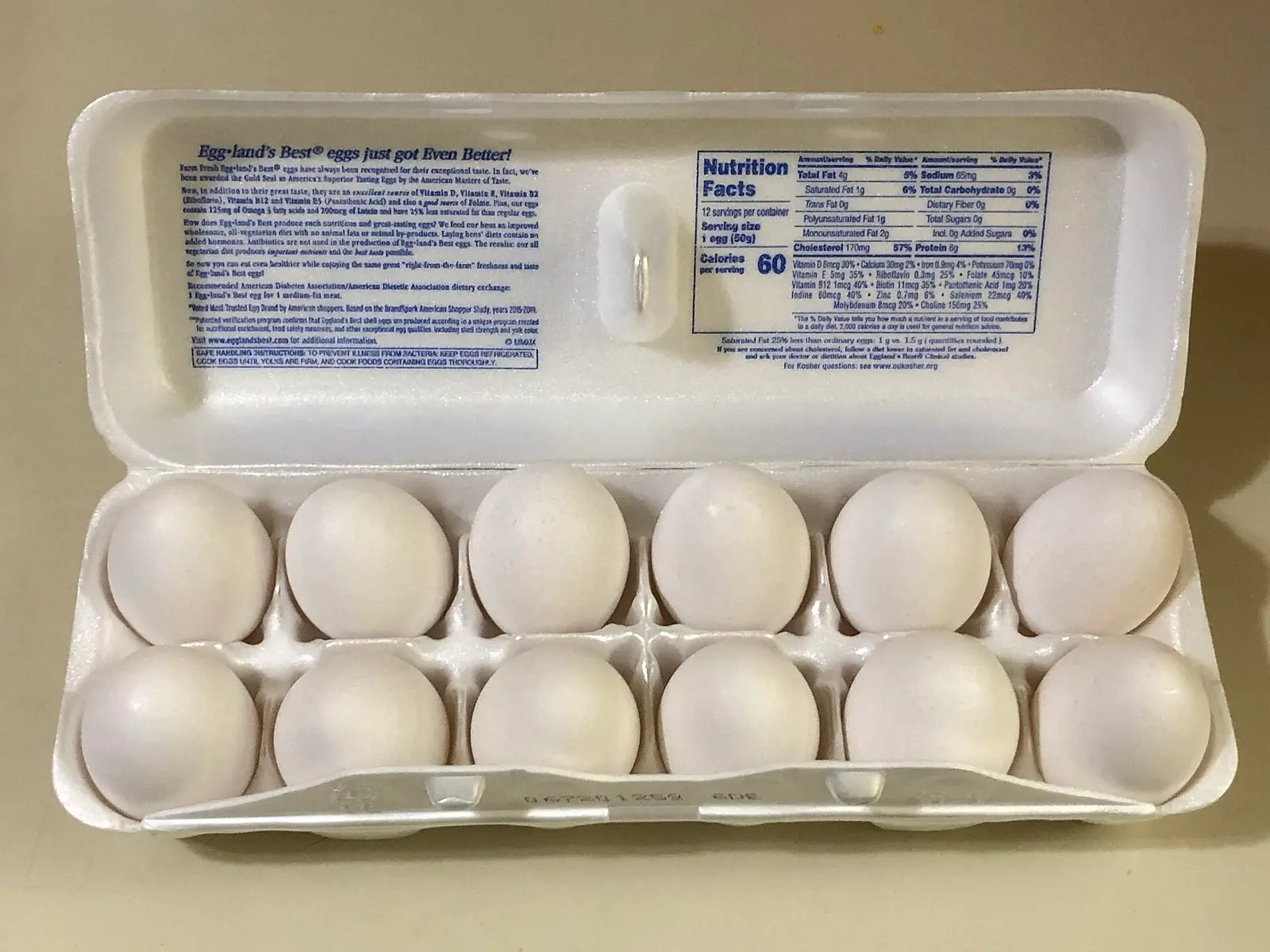
Photo: Famartin / CC BY-SA 4.0, via Wikimedia Commons
Frequently asked questions
How much is a dozen eggs right now?
The latest official U.S. average is $2.272 for a dozen Grade A large eggs in September 2026, according to the Bureau of Labor Statistics. That works out to about 19 cents an egg. Prices in your store can be higher or lower depending on the region, the brand and whether the eggs are cage-free or organic.
Are egg prices going down in 2026?
Yes, compared with 2025. USDA's Economic Research Service forecasts that retail egg prices will average 29.4% less in 2026 than in 2025, with a forecast range of -32.9% to -25.2%. Month to month, however, prices bottomed out in June 2026 at $2.141 and have risen slightly since then.
What was the highest egg price?
In the current cycle, the U.S. average for a dozen Grade A large eggs peaked at $6.227 in March 2025, according to BLS. The CPI egg index also peaked in March 2025.
Why were eggs so expensive in 2025?
The main reason was highly pathogenic avian influenza (HPAI). Since APHIS confirmed the first commercial case of the current outbreak on February 8, 2022, the disease has forced producers to cull large numbers of egg-laying hens, which cuts egg supply. ERS says retail egg prices rose 8.5% in 2024 and 21.9% in 2025.
Will egg prices go up for the holidays?
Some increase is possible. USDA's September 2026 outlook forecasts the New York wholesale price of Grade A large eggs at 130 cents a dozen in the fourth quarter of 2026, up from 67 cents in the second quarter. Wholesale prices usually reach store shelves with a delay. Even so, the forecast is far below the 2025 levels.
Why is there no egg price for October 2025?
BLS did not collect price data for October 2025 because of the federal funding lapse. Its database marks that month as unavailable, so our table skips it.
How much do eggs cost in Canada?
Statistics Canada's monthly average retail price for a dozen eggs was C$4.83 in August 2026, compared with C$4.81 in August 2025. Canadian egg prices have stayed in a narrow range of roughly C$4.70 to C$4.95 over the past two years.
Sources
- U.S. Bureau of Labor Statistics: Average Price, Eggs, Grade A, Large, per doz. (APU0000708111)
- U.S. Bureau of Labor Statistics: CPI-U, Eggs, U.S. city average (CUUR0000SEFH)
- USDA Economic Research Service: Food Price Outlook, Summary Findings (updated September 25, 2026)
- USDA Economic Research Service: Livestock, Dairy, and Poultry Outlook, September 2026
- USDA Agricultural Marketing Service: Egg Markets Overview (weekly)
- USDA APHIS: Confirmations of HPAI in Commercial and Backyard Flocks
- USDA: USDA Invests Up To $1 Billion to Combat Avian Flu and Reduce Egg Prices (February 26, 2025)
- Statistics Canada: Table 18-10-0245-01, Monthly average retail prices for selected products
- Office for National Statistics: RPI Average price, Eggs, per dozen (J428)
Log in to comment
No comments yet. Be the first.