How to Prepare for a Winter Storm: Home, Car, Power Outage and Generator Safety Checklists
- Stock flashlights, a NOAA Weather Radio, no-cook food, water, medicine, first aid and pet supplies for several days without power.
- Car kit: blankets, shovel, sand or cat litter, scraper, jumper cables, food, water, phone charger, flashlight.
- If stranded, stay in the car, run the engine about 10 minutes an hour and keep the exhaust pipe clear.
- Generators only outdoors, at least 20 feet from windows, doors and vents; CO detectors on every level.
- Prevent frozen pipes: drip faucets, keep the thermostat steady and never below 55°F when away.
- Why winter storms are dangerous
- Before the storm: your home checklist
- Keep pipes from freezing (and what to do if they freeze)
- Your car winter survival kit
- Power outage plan for winter
- Generator and carbon monoxide safety
- During the storm: staying safe at home and outside
- Pets and livestock in winter storms
- Preparing in an apartment
- After the storm
This article is part of the 77.today Winter Weather Guide 2026–27, prepared by the 77.today editors from the sources listed at the end.
The best time to prepare for a winter storm is before the first watch is issued, when stores are quiet and roads are clear. This part of our Winter Weather Guide 2026–27 turns official guidance from ready.gov, the National Weather Service, the CDC and the American Red Cross into practical checklists: how to prepare for a winter storm at home, a winter car emergency kit, a power outage plan, generator and carbon monoxide safety, how to keep pipes from freezing, and how to protect pets. Every item below comes from those sources; nothing here requires buying expensive gear.
Why winter storms are dangerous
Ready.gov lists the main ways winter storms hurt people: car accidents, hypothermia, frostbite, carbon monoxide poisoning and heart attacks from overexertion. Storms can bring extreme cold, freezing rain, snow, ice and high winds, and they can knock out heat, power and communications for days. Most of these risks are preventable with a little planning. The checklists below follow the order in which you will need them: before the storm, during it, and if the power goes out.
Before the storm: your home checklist
Ready.gov's core advice is to prepare your home to keep out the cold with insulation, caulking and weather stripping; learn how to keep pipes from freezing; and gather supplies in case you need to stay home for several days without power, keeping in mind each person's specific needs, including medication, and the needs of your pets. The NWS winter preparedness page adds these supplies for home (and for work):
| Item | Why it matters |
|---|---|
| Flashlight and extra batteries | Safer than candles during outages |
| Battery-powered NOAA Weather Radio and portable radio | Alerts keep coming when power and cell service fail |
| Food that needs no cooking or refrigeration, and water | Dried fruit, nuts, granola bars and similar |
| Extra prescription medicine | Pharmacies and roads may be closed for days |
| Baby items (diapers, formula) | Hard to find during and after a storm |
| First-aid supplies | For minor injuries when help is slow |
| Heating fuel, refilled before you run low | Fuel deliveries may not reach you for days after a storm |
| Safe emergency heat source | Fireplace, wood stove or properly ventilated space heater |
| Fire extinguisher and working smoke alarms | Test smoke alarms monthly |
| Carbon monoxide detectors with battery backup | On every level of the home, in central locations |
| Extra pet food and a warm shelter for pets | Pets need water and warmth too |
| Phone chargers and power banks | Charge everything when a watch is issued |
If heating costs or weatherization are out of reach, ready.gov points households to the federal Low Income Home Energy Assistance Program (LIHEAP) for help with heating bills and energy-related repairs.
When a winter storm watch is issued
- Charge phones, laptops and power banks.
- Fill the car's gas tank; the NWS suggests keeping at least half a tank during Extreme Cold Watches.
- Refill prescriptions and buy a few days of food that needs no cooking.
- Move pets and livestock to shelter and stock extra water and feed.
- Check your alert sources: weather.gov, NOAA Weather Radio and phone alerts.
Keep pipes from freezing (and what to do if they freeze)
Burst pipes are one of the most expensive winter surprises. The American Red Cross recommends:
- Let cold water drip from faucets served by exposed pipes during very cold weather. Running water, even at a trickle, helps prevent freezing.
- Keep the thermostat at the same temperature day and night. You may pay a little more for heat, but you can prevent a much more costly repair.
- If you go away, leave the heat on, set no lower than 55°F.
If a pipe freezes, the Red Cross advises keeping the faucet open and applying heat to the frozen section with an electric heating pad, a hair dryer, a portable space heater kept away from flammable materials, or towels soaked in hot water, until full water pressure returns. Never use a blowtorch, kerosene or propane heater, charcoal stove or any other open flame. Running water through the pipe as it thaws helps melt the remaining ice. Remember that wind chill does not make pipes colder than the air temperature, as explained in our wind chill guide; it only cools them faster.
Your car winter survival kit
Ready.gov's minimum car kit is short: jumper cables, sand, a flashlight, warm clothes, blankets, bottled water and non-perishable snacks, plus a full tank of gas. The NWS recommends a more complete Winter Storm Survival Kit:
| Car winter survival kit item | Car winter survival kit item |
|---|---|
| Mobile phone, charger, batteries | Blankets or sleeping bags |
| Flashlight with extra batteries | First-aid kit |
| Knife | High-calorie, non-perishable food |
| Extra clothing to keep dry | Large empty can for an emergency toilet, tissues, toilet paper, paper towels |
| Small can and waterproof matches to melt snow | Sack of sand or cat litter for traction |
| Shovel | Windshield scraper and brush |
| Tool kit | Tow rope |
| Battery booster (jumper) cables | Water container |
| Candle and matches | Compass and paper road maps |
The NWS also advises carrying a compass and paper road maps rather than depending only on mobile devices with limited battery life.
If you get stranded in your car
The NWS rules are simple and have saved many lives:
- Stay in the vehicle. If you leave, you can become disoriented quickly in wind-driven snow and cold.
- Run the motor about 10 minutes each hour for heat, and open a window a little for fresh air while it runs.
- Clear snow from the exhaust pipe to avoid carbon monoxide poisoning.
- Be visible: turn on the dome light at night when the engine is running, tie a bright cloth (preferably red) to the antenna or door, and raise the hood after the snow stops to signal you need help.
Better still, do not drive into a blizzard warning, and if you are caught in freezing rain, follow the driving rules in our freezing rain vs. sleet part.
Power outage plan for winter
Ice storms and wind-driven snow are a common cause of long outages. Ready.gov's power outage guidance:
- Keep the refrigerator and freezer closed. A refrigerator keeps food cold for about four hours; a full freezer holds its temperature for about 48 hours. Use coolers with ice if needed and check with a thermometer.
- Throw out food that has been at 40°F or higher for two hours or more, or that has an unusual odor, color or texture. "When in doubt, throw it out."
- Disconnect appliances and electronics so surges do not damage them when power returns.
- Plan for medicines and medical devices that need refrigeration or power. If power is out for more than a day, discard refrigerated medicine unless its label says otherwise, and ask your doctor or pharmacist for a new supply.
- Ask local officials about warming centers near you.
- Never use a gas stove or oven to heat your home. It raises the risk of carbon monoxide poisoning and fire.
If your heat goes out
The NWS suggests closing off rooms you do not need, stuffing towels or rags in cracks under doors, and closing blinds or curtains to hold in heat. Eat and drink regularly, since food gives your body energy to produce heat, and drink plenty of water and other non-caffeinated, non-alcoholic drinks, because cold air is very dry. Wear layers of loose-fitting, lightweight, warm clothing and remove layers before you start to sweat.
The CDC says more than 400 Americans die each year from unintentional carbon monoxide poisoning not linked to fires, more than 100,000 visit an emergency department and more than 14,000 are hospitalized. Run generators only outdoors, more than 20 feet from windows, doors and vents; never use a gas stove or oven to heat your home; and never run a car in an attached garage, even with the door open. Headache, dizziness, weakness, upset stomach, vomiting, chest pain or confusion during an outage can be CO poisoning: get to fresh air and call 911.
Generator and carbon monoxide safety
Generators save lives in long outages, and they also kill people every winter when used wrongly. The CDC and ready.gov agree on the essentials:
- Outdoors only, at least 20 feet away from windows, doors, vents and attached garages. Never inside a home, basement or garage, even with the door open.
- Install CO detectors with battery backup on every level of your home. The CDC suggests checking detector batteries when you change your clocks each spring and fall, and replacing the detector according to the manufacturer's instructions or every 5 years.
- Keep the generator dry and protected from rain; touching a wet generator or connected devices can cause electric shock.
- Use heavy-duty extension cords to connect appliances, and follow the manufacturer's instructions.
- Let it cool before refueling; fuel spilled on hot engine parts can ignite.
- Camp stoves and charcoal grills belong outdoors too, never inside for heat or cooking.
Cars are a CO risk as well. The CDC warns never to run a car or truck inside a garage attached to a house, even with the garage door open, and to have the exhaust system checked every year. After a heavy snow, clear the tailpipe before starting the engine.
During the storm: staying safe at home and outside
- Stay off the roads if at all possible (ready.gov).
- Limit time outside. Wear layers, a hat, mittens, a scarf or face mask and water-resistant boots, as the CDC recommends, and watch for frostbite and hypothermia.
- Shovel with care. Ready.gov warns that overexertion while shoveling or walking in deep snow increases the risk of heart attack. Take breaks; wet snow and sleet are especially heavy.
- Keep vents clear. The NWS advises making sure a gas furnace vent is not blocked by a snowdrift as soon as it is safe to go out.
- Use space heaters safely, with fire safeguards and proper ventilation, and keep them away from anything that can burn.
Know the signs. Ready.gov describes frostbite as numbness and white or grayish-yellow, firm or waxy skin; hypothermia as shivering, exhaustion, confusion, fumbling hands, memory loss, slurred speech or drowsiness, with a body temperature below 95°F being an emergency. Our wind chill chart shows how fast frostbite can occur.
Pets and livestock in winter storms
The NWS asks owners to move animals to sheltered areas or bring pets inside, and to make sure pets have plenty of food, water and a warm shelter. For livestock, it notes that properly laid out shelter belts often protect cattle better than confining sheds, that extra feed should be hauled to nearby feeding areas ahead of the storm, and that water must be available, because most animals that die in winter storms die from dehydration. Animals feel wind chill just as people do, so Extreme Cold alerts apply to them too.
Preparing in an apartment
Apartment residents searching "how to prepare for a winter storm in an apartment" face the same risks with less control over heat and plumbing. Keep the same home kit in a smaller box, ask your building manager how heat outages and burst pipes are handled, let faucets on exterior walls drip during deep cold, as the Red Cross recommends, and never use a generator, grill or camp stove on a balcony or inside. If heat fails, move everyone into one room and ask local officials about warming centers.
After the storm
- Check on neighbors, especially older adults and people living alone.
- Throw out spoiled food and refrigerated medicine as described above.
- Keep the generator outside and the CO detectors on until power is fully restored.
- Stay off icy roads until they are treated; refreezing at night creates black ice.
- Restock your kits before the next storm, which in an active El Niño winter may not be far behind.
For school closures, see how snow days are decided, or return to the Winter Weather Guide hub.
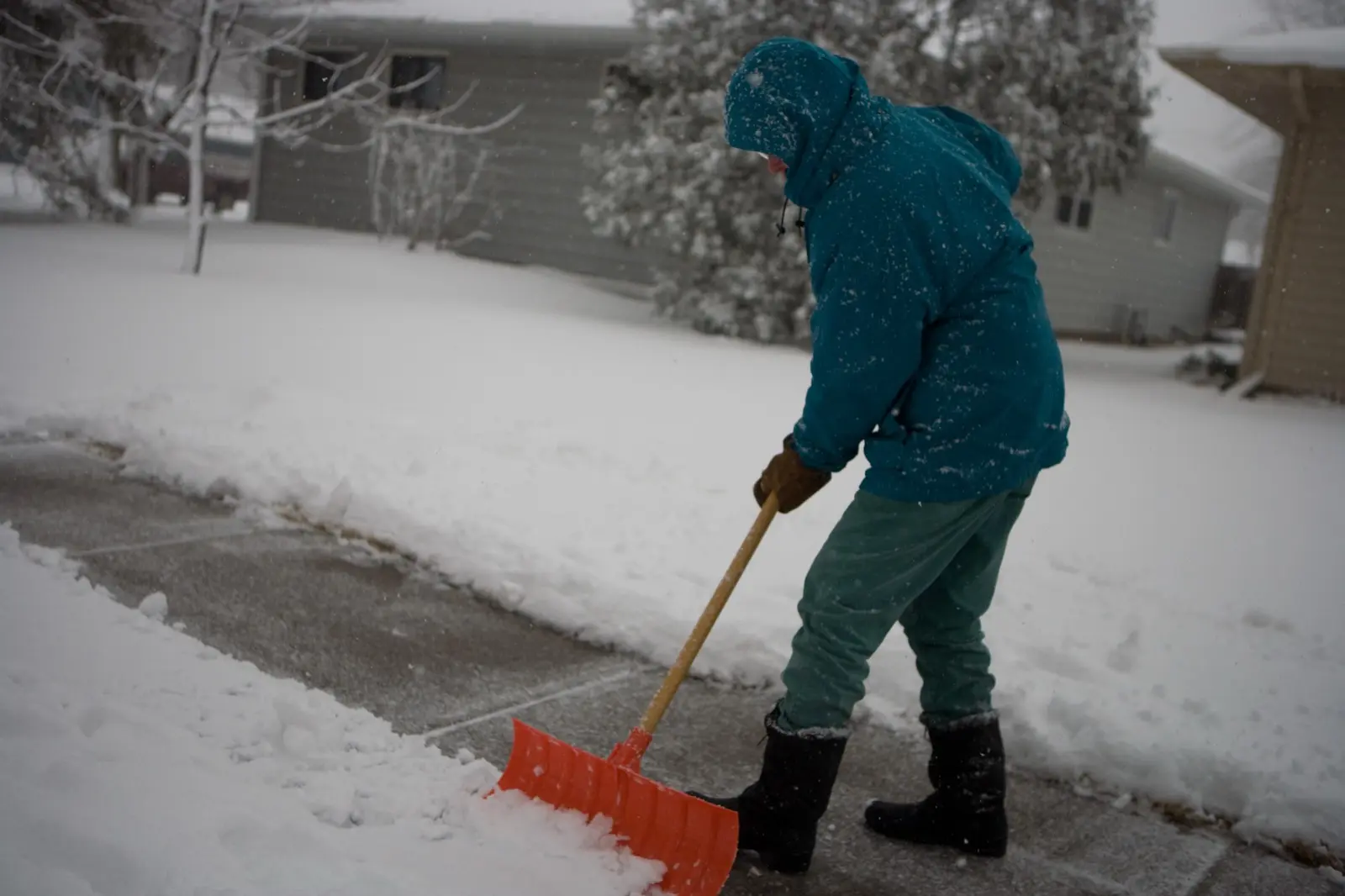
Cover image: A North Dakota resident shovels snow off his sidewalk. FEMA photo by Andrea Booher via Wikimedia Commons, public domain (U.S. government work).
Frequently asked questions
How do I prepare for a winter storm?
Insulate and weather-strip your home, protect pipes, and gather supplies for several days without power: flashlights, a battery radio, no-cook food, water, medicine, first aid, heating fuel and pet supplies. Keep a winter survival kit and a full tank of gas in the car.
What should be in a winter car emergency kit?
The NWS lists a phone and charger, blankets, flashlight, first-aid kit, knife, high-calorie food, extra clothing, a can and waterproof matches to melt snow, sand or cat litter, shovel, scraper, tool kit, tow rope, jumper cables, water, candle and matches, compass and road maps.
How far should a generator be from the house?
The CDC and ready.gov say at least 20 feet from windows, doors and vents, and only outdoors. Never run a generator inside a home, basement or garage.
How do I keep pipes from freezing during a winter storm?
The Red Cross recommends letting cold water drip from faucets served by exposed pipes, keeping the thermostat at the same temperature day and night, and never setting it below 55°F when you are away.
What should I do if my power goes out in a winter storm?
Keep the fridge and freezer closed, unplug electronics, never heat with a gas stove or oven, use a generator only outdoors, close off unused rooms and ask local officials about warming centers.
How long does food last in the fridge during a power outage?
Ready.gov says a closed refrigerator keeps food cold for about four hours and a full freezer for about 48 hours. Discard food that has been at 40°F or higher for two hours or more.
What do I do if I'm stuck in my car in a snowstorm?
Stay in the vehicle, run the engine about 10 minutes each hour with a window slightly open, clear snow from the exhaust pipe, and make the car visible with the dome light and a bright cloth.
How do I protect pets in a winter storm?
Bring pets inside or move animals to shelter, and make sure they have plenty of food, water and warmth. The NWS notes most animals that die in winter storms die from dehydration.
Sources
- Ready.gov – Winter Weather
- Ready.gov – Power Outages
- National Weather Service – Prepare! Don't let a winter storm take you by surprise
- National Weather Service – What to do if you're caught in a winter storm
- National Weather Service – Understanding Cold Weather Alerts
- CDC – Carbon Monoxide Poisoning Basics
- CDC – Prevent Carbon Monoxide Poisoning (natural disasters)
- CDC – Preventing Frostbite
- American Red Cross – Preventing and thawing frozen pipes
- Benefits.gov – Low Income Home Energy Assistance Program
Log in to comment
No comments yet. Be the first.