How Schools Decide Snow Days: Factors, Timeline and What Snow Day Odds Mean
- Superintendents usually decide, after staff drive the roads and check the NWS forecast; uncertain storms are decided around 4:30 a.m.
- Snow and ice between evening and early morning matter most; snow that starts after buses run rarely closes schools.
- Ice and extreme wind chill close schools even without much snow.
- Snow day calculators turn the forecast and local snow tolerance into odds; none knows what your district will decide.
- Some districts, including New York City since 2020, switch to remote learning instead of traditional snow days.
- Who decides whether school is closed?
- The factors behind a snow day
- The early-morning timeline
- How much snow does it take to close school?
- Ice and cold: the snow days without much snow
- How snow day calculators work
- How accurate are snow day calculators?
- Why some districts no longer have snow days
- Snow day odds this winter
This article is part of the 77.today Winter Weather Guide 2026–27, prepared by the 77.today editors from the sources listed at the end.
Every snowy evening, millions of students type "snow day calculator" into a search box. It is one of the most searched winter phrases in the United States, with an estimated 368,000 searches a month. But how do schools actually decide to close, and how do snow day calculators work? This part of our Winter Weather Guide 2026–27 explains the real factors superintendents weigh, the early-morning timeline, why ice and cold close more schools than people expect, how much snow it takes in different parts of the country, why some districts no longer have traditional snow days, and an honest look at what a snow day predictor can and cannot tell you, including the 77.today snow day calculator.
Who decides whether school is closed?
In most U.S. districts, the superintendent makes the call, usually after consulting transportation staff, facilities crews, local emergency management and the National Weather Service forecast. In a few places the decision sits elsewhere: in Washington, D.C., for example, the mayor decides for public schools and weighs temperature, wind chill, snow and ice, road conditions, the availability of public transportation and how the forecast will change through the day, according to WJLA's survey of Washington-area districts.
The same report shows how similar the process is across districts. Fairfax County Public Schools says it uses insights from emergency management agencies and the NWS. Montgomery County Public Schools in Maryland evaluates safety, the forecast and traffic, consults the NWS and county leaders, and tries to decide by 7 p.m. the night before or by 4:30 a.m. that morning. Prince George's County sends transportation supervisors to survey roads, driveways and sidewalks. Prince William County staff inspect roads, sidewalks, parking lots and bus lanes.
The factors behind a snow day
| Factor | What districts check | Why it matters |
|---|---|---|
| Overnight snow and ice | NWS forecast, especially the hours before buses roll | Snow that falls overnight is on the roads at 6 a.m.; snow that ends in the evening can be plowed |
| Road conditions | Staff drive bus routes, check driveways, sidewalks, parking lots | Back roads, hills and bridges ice first |
| Ice | Freezing rain and refreezing | A thin glaze is more dangerous for buses than several inches of snow |
| Temperature and wind chill | NWS wind chill forecast for bus stop times | Children wait outside; frostbite risk rises fast in extreme cold |
| Buses and staff | Can buses start and reach stops; can staff get to work | A district cannot open without drivers and teachers |
| Campus conditions | Cleared lots, walkways, heat and power at schools | Outages or unplowed lots can close one school or all |
| Timing of the forecast | Evening forecast vs. early-morning update | Uncertain storms push the decision to around 4:30 a.m. |
| Neighbors and county | Calls with county agencies, road crews and nearby districts | Shared roads and public transit |
| Calendar | Built-in snow days, remote-learning options, state rules | Some districts switch to remote learning instead of closing |
A Montgomery County spokesperson summed it up for WJLA: safety comes first, and "our ability to transport students, our staff's ability to get to work, and school campus conditions after a weather event are all factors," adding that conditions can vary significantly across a county, so one area may look clear while another is hazardous.
The early-morning timeline
When a storm is certain, many districts announce a closing the evening before so parents can plan. When it is uncertain, the decision waits for the latest overnight forecast and for staff who drive the roads before dawn. A typical uncertain-storm morning looks like this:
- Evening: the district reviews the NWS forecast and any winter storm watches or warnings; if confidence is high, it announces early.
- Around 3 to 4 a.m.: transportation and facilities staff check roads, bus lots and campuses. In cold districts, crews start bus engines early; one Minnesota district says its transportation team begins preparing buses as early as 4 a.m. so engines start and heaters work.
- By about 4:30 to 5:30 a.m.: the superintendent decides between opening on time, a delay (often two hours), early dismissal or a full closing. Fairfax County and Montgomery County both cite 4:30 a.m. as their morning deadline.
- Shortly after: the decision goes out by text, email, app, website and local media.
That timeline explains a common frustration: snow that starts at 9 a.m. rarely produces a snow day, because the decision was already made. It is also why districts sometimes dismiss early when a storm arrives during the school day.
How much snow does it take to close school?
"How many inches of snow for a snow day?" has no national answer, for the same reason the NWS has no national snowfall number for a winter storm warning: it depends on what an area is equipped for. A city with few plows and little salt can shut down for an inch or two or a glaze of ice, while districts in the snow belt routinely open with several inches on the ground because crews plow through the night.
Our own snow day calculator encodes this with three broad bands, which are 77.today's estimates rather than any official standard: in the South, about 1.5 inches of snow or a glaze of ice gives roughly an even chance of a closing; in a middle band from Virginia to Missouri, the Ohio Valley and the Pacific Northwest, about 4 inches; and in the snow belt from Minnesota to Maine, about 6.5 inches, or wind chills around −25°F. Mountain and rural districts with long bus routes often close earlier than city districts in the same state.
Ice and cold: the snow days without much snow
Ice is the most underrated cause of school closings. A thin layer of freezing rain makes roads more dangerous for buses than several inches of snow, which is why ice storms close schools across the South and Mid-Atlantic. Our part on freezing rain vs. sleet explains why.
Cold alone can close schools too. A Monticello, Minnesota, school district guide notes that a "snow day" can happen without a trace of snow in the air, because cold temperatures can be as hazardous as snow; its guidelines are based on how long it takes exposed skin to develop frostbite at a given wind chill on the NWS chart. Another Minnesota district, NRHEG, likewise bases cold-weather closings on the NWS wind chill forecast. Children wait at bus stops and walk to school in the coldest hours of the day, so districts watch NWS Extreme Cold Warnings and wind chill values closely. Criteria are local: what closes schools in Minneapolis is very different from what closes them in Atlanta.
No forecast tool can know what your superintendent will decide. A snow day calculator, like the 77.today calculator, is a translation of the weather forecast into odds, adjusted for how much snow your area is used to. The decision is made by people looking at roads, buses, staff and the forecast in the early morning. Treat a 50 percent chance as a coin toss and watch for the official announcement.
How snow day calculators work
The best known is SnowDayCalculator.com, created by David Sukhin. WBUR reported in 2015 that Sukhin began it as a "pet project" in sixth grade, launched the online tool as a 16-year-old high school junior, and was then a computer science and business student at MIT. Its algorithm uses the user's ZIP code, the type of school (public, private and so on) and other factors such as snow removal and the school's previous snow days. Ahead of the January 2015 blizzard, 305,000 people used it in one day. The site itself says its predictions improve as users report what actually happened at their schools.
Most snow day predictors follow the same basic recipe:
- Get the forecast for your location: snow, ice, temperature and wind for the night and early morning.
- Compare it with local tolerance: how much it usually takes to close schools in your region.
- Adjust for other signals: the type of school, the number of snow days already used, user reports or past closings.
- Convert the result into a percentage.
The 77.today calculator is transparent about its inputs. It reads the National Weather Service gridded forecast for your ZIP code, adds up snow and ice expected between 6 p.m. and 8 a.m., checks the coldest wind chill between 5 and 8 a.m., and compares those numbers with the regional bands described above. Ice counts more than snow: it treats about 0.15 inch of ice like a closing-level snowfall. The percentage is our estimate from the forecast and local snow tolerance; only your school district decides, and the tool is not affiliated with any school or district.
How accurate are snow day calculators?
Snow day calculators are only as accurate as two things: the weather forecast and the predictability of your district. Forecasts for the next night are usually much better than forecasts several days out, but the exact timing of a storm and the changeover between snow, sleet and freezing rain are hard. Districts also weigh things no forecast can see, such as which bus routes climb hills, whether road crews can finish by 6 a.m., whether a school lost power, and how many make-up days remain on the calendar.
Some tools advertise near-perfect accuracy. Treat that with caution: a claim like "100 percent accurate in many locations" cannot be checked from the outside, and a predictor that only reports a few schools' results can look better than it is. Use calculators as a fun, forecast-based guide, check again late in the evening and early in the morning, and trust only your district's official announcement.
Why some districts no longer have snow days
Remote learning changed the snow day. New York City public schools stopped having traditional snow days in 2020, according to Chalkbeat, because schools can offer virtual instruction and need to fit 180 days into a crowded calendar; in January 2026 the chancellor confirmed the city would pivot to remote learning if a winter storm hit. Other districts keep traditional snow days built into the calendar and add make-up days at the end of the year if they run out.
State rules vary. New York's education department, for example, says schools are not required to provide remote instruction on emergency closure days, but its rules give districts permanent flexibility to do so. Check your district's inclement weather page at the start of the season to learn whether a storm means a day off, a two-hour delay or a day of logging in from the kitchen table.
Snow day odds this winter
NOAA's official outlook for December 2026 through February 2027, released October 15, favors a warmer-than-average winter across the northern U.S. and a wetter South and East Coast because of a very strong El Niño. That does not translate into a snow day count: NOAA does not forecast seasonal snowfall, and a single cold storm in the South can close more schools than a mild month up north. Read the full winter forecast 2026–27 for details.
The night before a possible snow day, check the NWS forecast and alerts, try the snow day calculator for your ZIP code, and make sure your family's winter storm preparedness basics are covered in case the storm brings power outages instead of a fun day off. Return to the Winter Weather Guide hub for every part of the series.
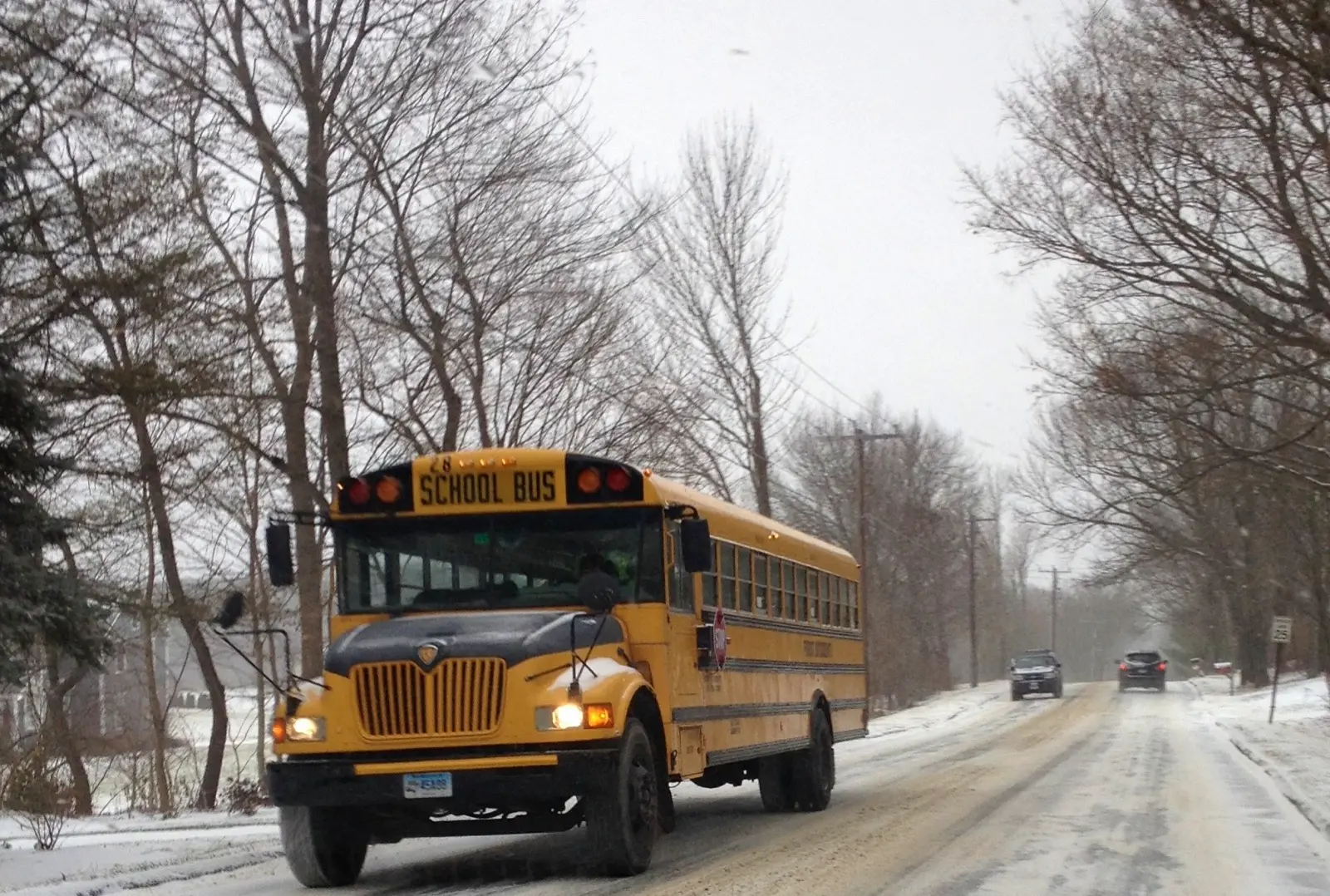
Cover image: A school bus on a snowy road. Photo by Coastline09 via Wikimedia Commons, CC BY-SA 4.0.
Frequently asked questions
How do schools decide snow days?
Usually the superintendent decides after staff check roads, bus lots and campuses and after reviewing the NWS forecast with county officials. Districts weigh overnight snow and ice, road conditions, wind chill at bus stop times, and whether buses and staff can get to school.
What time do schools decide on a snow day?
When a storm is certain, many districts announce the evening before. Otherwise the decision is usually made very early; Fairfax County and Montgomery County, for example, aim to decide by 4:30 a.m.
How many inches of snow for a snow day?
There is no national number. A city with few plows can close for an inch or two or a glaze of ice, while snow-belt districts often stay open with several inches. Ice and extreme cold can close schools with little snow.
How does the snow day calculator work?
Snow day calculators combine the weather forecast for your location with how much snow it typically takes to close schools there, sometimes adjusted for school type and past snow days, and turn that into a percentage.
How accurate is the snow day calculator?
Only as accurate as the overnight forecast and as predictable as your district. Districts weigh things a forecast cannot see, such as hilly bus routes and plowing progress, so treat the percentage as an estimate and wait for the official announcement.
Who made the Snow Day Calculator?
SnowDayCalculator.com was created by David Sukhin, who began the project in sixth grade and launched it online as a high school student; WBUR reported in 2015 that he was then studying at MIT.
Can schools close for cold weather without snow?
Yes. Many districts close or delay when wind chills make waiting for buses dangerous, using the NWS wind chill chart and frostbite times to set their guidelines.
Do NYC schools still have snow days?
No traditional snow days since 2020, according to Chalkbeat. New York City public schools pivot to remote learning when a major winter storm hits.
Sources
- WJLA – What influences school systems to close or delay start times? (Jan. 2026)
- Monticello Public Schools – Anatomy of a snow day
- NRHEG Schools – Weather closure guidelines
- WBUR – Now an MIT student, his Snow Day Calculator is still turning out predictions (2015)
- Snow Day Calculator
- Chalkbeat – NYC to pivot to remote learning if winter storm hits (Jan. 2026)
- New York State Education Department – Remote instruction in emergency conditions FAQ
- National Weather Service – Understanding Wind Chill
- National Weather Service – Understanding Cold Weather Alerts
- NOAA – El Nino looms large over U.S. Winter Outlook (Oct. 15, 2026)
Log in to comment
No comments yet. Be the first.