Orionid Meteor Shower 2026: Peak Night, Moonset Times, Where to Look
- The Orionid meteor shower peaks on the night of October 21–22, 2026, and is active from about October 2 to November 7.
- Expect about 10 to 20 meteors an hour under dark skies; the IMO lists a peak ZHR of about 20.
- A waxing gibbous Moon about 76% lit sets around 3 a.m. local time in the US and UK, leaving a dark window before dawn.
- The meteors appear to come from near Betelgeuse in Orion and can be seen from both hemispheres.
- Orionids are dust from Halley's Comet, enter the atmosphere at about 66 km/s, and Halley itself returns in 2061.

- Orionid meteor shower 2026 at a glance
- When to watch the Orionids in 2026: the Moon decides
- How many Orionid meteors will you see?
- Where to look: Orion and Betelgeuse
- Watching from the Northern and Southern Hemispheres
- How to watch the Orionids: a simple plan
- How to photograph the Orionid meteor shower
- Halley's Comet: where the Orionids come from
- Why Orionid meteors are so fast and bright
- What comes next in the night sky
The Orionid meteor shower reaches its 2026 peak on the night of Tuesday, October 21, into the morning of Wednesday, October 22, according to the American Meteor Society, NASA and the International Meteor Organization (IMO). Expect roughly 10 to 20 fast meteors an hour under dark skies, and plan to watch in the last dark hours before dawn, because a bright waxing gibbous Moon, about 76% lit, will wash out the sky for most of the night.
The Orionids are debris from Halley's Comet, they hit the upper atmosphere at about 66 kilometers (41 miles) per second, and they can be seen from almost anywhere on Earth. The shower is active from about October 2 to November 7, so the nights on either side of the peak are worth a look too. Below is when to go out where you live, how the Moon affects 2026, where to look, what to bring, and how to photograph the shower.
Orionid meteor shower 2026 at a glance
- Active period: October 2 to November 7, 2026 (AMS, IMO, NASA).
- Maximum: October 21, at solar longitude 208 degrees in the IMO's 2026 calendar. The Orionids have a broad, flat-topped peak, so activity is similar for a few nights either side.
- Best time to watch: after moonset and before the first light of dawn, roughly 3 a.m. to 5:30 a.m. local time in North America and the UK on the peak morning.
- Radiant: in the constellation Orion, just north of the bright reddish star Betelgeuse (right ascension 95 degrees, declination +16 degrees).
- Parent body: Comet 1P/Halley, last seen near the Sun in 1986 and due back in 2061.
When to watch the Orionids in 2026: the Moon decides
The single biggest factor this year is moonlight. The Moon reached first quarter on October 18 and will be full on October 26, so on the peak night it is a bright waxing gibbous that rises in the afternoon and stays up until the small hours. While it is above the horizon, it brightens the whole sky and hides the fainter meteors, which make up most of any shower. The American Meteor Society warns of significant interference while the Moon is up, though the brighter Orionids will still show through.
The good news is that the Moon sets several hours before sunrise. Once it drops below the western horizon, there is a window of genuinely dark sky just as the Orionid radiant climbs highest. That is the time to be outside. The table below shows moonset and the start of astronomical twilight (when the sky starts to brighten for dawn) on the peak morning, Wednesday, October 22, 2026. All times are local; the New York figures match timeanddate.com's moonset tables.
| City (local time) | Moonset, Oct 22 | Dawn twilight begins | Dark window |
|---|---|---|---|
| New York, Washington (EDT) | 3:12 a.m. | 5:43 a.m. | About 2.5 hours |
| Toronto (EDT) | 3:32 a.m. | 6:04 a.m. | About 2.5 hours |
| Chicago (CDT) | 3:08 a.m. | 5:37 a.m. | About 2.5 hours |
| Denver (MDT) | 3:22 a.m. | 5:47 a.m. | About 2.5 hours |
| Los Angeles (PDT) | 3:22 a.m. | 5:40 a.m. | About 2.3 hours |
| London (BST) | 2:49 a.m. | 5:44 a.m. | About 3 hours |
| Sydney (AEDT) | 3:38 a.m. | 4:37 a.m. | About 1 hour |
| Perth (AWST) | 3:00 a.m. | 4:03 a.m. | About 1 hour |
| Auckland (NZDT) | 4:05 a.m. | 4:55 a.m. | About 50 minutes |
Readers in the UK get the longest dark window of the major English-speaking regions, because the Moon sets earlier there and dawn is still late in October. Australians and New Zealanders, already on daylight saving time and with earlier spring sunrises, get a much shorter gap. South of the equator, the morning of Tuesday, October 21 is nearly as good, with moonset about 30 minutes earlier.
Night-by-night outlook
Because the Orionid maximum is broad, the choice of morning matters less than the Moon. Each night the Moon sets about an hour later and grows brighter, so the earlier mornings of the week actually give more dark time, while the later ones lose it almost entirely. Times below are for New York; most of the continental US is within a few minutes of these local times.
| Morning (2026) | Moon lit | Moonset (New York) | Dark time before dawn | Outlook |
|---|---|---|---|---|
| Mon, Oct 20 | About 70% | 1:02 a.m. | About 4.5 hours | Good: long dark window, rates building |
| Tue, Oct 21 | About 75% | 2:07 a.m. | About 3.5 hours | Very good: near-peak rates |
| Wed, Oct 22 | About 80% | 3:12 a.m. | About 2.5 hours | Best combination of peak rates and dark sky |
| Thu, Oct 23 | About 90% | 4:19 a.m. | About 1.5 hours | Fair: rates still decent, short window |
| Fri, Oct 24 | About 95% | 5:28 a.m. | Under 20 minutes | Poor: the Moon is up almost until dawn |
After the full Moon on October 26 the evenings start dark again, and from about October 30 onward the Moon rises late enough to leave the early part of the night free. Orionid rates by then are low, but the shower stays active into early November, alongside the slow, sometimes bright Taurid fireballs. For the full year's lineup, see our meteor shower calendar and the full moon calendar for 2026 and 2027.

How many Orionid meteors will you see?
Meteor rates are quoted as a zenithal hourly rate, or ZHR: the number of meteors one observer would see in an hour if the sky were perfectly dark and the radiant were directly overhead. The IMO lists the Orionid ZHR as 20 or more, and its analysis of recent years found average peak ZHRs in the range of about 20 to 30. NASA's guidance for observers is simpler: about 10 to 20 meteors an hour under dark skies.
Real conditions always lower the count. The radiant is never overhead for most observers, suburban light pollution hides the faintest meteors, and in 2026 the sky will still be brightening slightly from twilight by the end of the window. Under a reasonably dark rural sky after moonset, 10 to 15 meteors an hour is a realistic expectation. From a city backyard, it may be a handful.
Some years surprise. From 2006 to 2009 the Orionids produced unusually strong displays, with ZHRs of about 40 to 70 for two or more nights, which the American Meteor Society compares to the Perseids at 50 to 75 an hour. Nothing similar is forecast for 2026.
Where to look: Orion and Betelgeuse
All Orionid meteors appear to fly away from a single point in the sky, the radiant, which lies in the raised club of Orion the Hunter, just north of Betelgeuse, the red shoulder star of the constellation. The radiant rises in the east around 10 p.m. to 11 p.m. local time in October and is highest in the south (from northern latitudes) a little before dawn, which is exactly when the 2026 window opens.
You do not need to stare at the radiant. Meteors close to it look short because they are coming almost straight at you; the longest and most impressive streaks appear 45 to 90 degrees away from it. NASA suggests lying flat on your back with your feet pointing southeast in the Northern Hemisphere, or northeast in the Southern Hemisphere, and taking in as much sky as you can.
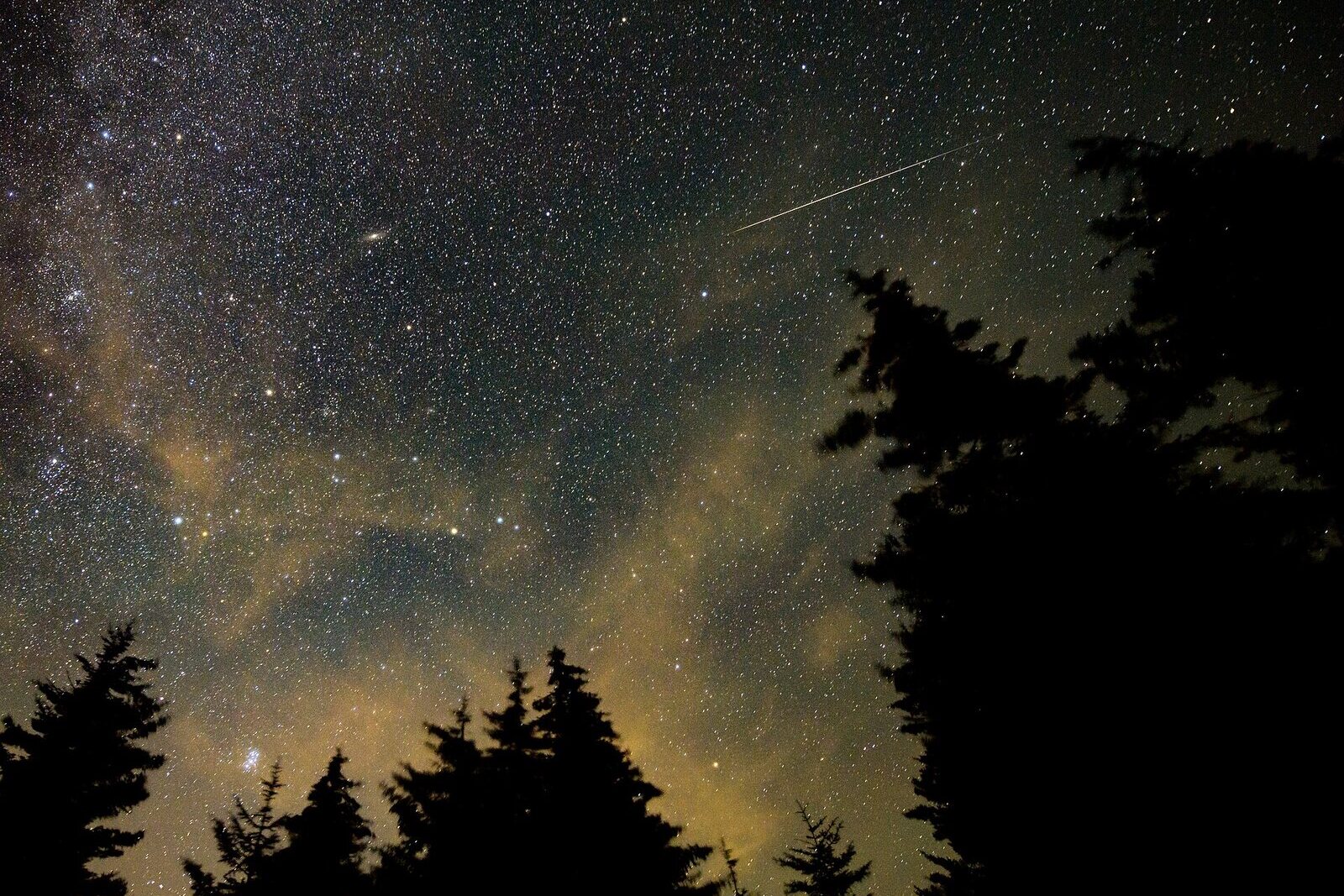
To tell an Orionid from a random, or sporadic, meteor, trace its path backward. If the line leads back to Orion, it is very likely an Orionid. The shower's meteors are fast and often leave a glowing trail, called a persistent train, that can linger for a second or two after the meteor itself is gone.
Watching from the Northern and Southern Hemispheres
The Orionid radiant sits just north of the celestial equator, so the shower is one of the few major meteor showers that work equally well from both hemispheres. NASA notes that it can be seen from both the Northern and Southern Hemispheres in the hours after midnight.
- United States and Canada: Orion climbs in the east after midnight and stands high in the southern sky before dawn. In 2026 the dark window opens around 3 a.m. local time on most of the continent.
- United Kingdom and Ireland: the Royal Observatory Greenwich puts the 2026 peak on the night of October 21, between midnight and dawn, with about 15 meteors an hour at best. Moonset before 3 a.m. BST gives UK observers a generous dark spell.
- Australia and New Zealand: Orion appears upside down compared with northern charts, with Betelgeuse below the three belt stars, and rises in the northeast. Rates can be just as good, but sunrise comes earlier, so the dark window after moonset is short. Go out promptly at moonset.
How to watch the Orionids: a simple plan
- Check the forecast. Clouds are the real enemy. Look at a cloud-cover forecast the evening before and be ready to switch mornings.
- Get away from lights. A park, field or beach away from streetlights makes a large difference. Even a backyard is better if you turn off porch lights and stand in a building's shadow.
- Set an alarm for moonset. Use the table above. Getting up for the last two to three hours before dawn is better than staying up late under the Moon.
- Dress for it. Pre-dawn hours in late October are cold in most of North America and the UK. Bring a blanket, sleeping bag or reclining chair, and a warm drink.
- Let your eyes adapt. NASA says it takes under 30 minutes in the dark for your eyes to adjust. Avoid looking at your phone; if you must, use a red-light mode or the lowest brightness.
- Be patient. Give it at least an hour. The show continues until the sky brightens.
Meteors are best seen with the naked eye. Binoculars and telescopes narrow your view to a tiny patch of sky and will make you miss nearly everything. The best equipment is a dark location, a comfortable place to lie back, and warm clothes.
How to photograph the Orionid meteor shower
Catching a meteor on camera is mostly a numbers game: you take hundreds of long exposures and keep the few frames that caught a streak. The same settings that work for the aurora work here, so if you have read our guide on how to photograph the northern lights, you already have most of the technique.
- Use a tripod and a wide lens. A focal length of about 14 to 24 mm on a full-frame camera (10 to 16 mm on a crop sensor) covers a big slice of sky, raising your odds.
- Open the aperture. f/1.8 to f/2.8 gathers the most light.
- Set exposure and ISO. Start at ISO 1600 to 3200 and 10 to 20 seconds. Keep exposures short enough that stars stay as points; a common rule of thumb is about 500 divided by your focal length in seconds on full frame.
- Focus manually on a bright star. Turn off autofocus, zoom in on the screen and adjust until a star is a sharp pinpoint, then tape the focus ring.
- Shoot continuously. Use an intervalometer or the camera's built-in interval timer to fire frame after frame for an hour or more.
- Aim smart. Point the camera about 45 degrees away from Orion, roughly halfway up the sky, where meteors are longest. Include a tree line or landscape for scale.
- Phones work too. Recent phones with a night mode on a small tripod can record bright meteors and fireballs, though fainter streaks are hard to catch.
After the session, scroll through the frames and look for a straight streak that does not match a star. Planes leave dotted lines with blinking lights, and satellites leave even, steady trails that cross several frames; a meteor appears in a single frame, often brighter in the middle.
Halley's Comet: where the Orionids come from
Every Orionid is a speck of dust shed by Comet 1P/Halley, the most famous comet of all. Each time Halley swings past the Sun, ice in its nucleus turns to gas and releases grains of rock and dust that spread along its orbit. Earth crosses that stream of debris twice a year: in early May, producing the Eta Aquarid meteor shower, and in October, producing the Orionids.
Halley's orbit takes about 76 years, though NASA notes the period has varied between about 74 and 79 years. Its nucleus measures about 15 by 8 kilometers (9.3 by 5 miles), according to NASA. The comet last passed closest to the Sun on February 9, 1986, when an international fleet of spacecraft, including the European Space Agency's Giotto, flew past it and photographed the nucleus for the first time. Its next return to the inner solar system is due in 2061.
The comet carries the name of English astronomer Edmond Halley, who in 1705 used Isaac Newton's theory of gravity to show that bright comets seen in 1531, 1607 and 1682 were one object on a repeating orbit. He predicted it would return in 1758. It did, after his death. Records of its appearances go back more than 2,000 years, including its depiction on the Bayeux Tapestry before the Battle of Hastings in 1066.
Halley is not the only comet that feeds a major shower. The August Perseids come from Comet Swift-Tuttle, a much larger object; read more in our story on Comet Swift-Tuttle, and for the bigger picture on what is out there, see the scariest things in space.
Why Orionid meteors are so fast and bright
Orionid particles meet Earth almost head-on. Halley orbits the Sun in the opposite direction to the planets, so the dust and Earth approach each other at a combined speed of about 66 kilometers per second, or 41 miles per second, by NASA's figure. Only the November Leonids are faster among the major showers. At that speed, a grain smaller than a grain of sand heats the air around it to incandescence about 100 kilometers up, producing a quick, bright streak.
Speed is why the Orionids are known for persistent trains: the glowing, ionized trail of gas a fast meteor leaves behind, which can drift for a few seconds. Occasionally the shower also produces fireballs, meteors brighter than the planet Venus. None of the debris reaches the ground.
What comes next in the night sky
After the Orionids, the next shows are the Taurids, with the Southern Taurids peaking around November 4 to 5 and the Northern Taurids around November 11 to 12, then the Leonids around November 16 to 17, according to the American Meteor Society. The year closes with the Geminids, usually the strongest shower of the year, peaking December 13 to 14. The full Hunter's Moon on October 26 will be the next bright Moon to plan around. For a single page covering meteors, Moon phases, eclipses and the aurora, bookmark our night sky guide.

Frequently asked questions
When is the Orionid meteor shower 2026 peak?
The Orionids peak on the night of Tuesday, October 21, into the morning of Wednesday, October 22, 2026, according to the American Meteor Society and NASA. The International Meteor Organization places the maximum on October 21. Because the peak is broad, the mornings of October 20, 21 and 22 all offer good rates, and the earlier mornings give more dark time before the Moon interferes.
What time should I watch the Orionids?
In 2026, watch after the Moon sets and before dawn twilight begins. On the peak morning of October 22 that is roughly 3:10 a.m. to 5:40 a.m. in New York, 3:20 a.m. to 5:40 a.m. in Los Angeles and 2:50 a.m. to 5:45 a.m. in London. In Sydney the window is shorter, about 3:40 a.m. to 4:35 a.m. local daylight time.
How many meteors per hour will the Orionids produce?
NASA says to expect about 10 to 20 meteors per hour under dark skies, and the International Meteor Organization lists a zenithal hourly rate of about 20. Real counts depend on how dark your sky is and how high Orion is. In exceptional years from 2006 to 2009, rates reached roughly 40 to 70 an hour, but no outburst is forecast for 2026.
Will the Moon ruin the 2026 Orionids?
It reduces the show but does not ruin it. A waxing gibbous Moon about 76% lit is up for most of the night and hides fainter meteors. However, it sets around 3 a.m. local time in most of the US and UK on the peak morning, leaving two to three hours of dark sky before dawn, exactly when the radiant is highest.
Where do I look to see the Orionid meteor shower?
The meteors appear to radiate from a point just north of Betelgeuse, the red star at Orion's shoulder, which rises in the east late in the evening and is high in the south before dawn. You do not need to look at that point. Meteors can appear anywhere, and the longest streaks are 45 to 90 degrees away from it.
Can you see the Orionids from the Southern Hemisphere?
Yes. The radiant lies just north of the celestial equator, so the Orionids are visible from both hemispheres. In Australia and New Zealand, Orion appears upside down and rises in the northeast. Rates can be good, but in 2026 the dark gap between moonset and dawn is only about an hour, so go out promptly once the Moon sets.
What comet causes the Orionid meteor shower?
The Orionids are debris from Comet 1P/Halley. Each pass near the Sun releases dust that spreads along the comet's orbit, and Earth crosses that stream in October and again in May, when it produces the Eta Aquarids. Halley takes about 76 years to orbit the Sun, last came closest in February 1986 and is due back in 2061.
How fast are Orionid meteors?
Orionid meteors hit the upper atmosphere at about 66 kilometers per second, or 41 miles per second, according to NASA. That makes them among the fastest of the major showers, second only to the Leonids. Their speed is why they often leave glowing persistent trains and occasionally produce bright fireballs.
Do I need a telescope to see the Orionids?
No. Meteors are best seen with the naked eye because they can appear anywhere across the sky. Telescopes and binoculars show only a tiny area and will make you miss most of them. Find a dark spot away from lights, lie back on a blanket or reclining chair, and give your eyes about 30 minutes to adapt.
What camera settings are best for photographing meteors?
Use a tripod, a wide-angle lens at its widest aperture (about f/1.8 to f/2.8), ISO 1600 to 3200 and exposures of 10 to 20 seconds. Focus manually on a bright star, then shoot continuously with an interval timer for an hour or more, aiming about 45 degrees away from Orion. Most frames will be empty; the few with meteors make it worthwhile.
Sources
- American Meteor Society: Meteor Shower Calendar 2026-2027
- International Meteor Organization: 2026 Meteor Shower Calendar (PDF)
- NASA Science: Orionids
- NASA Science: 1P/Halley
- Royal Museums Greenwich: Orionid meteor shower 2026, when and where to see it in the UK
- The Planetary Society: The Orionid meteor shower 2026, how to watch
- timeanddate.com: Moonrise, Moonset and Moon Phase in New York, October 2026
Read next
 SpaceMeteor Showers 2026–2027: Calendar, Peak Dates and When to Watch Tonight
 SpaceKp Index Explained: How to Read a Northern Lights Forecast, G-Scale and Aurora Map
 SpaceHow to Photograph the Northern Lights With a Phone or Camera (Settings Guide)
 SpaceWhere to See the Northern Lights in the US: Best States, Places and Times
Log in to comment
No comments yet. Be the first.