Full Moon Calendar 2026 and 2027: Dates, Times (ET), Names and Moon Phases
- Next full moon: Hunter's Moon, Monday, Oct. 26, 2026, at 12:12 a.m. EDT (full on the night of Oct. 25).
- 2026 has 13 full moons, including a Blue Moon on May 31.
- The Dec. 23, 2026, Cold Moon is the closest full moon of the year at 221,667 miles: a supermoon.
- The Jan. 22, 2027, Wolf Moon is also a supermoon under the 360,000 km definition.
- The Moon cycles through eight phases about every 29.5 days.
This article is part of the 77.today Night Sky Guide, prepared by the 77.today editors from the sources listed at the end.
The next full moon is the Hunter's Moon on Monday, October 26, 2026, at 12:12 a.m. EDT – which means it will look full on the night of Sunday, October 25. After that come the Beaver Moon on November 24 and the Cold Moon on December 23, the closest and largest full moon of 2026. This part of our Night Sky Guide explains the moon phases in plain language and gives the complete full moon calendar for 2026 and 2027 with exact dates and times in Eastern Time, the traditional full moon names, the new moons for dark-sky planning, and which full moons count as supermoons.
Moon phases explained
The Moon makes no light of its own. As NASA puts it, the Sun always illuminates half of the Moon while the other half stays dark; what changes during the month is how much of that sunlit half we can see from Earth as the Moon travels around its orbit. NASA lists eight phases, which repeat about every 29.5 days:
| Phase | What you see | Visible in the sky |
|---|---|---|
| New moon | Nothing: the lit side faces away from Earth | Up with the Sun during the day |
| Waxing crescent | A thin sliver, lit on the right (from the US) | Western sky after sunset |
| First quarter | Right half lit | Afternoon and evening, sets around midnight |
| Waxing gibbous | More than half, growing | Evening and most of the night |
| Full moon | The whole disk | Rises around sunset, sets around sunrise |
| Waning gibbous | More than half, shrinking | Rises after sunset, up into the morning |
| Third (last) quarter | Left half lit | Rises around midnight, visible in the morning |
| Waning crescent | A thin sliver, lit on the left | Eastern sky before dawn |
"Waxing" means growing and "waning" means shrinking; "crescent" is less than half lit and "gibbous" more than half. A useful mnemonic for the Northern Hemisphere: if the lit side is on the right, the Moon is waxing; on the left, it is waning. NASA also points out a nice paradox: at full moon we see the entire day side of the Moon, so technically the full moon is the real "half moon," while the first and last quarters show only a quarter of the Moon's surface lit.
Full moon calendar 2026
Times below are the instant of full moon from the US Naval Observatory converted to Eastern Time (EST or EDT as in effect). Names follow The Old Farmer's Almanac. A full moon looks full for about a day on either side, so the night before an early-morning full moon is usually the best night to look.
| Date (ET) | Time (ET) | Name | Notes |
|---|---|---|---|
| Sat, Jan 3 | 5:03 a.m. EST | Wolf Moon | |
| Sun, Feb 1 | 5:09 p.m. EST | Snow Moon | |
| Tue, Mar 3 | 6:38 a.m. EST | Worm Moon | Total lunar eclipse |
| Wed, Apr 1 | 10:12 p.m. EDT | Pink Moon | |
| Fri, May 1 | 1:23 p.m. EDT | Flower Moon | |
| Sun, May 31 | 4:45 a.m. EDT | Blue Moon | Second full moon in May; farthest full moon of 2026 |
| Mon, Jun 29 | 7:56 p.m. EDT | Strawberry Moon | |
| Wed, Jul 29 | 10:36 a.m. EDT | Buck Moon | |
| Fri, Aug 28 | 12:18 a.m. EDT | Sturgeon Moon | Deep partial lunar eclipse |
| Sat, Sep 26 | 12:49 p.m. EDT | Harvest Moon | Closest full moon to the Sept. 22 equinox |
| Mon, Oct 26 | 12:12 a.m. EDT | Hunter's Moon | Looks full on the night of Oct 25 |
| Tue, Nov 24 | 9:53 a.m. EST | Beaver Moon | Near-supermoon |
| Wed, Dec 23 | 8:28 p.m. EST | Cold Moon | Supermoon; closest full moon of 2026 |
2026 has 13 full moons because two of them fall in May, which makes the May 31 full moon a Blue Moon under the Almanac's calendar-month definition (the second full moon in a calendar month). The Almanac notes that Blue Moons happen about every 2½ years.
Full moon calendar 2027
| Date (ET) | Time (ET) | Name | Notes |
|---|---|---|---|
| Fri, Jan 22 | 7:17 a.m. EST | Wolf Moon | Supermoon |
| Sat, Feb 20 | 6:23 p.m. EST | Snow Moon | Penumbral lunar eclipse (Feb 20–21) |
| Mon, Mar 22 | 6:44 a.m. EDT | Worm Moon | |
| Tue, Apr 20 | 6:27 p.m. EDT | Pink Moon | Near the Lyrid meteor shower peak |
| Thu, May 20 | 6:59 a.m. EDT | Flower Moon | |
| Fri, Jun 18 | 8:44 p.m. EDT | Strawberry Moon | |
| Sun, Jul 18 | 11:45 a.m. EDT | Buck Moon | Farthest full moon of 2027 |
| Tue, Aug 17 | 3:29 a.m. EDT | Sturgeon Moon | Penumbral lunar eclipse (Aug 16–17) |
| Wed, Sep 15 | 7:03 p.m. EDT | Harvest Moon | Closest full moon to the Sept. 23 equinox |
| Fri, Oct 15 | 9:47 a.m. EDT | Hunter's Moon | |
| Sat, Nov 13 | 10:26 p.m. EST | Beaver Moon | |
| Mon, Dec 13 | 11:09 a.m. EST | Cold Moon |
For other US time zones, subtract one hour for Central, two for Mountain and three for Pacific Time (Alaska and Hawaii differ further). Near midnight that can change the date: the October 26, 2026, full moon at 12:12 a.m. EDT is 9:12 p.m. PDT on October 25.
Full moon names and what they mean
The Old Farmer's Almanac's names are the ones most US media use: Wolf (January), Snow (February), Worm (March), Pink (April), Flower (May), Strawberry (June), Buck (July), Sturgeon (August), Corn or Harvest (September), Hunter's (October), Beaver (November) and Cold (December). The Almanac explains that these come largely from Native American and other traditional names used to track the seasons, and that each name was typically applied to the whole lunar month rather than a single night.
Two names follow the seasons rather than the calendar. According to the Almanac's tradition, the Harvest Moon is always the full moon closest to the September equinox – most years in September, about every three years in October – and when it falls in October, the September full moon is called the Corn Moon. The Hunter's Moon is the full moon after the Harvest Moon. Using the Naval Observatory's equinox times (September 22, 2026, at 8:05 p.m. EDT and September 23, 2027, at 2:02 a.m. EDT), the Harvest Moon is September 26 in 2026 and September 15 in 2027.
The names are cultural labels, not astronomical events. A "Pink Moon" does not look pink and a "Blue Moon" is not blue; their color depends on how low they are and on haze or smoke in the air. A full moon low on the horizon often looks orange or reddish for that reason.
Supermoons in 2026 and 2027
The Moon's orbit is an ellipse, so its distance from Earth changes through the month. A "supermoon" is a full moon that happens near the closest point. The term has no official astronomical definition, and different sources use different cutoffs. Timeanddate.com uses one of the strictest: a full or new moon when the center of the Moon is less than 360,000 km (about 223,694 miles) from the center of Earth.
To check each full moon against that line, we queried NASA JPL's Horizons ephemeris for the Moon's center-to-center distance at the moment of every full moon:
| Full moon (ET) | Distance | Supermoon (under 360,000 km)? |
|---|---|---|
| Oct 26, 2026 (Hunter's) | 229,207 mi (368,872 km) | No |
| Nov 24, 2026 (Beaver) | 224,170 mi (360,766 km) | Just outside; some lists include it |
| Dec 23, 2026 (Cold) | 221,667 mi (356,738 km) | Yes – closest of 2026 |
| Jan 22, 2027 (Wolf) | 222,230 mi (357,644 km) | Yes |
| Feb 20, 2027 (Snow) | 225,747 mi (363,304 km) | No |
| Jul 18, 2027 (Buck) | 252,264 mi (405,979 km) | No – farthest of 2027 ("micromoon") |
For comparison, the Blue Moon of May 31, 2026, was the farthest full moon of the year at 252,360 miles (406,135 km). A supermoon appears slightly larger and brighter than a micromoon, but the difference is hard to notice without side-by-side photos. The "moon illusion" – the Moon looking huge near the horizon – has a much bigger effect on what you perceive.
New moons: the darkest nights of 2026 and 2027
For aurora watching, meteor showers and Milky Way photography, the new moon matters more than the full moon. These are the remaining new moons of 2026 and those of 2027, from the same USNO data, in Eastern Time:
| 2026 | 2027 |
|---|---|
| Nov 9, 2:02 a.m. EST | Jan 7, 3:24 p.m. EST; Feb 6, 10:56 a.m. EST |
| Dec 8, 7:52 p.m. EST | Mar 8, 4:29 a.m. EST; Apr 6, 7:51 p.m. EDT |
| May 6, 6:58 a.m. EDT; Jun 4, 3:40 p.m. EDT | |
| Jul 3, 11:02 p.m. EDT; Aug 2, 6:05 a.m. EDT | |
| Aug 31, 1:41 p.m. EDT; Sep 29, 10:36 p.m. EDT | |
| Oct 29, 9:36 a.m. EDT; Nov 27, 10:24 p.m. EST | |
| Dec 27, 3:12 p.m. EST |
The August 2, 2027, new moon is also the day of a total solar eclipse over Spain and North Africa – a solar eclipse can only happen at new moon, and a lunar eclipse only at full moon. Our eclipse guide covers what will be visible from the US.
Lunar eclipses at full moon
Two of 2026's full moons came with eclipses visible from North America. On March 3, 2026, the Moon passed fully into Earth's shadow in a total lunar eclipse, shown in NASA's visibility map. On the night of August 27–28, 2026, NASA's Scientific Visualization Studio describes a deep partial lunar eclipse with the Americas centrally located for observing it. The next eclipses at full moon in 2027 are both penumbral – February 20–21 and August 16–17 – when the Moon dims only subtly. The details are in our eclipse guide.
Is tonight a full moon? Using the moon to plan your nights
A quick way to answer "is tonight a full moon" is to check the tables above: if a full moon falls within about a day, the Moon will look full to the eye. For planning, think in terms of what you want to see:
To work out the moon phase today without an app, count the days since the last new moon in the tables above. Days 1 to 6 are a waxing crescent, about day 7 is first quarter, days 8 to 14 waxing gibbous, about day 15 full, days 16 to 21 waning gibbous, about day 22 last quarter and days 23 to 29 a waning crescent. The count is approximate because the Moon's orbital speed varies, but it is close enough to know whether tonight's sky will be bright or dark. For example, the new moon of October 10, 2026, puts October 16 at about day 6 – a waxing crescent that sets in the evening and leaves the rest of the night dark – and the full moon arrives on day 15 or 16, on October 26.
- Northern lights: the week around the new moon is best; a bright Moon dims faint aurora. Check the northern lights forecast and the moon percentage on our northern lights tonight page.
- Meteor showers: the AMS lists the Moon's illumination for each peak in our meteor shower calendar.
- Moonrise photos: the full moon rises around sunset, so it often comes up during the blue hour – see golden hour and blue hour.
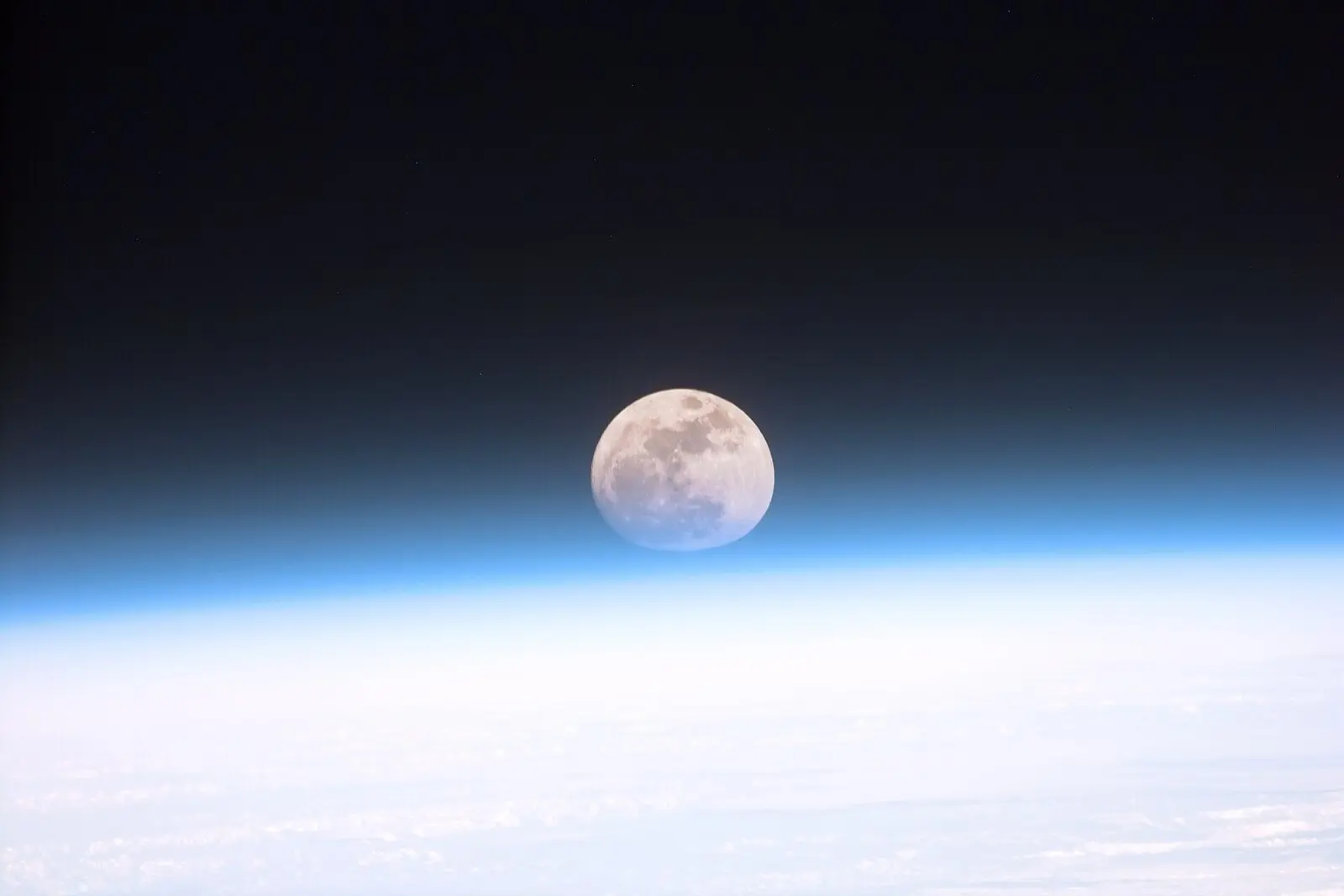
Cover photo: NASA, Wikimedia Commons (public domain).

Frequently asked questions
When is the next full moon?
The next full moon is the Hunter's Moon on Monday, October 26, 2026, at 12:12 a.m. EDT, according to US Naval Observatory data. It will look full on the night of Sunday, October 25.
When is the full moon in October 2026?
The October 2026 full moon, the Hunter's Moon, occurs on October 26 at 12:12 a.m. EDT (9:12 p.m. PDT on October 25).
How many full moons are there in 2026?
Thirteen. May 2026 has two full moons, on May 1 and May 31; the second is called a Blue Moon.
When is the next supermoon?
The Cold Moon on December 23, 2026, at 8:28 p.m. EST, at about 221,667 miles from Earth, is the closest full moon of 2026. The Wolf Moon on January 22, 2027, is also a supermoon under the 360,000 km definition.
What are the 8 phases of the Moon?
New moon, waxing crescent, first quarter, waxing gibbous, full moon, waning gibbous, third (last) quarter and waning crescent. The cycle repeats about every 29.5 days, according to NASA.
When is the next new moon?
The next new moon is November 9, 2026, at 2:02 a.m. EST, followed by December 8 at 7:52 p.m. EST.
What is the Harvest Moon in 2026 and 2027?
The Harvest Moon is the full moon closest to the September equinox. It was September 26, 2026, and will be September 15, 2027.
Is tonight a full moon?
Check the calendar above: the Moon looks full for about a day on either side of the exact time. In the coming weeks, the nights of October 25 and 26, November 23 and 24 and December 23, 2026, will look full.
Sources
- US Naval Observatory – Phases of the Moon (2026, 2027)
- US Naval Observatory – Earth's seasons: equinoxes and solstices
- NASA Science – Moon phases
- The Old Farmer's Almanac – Full moon names
- Timeanddate.com – What is a supermoon
- NASA JPL – Horizons ephemeris system (Moon distances)
- NASA SVS – March 3, 2026 total lunar eclipse visibility map
- NASA SVS – August 27–28, 2026 deep partial lunar eclipse
Log in to comment
No comments yet. Be the first.