Where to See the Northern Lights in the US: Best States, Places and Times
- Interior Alaska is the best US destination: Fairbanks' aurora season runs August 21 to April 21.
- In the lower 48, the northern tier from Washington to Maine sees aurora during G1–G2 storms (Kp 5–6).
- SWPC says the best viewing is usually 10 p.m. to 2 a.m., with more storms near the equinoxes.
- Dark skies and an open northern horizon matter more than a perfect forecast.
- Solar cycle 25's smoothed sunspot number peaked at 160.9 in October 2024 in SWPC data and is declining, but strong storms remain possible.
- The short answer: where the northern lights are most visible
- Alaska: Fairbanks and the interior
- The best states in the lower 48
- Dark skies: why city lights and the moon matter
- Best time of night and best time of year
- Solar cycle 25 in 2026: is it too late?
- Beyond the US: Canada, Iceland and Norway
- A northern lights night: practical checklist
This article is part of the 77.today Night Sky Guide, prepared by the 77.today editors from the sources listed at the end.
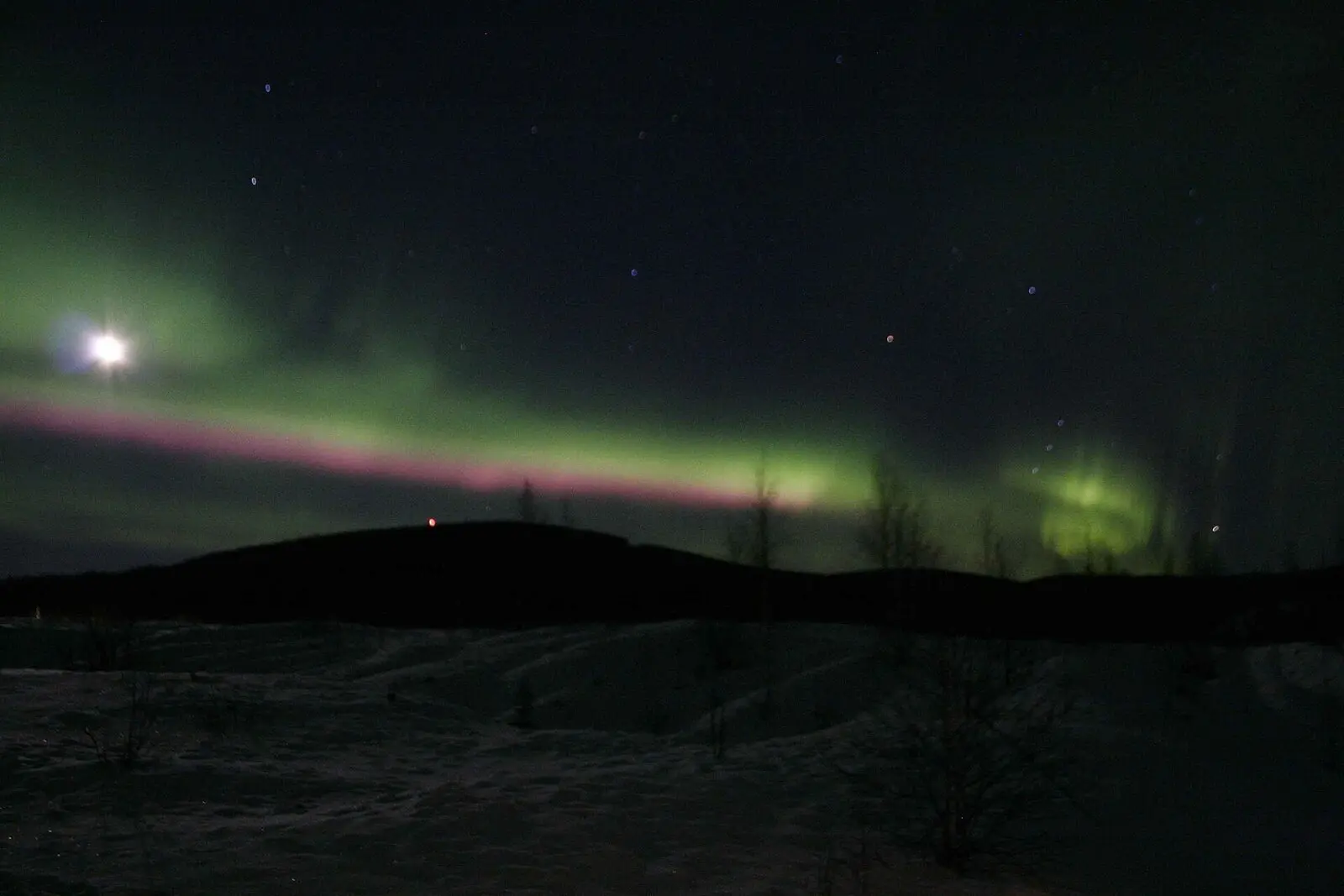
The best place to see the northern lights in the United States is Alaska – specifically the interior around Fairbanks, which sits under the auroral oval. But you do not have to fly north to have a chance. During geomagnetic storms the aurora regularly reaches the northern tier of the lower 48, from Washington and Montana across North Dakota, Minnesota and Michigan to Maine, and every few years a major storm pushes it far enough south that people in Pennsylvania, Illinois or even Texas see a red glow. This part of our Night Sky Guide covers where to go, what time of night and year to look, how dark the sky needs to be, and what the current state of solar cycle 25 means for your odds through 2027.
The short answer: where the northern lights are most visible
NOAA's Space Weather Prediction Center (SWPC) boils aurora viewing down to four factors in its tips on viewing the aurora: geomagnetic activity, location, darkness and timing. Location is the one you control most. The rule is simple – go toward the magnetic pole, which currently sits over the islands of northeastern Canada – and then find a spot with an open view to the north. That geometry is why North America is unusually well placed: at the same geographic latitude, the US and Canada are closer to the auroral oval than Europe or Asia.
| Region | How often | Activity needed | Best for |
|---|---|---|---|
| Interior Alaska (Fairbanks, Denali area, the Arctic) | Most clear, dark nights in season | Quiet to moderate (Kp 1–3) | A trip built around the aurora |
| Southern Alaska (Anchorage, Juneau) | Often, on active nights | Moderate (around Kp 2–4) | Combining aurora with a city stay |
| Northern tier of the lower 48 | Several times a year in active years | Minor to moderate storms (Kp 5–6, G1–G2) | Short drives on storm nights |
| Middle latitudes (New York, Pennsylvania, Illinois, Oregon) | A few times per solar cycle | Strong to severe storms (Kp 7–8, G3–G4) | Watching storm alerts |
| Southern states | Rarely | Extreme storms (Kp 9, G5) | Once-in-a-decade events |
Alaska: Fairbanks and the interior
If seeing the aurora is the goal of the trip, interior Alaska is the place. Explore Fairbanks, the city's visitor bureau, puts Fairbanks under the "auroral oval" and defines its aurora season as August 21 to April 21. It says the aurora is visible in Fairbanks on average four out of five nights when the sky is clear and dark enough, and that visitors who stay at least three nights and are out during the late evening raise their chance of seeing it to more than 90 percent.
The season dates are about darkness, not aurora activity. In summer the sun barely sets at Fairbanks' latitude, so the sky never gets dark enough. From late August the nights lengthen quickly, and the weeks around the September equinox combine long nights, milder temperatures and – as SWPC notes – a statistical tendency toward stronger geomagnetic storms near the equinoxes. March is the other sweet spot. Midwinter brings the longest nights but also temperatures that can make standing outside for hours a serious undertaking.
The University of Alaska Fairbanks Geophysical Institute publishes an aurora forecast tuned for Alaska, and our own Alaska aurora page shows tonight's outlook for Fairbanks, Anchorage and Juneau with cloud cover.
The best states in the lower 48
For the contiguous United States, the northern tier is where realistic chances start. NOAA's G-scale lists northern Michigan and Maine as places where the aurora is commonly visible during a G1 storm, and New York and Idaho during G2. In practice, anywhere along the Canadian border with dark skies and a low northern horizon is worth watching on storm nights.
| State | Where to look | Why it works |
|---|---|---|
| Minnesota | Voyageurs National Park, the North Shore of Lake Superior around Duluth | Far north, big lakes give open northern horizons; Voyageurs is a designated Dark Sky Park |
| Michigan | The Upper Peninsula (Marquette and the Lake Superior shore), northern Lower Peninsula | Lake Superior's shore faces north with no city glow |
| Montana | Rural northern Montana, mountain valleys away from towns | High latitude and very low population |
| North Dakota | Anywhere outside towns on the open plains | Flat horizon in every direction |
| Washington | The north Cascades and eastern Washington | Northerly latitude; drier skies east of the mountains |
| Maine | The north woods and the coast away from towns | Northern New England's darkest skies |
| Wisconsin | Northern Wisconsin and the Lake Superior shore | Needs a slightly stronger storm than Minnesota |
| Pennsylvania | Cherry Springs State Park | One of the darkest skies in the East; needs a strong storm |
The National Park Service says the aurora can appear in Voyageurs National Park any time of year, with better chances in winter because of the longer nights. It recommends an open view to the north and suggests the Ash River Visitor Center grounds, the Meadwood Road Day Use Area and the upper parking lot of the Rainy Lake Visitor Center. In Pennsylvania, the Department of Conservation and Natural Resources declared Cherry Springs State Park its first Dark Sky Park in 2000; it sits far enough south that it needs a strong storm, but when one comes, its dark northern horizon makes it a favorite.
You can check tonight's chances state by state on our pages for Minnesota, Michigan, Montana, North Dakota, Washington and Maine.
Dark skies: why city lights and the moon matter
At mid-latitudes the aurora is usually a faint glow low on the northern horizon, so the darkness of your sky decides whether you see anything. SWPC's advice is to go out at night, get away from city lights, and remember that a full moon diminishes the apparent brightness of the aurora (though not its actual brightness). The National Park Service's Natural Sounds and Night Skies Division measures sky quality with tools such as the Bortle scale, which runs from Class 1, a pristine sky, to Class 9, a severely light-polluted sky where only the brightest dozen or so stars are visible. The NPS notes that only a few areas in the lower 48 have Class 1 or 2 skies; many western national parks are Class 3 or 4, and Class 5 and higher skies are typical around big metro areas.
You do not need a perfect sky. A 30- to 60-minute drive that puts a city's glow behind you and gives you a clear view north – a lakeshore, a field, a hilltop – usually makes the difference. Check the moon before you go: the full moon calendar lists the dates, and the week around a new moon is best.
Do not trespass, park on highway shoulders or walk onto frozen lakes in the dark to get a view. In winter, northern states can drop well below zero at night; dress for standing still for hours, carry a charged phone, and tell someone where you are going.
Best time of night and best time of year
SWPC says the best aurora is usually within an hour or two of local midnight, roughly 10 p.m. to 2 a.m., and that the window widens toward evening and morning as geomagnetic activity increases. During the strongest storms people have seen the aurora begin at nightfall. For the season, SWPC points to the spring and fall equinoxes as a time when larger storms are more common – with the caveat that the number of dark hours shrinks rapidly after the spring equinox and grows rapidly after the fall one.
| Season | Northern tier of the lower 48 | Interior Alaska |
|---|---|---|
| September–October | Good: long-enough nights, equinox storms, mild weather | Excellent: season opens, lakes not yet frozen for reflections |
| November–February | Good: longest nights, but more clouds and cold | Excellent darkness; extreme cold possible |
| March–April | Good: equinox storms, nights shortening | Excellent until mid-April |
| May–August | Possible during storms, short nights | Too light to see the aurora |
The best place to see northern lights in November is still Alaska. In the lower 48, November nights are long, but late-fall storm systems often bring extended cloud cover, so watch the cloud forecast as closely as the Kp forecast and be ready to drive toward a clear gap.
Solar cycle 25 in 2026: is it too late?
Aurora activity follows the Sun's roughly 11-year cycle of sunspots and eruptions. On October 15, 2024, NASA, NOAA and the international Solar Cycle Prediction Panel announced that the Sun had reached its solar maximum period, adding that the exact month of the peak can only be identified after a consistent decline. They expected the maximum phase to last another year or so before the Sun entered the declining phase.
SWPC's solar cycle progression data show what has happened since. The 13-month smoothed sunspot number – the standard yardstick – reached 160.9 in October 2024, the highest value of cycle 25 in the record so far, and has fallen since, to 94.4 for March 2026, the latest smoothed value available. Monthly sunspot numbers through September 2026 (preliminary) have been lower still. In other words, cycle 25 is in its declining phase, but nobody can yet stamp an official date on the peak.
| Month | Monthly sunspot number | Smoothed sunspot number |
|---|---|---|
| October 2024 | 165.8 | 160.9 (highest so far) |
| October 2025 | 114.8 | 108.5 |
| March 2026 | 86.6 | 94.4 |
| September 2026 | 60.3 (preliminary) | not yet available |
That does not mean the aurora is finished. NASA's announcement noted that scientists often see fairly significant storms during the declining phase of a solar cycle. SWPC says solar cycle 26 is expected to begin sometime between January 2029 and December 2032. For the next couple of winters, expect fewer big storms than in 2024, but still regular G1 and G2 nights for the northern states – and keep an eye on alerts, because the largest storms do not politely follow the sunspot curve.
Beyond the US: Canada, Iceland and Norway
People searching "what country is the northern lights in" are usually comparing trips. The aurora belongs to no single country; it appears wherever the auroral oval passes overhead. In North America that includes northern Canada – Yellowknife in the Northwest Territories sits close to the oval – and in Europe, Iceland and northern Norway around Tromsø. These destinations have the same rules as Alaska: dark months only, clear skies needed, and the best odds around midnight. Our tonight page tracks Yellowknife, Reykjavík and Tromsø next to the US cities.
A northern lights night: practical checklist
- Afternoon: read the forecast – a Kp of 5 or more (G1+) in the 3-day forecast is the signal for the northern tier. Our guide to the northern lights forecast explains how.
- Before dark: pick a spot with an open northern horizon, away from lights, that you can reach legally and safely.
- Weather: check cloud cover for the hours after dark; a clear gap matters more than the Kp number.
- Gear: warm layers, a hat and gloves, a chair, a headlamp with a red setting, a phone tripod and a spare battery kept in an inside pocket.
- On site: let your eyes adapt for 15–20 minutes, look low to the north, and take a test photo – cameras often show green or red before your eyes do. See how to photograph the northern lights for settings.
- Be patient: activity comes in surges; a quiet hour can end in a sudden display.
Nights that bring no aurora can still bring a meteor shower – the Orionids, Leonids and Geminids all peak in the aurora season.
Cover photo: Primmer, Rich and Rose, U.S. Fish and Wildlife Service, Wikimedia Commons (public domain).

Frequently asked questions
Where is the best place to see the northern lights in the USA?
Interior Alaska around Fairbanks. Explore Fairbanks says the aurora is visible there on average four out of five clear, dark nights during its August 21 to April 21 season.
Can you see the northern lights in the lower 48 states?
Yes. During minor to moderate geomagnetic storms (Kp 5 to 6) the aurora is often visible from the northern tier, including Washington, Montana, North Dakota, Minnesota, northern Michigan and Maine. Stronger storms push it much further south.
Where can we see the northern lights tonight?
It depends on tonight's Kp forecast and clouds. Our northern lights tonight page lists US cities where the aurora is likely or possible tonight based on NOAA's Kp forecast and hourly cloud cover.
What month is best to see the northern lights?
In Alaska, September to March, when nights are long and dark. NOAA notes that larger geomagnetic storms are somewhat more common near the spring and fall equinoxes, which makes September, October and March especially good.
What time of night are the northern lights most visible?
NOAA's Space Weather Prediction Center says the best aurora is usually within an hour or two of midnight, between about 10 p.m. and 2 a.m. local time.
Is solar maximum over in 2026?
NASA and NOAA announced in October 2024 that the Sun had reached its maximum period. SWPC's smoothed sunspot number peaked at 160.9 in October 2024 in the data so far and has declined since, but significant storms can still occur during the declining phase.
Does a full moon ruin the northern lights?
It does not stop the aurora, but NOAA notes that a full moon diminishes its apparent brightness. Faint displays at mid-latitudes are much easier to see around the new moon.
Where are the northern lights most visible in the world?
Under the auroral oval: interior Alaska, northern Canada, Iceland, northern Scandinavia and parts of Greenland and Russia. Because the magnetic pole is over northeastern Canada, North America sees aurora at lower latitudes than Europe.
Sources
- NOAA SWPC – Tips on viewing the aurora
- NOAA SWPC – NOAA Space Weather Scales
- NOAA SWPC – Solar cycle progression
- NASA – NASA, NOAA: Sun reaches maximum phase in 11-year solar cycle
- Explore Fairbanks – Aurora season
- University of Alaska Fairbanks Geophysical Institute – Aurora forecast
- National Park Service – Northern lights, Voyageurs National Park
- National Park Service – Dark Sky Park designation, Voyageurs
- Pennsylvania DCNR – Cherry Springs State Park
- National Park Service – Natural Sounds and Night Skies
Log in to comment
No comments yet. Be the first.