Meteor Showers 2026–2027: Calendar, Peak Dates and When to Watch Tonight
- Next peaks: Orionids Oct 21–22, Leonids Nov 16–17 and Geminids Dec 13–14, 2026.
- The Geminids (ZHR 150) are the best bet, with only a 17% crescent Moon on peak night.
- The Quadrantids peak near 10:30 p.m. EST on Jan 3, 2027, under a thin crescent Moon.
- Most showers are best between midnight and dawn; look about halfway up the sky, away from the Moon.
- No telescope needed: give your eyes 20–30 minutes in the dark and avoid phone screens.
- Meteor shower calendar 2026–2027
- The best showers to watch in the next 12 months
- Meteor shower tonight: what time should you look?
- Meteor shower tonight: where to look
- How to watch a meteor shower: step by step
- Meteors, meteoroids, meteorites and fireballs
- Leonid storms and other surprises
- Meteor showers month by month
- The 2026 showers you may have missed
This article is part of the 77.today Night Sky Guide, prepared by the 77.today editors from the sources listed at the end.
A good meteor shower is the easiest sky show there is: no telescope, no forecast model, no special camera – just a dark place, a reclining chair and an hour of patience. The catch is timing. Each shower peaks on a particular night, and the Moon can wash out all but the brightest meteors. This part of our Night Sky Guide lists every major meteor shower from October 2026 through the Perseids of August 2027, with peak nights, active periods, expected rates and how bright the Moon will be, and then explains what time to watch and where to look tonight.
Meteor shower calendar 2026–2027
The dates below come from the American Meteor Society's 2026/2027 meteor shower calendar, which gives the peak night, the active period and the Moon's illumination on peak night. The zenithal hourly rate (ZHR) comes from the International Meteor Organization's 2026 Meteor Shower Calendar. ZHR is a calculated maximum: the number of meteors an ideal observer would see in an hour under a perfectly clear, very dark sky with the shower's radiant directly overhead. Real counts are almost always lower.
| Shower | Peak night | Active | ZHR (IMO) | Moon on peak night (AMS) |
|---|---|---|---|---|
| Orionids | Oct 21–22, 2026 | Oct 2 – Nov 7 | 20 | 76%, waxing gibbous |
| Southern Taurids | Nov 4–5, 2026 | Sep 20 – Nov 20 | 7 | 22%, waning crescent |
| Northern Taurids | Nov 11–12, 2026 | Oct 20 – Dec 10 | 5 | 5%, waxing crescent |
| Leonids | Nov 16–17, 2026 | Nov 6–30 | 15 | 41%, first quarter |
| Geminids | Dec 13–14, 2026 | Dec 4–17 | 150 | 17%, waxing crescent |
| Ursids | Dec 21–22, 2026 | Dec 17–26 | 10 | 91%, waxing gibbous |
| Quadrantids | Jan 3–4, 2027 | Dec 28, 2026 – Jan 12, 2027 | 80 | 16%, waning crescent |
| Lyrids | Apr 21–22, 2027 | Apr 14–30 | 18 | 99%, full |
| Eta Aquariids | May 5–6, 2027 | Apr 19 – May 28 | 50 | 1%, waning crescent |
| Southern Delta Aquariids | Jul 30–31, 2027 | Jul 12 – Aug 23 | 25 | 12%, waning crescent |
| Alpha Capricornids | Jul 30–31, 2027 | Jul 3 – Aug 15 | 5 | 12%, waning crescent |
| Perseids | Aug 12–13, 2027 | Jul 17 – Aug 24 | 100 | 81%, waxing gibbous |
The ZHR values are IMO's figures based on recent returns, listed in its 2026 calendar; individual years vary, and the 2027 rates will be confirmed in IMO's next calendar. The Eta Aquariid ZHR applies best to the southern tropics: from the US, the AMS expects only 10–30 meteors per hour just before dawn.
The best showers to watch in the next 12 months
Geminids, December 13–14, 2026. The AMS calls the Geminids usually the strongest meteor shower of the year, and 2026 is a good year for them: the Moon is only a 17% crescent on peak night and sets in the evening. The Geminids are also the one major shower that is active before midnight, because the constellation Gemini is well placed from about 10 p.m. local time. IMO places the maximum around 14:00 UT on December 14 (9 a.m. EST), with a broad peak that produces high rates over roughly 10–12 hours, so both the night of December 13–14 and, to a lesser extent, December 14–15 are worth watching. Geminids are often bright and intensely colored.
Quadrantids, January 3–4, 2027. The Quadrantids can rival the Geminids, but their peak lasts only about six hours, and early January weather is often poor. The AMS says predictions for 2027 put the peak near 3:30 UT on January 4 – 10:30 p.m. EST on January 3 – a timing that favors Europe and western Asia, while North Americans see the shower rising in the hours after the peak. The Moon is a thin 16% crescent that will not interfere. Expect around 25 meteors per hour under dark skies, the AMS says.
Perseids, August 12–13, 2027. The most popular shower of the year peaks on warm summer nights, with 30–50 meteors per hour from rural locations at maximum, according to the AMS. In 2027 an 81% waxing gibbous Moon will be up for the first part of the night; the best rates come after it sets, before dawn.
Orionids, October 21–22, 2026. In a normal year the Orionids produce 10–20 meteors per hour at maximum, and the AMS notes that recent displays have produced low to average activity. This year a 76% Moon will brighten the sky for much of the night, so the hours before dawn, after moonset, are best.
Meteor shower tonight: what time should you look?
The AMS's short answer is that most meteor showers are best observed between midnight and dawn. After midnight your side of Earth faces forward in its orbit, and the radiants of most showers climb higher in the sky, so more meteors reach your part of the atmosphere. The Geminids are the main exception, with good activity from mid-evening.
| Shower | Radiant near | Best local time |
|---|---|---|
| Orionids | Orion's raised club | After midnight until dawn |
| Taurids | Taurus | Late evening to early morning |
| Leonids | The "sickle" of Leo | After midnight until dawn |
| Geminids | Castor in Gemini | From about 10 p.m. through the night |
| Quadrantids | Northern Boötes, near the Big Dipper's handle | Pre-dawn hours |
| Lyrids | Near Vega in Lyra | After about 10:30 p.m., best before dawn |
| Eta Aquariids | Aquarius | The hour or two before dawn |
| Perseids | Perseus | After midnight, best before dawn |
Moonlight matters as much as the clock. When the AMS calendar shows a bright Moon on peak night, look for the hours when the Moon is below the horizon – usually before moonrise for a waning Moon or after moonset for a waxing one. Our moon phases and full moon calendar shows the phase for any night.
Meteor shower tonight: where to look
You do not need to stare at the radiant – the point in the sky the meteors appear to come from. The AMS recommends looking toward a dark, clear part of the sky roughly halfway between the horizon and directly overhead, away from nearby lights and, when possible, away from the Moon. Meteors close to the radiant tend to have short trails, while those farther away trace longer paths, so a patch of sky 40 or 50 degrees away from the radiant often gives the most striking meteors.
Leave the binoculars and telescope at home. As the AMS points out, they restrict your field of view and make it harder to catch meteors appearing anywhere across the sky. The best "equipment" is a reclining lawn chair or a sleeping pad, warm clothes and a blanket.
Give your eyes at least 20–30 minutes in the dark before you judge a shower, the AMS advises, and avoid bright lights and phone screens. If you need a light, use a dim red one sparingly. Ten minutes of scrolling on your phone will reset your night vision.
How to watch a meteor shower: step by step
- Check the date and the Moon. Pick the peak night or the night before or after, and note when the Moon rises or sets.
- Check the clouds. A clear gap of two hours is worth more than a perfect peak under overcast.
- Get away from lights. A rural park or field with a wide view of the sky can double or triple what you see compared with a suburban backyard. See where to see the northern lights for dark-sky places that work for meteors too.
- Dress for the cold. You will be still for an hour or more; December and January nights in the northern states are often far below freezing.
- Lie back and wait. Meteors come in clusters and lulls. Give it at least an hour.
- Count or photograph. Counting meteors keeps you alert; a camera on a tripod with 15–30 second exposures can catch bright ones – the same setup as in how to photograph the northern lights.
Meteors, meteoroids, meteorites and fireballs
The names get mixed up constantly. The AMS defines them this way: a meteoroid is a small natural object in space, often a fragment of a comet or asteroid; a meteor is the streak of light produced when a meteoroid enters the atmosphere (a "shooting star," though no star is involved); and a meteorite is material that survives the trip and reaches the ground. Most particles in meteor showers do not survive. Many visible meteors are produced by particles ranging from the size of a grain of sand to a small pebble. A fireball is simply a very bright meteor; the Taurids of late October and November are known for producing them.
| Shower | Parent body |
|---|---|
| Perseids | Comet 109P/Swift-Tuttle |
| Leonids | Comet 55P/Tempel-Tuttle |
| Ursids | Comet 8P/Tuttle |
| Lyrids | Comet C/1861 G1 (Thatcher) |
Leonid storms and other surprises
Showers occasionally outperform their averages. The Leonids are famous for meteor storms in 1833, 1866, 1966, 1999, 2001 and 2002, when Earth passed through dense trails of debris from comet 55P/Tempel-Tuttle. The AMS says Earth does not appear to encounter any dense clouds of Leonid debris until 2099, though returns of the comet in 2031 and 2064 may bring good displays with rates above 100 per hour. For 2026, IMO's calendar lists model calculations by Jérémie Vaubaillon and Mikiya Sato showing encounters with several low-density trails on November 17–19, which are expected to produce at most modest activity. The Ursids, usually 5–10 per hour, have had occasional outbursts above 25 per hour, and the Lyrids once produced a short-lived ZHR of 90, in 1982.
Meteor showers month by month
People often search for a shower in a specific month, such as "meteor shower June" or "meteor shower March." Here is what the calendars show for a typical year:
- January: Quadrantids (early January).
- February and March: no major shower; IMO lists only weak sources such as the Antihelion Source, with rates of about 2 to 3 per hour.
- April: Lyrids (around April 22).
- May: Eta Aquariids (early May), best before dawn.
- June: no major night-time shower. IMO lists the June Bootids, which are variable and usually weak, around June 22, and daytime showers such as the Arietids that are detected mainly by radio.
- July: Southern Delta Aquariids and Alpha Capricornids (late July), plus the start of the Perseids.
- August: Perseids (August 12–13).
- September: the minor September epsilon-Perseids and the start of the Southern Taurids.
- October: Draconids (around October 8–9) and Orionids (around October 21).
- November: Taurids (early to mid-November) and Leonids (mid-November).
- December: Geminids (December 13–14) and Ursids (around December 22).
The 2026 showers you may have missed
For the record, 2026 was kind to two of the big three. IMO's 2026 calendar notes that the Perseids peaked on August 13 with a New Moon on August 12, giving moon-free skies, and the Geminids in December also fall near a moon-free sky. The Quadrantids of January 3, 2026, on the other hand, peaked at Full Moon. If you missed the Perseids, the next good opportunity for a dark, high-rate shower is the Geminids on December 13–14, 2026.
Meteor showers are only one part of the night sky calendar. For the aurora, start with the northern lights forecast; for the Moon, see the full moon calendar; and for eclipses visible from the US, see our eclipse guide.
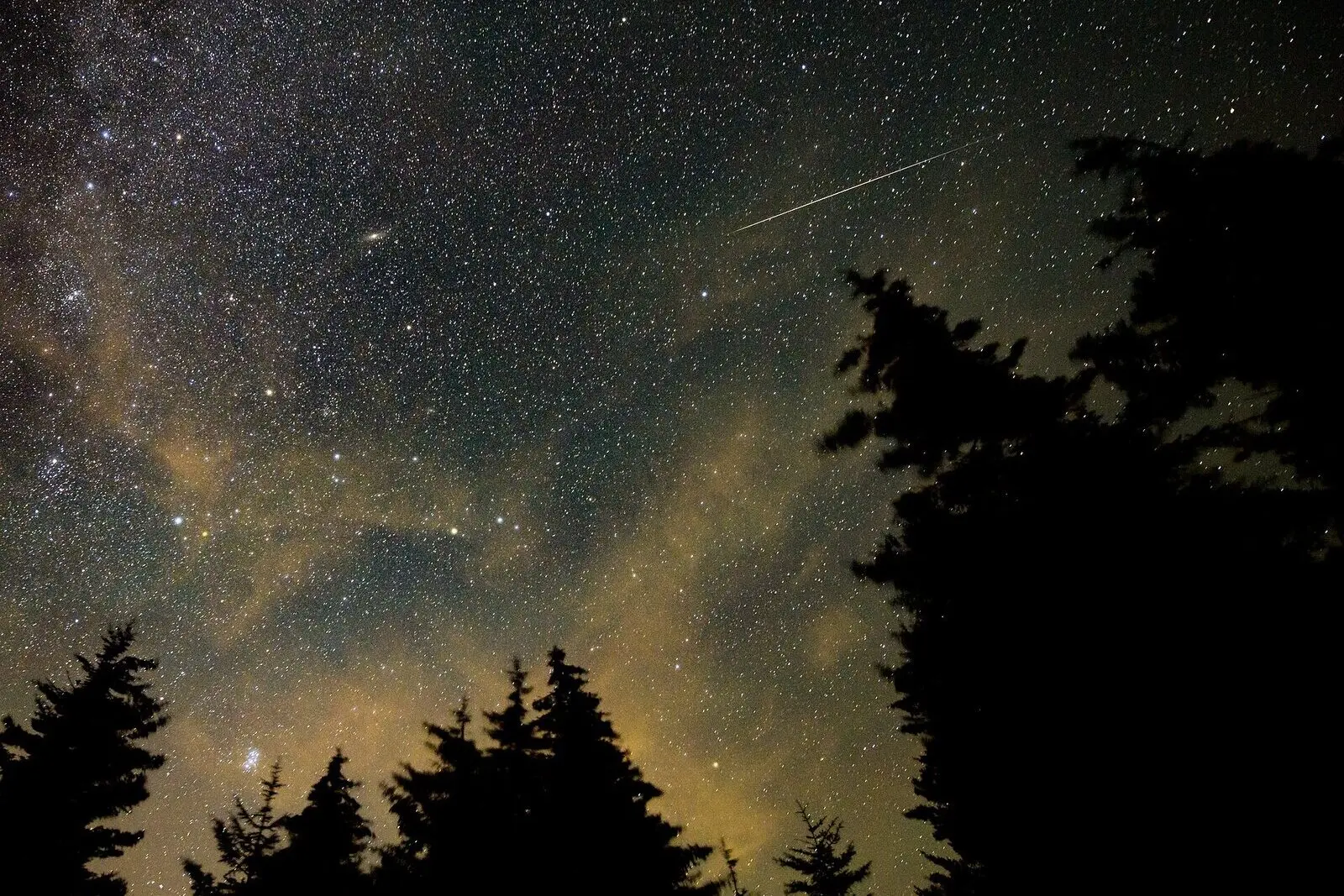
Cover photo: Bill Ingalls, Wikimedia Commons (public domain).
.jpg)
Frequently asked questions
When is the next meteor shower?
The Orionids peak on the night of October 21–22, 2026, followed by the Southern Taurids (Nov 4–5), Northern Taurids (Nov 11–12), Leonids (Nov 16–17) and Geminids (Dec 13–14), according to the American Meteor Society.
What time is the meteor shower tonight?
Most showers are best between midnight and dawn, when their radiants are high. The Geminids are the main exception, with good rates from about 10 p.m. local time.
Where should I look for a meteor shower tonight?
Look at a dark, clear part of the sky about halfway between the horizon and overhead, away from lights and the Moon. You do not need to look straight at the radiant; meteors farther from it have longer trails.
What is the best meteor shower of the year?
The Geminids in December are usually the strongest, with an IMO zenithal hourly rate of 150. The Perseids in August (ZHR 100) are the most popular because they peak on warm summer nights.
How many meteors will I see per hour?
Fewer than the ZHR. ZHR assumes a perfectly dark sky with the radiant overhead. The AMS says rural observers typically see 30–50 Perseids per hour at maximum, and about 25 Quadrantids per hour under dark skies.
Does the Moon affect meteor showers?
Yes. Moonlight hides fainter meteors. The AMS calendar shows a 91% Moon for the 2026 Ursids and a nearly full Moon for the 2027 Lyrids, but only 17% for the 2026 Geminids.
When are the Perseids in 2027?
The Perseids are active from July 17 to August 24, 2027, and peak on the night of August 12–13, with an 81% waxing gibbous Moon on peak night, according to the American Meteor Society.
Do I need a telescope to see a meteor shower?
No. Binoculars and telescopes narrow your field of view. Your eyes, a dark site and a reclining chair are all you need.
Log in to comment
No comments yet. Be the first.