Solar and Lunar Eclipses 2026–2045: What the US Can See and How to Watch Safely
- The Aug. 12, 2026 total solar eclipse crossed Greenland, Iceland and Spain; Fairbanks saw 37% coverage, Boston 16%.
- The Aug. 2, 2027 total eclipse crosses southern Spain and North Africa; in the US only northern Maine sees a partial phase.
- Next total solar eclipses in the US: Alaska on Mar. 30, 2033; lower 48 on Aug. 23, 2044, and Aug. 12, 2045.
- Total lunar eclipses visible from the US are coming on Dec. 31, 2028, Jun. 26, 2029, and Dec. 20, 2029.
- Use only eclipse glasses meeting ISO 12312-2; regular sunglasses are not safe.
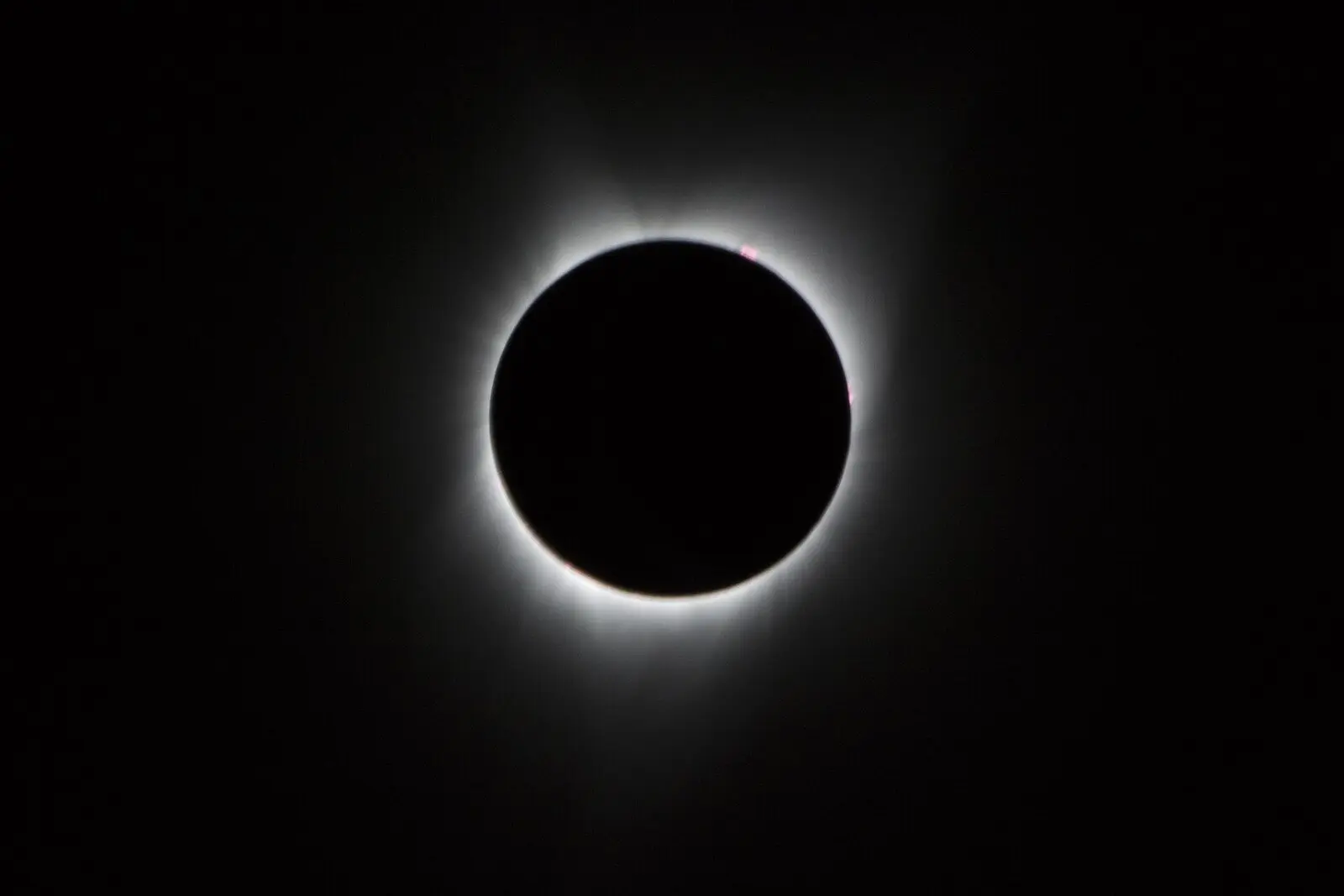
- The August 12, 2026, total solar eclipse
- Solar eclipses ahead: 2027 to 2030
- When is the next total solar eclipse in the USA?
- How to watch a solar eclipse safely
- Total, annular, partial and hybrid: the types of solar eclipse
- Lunar eclipses: easier to see, safe to watch
- Lunar eclipse vs. solar eclipse
- Planning an eclipse trip
This article is part of the 77.today Night Sky Guide, prepared by the 77.today editors from the sources listed at the end.
The most talked-about eclipse of 2026 happened on August 12, when the Moon's shadow raced from the Arctic across Greenland and Iceland to Spain. Most Americans saw at most a partial bite out of the Sun that afternoon, and many saw nothing at all. If you are wondering when the next solar eclipse visible from the US is, the honest answer is that partial solar eclipses come every year or two, but the next total solar eclipse anywhere in the country is in Alaska in 2033, and the lower 48 has to wait until August 23, 2044. Lunar eclipses, which anyone on the night side of Earth can see, come much more often. This part of our Night Sky Guide recaps 2026, lists the eclipses ahead and explains how to watch them safely.
The August 12, 2026, total solar eclipse
According to NASA, the total eclipse of August 12, 2026, swept across Greenland, Iceland, northern Russia, the Atlantic Ocean, Spain and a small corner of Portugal. For most people in the path, totality lasted less than two minutes, and even near the center of the path in Greenland, Russia and the North Atlantic it stayed under two and a half minutes. In Spain the Sun was fully eclipsed in the late evening, shortly before sunset; NASA's table lists totality in Reykjavík from 5:48 to 5:49 p.m. local time and in León, Spain, from 8:28 to 8:30 p.m.
For the United States it was a partial eclipse. NASA said a partial eclipse would be visible across parts of the northern US from Alaska to North Carolina. In Alaska it started and ended in the morning; in the northern contiguous states it began around midday and lingered into mid-afternoon farther east.
| City | Partial began | Maximum | Sun covered | Partial ended |
|---|---|---|---|---|
| Fairbanks, Alaska | 7:37 a.m. | 8:27 a.m. | 37% | 9:18 a.m. |
| Anchorage, Alaska | 7:36 a.m. | 8:21 a.m. | 28% | 9:09 a.m. |
| Bangor, Maine | 12:54 p.m. | 1:53 p.m. | 24% | 2:49 p.m. |
| Portland, Maine | 12:57 p.m. | 1:53 p.m. | 19% | 2:27 p.m. |
| Boston, Massachusetts | 1:01 p.m. | 1:55 p.m. | 16% | 2:46 p.m. |
| Philadelphia, Pennsylvania | 1:11 p.m. | 1:53 p.m. | 7% | 2:35 p.m. |
| Washington, D.C. | 1:17 p.m. | 1:53 p.m. | 4% | 2:27 p.m. |
| Detroit, Michigan | 1:03 p.m. | 1:36 p.m. | 3% | 2:08 p.m. |
Times are local (Alaska Daylight Time in Alaska, Eastern Daylight Time elsewhere), from NASA's eclipse page. People who searched "when was the last solar eclipse" in the fall of 2026 were usually looking for this one.
Solar eclipses ahead: 2027 to 2030
NASA's future eclipses list gives two solar eclipses in 2027, neither of them a good show from the US:
- February 6, 2027 – annular: visible in parts of South America and Africa, including Chile, Argentina, Uruguay, Brazil, Ivory Coast, Ghana, Togo, Benin and Nigeria, with a partial eclipse over large areas of the Southern Hemisphere.
- August 2, 2027 – total: totality crosses southern Spain, North Africa (including Morocco, Algeria, Tunisia, Libya and Egypt), Saudi Arabia and Yemen. NASA says a partial eclipse will be visible in most of Europe, much of Africa, the Middle East, eastern Canada and northern Maine in the US.
Looking further ahead, timeanddate.com's list of eclipses visible in the United States shows these solar eclipses through 2030, each seen as partial from at least part of the country:
| Date | Global type | As seen from the US |
|---|---|---|
| Aug 2, 2027 | Total | Partial (northern Maine) |
| Jan 26, 2028 | Annular | Partial |
| Jan 14, 2029 | Partial | Partial |
| Jun 12, 2029 | Partial | Partial |
| Jun 1, 2030 | Annular | Partial |
How much of the Sun is covered, and whether the eclipse is visible at all, varies a lot by location for each of these; check a local eclipse map closer to the date.
When is the next total solar eclipse in the USA?
The 2024 total eclipse spoiled a generation of American eclipse watchers, and the next ones are a long way off:
| Date | Type | Where in the US |
|---|---|---|
| Mar 30, 2033 | Total | Alaska |
| Jun 21, 2039 | Annular | Next annular eclipse visible in the US |
| Aug 23, 2044 | Total | Montana, North Dakota and South Dakota |
| Aug 12, 2045 | Total | Coast to coast, from California to Florida |
The 2033 and 2039 dates come from timeanddate.com's US list. For 2044, CBS News reported, citing NASA, that totality will be visible from just three states – Montana, North Dakota and South Dakota – and that the August 12, 2045, eclipse will start in California and move east to end in Florida, similar to 2017, before crossing Haiti, the Dominican Republic and northern South America.
Never look at the Sun during a partial or annular eclipse without proper protection. NASA says regular sunglasses, no matter how dark, are not safe; eclipse glasses and handheld solar viewers are thousands of times darker and should comply with the ISO 12312-2 international standard. The only time you can look with the naked eye is during totality, when the Sun's bright face is completely covered.
How to watch a solar eclipse safely
NASA's eclipse safety guidance comes down to a few rules:
- Use certified solar viewers. Eclipse glasses or handheld viewers should meet the ISO 12312-2 standard. The American Astronomical Society explains the standard and how to spot compliant viewers on its ISO certification page.
- Keep them on for the whole partial phase. During a partial or annular eclipse, some of the Sun is always uncovered, so glasses stay on from start to finish.
- Totality is the exception. NASA says you can view the eclipse directly only when the Moon completely blocks the Sun's bright face; you will know it is safe when you can no longer see any part of the Sun through eclipse glasses. As soon as the bright Sun reappears, put the glasses back on.
- Filters go in front of optics. Cameras, binoculars and telescopes need their own solar filters attached to the Sun-facing end. NASA says eclipse glasses are not a substitute for these filters, notes that solar filters must be attached to the front of any telescope, binoculars or camera lens, and recommends seeking expert advice before using a solar filter with any optical device.
- Indirect viewing is always safe. A pinhole projector – a small hole in an index card – projects an image of the Sun onto a surface; stand with the Sun at your back. Leaves on trees act as natural pinholes and project crescents onto the ground.
Total, annular, partial and hybrid: the types of solar eclipse
Whether a solar eclipse is total or annular depends on the Moon's distance. Its orbit is slightly elliptical, so its apparent size changes during the month (the same effect that makes some full moons "supermoons," as explained in our full moon calendar).
- Total: the Moon is close enough to cover the Sun's bright face completely. Along a narrow path, the sky darkens, the temperature drops and the Sun's outer atmosphere, the corona, appears – the only time it can be seen with the naked eye.
- Annular: the Moon is farther away and too small to cover the Sun, leaving a bright "ring of fire." Eye protection is needed the whole time.
- Partial: the Moon covers only part of the Sun. Everyone outside the central path of a total or annular eclipse sees a partial one, and some eclipses are partial everywhere.
- Hybrid: a rare eclipse that shifts between annular and total along its path because of the curvature of Earth.
For viewers, the practical difference is simple: only the brief totality of a total eclipse is safe to look at without filters. Even 99% coverage, as Madrid saw on August 12, 2026, according to NASA's table, leaves enough of the Sun exposed to damage your eyes.
Lunar eclipses: easier to see, safe to watch
A lunar eclipse happens when Earth's shadow falls on a full moon. Unlike a solar eclipse, it can be seen from the entire night side of Earth and requires no eye protection. There are three kinds: total (the Moon passes completely into Earth's dark inner shadow and often turns coppery red), partial (only part of the Moon enters the inner shadow) and penumbral (the Moon passes only through the faint outer shadow, a subtle dimming that is easy to miss).
2026 brought two good ones for North America. On March 3, 2026, a total lunar eclipse was visible across the continent, shown in NASA's visibility map; The Old Farmer's Almanac lists totality from 6:04 to 7:02 a.m. EST. On the night of August 27–28, NASA's Scientific Visualization Studio described a deep partial lunar eclipse with the Americas centrally located; timeanddate.com put it at 96.2% and timed the partial phase from 10:33 p.m. EDT on August 27 to 1:51 a.m. EDT on August 28.
| Date | Type | Visibility |
|---|---|---|
| Feb 20–21, 2027 | Penumbral | Americas, Europe, Africa, Asia, Australia (NASA) |
| Aug 16–17, 2027 | Penumbral | Americas and other regions (NASA) |
| Jan 12, 2028 | Partial | Visible from the US |
| Jul 6, 2028 | Partial (penumbral from the US) | Visible from the US |
| Dec 31, 2028 | Total | Visible from the US |
| Jun 26, 2029 | Total | Visible from the US |
| Dec 20, 2029 | Total | Visible from the US |
The 2028 and 2029 entries come from timeanddate.com's list of eclipses visible in the US. "Visible from the US" means at least part of the eclipse can be seen from somewhere in the country; how much depends on whether the Moon is above your horizon at the time.
Lunar eclipse vs. solar eclipse
| Solar eclipse | Lunar eclipse | |
|---|---|---|
| What happens | The Moon passes between the Sun and Earth | Earth passes between the Sun and Moon |
| Moon phase | New moon | Full moon |
| Where visible | Narrow path (total/annular) and a wider partial zone | The whole night side of Earth |
| Duration of the main phase | Totality lasts minutes at most | Totality can last over an hour |
| Eye protection | Required except during totality | Not needed |
Because eclipses can only happen at new or full moon, our full moon calendar lists them next to the relevant moons. The August 2, 2027, solar eclipse falls on the new moon of that day.
Planning an eclipse trip
For the August 2, 2027, total eclipse, the nearest destinations for Americans are southern Spain and North Africa. Lessons from 2026 apply: the eclipse in Spain occurred low in the evening sky, and cloud statistics and the horizon matter as much as the path. Book early, pick a site with a clear view toward the Sun's position at eclipse time, and have a backup location within driving distance. For photographing an eclipse, a camera needs a solar filter for every partial phase; the filter comes off only during totality. The same tripod you use for aurora photography works well, and if you are traveling in winter for an eclipse or the aurora, check our guide to where to see the northern lights as well.
Closer to home, the next sky events are free and need no travel: the Geminid meteor shower on December 13–14, 2026, and the December 23 supermoon. Golden light before and after an eclipse is covered in golden hour and blue hour.
Cover photo: NASA Armstrong Flight Research Center / NASA/Carla Thomas, Wikimedia Commons (public domain).
.jpg)
Frequently asked questions
When is the next total solar eclipse in the USA?
In Alaska on March 30, 2033. The next total solar eclipse in the lower 48 is August 23, 2044, visible from Montana, North Dakota and South Dakota, followed by a coast-to-coast eclipse on August 12, 2045.
When was the last solar eclipse?
The last was the total solar eclipse of August 12, 2026, total over Greenland, Iceland and Spain and partial across parts of the northern US from Alaska to North Carolina.
Is there a solar eclipse in 2027?
Yes, two: an annular eclipse on February 6, 2027, over South America and Africa, and a total eclipse on August 2, 2027, over southern Spain, North Africa and the Middle East. In the US, only northern Maine sees a partial phase of the August eclipse, according to NASA.
When is the next lunar eclipse?
The next is a penumbral lunar eclipse on February 20–21, 2027, visible from the Americas, followed by another penumbral eclipse on August 16–17, 2027. The next total lunar eclipse visible from the US is on December 31, 2028.
What eclipse glasses are safe?
NASA says safe solar viewers are thousands of times darker than sunglasses and should comply with the ISO 12312-2 international standard. Regular sunglasses are never safe for looking at the Sun.
What is the difference between a lunar and a solar eclipse?
In a solar eclipse the Moon passes between Earth and the Sun at new moon; in a lunar eclipse Earth's shadow falls on the full moon. Lunar eclipses are visible from the whole night side of Earth and are safe to watch without protection.
How much of the August 2026 eclipse could the US see?
NASA's tables show 37% of the Sun covered at Fairbanks, 28% at Anchorage, 24% at Bangor, 16% at Boston, 7% at Philadelphia and 4% at Washington, D.C.
Can I look at a solar eclipse through a camera or binoculars with eclipse glasses on?
No. Optics need their own solar filter attached to the front. NASA says solar filters must be attached to the Sun-facing end of any telescope, binoculars or camera, and recommends asking an astronomer before using one.
Sources
- NASA Science – Total solar eclipse on August 12, 2026
- NASA Science – Future eclipses
- NASA Science – Eclipse viewing safety
- American Astronomical Society – ISO 12312-2 certification
- Timeanddate.com – Eclipses in the United States
- Timeanddate.com – August 27–28, 2026 partial lunar eclipse
- CBS News – Next total solar eclipses in the US, 2044 and 2045
- NASA SVS – March 3, 2026 total lunar eclipse visibility map
- NASA SVS – August 27–28, 2026 deep partial lunar eclipse
- The Old Farmer's Almanac – Eclipse dates 2026 and 2027
Read next
 SpaceGolden Hour and Blue Hour: What They Are, How to Calculate Them and Times by Season
 SpaceKp Index Explained: How to Read a Northern Lights Forecast, G-Scale and Aurora Map
 SpaceWhere to See the Northern Lights in the US: Best States, Places and Times
 SpaceHow to Photograph the Northern Lights With a Phone or Camera (Settings Guide)
Log in to comment
No comments yet. Be the first.