Space Data Centers: Why Google and SpaceX Want Servers in Orbit
- Space data centers are solar-powered computing satellites that cool themselves by radiating heat into the vacuum of space.
- Google's Project Suncatcher launched its first prototype with four TPUs on October 1, 2026; Starcloud has run an Nvidia H100 in orbit since November 2025.
- SpaceX asked the FCC in January 2026 for up to one million AI data center satellites and told IPO investors deployments could start as early as 2028.
- Google calculates orbit becomes cost-comparable with ground data centers only when launch prices fall below about $200 per kilogram, projected for the mid-2030s.
- The IEA projects data-centre electricity use will more than double from 415 TWh in 2024 to about 945 TWh in 2030; orbital capacity will not change that this decade.
- Why put data centers in space? The three arguments
- Who is doing what: the space data center projects, with dates
- The physics and engineering: power, heat, radiation, latency, cost
- Ground vs. orbital data centers: side by side
- What it means for AI energy demand on Earth
- Timeline: announced milestones, 2024 to the 2030s
- The sceptic case, stated plainly
- What to watch next
Space data centers are clusters of computing hardware launched into orbit, powered by solar panels that see the Sun almost constantly and cooled by radiating heat into the vacuum of space. The idea has gone from paper to hardware in under two years: Google put a prototype satellite carrying its own TPU chips into orbit on October 1, 2026, Starcloud has been running an Nvidia H100 GPU in space since November 2025, and SpaceX has asked U.S. regulators for permission to fly up to one million solar-powered AI satellites. The case rests on three things Earth cannot easily offer: near-continuous sunlight, cooling without water, and no land, grid queue or permits.
Whether orbital data centers can ever beat a warehouse of servers on cost is a live engineering question. This guide covers who has done what, the physics, the launch price that decides the economics, a side-by-side table, a timeline and the sceptic case.
Why put data centers in space? The three arguments
Every serious proposal leans on the same three advantages.
- Power. Above the atmosphere, sunlight arrives at about 1,361 watts per square metre, the total solar irradiance NASA measures from satellites, with no clouds and, in the right orbit, effectively no night. Google's Project Suncatcher team calculates that a panel in a dawn-dusk sun-synchronous orbit can be up to eight times more productive than on the ground.
- Cooling. Terrestrial AI data centers rely on chillers and evaporative towers that can use billions of litres of water a year. In orbit heat leaves only as infrared radiation from large panels: partly a drawback, but zero water and no refrigeration.
- Land, grid and permits. On Earth the bottleneck for new AI capacity is increasingly grid connections and local opposition rather than chips. SpaceX told the Federal Communications Commission its satellites "will achieve transformative cost and energy efficiency" with little operating or maintenance cost.
Who is doing what: the space data center projects, with dates
Google: Project Suncatcher
Google announced Project Suncatcher on November 4, 2025, with a research paper (since published in the journal Joule) describing compact constellations of solar-powered satellites carrying its Tensor Processing Units, linked by lasers and flying in close formation in a dawn-dusk sun-synchronous orbit at about 650 km. Two findings mattered most. Google's Trillium (v6e) TPUs survived a 67 MeV proton beam better than expected: the high-bandwidth memory only began to misbehave after a cumulative dose of 2 krad(Si), almost three times the 750 rad(Si) a shielded five-year mission would receive, with no hard failures up to 15 krad(Si). And a bench test of the laser links reached 1.6 Tbps over a single transceiver pair.
On October 1, 2026, the first Suncatcher prototype, built with the satellite company Planet, launched on SpaceX's Transporter-18 rideshare mission. Google confirmed contact and said the satellite carries four TPUs and will run its open Gemma model to see how the chips cope with launch stress, radiation and thermal extremes. A two-satellite mission with Planet is planned for 2027 to test optical links for distributed machine learning.
Starcloud: the first H100 in orbit
Starcloud, a Redmond, Washington startup founded in 2024, launched Starcloud-1 in early November 2025 aboard a SpaceX rocket. It carries one Nvidia H100, about 100 times more GPU compute than had ever flown. Within weeks the company said it had trained a small language model in orbit and run Google's Gemma model on the H100. Starcloud raised $170 million in March 2026 and $250 million more on August 21, 2026 at a $2.3 billion valuation, with Nvidia and Cisco among the new investors, and is working with Nvidia on the Space-1 Vera Rubin Module, a space-rated computing platform announced at GTC on March 16, 2026. Its stated goal is 88,000 satellites and 20 gigawatts of orbital compute; its white paper sketches a 5 GW data center with panels roughly 4 km on a side. CNBC reported in December 2025 that a second satellite with Nvidia Blackwell hardware was planned for October 2026; as of October 19, 2026, Starcloud has not announced that launch, and its August release speaks of production lines for a next-generation Starcloud-3.
SpaceX: one million satellites and the AI1 design
SpaceX is the largest bet by scale. On January 30, 2026, it filed with the FCC for a constellation of up to one million solar-powered satellites to operate as AI data centers. Reuters noted that operators often request more than they intend to fly: SpaceX sought approval for 42,000 Starlink satellites and had roughly 9,500 in orbit at the time, out of about 15,000 satellites in space overall. SpaceX and Elon Musk's xAI combined in February 2026, and ahead of its June 12, 2026 stock market debut, SpaceX showed a first-generation AI satellite, AI1, built around large solar arrays, a compute module, a deployable radiator and laser links. Musk said the first version would likely use Nvidia chips with the power of one GB300 rack: "A lot of this is technology we've already made for the Starlink V3 satellites." The IPO prospectus said deployments could begin "as early as 2028"; executives told investors they aim to fly demonstrators by late 2027, with a Bastrop, Texas factory reaching meaningful production by the end of 2027. The enabler is Starship, which reached orbit for the first time on September 28, 2026 and deployed 26 Starlink V3 satellites.
Axiom Space: the first dedicated nodes
Houston-based Axiom Space builds small orbital data center nodes for edge processing and secure storage. Its first two launched on January 11, 2026 on Kepler Communications' optical relay satellites, with 2.5 Gbps laser links; Axiom says both are operating.
Lonestar: data storage on the Moon
Florida-based Lonestar Data Holdings treats the Moon as a disaster-recovery vault. Its Independence payload completed a data storage test from the lunar surface on Intuitive Machines' IM-1 lander in February 2024; its Freedom payload launched on February 26, 2025 aboard the IM-2 Athena lander; Lonestar says it completed data transfers in transit and lunar orbit. Athena touched down near the lunar south pole on March 6, 2025, but came to rest on its side and surface operations ended early.
Europe: the ASCEND study
ASCEND, led by Thales Alenia Space for the European Commission with partners including Airbus, ArianeGroup and the German space agency DLR, reported on June 27, 2024 that space data centers are technically feasible and could cut the carbon footprint of digital services, provided Europe builds a launcher about ten times less emissive over its life cycle. The target is one gigawatt in orbit before 2050.
Jeff Bezos and Blue Origin
In Turin on October 3, 2025, Amazon founder Jeff Bezos predicted gigawatt-scale data centers in space within 10 to 20 years. In December 2025, Reuters, citing the Wall Street Journal, reported that Blue Origin had worked on the technology for over a year. In May 2026, Bezos told CNBC the outcome was "very realistic" but a two-to-three-year timeline was "a little ambitious".
The physics and engineering: power, heat, radiation, latency, cost
Solar power in orbit versus on the ground
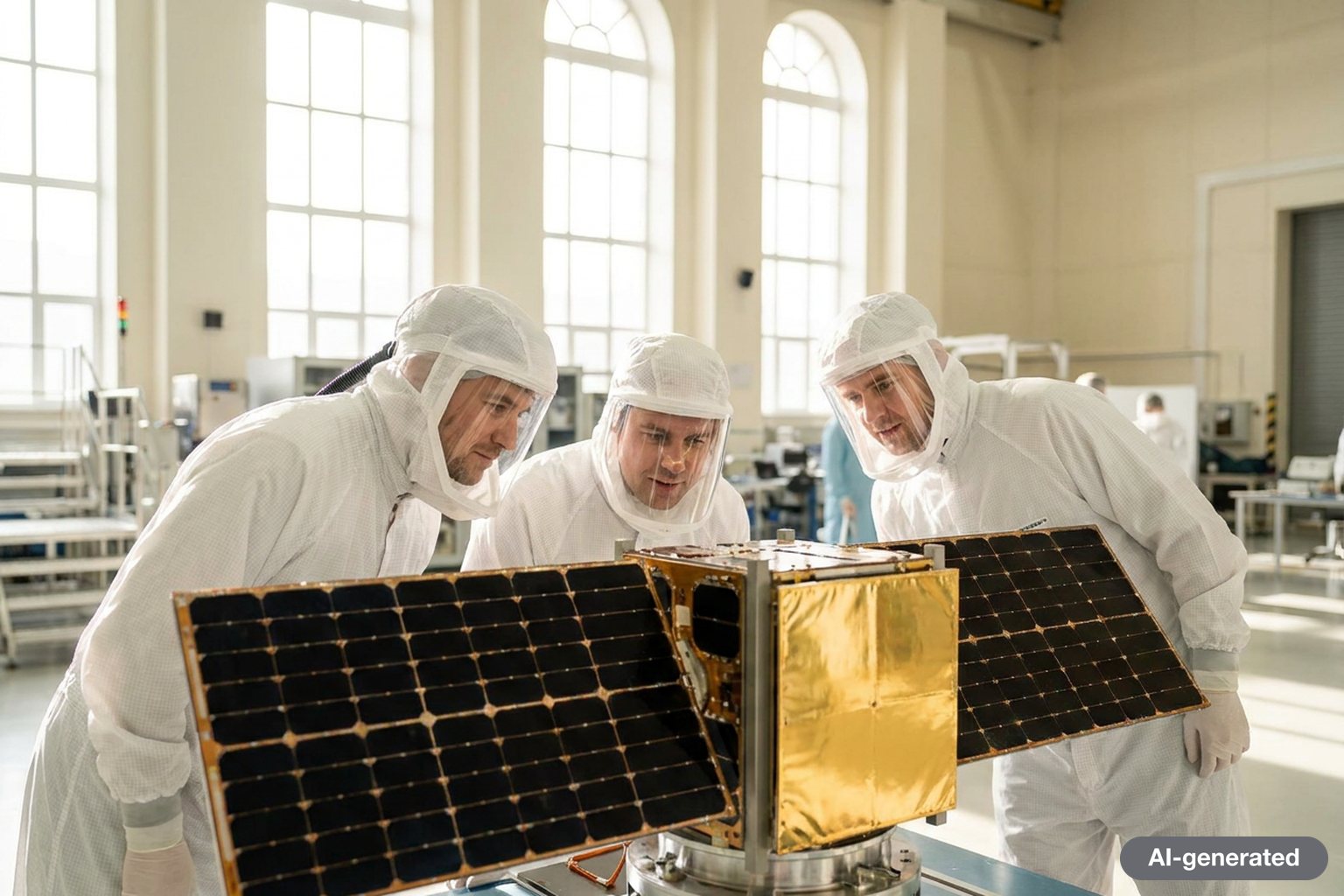
The solar constant above the atmosphere is about 1,361 W/m². A fixed panel on the ground averages far less over a year once night, atmosphere, weather and Sun angle are counted; that gap is where Google's "up to eight times" comes from. In a dawn-dusk sun-synchronous orbit the satellite rides the line between day and night, so its panels stay lit through almost every orbit. Constant input means less battery mass, and every kilogram of battery costs launch money; see our explainer on sodium-ion batteries.
Cooling: radiation is the only way out
On Earth a data center dumps heat into air or water. In vacuum heat can only leave as infrared radiation, governed by the Stefan-Boltzmann law. An ideal black radiator at about 27 °C (300 K) emits roughly 460 watts per square metre per side, so a 1 GW system needs radiators covering on the order of one to two square kilometres. That is why Starcloud's 5 GW concept is drawn about 4 km across, why SpaceX's AI1 includes a deployable liquid radiator, and why Google lists thermal management first among the "significant engineering challenges" that remain. Running chips hotter helps, since radiated power rises with the fourth power of temperature, but silicon has limits.
Radiation and chip reliability
Trapped charged particles and cosmic rays cause a slow total ionising dose that degrades transistors and single-event upsets that flip bits in memory. Suncatcher's proton-beam results suggest commercial accelerators can survive a five-year mission at around 650 km with modest shielding, and Starcloud designs around a five-year chip lifetime. Nobody has yet run a large cluster in orbit long enough to measure real failure rates, which is what the current prototypes are meant to find out.
Latency and laser links
Low Earth orbit at 500 to 650 km adds only a few milliseconds each way, which is why Starlink latency is comparable to ground broadband; see how Starlink internet works. The harder problem is bandwidth between satellites, since training large AI models needs tens of terabits per second between accelerators. Starlink's optical inter-satellite links are the proven precedent; Google's approach is to fly satellites only hundreds of metres apart so dense wavelength-division multiplexing can push each link into the terabit class, as its 1.6 Tbps bench test showed. Downlinking large volumes of data through weather is a separate bottleneck.
Launch cost: the number that decides everything
Google's analysis is the clearest public benchmark. From historical and projected launch prices, its team concluded that with a sustained learning rate, prices may fall below about $200 per kilogram by the mid-2030s, at which point the cost of launching and operating a space-based data center could become roughly comparable, per kilowatt per year, to the reported energy costs of an equivalent terrestrial data center. Today's prices are several times higher, which is why every plan depends on fully reusable heavy launch; SpaceX's filing says the scale only works with vehicles that can "deploy millions of tons of mass per year to orbit when launching at rate".
Maintenance, debris and end of life
Nobody swaps a failed board at 650 km, so satellites must be built for redundancy and remote recovery, and must deorbit cleanly. Adding thousands of large, radiator-winged spacecraft to orbits that already hold roughly 15,000 satellites raises collision and debris questions regulators have barely begun to address, and larger surfaces take more micrometeoroid hits. Everything in orbit is temporary, as the spent rocket stage that hit the Moon showed.
Ground vs. orbital data centers: side by side
| Factor | Ground data center | Orbital data center |
|---|---|---|
| Power | Grid, on-site gas, solar, wind, nuclear deals | Solar arrays in near-constant sunlight; up to 8x ground yield (Google) |
| Cooling | Air, chilled water, evaporative towers | Radiation only; square kilometres of radiator per gigawatt |
| Water | Billions of litres a year at hyperscale sites | None |
| Cost per kW | Known; electricity and chips dominate | Launch mass dominates; comparable only below about $200/kg (Google) |
| Latency | Milliseconds to tens of milliseconds | A few extra milliseconds; downlink capacity is the constraint |
| Repairability | Hot-swap a board in minutes | None; replace whole satellites |
| Regulatory | Zoning, permits, interconnection, water rights | Spectrum and orbital licences (FCC, ITU), debris rules, data sovereignty |
What it means for AI energy demand on Earth
The International Energy Agency estimated that data centres consumed about 415 TWh in 2024, roughly 1.5% of global electricity, with the United States accounting for 45%. In its base case, consumption more than doubles to around 945 TWh by 2030 and reaches roughly 1,200 TWh by 2035; the IEA's 2026 update kept the 2030 figure at about 950 TWh while raising the 2025 estimate to 485 TWh.
Against those numbers, space will not relieve the grid this decade: the hardware in orbit today adds up to a few kilowatts, and SpaceX's own prospectus points to deployments no earlier than 2028. Google's framing is the honest one: the core concepts are "not precluded by fundamental physics or insurmountable economic barriers", but the engineering and launch economics still have to be proven at scale. Orbit is a bet on the 2030s.
Timeline: announced milestones, 2024 to the 2030s
Future entries are announced targets, not commitments; this table is the part of the guide most likely to need refreshing.
| Date | Milestone | Who | Status |
|---|---|---|---|
| February 2024 | Data storage test from the lunar surface (IM-1) | Lonestar | Done |
| June 27, 2024 | ASCEND study: 1 GW in orbit before 2050 if a 10x cleaner launcher is built | Thales Alenia Space | Published |
| Feb 26 to Mar 6, 2025 | Freedom payload flies to the Moon on IM-2; lander tips on landing | Lonestar | Partial |
| November 2025 | Starcloud-1 launches with the first Nvidia H100 in orbit; Project Suncatcher announced (Nov 4) | Starcloud, Google | Done |
| January 11, 2026 | First two orbital data center nodes launch | Axiom Space | Operating |
| January 30, 2026 | FCC filing for up to one million AI satellites | SpaceX | Pending |
| June 2026 | AI1 satellite shown; IPO filing says deployments "as early as 2028" | SpaceX | Announced |
| August 21, 2026 | $250 million raise at $2.3 billion valuation; 88,000-satellite goal | Starcloud | Done |
| October 1, 2026 | First Suncatcher prototype with four TPUs launches | Google, Planet | In orbit |
| 2027 | Two-satellite Suncatcher mission; SpaceX demonstrators; Bastrop factory output | Google, SpaceX | Target |
| 2028 | Earliest deployments per SpaceX prospectus | SpaceX | Target |
The sceptic case, stated plainly
Chips already run in space; the debate is whether the whole system beats a solar farm, a battery bank and a building. The main objections:
- Radiators are the real payload. Square kilometres of thermal panels per gigawatt add mass, drag and deployment risk. Google's paper says gigawatt-scale constellations may need "a more radical satellite design" integrating power, compute and cooling.
- The economics hinge on a forecast. Parity assumes launch prices below roughly $200/kg; Reuters noted in June 2026 that Starship remained years behind its original targets and had yet to demonstrate rapid reusability.
- Chips age faster than satellites. Ground operators swap in new accelerators every few years; an orbital cluster is frozen at launch.
- No repair, more debris. Morgan Stanley analysts, cited by CNBC, listed radiation, in-orbit maintenance, debris hazards and regulatory issues around data governance and space traffic as the main hurdles.
The builders argue these are bounded engineering problems. Bezos's "a little ambitious" and Musk's statement that SpaceX was making no promises about when or how large the deployment would be say the same thing: the physics works, the schedule is the uncertain part.
What to watch next
Three signals will show whether space data centers are becoming real: how Google's TPUs behave over months in orbit; whether SpaceX flies demonstrators by late 2027 and what Starship launch prices settle at; and whether anyone sells orbital compute to a paying customer at a price that undercuts a ground cloud. For more on frontier computing, read our guide to quantum computing breakthroughs, follow crews returning to deep space in Artemis 2's record lunar flyby, or browse the rest of our tech coverage.
Frequently asked questions
What is a space data center?
A space data center is computing hardware, usually AI accelerators and storage, placed on a satellite or a cluster of satellites in orbit. It draws power from solar panels in near-constant sunlight, sheds heat by radiating it into space, and talks to other satellites and to Earth over laser and radio links. Today's examples are single-satellite prototypes such as Google's Suncatcher test satellite and Starcloud-1.
Why do companies want to put data centers in space?
Three reasons: solar panels in the right orbit can produce up to eight times more energy than on the ground and run almost continuously; cooling needs no water or chillers because heat radiates straight into space; and there are no land purchases, grid connection queues or local permits. Companies such as Google, SpaceX and Starcloud argue this could eventually make orbital AI computing cheaper than building on Earth.
How are data centers cooled in space?
Only by radiation. There is no air or water in a vacuum, so heat is carried from the chips to large flat radiator panels that emit infrared light. A radiator near room temperature sheds roughly 460 watts per square metre per side, so a gigawatt-scale system would need radiators covering around one to two square kilometres. Thermal management is the first challenge Google lists for Project Suncatcher.
Has anyone actually put a data center in orbit yet?
Small ones, yes. Starcloud-1 has operated an Nvidia H100 GPU in orbit since November 2025 and has trained and run AI models there. Axiom Space launched two orbital data center nodes in January 2026. Google's Project Suncatcher prototype with four TPUs reached orbit on October 1, 2026. None of these is a commercial data center at scale; they are tests measured in kilowatts, not megawatts.
What is Google's Project Suncatcher?
Project Suncatcher is Google's research moonshot, announced on November 4, 2025, to study constellations of solar-powered satellites carrying its TPU chips, linked by lasers and flying in tight formation in a sun-synchronous orbit. Google tested TPUs in a proton beam, demonstrated 1.6 Tbps optical links on the bench, launched a first prototype satellite in October 2026 and plans a two-satellite mission with Planet in 2027.
What is Starcloud?
Starcloud is a startup based in Redmond, Washington, founded in 2024, that builds orbital data centers. Its Starcloud-1 satellite launched in November 2025 with the first Nvidia H100 GPU in space. The company has raised $450 million in total, including $250 million in August 2026 at a $2.3 billion valuation, works with Nvidia on space-rated Vera Rubin hardware, and aims for a constellation of 88,000 satellites and 20 gigawatts of compute.
Is SpaceX really going to launch one million data center satellites?
SpaceX filed with the FCC on January 30, 2026 for authority to fly up to one million solar-powered AI satellites. Reuters pointed out that operators often ask for far more than they deploy to keep design flexibility, and that SpaceX requested 42,000 Starlink satellites before launching about 9,500. SpaceX's IPO prospectus says deployments could begin as early as 2028, with demonstrators targeted for late 2027.
How much does it cost to launch a data center into space?
Launch is priced by mass, and today's prices are several times above the level Google considers competitive. Google's Suncatcher analysis found that if launch prices fall below about $200 per kilogram, which its trend projection places in the mid-2030s, the cost of launching and operating an orbital data center becomes roughly comparable, per kilowatt per year, to the energy costs of an equivalent ground data center.
Would space data centers have high latency?
Not for users. Low Earth orbit at 500 to 650 km adds only a few milliseconds each way, which is why Starlink latency is comparable to ground broadband. The real constraints are bandwidth between satellites, which needs terabit-class laser links for AI training, and the capacity to downlink large volumes of data through the atmosphere in all weather.
When will space data centers be real?
Prototypes are real now; commercial capacity is not. Announced targets are a two-satellite Google test in 2027, SpaceX demonstrators by late 2027 and deployments as early as 2028, Starcloud's larger satellites later this decade, and a European 1 GW system before 2050. Jeff Bezos has said gigawatt-scale orbital data centers are 10 to 20 years away and called a two-to-three-year timeline a little ambitious.
Sources
- Google Research: Exploring a space-based, scalable AI infrastructure system design (Project Suncatcher, November 4, 2025)
- Google: Our Project Suncatcher prototype satellite is in orbit (October 1, 2026)
- CNBC: Nvidia-backed Starcloud trains first AI model in space (December 10, 2025)
- Starcloud (Business Wire): Starcloud Raises $250 Million at $2.3 Billion Valuation (August 21, 2026)
- Reuters: SpaceX seeks FCC nod for solar-powered satellite data centers for AI (January 31, 2026)
- Reuters: SpaceX aims to launch orbital AI computing tests by end of next year (June 9, 2026)
- Axiom Space: Orbital Data Centers
- Lonestar Data Holdings: Successful Test of Solar System Internet on Lonestar Mission (August 20, 2025)
- Thales Alenia Space: Results of the ASCEND feasibility study on space data centers (June 27, 2024)
- Reuters: Data centres in space? Jeff Bezos says it's possible (October 3, 2025)
- IEA: Energy and AI, Energy demand from AI
- NASA: Solar Irradiance Science




Log in to comment
No comments yet. Be the first.