SpaceX Rocket Crashes Into Moon: Lithium Found
- A 4.3-ton SpaceX Falcon 9 upper stage struck the Moon at 5,400 mph (8,690 km/h) on August 5, 2026.
- While the impact was not caught on camera, telescopes detected a massive dust and gas cloud lasting up to 10 minutes.
- Astronomers found unexpected spectral signatures of lithium and sodium in the debris plume.
- The event serves as a rare, accidental experiment to test lunar crater formation and seismic models.
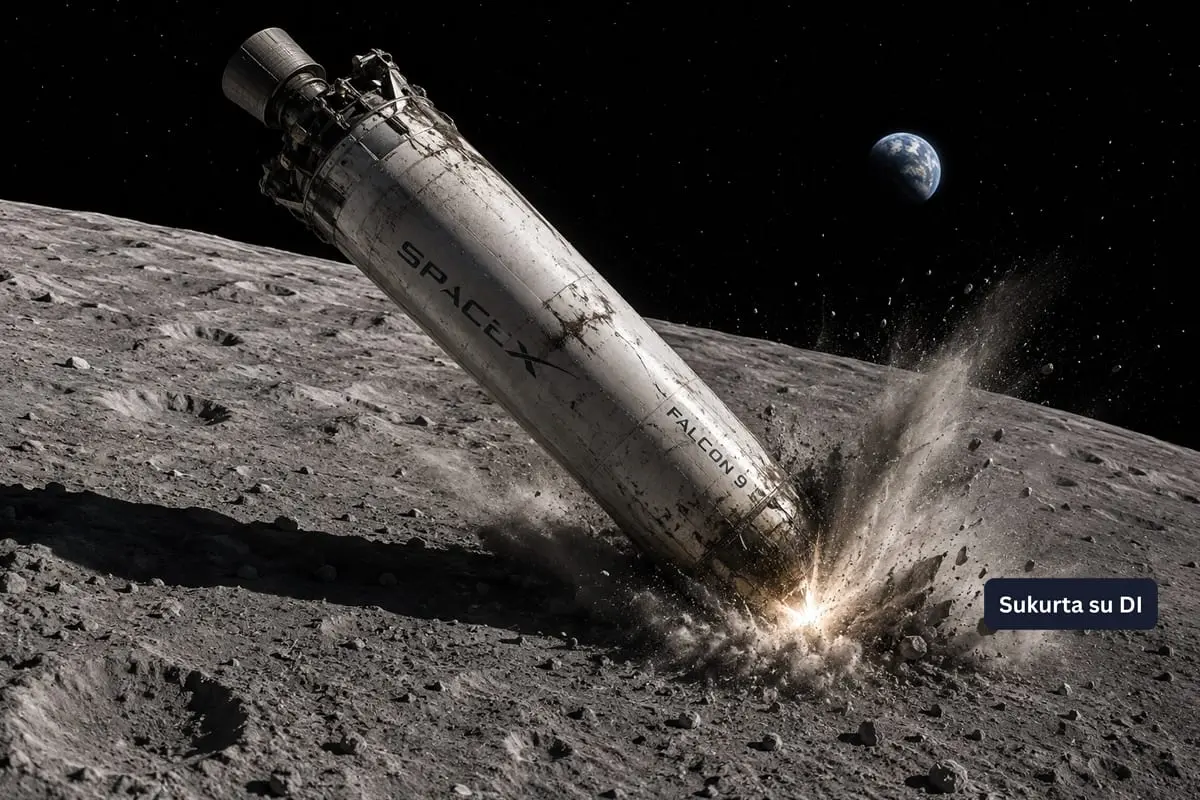
- SpaceX rocket crashes into Moon at 5,400 mph (8,690 km/h)
- The impact itself was not captured on video, but telescopes detected a massive debris cloud
- Spectral lines of sodium and lithium became the "chemical fingerprints" of the rocket collision
- The impact could have thrown lunar dust up to 62 miles (100 km) high
- The rocket stage had been flying uncontrollably in space since January 2025
- NASA and South Korean lunar probes are expected to check the size of the new crater
- The accidental Falcon 9 impact turned into a rare lunar geology experiment
- Uncontrolled rocket stages are becoming a growing problem around the Moon
SpaceX rocket crashes into Moon at 5,400 mph (8,690 km/h)
On August 5, 2026, at around 6:35 a.m. UTC, a spent upper stage of a SpaceX Falcon 9 rocket crashed uncontrollably into the lunar surface. The impact occurred near the Bell and Einstein craters, close to the edge of the lunar disk visible from Earth.
The stage, weighing approximately 4.3 tons (3.9 metric tons), slammed into the surface at a speed of about 1.5 miles per second (2.43 km/s), or 5,400 mph (8,690 km/h). The Moon has almost no atmosphere, meaning the falling object was not slowed by air resistance, and all its kinetic energy was concentrated on a small surface area.
Before the collision, NASA calculated that the impact should carve out a crater roughly 59 feet (18 meters) in diameter and 12 feet (3.7 meters) deep. Other scientific models predicted a crater ranging from 66 to 131 feet (20 to 40 meters) across, so its exact size will only be known once older and newer images of the impact site are compared.
The event posed no danger to Earth. According to NASA estimates, meteoroids of similar energy strike the Moon about once every six days on average. This time, however, scientists knew the object's origin, mass, approximate composition, and exact time of impact in advance.
The impact itself was not captured on video, but telescopes detected a massive debris cloud
Professional observatories and amateur astronomers prepared for the collision. The impact site was on the illuminated portion of the lunar surface, meaning the brief flash and dust cloud were expected to be washed out against the bright background.
Although several telescopes were pointed at the Moon at the time, no clear photos or videos of the rocket's impact were obtained. Spacecraft orbiting the Moon were also not in the right position to observe the strike directly.
However, the European Southern Observatory's Very Large Telescope, operating at the Paranal Observatory in Chile, captured a spectral signal emanating from the impact cloud. Traces of gas and dust were visible for about 5 to 10 minutes after the scheduled collision time.
Carl Schmidt, an astronomer at Boston University's Center for Space Physics, noted that the gas cloud could have stretched for tens of miles (dozens of kilometers). Although the direct flash of the impact went unnoticed, the timing, location, and chemical composition of the detected cloud allowed scientists to confirm that the collision had occurred.
Spectral lines of sodium and lithium became the "chemical fingerprints" of the rocket collision
The UVES spectrograph on the telescope at the Paranal Observatory recorded sodium and lithium emission lines. This is the light emitted by the atoms of a specific chemical element when the material heats up or its atoms receive additional energy.
Each element emits light only at its characteristic wavelengths. By splitting the light into a spectrum, the instrument reveals distinct lines that act like chemical fingerprints. This allows astronomers to determine the composition of a cloud even when it cannot be clearly photographed.
According to Schmidt, the sodium likely came from the lunar regolith ejected by the impact. Traces of this element have previously been detected on the Moon's surface and in its extremely thin exosphere.
The origin of the lithium has not yet been definitively established. Scientists speculate that it may have vaporized from the rocket stage's structures, paint, alloys, batteries, or thermal protection materials. This remains a preliminary hypothesis rather than confirmed proof that all the detected lithium belonged to the Falcon 9 stage.
The impact could have thrown lunar dust up to 62 miles (100 km) high
A model published by University of Texas scientists before the collision predicted that the main curtain of ejected dust could rise about 9 to 12 miles (15 to 20 km). The central stream of the fastest-moving material could theoretically have reached an altitude of 47 to 62 miles (75 to 100 km).
According to this model, some of the ejected particles should have spread up to 114 miles (183 km) from the impact site. Most of them were expected to return to the surface due to lunar gravity, but the smallest particles could have traveled much further.
The authors of the model expected the cloud to be bright enough for telescopes during the first few minutes. Practical observation conditions proved more difficult: the collision occurred near the bright edge of the Moon, and the contrast visible from Earth was lower than calculations suggested.
These data currently rely on digital modeling and preliminary spectral observations. The exact shape, height, and particle distribution of the cloud can only be determined after a more detailed analysis of the information gathered by different observatories.
The rocket stage had been flying uncontrollably in space since January 2025
The Falcon 9 rocket was launched on January 15, 2025, during the Ghost Riders in the Sky mission. It carried Firefly Aerospace's Blue Ghost 1 lander and the Japanese company ispace's Resilience lander toward the Moon.
The first stage of the rocket returned to Earth after launch, but the upper stage, having completed its payload delivery task, was left in a highly elongated and eventually unstable orbit. The object was assigned the catalog designation 2025-010D.
Solar radiation pressure, solar activity, and the gravitational pull of the Earth and Moon gradually altered the empty stage's trajectory. It lacked the fuel for a controlled maneuver and had no active guidance system, making a collision unavoidable.
Independent astronomers, including Bill Gray, creator of the orbit calculation software Project Pluto, were the first to identify the object's origin and project its impact site. NASA's Jet Propulsion Laboratory later confirmed that the probability of a lunar collision had reached 100 percent.
NASA and South Korean lunar probes are expected to check the size of the new crater
NASA's Lunar Reconnaissance Orbiter is expected to photograph the projected impact site and compare it with previously taken images of the same region. South Korea's Danuri probe may also provide additional observations.
However, the probes could not immediately turn their cameras to the required location. Their orbits, instrument schedules, lighting conditions, and communication windows with Earth are planned in advance, so acquiring and analyzing new data may take time.
Only new photographs will reliably determine the crater's diameter, shape, and the distribution of ejected rocks. They will also help verify whether the stage struck exactly at the predicted location between the Bell and Einstein craters.
Different preliminary models predicted varying crater sizes. NASA announced a diameter of about 59 feet (18 meters), while scientists studying the physical structure of the stage predicted a crater of roughly 131 feet (40 meters). Until orbital imagery is available, neither of these figures can be presented as a final measurement.
The accidental Falcon 9 impact turned into a rare lunar geology experiment
Although the rocket stage fell to the Moon unintentionally, its known mass, impact speed, trajectory, and structure provide scientists with a rare opportunity to test crater formation models. The size and composition of natural meteoroids are usually only determined approximately.
Benjamin Fernando, a scientist at Los Alamos National Laboratory, noted that such an event allows for the testing of methods for future lunar seismic research. If enough sensitive seismometers were operating on the lunar surface, the shockwaves from a precisely known impact would help study the structure of the satellite's crust and mantle.
NASA deliberately conducted a similar experiment in 2009 during the LCROSS mission. At that time, a roughly 2.2-ton (2-metric-ton) Centaur upper stage was directed into the Cabeus crater, ejecting a debris cloud in which water ice, sodium, silver, mercury, and other materials were detected.
The 2026 impact differed from LCROSS in that it was not planned as a scientific mission. Scientists had to hastily coordinate ground-based telescopes and orbiters once the object's trajectory made it impossible to change course.
Uncontrolled rocket stages are becoming a growing problem around the Moon
Tens of thousands of larger artificial objects are tracked in Earth's orbit, but accounting for them in the space between the Earth and the Moon is much poorer. Such orbits are complex because they are simultaneously affected by the gravity of the Earth, Moon, and Sun, as well as solar radiation.
On March 4, 2022, another rocket stage of unidentified origin crashed into the Moon near the Hertzsprung crater. NASA's LRO probe later discovered an unusual double crater, about 92 feet (28 meters) wide. The object's origin has not yet been definitively confirmed.
With the increasing number of lunar orbital stations, landers, communication satellites, and crewed missions, uncontrolled objects can pose a danger to more than just the surface. Particles ejected during a collision, or the drifting stage itself, could threaten active spacecraft and future infrastructure.
A single Falcon 9 stage impact on the Moon did not cause a catastrophe. However, the event demonstrated that the new era of lunar exploration brings a very earthly problem: humanity is beginning to leave hard-to-track debris not only around its own planet but throughout the entire region between the Earth and the Moon.
Frequently asked questions
Why did the SpaceX rocket crash into the Moon?
The Falcon 9 upper stage was left in a highly elongated orbit after a January 2025 launch. Lacking fuel and active guidance, gravitational forces and solar radiation eventually pushed it into an unavoidable lunar collision.
How big is the crater left by the SpaceX rocket?
Preliminary models estimate the crater is between 59 and 131 feet (18 to 40 meters) wide. NASA and South Korean lunar probes will photograph the site to confirm its exact dimensions.
What chemicals were found in the lunar dust cloud?
Astronomers detected spectral lines of sodium and lithium. The sodium likely came from the lunar soil, while the lithium may have vaporized from the rocket's batteries, paint, or thermal protection materials.
Log in to comment
No comments yet. Be the first.