Isaac Newton: Life, Discoveries, Laws and the Apple Story
- Isaac Newton was born at Woolsthorpe Manor, Lincolnshire, on December 25, 1642 Old Style, which is January 4, 1643 by today's calendar.
- During the plague years 1665 to 1667 he laid the foundations of calculus, showed that white light is a mixture of colors and derived the inverse-square law of gravity.
- His Principia (1687) set out the three laws of motion and the law of universal gravitation, still used by NASA for flight and spacecraft.
- He built the first working reflecting telescope in 1668, became a Fellow of the Royal Society in 1672, its President in 1703, and was knighted in 1705.
- As Master of the Royal Mint from 1699 he pursued counterfeiters; he died on March 31, 1727 (New Style) and is buried in Westminster Abbey.
- When was Isaac Newton born? The two-date answer
- Childhood, Grantham and Cambridge
- The plague years, 1665 to 1667: Newton's "year of wonders"
- The Isaac Newton apple story: what is documented and what is myth
- The reflecting telescope and the Royal Society, 1668 to 1672
- Principia, 1687: the three laws of motion and universal gravitation
- Opticks, 1704, and the color spectrum
- The calculus dispute with Leibniz
- Warden and Master of the Royal Mint: Newton and the counterfeiters
- President of the Royal Society and knighthood
- Newton's alchemy and theology
- Death in 1727 and burial in Westminster Abbey
- Newton's legacy: the newton, the cradle and Einstein
- 10 surprising Isaac Newton facts
Isaac Newton (born December 25, 1642 by the calendar then used in England, January 4, 1643 by today's calendar, at Woolsthorpe Manor in Lincolnshire; died March 31, 1727 in London) was the English mathematician and physicist whose work closed the Scientific Revolution and opened modern science. He is remembered for five things above all: the three laws of motion, the law of universal gravitation, the invention of calculus, the discovery that white light is a mixture of colors, and the first working reflecting telescope.
Around those achievements sits a stranger life: a premature baby not expected to survive the day, a secret alchemist and heretic, a hunter of counterfeiters at the Royal Mint, and finally a knighted president of the Royal Society. Every date below is checked against the Royal Society, the Newton Project at Oxford, Britannica, Westminster Abbey, the Royal Mint Museum and the National Trust.
When was Isaac Newton born? The two-date answer
Ask when Isaac Newton was born and you will see two dates, December 25, 1642 and January 4, 1643, and both are correct. England still used the Julian calendar (Old Style) while most of continental Europe had adopted the Gregorian calendar (New Style) that we use today. At his birth, the Newton Project explains, Gregorian dates ran ten days ahead of Julian ones, so Christmas Day 1642 in Lincolnshire was already January 4, 1643 in Paris. The gap grew to eleven days in 1700, which is why his death is also dated two ways: March 20, 1727 Old Style, March 31 New Style. English custom also began the legal year on March 25, so old documents write "1726/7" for early 1727.
He was born in the manor house at Woolsthorpe, near Grantham, to a family of prosperous but unlettered yeoman farmers. His father, also Isaac, had died in October 1642, three months before the birth. Britannica records that the baby was so tiny and weak that he was not expected to survive his first day.
Childhood, Grantham and Cambridge
When Isaac was three, his mother Hannah Ayscough married Barnabas Smith, the rector of a nearby village, and moved to his house, leaving the boy with her own mother. Until Smith died in 1653 Isaac was effectively separated from her, and he never forgot it: in a list of sins he wrote at 19 he confessed to once threatening to burn his mother and stepfather "and the house over them."
From 1654 he attended the King's School in Grantham, lodging with the town apothecary. Around 1658 his mother pulled him out to run the farm, which failed: set to watch the cattle, Britannica notes, he would curl up under a tree with a book. His schoolmaster and uncle persuaded her to send him back to prepare for university.
He entered Trinity College, Cambridge, in June 1661 as a subsizar, a student who paid his way by waiting on richer students and tutors. The official curriculum was still Aristotle; Newton taught himself the new science of Descartes, Galileo, Boyle and Kepler from books and filled a notebook headed "Certain Philosophical Questions" with his own investigations. Within little more than a year of starting serious mathematics he had mastered the field and discovered the binomial theorem. He took his BA in April 1665 with nothing yet to show the world.
The plague years, 1665 to 1667: Newton's "year of wonders"
In the summer of 1665 the plague closed Cambridge and Newton went home to Woolsthorpe, where, apart from a brief return in spring 1666, he stayed until March 1667. In those roughly 18 months, which the National Trust calls his Year of Wonders and historians the annus mirabilis, the 23-year-old did three things that would each have made a career:
- Calculus. He set down the basic rules of differentiation and integration in a paper dated October 1666, calling the method "fluxions," and told almost no one.
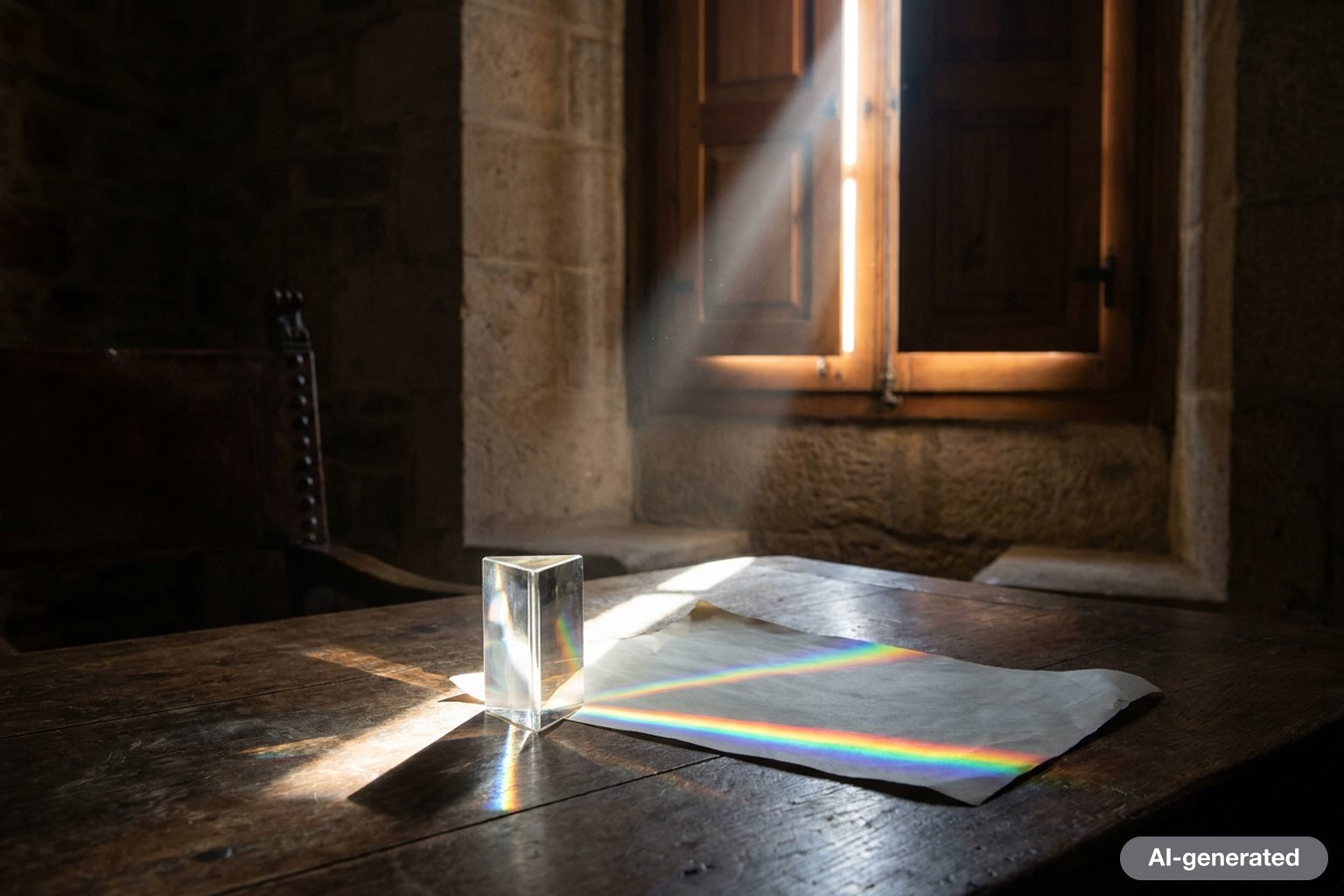
- Optics. With a prism in a darkened room he showed that white sunlight is a mixture of colors that the prism separates and a second prism can recombine. Visitors can still stand in the room where he did it. He also nearly blinded himself experimenting on his own eyes.
- Gravity. Analyzing circular motion and applying it to the Moon and planets, he found that the force holding them in orbit must weaken with the square of the distance, and he compared the Moon's fall toward Earth with a stone's fall at the surface.
Britannica's judgment is blunt: the world heard nothing of these discoveries, and universal gravitation would not be fully worked out for another twenty years.
The Isaac Newton apple story: what is documented and what is myth
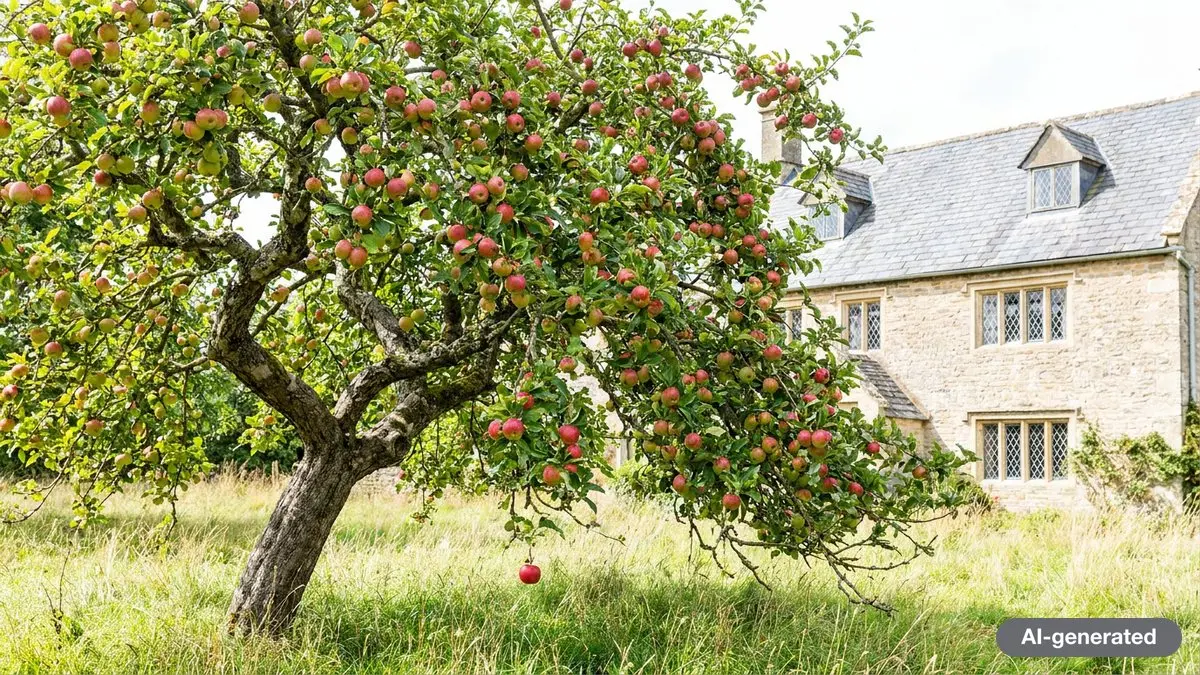
The most famous apple in science has a real source. In 1726, the year before Newton died, the physician and antiquarian William Stukeley took tea with him in a London garden and recorded what the old man said. Stukeley's manuscript, Memoirs of Sir Isaac Newton's Life (1752), is held by the Royal Society, which put the pages online in 2010. As the Guardian quoted the passage at the time, Stukeley wrote: "After dinner, the weather being warm, we went into the garden and drank tea, under the shade of some apple trees... He told me, he was just in the same situation, as when formerly, the notion of gravitation came into his mind. It was occasion'd by the fall of an apple, as he sat in contemplative mood. Why should that apple always descend perpendicularly to the ground, thought he to himself."
So the documented version is that Newton himself, late in life, said an apple falling at Woolsthorpe set him wondering why things fall straight down and whether the same pull reached the Moon. What is not in any source is the apple hitting his head, and gravity did not arrive in a flash: the full theory took two decades. Keith Moore, the Royal Society's head of library and archives, told the Guardian it is "clearly an anecdote Newton polished," with later generations adding their own gloss. The tree is real: a Flower of Kent apple tree associated with Newton still grows in the Woolsthorpe orchard, visible from the window of his room. For how retelling reshapes shared memories, see our guide to the Mandela effect.
The three laws of motion and the law of universal gravitation (Principia, 1687); calculus, independently of Leibniz; the fact that white light is a mixture of colors that a prism separates rather than creates (Opticks, 1704); the first working reflecting telescope (1668); the generalized binomial theorem; and the interference pattern known as Newton's rings.
The reflecting telescope and the Royal Society, 1668 to 1672
Newton became a Fellow of Trinity in 1667 and, in 1669 at 26, succeeded his mentor Isaac Barrow as Lucasian Professor of Mathematics. Convinced by his color experiments that lenses would always smear light into colored fringes, he built a telescope that focused light with a curved mirror he ground himself. His first reflector dates from 1668; the second, made in 1671, is the one the Royal Society still owns, with a brass plaque recording that it was "made with his own hands."
In 1671 Barrow had the telescope shown to the Royal Society in London, where it caused a sensation. Newton was elected a Fellow on January 11, 1672, and weeks later sent the Society his paper on light and colors, published in Philosophical Transactions that February. Robert Hooke, the Society's leading authority on optics, wrote a condescending critique; Newton's response was a rage out of all proportion, and within a year he had withdrawn into near-total isolation.
One grace note survives. When Hooke wrote privately in early 1676 proposing that they correspond as friends rather than fight in print, Newton replied from Cambridge on February 5, 1675/6 (1676 by our reckoning) in a letter the Newton Project has transcribed in full: "If I have seen farther, it is by standing on the shoulders of giants." He was crediting Descartes and Hooke himself for their work on colors.
Principia, 1687: the three laws of motion and universal gravitation
Two nudges ended Newton's silence on mechanics. A correspondence with Hooke in 1679 and 1680 about the path of a falling body handed him, in Britannica's words, the key concepts of inertia and centripetal attraction. Then, in August 1684, the astronomer Edmond Halley visited Cambridge and asked what path a planet would follow under an inverse-square force. Newton said he had already calculated it. Three months later Halley received a short tract, De Motu, and over two and a half years it grew into Philosophiae Naturalis Principia Mathematica, published in July 1687 at Halley's own expense.
The Principia rests on three laws of motion, which NASA's Glenn Research Center still uses to teach how aircraft and rockets fly. The table gives each law as NASA states it, with an everyday example and a modern use.
| Law | Statement (as given by NASA) | Everyday example | Modern use |
|---|---|---|---|
| First law (inertia) | An object at rest remains at rest, and an object in motion remains in motion at constant speed and in a straight line unless acted on by an unbalanced force. | Coffee sloshes forward when a car brakes; the liquid keeps moving while the cup stops. | Seat belts and airbags; coasting spacecraft that need no engine between course corrections. |
| Second law (force) | The acceleration of an object depends on the mass of the object and the amount of force applied. | The same push sends an empty shopping cart off faster than a full one. | Rocket thrust, crash forces and bridge loads, written as F = ma. |
| Third law (action and reaction) | Whenever one object exerts a force on another object, the second object exerts an equal and opposite force on the first. | Step off a small boat and the boat moves backward as you move forward. | Jet and rocket propulsion: hot gas pushed backward pushes the vehicle forward. |
From those laws came the result that made him famous. Combining his formula for centripetal force with Kepler's third law, he showed that the force holding the planets around the Sun, the moons around Jupiter and the Moon around Earth all weaken with the square of the distance. The decisive test: the Moon is about 60 Earth radii away, so if the same pull reaches it, the Moon should "fall" toward Earth 60 times 60, or 3,600, times more slowly than a stone at the surface. It does. Newton named the force with the Latin gravitas and stated the law of universal gravitation: every particle of matter attracts every other with a force proportional to the product of their masses and inversely proportional to the square of the distance between them. The same law explained the tides and comets, and it still lets astronomers compute the orbits of asteroids that might approach Earth and predict solar and lunar eclipses decades ahead.
Opticks, 1704, and the color spectrum
Opticks, written in plain English and published in 1704, the year after Hooke died, gathered work done thirty years earlier: the prism experiments proving that white light is a mixture of rays, each refracted by a fixed amount, so that the spectrum from red to violet is light analyzed into its parts rather than altered by the glass. The rainbow is the same analysis performed by raindrops. Book Two described the colored rings in the thin film of air between a lens and a flat sheet of glass, still called Newton's rings. The "Queries" at the end, expanded in 1717, set out his speculations on light, matter and the universe, and two mathematical papers appended to the 1704 edition were, at last, his first real publication of the calculus.
The calculus dispute with Leibniz
Newton had calculus in 1666 and in manuscripts of 1669 and 1671, but did not print it. Gottfried Wilhelm Leibniz developed his own version independently and published in 1684, with the notation most of the world still uses. Britannica summarizes the consensus: Newton was first, Leibniz was independent, Leibniz published first. That should have settled it. Instead, from 1699, when Newton's friend Fatio de Duillier implied in print that Leibniz had stolen the idea, the quarrel escalated into mutual charges of plagiarism. In 1712 the Royal Society, with Newton as president, appointed a committee to judge the matter; Newton chose its members, compiled its report, and in 1715 anonymously reviewed his own report in Philosophical Transactions. Leibniz died in 1716; Newton kept fighting him on paper until his own death.
Warden and Master of the Royal Mint: Newton and the counterfeiters
After the Principia Newton drifted toward London. He sat as Cambridge University's member of Parliament in 1689 and 1701, befriended John Locke, suffered a severe breakdown in 1693, and sought a government post. His friend Charles Montague, Chancellor of the Exchequer, delivered one: a letter of March 19, 1696 promised him the wardenship of the Royal Mint, then in the Tower of London, and Newton took up his duties that April, in the middle of the Great Recoinage of England's clipped and worn silver. The Royal Mint Museum records that the enormous operation was finished within three years and that Montague credited its success largely to Newton's administration. In 1699 the more lucrative post of Master fell vacant, and Newton took it up from Christmas Day 1699, his birthday, holding it until he died.
The job most men treated as a sinecure, Newton treated as a vocation, and his passion was the pursuit of coiners and clippers. The Mint Museum notes that he personally interviewed criminals and informers; Britannica says he became the terror of London's counterfeiters and sent a good number to the gallows. His most notorious adversary was William Chaloner, a prolific forger who in 1696 had accused the Mint itself of abuses before the Lords Justices, as the Royal Society's journal Notes and Records documents; Newton gathered the evidence that saw Chaloner convicted of high treason and hanged. His report of September 21, 1717 also set the guinea at 21 shillings, where it stayed.
President of the Royal Society and knighthood
Hooke died in March 1703; that November Newton was elected President of the Royal Society, a post he held by annual re-election for the rest of his life. In 1705 Queen Anne knighted him, which Britannica describes as the first time a scientist was so honored. He ran the Society, in Britannica's word, magisterially, and his bullying of John Flamsteed, the first Astronomer Royal, over star data is the low point of those years. The second edition of the Principia in 1713 added the "General Scholium" on God and creation; a third followed in 1726.
Newton's alchemy and theology
The author of the Principia spent at least as much of his life on alchemy and the Bible as on physics, and the manuscripts transcribed by the Newton Project show these were not hobbies but one unified search for the laws behind nature and history. From 1668 he kept furnaces in a shed at Trinity, copied alchemical treatises by hand and experimented for nearly thirty years; his most substantial alchemical essay, "Praxis," dates from about 1696. Britannica argues that this immersion changed his science: the alchemical idea of hidden attractions between substances led him, around 1679, to accept forces acting at a distance, the concept that made universal gravitation thinkable.
His theology was more dangerous. From about 1673 he studied the Bible and the early Church Fathers and concluded that the doctrine of the Trinity was a fourth-century error. In 1675 he obtained a royal dispensation from the rule that Cambridge fellows take holy orders, almost certainly because he could not in conscience subscribe. In 1690 he sent Locke a long manuscript on what he saw as corruptions of Scripture, then withdrew it when Locke moved to publish. His later works on the prophecies of Daniel and Revelation and on ancient chronology appeared only after his death. For a modern take on the questions he circled, see whether time itself is an illusion, which runs from Newton's absolute time to Einstein.
Death in 1727 and burial in Westminster Abbey
From 1722 Newton suffered from bladder stones and delegated much of his work to his niece's husband John Conduitt, who lived with him. He presided over his last Royal Society meeting on March 2, 1727 (New Style) and died at Kensington on March 20 Old Style, March 31 by today's calendar, having, the Newton Project records, refused the last rites. He never married.
Westminster Abbey's own account describes what followed: his body lay in state in the Jerusalem Chamber and was buried in the nave on March 28 (Old Style), with the Lord Chancellor, two dukes and three earls as pallbearers and most of the Fellows of the Royal Society walking behind. The grave slab reads, in Latin, "Here lies that which was mortal of Isaac Newton." The monument above it, by Michael Rysbrack to William Kent's design and finished in 1730, shows Newton reclining on books labeled Divinity, Chronology, Opticks and the Principia. Alexander Pope's couplet for the tomb was declined by the Abbey: "Nature and Nature's laws lay hid in night: God said, Let Newton be! and all was light."
| Date | Event |
|---|---|
| December 25, 1642 (January 4, 1643 NS) | Born at Woolsthorpe Manor, Lincolnshire |
| June 1661 | Enters Trinity College, Cambridge |
| 1665 to March 1667 | Plague years at Woolsthorpe: calculus, prism experiments, inverse-square law |
| 1669 | Lucasian Professor of Mathematics |
| 1668 and 1671 | First and second reflecting telescopes |
| January 11, 1672 | Elected Fellow of the Royal Society |
| February 5, 1676 | "Shoulders of giants" letter to Hooke |
| July 1687 | Principia published |
| April 1696 | Warden of the Royal Mint |
| December 25, 1699 | Master of the Mint |
| 1703 | President of the Royal Society |
| 1704 | Opticks published |
| 1705 | Knighted by Queen Anne |
| March 20, 1727 (March 31 NS) | Dies in London; buried in Westminster Abbey |
Newton's legacy: the newton, the cradle and Einstein
Newton's laws remain the working physics of engineering, from bridges to satellite launches, and NASA teaches them as the basis of flight. The SI unit of force, the newton, is the force that accelerates one kilogram by one meter per second each second; a medium apple resting on your palm presses down with roughly one newton. The desk toy called Newton's cradle, a row of swinging steel balls, demonstrates his third law and the conservation of momentum that follows from it.
Albert Einstein's general relativity of 1915 replaced Newton's instant force with the curvature of spacetime and explains what Newton's law cannot, from Mercury's orbit to black holes. Yet for almost every practical purpose Newton's equations remain accurate enough to use, and his own line to Hooke works both ways: later physicists have seen farther by standing on his shoulders. For more lives of scientists who changed daily life, read our biography of Marie Curie or browse the biographies hub.
10 surprising Isaac Newton facts
- He was born after his father's death and was so small that he was not expected to live through the day.
- As a Cambridge student he paid his way as a servant to richer students and ran a small money-lending business.
- At 19 he wrote out a list of his sins, including "Squirting water on Thy day" and stealing cherry cobs.
- Stukeley's memoir describes a model windmill he built as a boy and improved by installing a mouse to drive it.
- His Lucasian lectures were, by later accounts gathered by the Newton Project, extremely poorly attended.
- Stukeley also recorded that he once led a horse up a hill while reading and reached the top holding an empty bridle.
- He became Master of the Mint on his 57th birthday, Christmas Day 1699.
- By his niece's account he lost 20,000 pounds in the South Sea Bubble of 1720.
- In his last years he often dozed through the Royal Society meetings he was chairing.
- The Royal Society's Newton telescope was mislaid in the 1700s and only returned in 1766, presented by instrument makers who affirmed it was the original.
Frequently asked questions
What is Isaac Newton most famous for?
Newton is most famous for the three laws of motion and the law of universal gravitation, published in his Principia in 1687. He is also known for inventing calculus, for proving that white light is a mixture of colors, and for building the first working reflecting telescope in 1668.
When was Isaac Newton born?
He was born on December 25, 1642 by the Julian (Old Style) calendar then used in England, which corresponds to January 4, 1643 in the Gregorian (New Style) calendar used today. Both dates are correct; they simply use different calendars. He was born at Woolsthorpe Manor near Grantham, Lincolnshire.
Did an apple really fall on Isaac Newton's head?
No source says it hit his head. The story comes from William Stukeley's 1752 memoir, held by the Royal Society, in which Newton himself recalled that seeing an apple fall at Woolsthorpe set him thinking about why objects fall straight down and whether the same pull reaches the Moon. The idea took years, not an instant, to become a theory.
What are Newton's three laws of motion?
First, an object stays at rest or in uniform straight-line motion unless an unbalanced force acts on it. Second, an object's acceleration depends on its mass and the force applied, written F = ma. Third, whenever one object exerts a force on another, the second exerts an equal and opposite force on the first.
What did Isaac Newton discover about light?
Using prisms in a darkened room in 1665 and 1666, he showed that white sunlight is a mixture of colored rays that a prism separates by bending each by a different amount, and that a second prism can recombine them into white light. He published the work in Opticks in 1704 and also described the interference rings now called Newton's rings.
Did Isaac Newton invent calculus?
Yes. He developed the method he called fluxions in 1665 and 1666 and wrote it up in manuscripts of 1669 and 1671, but did not publish it. Gottfried Leibniz independently developed calculus and published first, in 1684. Historians agree Newton was first and Leibniz was independent, which did not stop a bitter priority dispute.
What did Isaac Newton do at the Royal Mint?
He became Warden of the Mint in 1696, oversaw the Great Recoinage of England's silver, and from Christmas Day 1699 served as Master until his death. He took the job seriously, personally interrogating suspects and pursuing counterfeiters, including the forger William Chaloner, who was convicted of high treason.
Was Isaac Newton knighted?
Yes. Queen Anne knighted him in 1705, which Britannica describes as the first time a scientist received the honor. By then he was President of the Royal Society, elected in 1703 and re-elected every year until his death in 1727.
How did Isaac Newton die?
He suffered from bladder stones from 1722, presided over his last Royal Society meeting in early March 1727, and died at Kensington, London, on March 20, 1727 Old Style (March 31 New Style), aged 84. He was buried in Westminster Abbey, where his grave and monument stand in the nave.
Where is Isaac Newton buried?
In Westminster Abbey, London, in the part of the nave now known as Scientists' Corner. His grave lies in front of the choir screen, and his marble monument by Michael Rysbrack, designed by William Kent, was completed in 1730 and shows him reclining on his books.
Sources
- Encyclopaedia Britannica: Isaac Newton
- Encyclopaedia Britannica: Isaac Newton, The Principia
- Encyclopaedia Britannica: Isaac Newton, International prominence
- The Newton Project (University of Oxford): Newton's Life and Work at a Glance
- The Newton Project (University of Oxford): Newton's letter to Hooke, February 5, 1675/6 (Brewster, Memoirs, Chapter VI)
- Royal Society Picture Library: Newton's reflecting telescope, 1671
- Royal Society: Memoirs of Sir Isaac Newton's life, by William Stukeley (Turning the Pages)
- The Guardian: Isaac Newton's falling apple tale drops into the web
- NASA Glenn Research Center: Newton's Laws of Motion
- Royal Mint Museum: Isaac Newton, Warden and Master of the Royal Mint 1696-1727
- Westminster Abbey: Sir Isaac Newton
- National Trust: Woolsthorpe Manor


Log in to comment
No comments yet. Be the first.