Adobe Firefly: The Future of Generative AI Image Editing
- Adobe Firefly integrates generative AI into Photoshop, allowing users to easily replace objects and backgrounds using text prompts.
- To avoid copyright issues, Adobe trained its AI image generator exclusively on Adobe Stock and public domain images.
- A global survey shows that 96 percent of marketing professionals believe AI will boost their creativity and work quality.
- The rise of AI-generated images poses new challenges in distinguishing real photos from fake ones, requiring heightened digital literacy.
Photoshop and Adobe Firefly Join Forces to Become an Unbeatable Duo
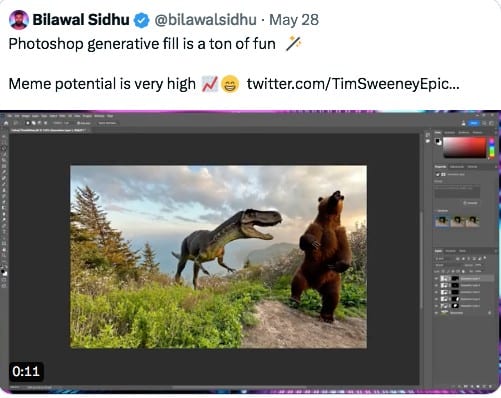
Adobe presented its customers with a real surprise: an updated version of the popular Photoshop software, supplemented with the latest artificial intelligence (AI) capabilities, allowing users to smartly edit photos and visuals.
The new Adobe Firefly tool can quickly and easily replace objects or backgrounds with images created from a text prompt. While this capability is not entirely new—startups like Runway, Midjourney, and Stability AI have offered such services for a while—Adobe Firefly surprised users with its capabilities.
Many experts state that, when used properly, Adobe Firefly will accelerate the image creation and editing process, allowing creators to focus on the artistic side of visualization.
According to Ashley Still, senior vice president of digital media at Adobe, their product stands out because the image generator is trained exclusively on Adobe Stock or other publicly available visual material.
This avoids actions of questionable legality, where AI "appropriates" copyrighted material when creating artificial visuals [1].
Furthermore, to prevent copyright infringement, Adobe also seeks to align its AI operations with companies like Nvidia and Canon.
Under this collaborative campaign, Adobe will attach digital content credentials to every Adobe Firefly creation, showing how it was altered using artificial intelligence.
More Visual Artists Welcome AI Expansion Into the Field
According to Adobe's Future of Digital Experience report, visual marketing and customer experience specialists are highly optimistic about AI technologies being integrated into this sector.
As many as 9 out of 10 respondents expect AI to help increase the quality of their work, and 96 percent of respondents believe this technology will also boost their creativity and help reach more clients.
A global survey involving 13,000 consumers and 4,250 marketing and customer experience professionals reveals interesting trends. Experts predict that the expansion of AI in visual content creation will be felt first in Asia.
Consumers and marketing professionals in India, Malaysia, Singapore, and Thailand stated that they are already actively using the latest AI technologies.
Additionally, 91 percent of users in India, 87 percent in Singapore and Thailand, and 83 percent in Malaysia expect various brands to start offering new ways for AI to engage in the visual creation agenda [2].
AI Image Creation Capabilities Force Us to Question What Is True and What Is Fake
However, with the expansion of AI comes risk. A fake image showing a large explosion near the Pentagon was shared on social media in May 2023.
Although US Department of Defense officials later confirmed that no such incident occurred, the rapid spread of the photo raised questions about how much damage AI can truly cause.
As Bellingcat researcher Nick Waters stated, in this specific story, the fact that there were no other direct eyewitnesses to corroborate the event helped confirm that the photo was merely a hoax [3].
Nevertheless, it is necessary to note that if AI is used for disinformation purposes, finding such "witnesses" would not be difficult. This situation could set a frightening precedent where a single piece of fake news could lead to very tragic consequences.
Expert N. Waters explains that to recognize whether a photo is real or just the work of AI, it is essential to focus on the details. AI still struggles to recreate locations without random objects that should not be there.
Meanwhile, according to a study by Australian researchers examining how people perceive fake and real images, scientists found that humans generally recognize faces and photos perfectly, but AI is already causing us difficulties.
Australian scientists, conducting behavioral tests and neuroimaging experiments, investigated how the human brain perceives and distinguishes realistic photos created by artificial intelligence.
During the neuroimaging test, researchers used electroencephalography, which measures the electrical activity of the brain. At that time, study participants were shown real and fake photos, as well as real photos enhanced with the help of AI.
Participants were able to determine that the AI-created photos were not real, but they had a harder time distinguishing real photos adjusted by artificial intelligence from completely authentic ones.
Interestingly, the researchers found that the participants' brain activity accurately recognized AI-generated facial photos in 54 percent of cases, but the individuals themselves rarely dared to verbalize this recognition [4].
The scientists who conducted the study argue that the human brain must already be encouraged and trained to recognize real visuals from those altered by AI technology.
The initiators of this study also emphasize that AI's ability to work without errors perceivable by the human eye and brain will only expand. This means that we ourselves must become experts in cybersecurity, social media, and technology, capable of quickly and safely separating lies from reality.
Frequently asked questions
What is Adobe Firefly?
Adobe Firefly is a generative AI tool integrated into Photoshop that allows users to create, edit, and replace image elements using simple text prompts.
Does Adobe Firefly use copyrighted images?
No, Adobe trained its AI image generator exclusively on Adobe Stock and publicly available material to avoid copyright infringement.
How can you tell if an image is AI-generated?
Experts suggest focusing on details, as AI often struggles to recreate locations without including random, out-of-place objects.
Sources
- Emerging Tech Brew: Haters will say it's photoshopped
- Storyboard18: Over 95% marketing professionals believe Generative AI will enhance creativity: Adobe
- Al Jazeera: Fake Pentagon explosion photo goes viral: How to spot an AI image
- Fox News: Humans stumped on difference between real or AI-generated images: study
Log in to comment
No comments yet. Be the first.