Beaver Moon 2026: November Supermoon Date and Time
- The Beaver Moon is full on Tuesday, November 24, 2026, at 9:53 a.m. EST (14:53 UTC) – after moonset in most of the US, so watch on the evenings of November 23 and 24.
- It is a supermoon: the moon reaches perigee about a day later, on November 25, and is roughly 360,768 km away at full phase.
- The name comes from the season when beavers retreat to their lodges for winter – and when fur trappers set their traps.
- When is the Beaver Moon 2026?
- Full moon time in every US time zone
- Is the November 2026 full moon a supermoon?
- Why is it called the Beaver Moon? Names and folklore
- How to see and photograph it
- Best places and conditions to watch
- Moonrise times on November 23–25 in 14 US cities
- November 2026 moon phase calendar
- November 2026 night sky: meteor showers and the next full moon
- Beaver Moon meaning and traditions
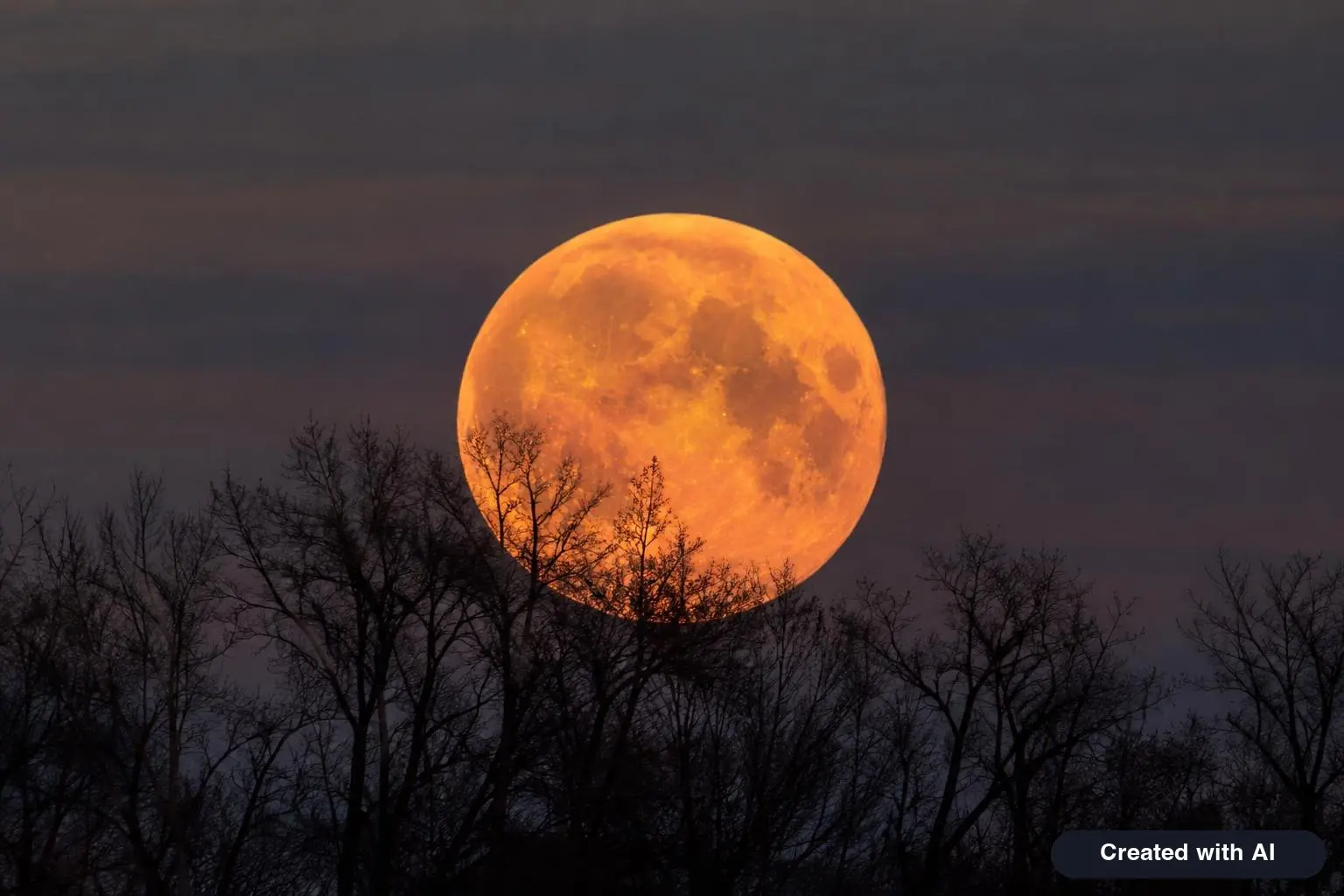
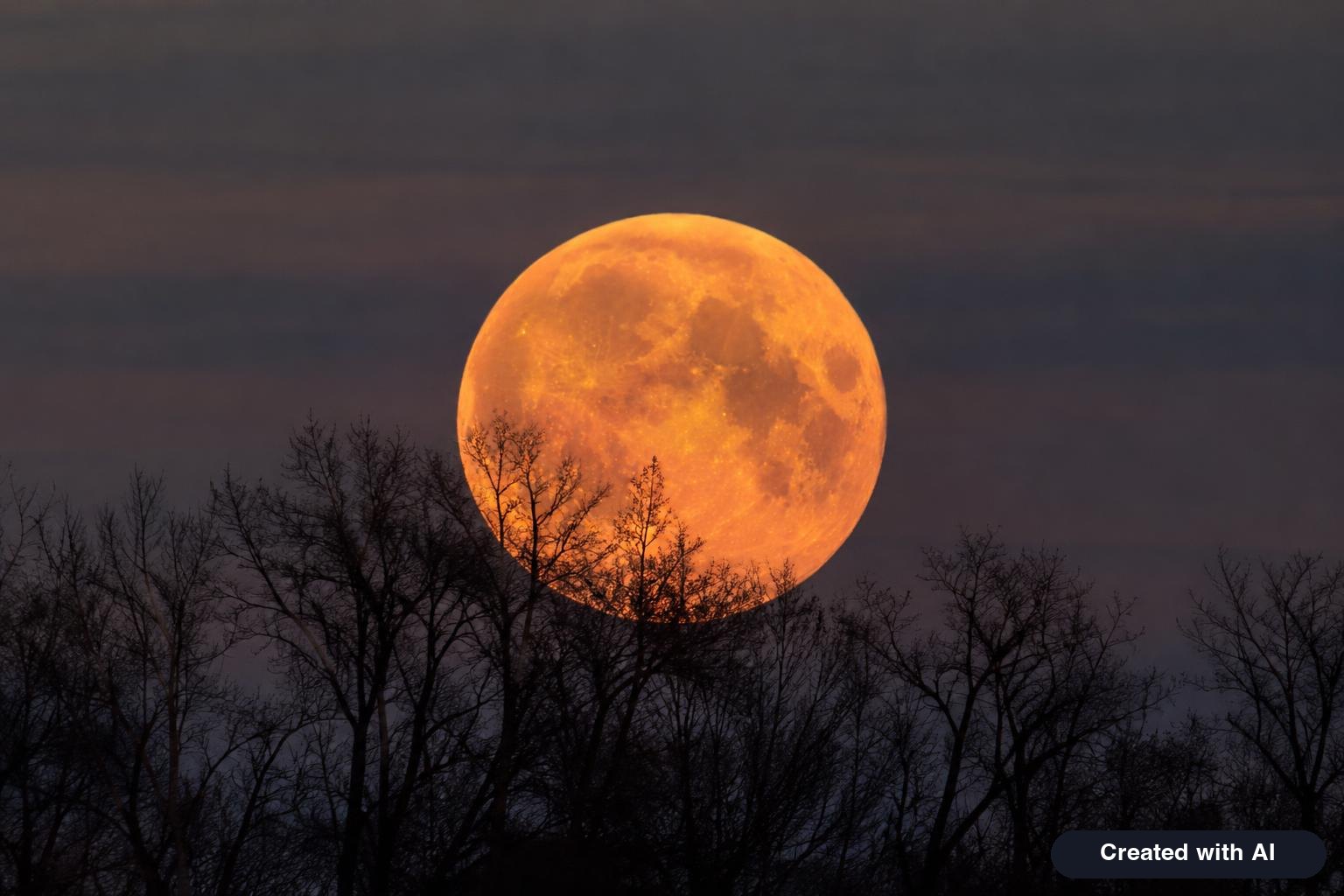
The Beaver Moon, November's full moon, is full on Tuesday, November 24, 2026, at 9:53 a.m. Eastern Standard Time (14:53 UTC), according to timeanddate.com and The Old Farmer's Almanac. That moment comes after the moon has set for most of the United States, so the best time to see it is at moonrise on the evenings of Monday, November 23, and Tuesday, November 24. On both nights it will look completely full.
This year the Beaver Moon is also a supermoon. The moon reaches perigee, its closest point to Earth this month, about a day after the full phase. The Almanac counts it as the first of three supermoons in a row, followed by the December and January full moons.
The name comes from late autumn in North America. It is the season when beavers move into their lodges for winter and when fur trappers once set beaver traps before the water froze. Here is when to look, what to expect and where the name comes from.
When is the Beaver Moon 2026?
The full moon falls on Tuesday, November 24, 2026, at 14:53 UTC. Astronomers give the time in UTC (Coordinated Universal Time) because the full moon happens at the same instant everywhere; only the clock time changes by time zone.
For watching, moonrise matters more than the exact peak. On the evening of November 24, the moon rises in the northeast at about sunset. These are the moonrise times from Star Walk and, for Denver, timeanddate.com:
| City | Moonrise, Tuesday, Nov. 24 |
|---|---|
| New York | 4:16 p.m. EST |
| Chicago | 4:08 p.m. CST |
| Denver | 4:28 p.m. MST |
| Los Angeles | 4:43 p.m. PST |
Times shift by a few minutes within each metro area, and hills or buildings on the eastern horizon will delay the moment you actually see it. On Monday, November 23, the moon rises roughly 45 to 55 minutes earlier, while it is still light. On Wednesday, November 25, it rises about an hour later, after dark.
Full moon time in every US time zone
Converted from 14:53 UTC, the peak falls in the morning everywhere in the United States:
| Time zone | Full moon | Date |
|---|---|---|
| Eastern (EST) | 9:53 a.m. | Tuesday, November 24, 2026 |
| Central (CST) | 8:53 a.m. | Tuesday, November 24, 2026 |
| Mountain (MST) | 7:53 a.m. | Tuesday, November 24, 2026 |
| Pacific (PST) | 6:53 a.m. | Tuesday, November 24, 2026 |
| Alaska (AKST) | 5:53 a.m. | Tuesday, November 24, 2026 |
| Hawaii (HST) | 4:53 a.m. | Tuesday, November 24, 2026 |
| UTC | 14:53 | Tuesday, November 24, 2026 |
Daylight saving time ended on Sunday, November 1, 2026, so these are all standard times.
At the exact moment of full moon the moon is below the horizon, or just setting, for most of the country, and the sun is up. That is why the evenings on either side are the best times to look. The difference in brightness between 99% and 100% illumination is not visible to the eye, so the moon will look full on both the 23rd and the 24th.
Is the November 2026 full moon a supermoon?
Yes. "Supermoon" is a popular term rather than a formal astronomical one, but it is commonly used for a full moon that happens near perigee, the closest point of the moon's elliptical orbit. In November 2026 the full moon comes on the 24th, and perigee follows on November 25 at 4:00 p.m. EST, at a distance of 359,347 km (223,288 miles), according to timeanddate.com.
At the moment it is full, the moon will be about 360,768 km from Earth, according to Star Walk. That is far closer than the year's smallest full moon, the May 31 micromoon, at 406,135 km. Star Walk estimates the Beaver Moon will look about 6.5% larger and 13.5% brighter than an average full moon. The Almanac puts the maximum at up to 8% larger and 16% brighter. Either way, most people won't notice the difference without a side-by-side photo.
What you will notice is the "moon illusion": a moon near the horizon looks huge next to trees and buildings, then seems to shrink as it climbs. The effect happens with every full moon. A supermoon simply gives photographers a slightly larger disk to work with.
The supermoon run continues. December's full moon, the Cold Moon, comes just hours before perigee on December 24, when the moon will be only 356,650 km from Earth. That makes December's supermoon closer than November's.
Why is it called the Beaver Moon? Names and folklore
Full moon names come from Native American, colonial American and European traditions, and each one ties the month to what was happening in nature. According to The Old Farmer's Almanac, November's moon is the Beaver Moon because this is when beavers begin sheltering in their lodges, having stored enough food for the winter. During the North American fur trade, November was also the season for trapping beavers, whose pelts were at their thickest before winter.
The Almanac lists several other November names:
- Digging or Scratching Moon (Tlingit): animals forage for fallen nuts and green shoots, and bears dig their winter dens.
- Deer Rutting Moon (Dakota and Lakota): deer are looking for mates.
- Whitefish Moon (Algonquin): whitefish spawn.
- Frost Moon (Cree and Assiniboine): the cold weather is setting in.
- Freezing Moon (Anishinaabe): winter is approaching.
All of these names describe the same few weeks of late autumn: animals getting ready, the first hard frosts and lakes beginning to freeze.
How to see and photograph it
Find a spot with a clear view of the eastern horizon – a beach, an open field, a hilltop or the top floor of a parking garage – and arrive a few minutes before moonrise. The moon rises in the east around sunset, crosses the southern sky during the night and sets in the west around sunrise.
Let your eyes adjust to the dark for about 20 minutes, and avoid looking at bright screens. The full moon is bright enough to see easily without any equipment; binoculars show the dark "seas" (maria) and the bright rays around crater Tycho.
For photos with a dedicated camera:
- Lens: a telephoto of 200 mm or longer makes the moon big enough in the frame to show surface detail.
- Support: use a tripod and a remote release or the self-timer to avoid camera shake.
- Settings: start in manual mode at ISO 100–200 and f/8–f/11, with a shutter speed of about 1/125 to 1/250 of a second. The full moon is a sunlit surface, so it needs far less exposure than most people expect.
- Timing: shoot in the first half hour after moonrise, while the sky still has color and you can include buildings, trees or ridgelines in the frame.
On a phone, tap the moon to focus, then drag the exposure slider down until the surface detail appears instead of a white blob. A small phone tripod and the zoom lens (if your phone has one) make a big difference. In editing, lower the highlights and add a little contrast to bring out the craters.
Best places and conditions to watch
The one thing you need for moonrise is a clear view low to the east. Tall buildings, tree lines and hills will hide the moon for its first minutes above the horizon, so pick an east-facing beach, an open field, a large park or the top level of a parking garage. In hilly country, a ridge beats a valley.
Light pollution matters far less for a full moon than for meteors or faint stars; the moon is easy to see from the middle of a city. A darker site does give more contrast, and moonlight there is bright enough to cast shadows. If you drive somewhere unfamiliar, check it in daylight for safe parking and an open eastern view.
Clouds are the real risk. Check the cloud-cover forecast a day or two ahead and have a backup spot in mind. Thin haze can put a halo around the moon but softens surface detail.
Late November evenings are cold in much of the country. Dress in layers, bring gloves, a hat, a folding chair and a hot drink, and keep your phone screen dim while you wait. Dew often forms on cold, clear nights, so keep lens caps on binoculars and cameras until you use them. A tripod set on pavement shakes less than one on grass or a wooden deck.
Planning apps that show the moon's path over a camera view of your surroundings can help you line up the rising moon behind a landmark before the night itself.
Moonrise times on November 23–25 in 14 US cities
These moonrise times come from 77.today's own lunar ephemeris and are given in local standard time. In most cities the moon rises about 45 minutes to an hour later each evening; in Anchorage the gap is much smaller. On Monday, November 23, it comes up in the afternoon while it is still light in most of the lower 48. On Wednesday, November 25, it rises later, in a darker sky.
| City | Monday, Nov. 23 | Tuesday, Nov. 24 | Wednesday, Nov. 25 |
|---|---|---|---|
| New York (ET) | 3:29 p.m. | 4:16 p.m. | 5:15 p.m. |
| Boston (ET) | 3:11 p.m. | 3:57 p.m. | 4:55 p.m. |
| Washington, DC (ET) | 3:47 p.m. | 4:35 p.m. | 5:35 p.m. |
| Atlanta (ET) | 4:32 p.m. | 5:23 p.m. | 6:24 p.m. |
| Miami (ET) | 4:34 p.m. | 5:28 p.m. | 6:31 p.m. |
| Chicago (CT) | 3:21 p.m. | 4:08 p.m. | 5:07 p.m. |
| Dallas (CT) | 4:26 p.m. | 5:18 p.m. | 6:20 p.m. |
| Houston (CT) | 4:27 p.m. | 5:20 p.m. | 6:23 p.m. |
| Denver (MT) | 3:40 p.m. | 4:28 p.m. | 5:28 p.m. |
| Phoenix (MST) | 4:27 p.m. | 5:19 p.m. | 6:21 p.m. |
| Los Angeles (PT) | 3:51 p.m. | 4:43 p.m. | 5:45 p.m. |
| Seattle (PT) | 3:22 p.m. | 4:04 p.m. | 5:03 p.m. |
| Anchorage (AKST) | 2:40 p.m. | 2:49 p.m. | 3:25 p.m. |
| Honolulu (HST) | 5:05 p.m. | 6:03 p.m. | 7:08 p.m. |
The times are for the moon's upper edge clearing a flat horizon. If trees, buildings or mountains block the east, you may not see it until several minutes later, so be in place a little before the listed time.
November 2026 moon phase calendar
The main moon phases for November and December 2026, from 77.today's ephemeris, converted from UTC to Eastern Standard Time (daylight saving time ends November 1, 2026):
| Phase | Date and Time (ET) |
|---|---|
| Last Quarter | November 1, 3:28 p.m. |
| New Moon | November 9, 2:02 a.m. |
| First Quarter | November 17, 6:48 a.m. |
| Full Moon (Beaver Moon) | November 24, 9:53 a.m. |
| Last Quarter | December 1, 1:09 a.m. |
| New Moon | December 8, 7:52 p.m. |
| First Quarter | December 17, 12:43 a.m. |
| Full Moon (Cold Moon) | December 23, 8:28 p.m. |
The new moon on November 9 is the darkest stretch of the month and the best time for faint stars and galaxies. After first quarter on November 17, the moon grows toward full; around first quarter, binoculars show the most crater detail along the terminator, the line between the lit and dark parts of the moon. At full phase on November 24, our ephemeris puts the moon 360,797 km from Earth. December's full moon, the Cold Moon, comes on December 23 at 8:28 p.m. EST at 356,763 km, closer than November's.
November 2026 night sky: meteor showers and the next full moon
One week before the Beaver Moon, the Leonid meteor shower peaks. EarthSky predicts the peak around 0:00 UTC on November 18, 2026, and recommends watching from late on the night of November 17 until dawn on November 18. The first-quarter moon on November 17 sets around midnight, so the hours before dawn are dark. Even so, EarthSky expects somewhat reduced numbers this year.
The Leonids come from debris left by Comet Tempel-Tuttle. The meteors seem to come from the constellation Leo, but they can appear anywhere in the sky. Dress warmly, lie back in a reclining chair and look up – not at the radiant – for at least half an hour.
The next full moon is the Cold Moon, on Wednesday, December 23, 2026, at 8:28 p.m. EST (01:28 UTC on December 24). It is the last full moon of the year and the second supermoon in a row.
Dark-sky watchers who are out for the moon or the meteors can also check the 77.today northern lights forecast tonight; strong geomagnetic storms sometimes push the aurora far enough south to be seen from the northern United States.
Beaver Moon meaning and traditions
For the people who named it, the Beaver Moon was a practical signal: finish the work of autumn before the freeze. Food had to be stored, traps set and shelters made ready. Many people still treat it as a seasonal marker – a good night to take stock of the year as the days get shorter and the holidays approach. In 2026 it falls two days before Thanksgiving, which gives it a natural place on the calendar.
For the spiritual and astrological side of lunar cycles, browse the 77.today esoteric section. If you photographed the Beaver Moon in 2025, the same techniques work this year – with the bonus that 2026's is a supermoon.
Frequently asked questions
What is a Beaver Moon?
It is the traditional name for the full moon in November. According to The Old Farmer's Almanac, it marks the time when beavers shelter in their lodges after storing food for winter; during the North American fur trade it was also the season for trapping beavers for their thick winter pelts.
When is the Beaver Moon in 2026?
The moon is full on Tuesday, November 24, 2026, at 14:53 UTC – 9:53 a.m. EST, 8:53 a.m. CST, 7:53 a.m. MST and 6:53 a.m. PST. The best viewing is at moonrise on the evenings of Monday, November 23, and Tuesday, November 24.
Is the November 2026 full moon a supermoon?
Yes. The full moon comes about a day before perigee, the moon's closest point to Earth (November 25). Star Walk puts the distance at full phase at about 360,768 km and says the moon will look about 6.5% larger and 13.5% brighter than an average full moon – a difference most people won't notice without a side-by-side comparison.
Why is it called the Beaver Moon?
Because beavers are retreating into their lodges for winter at this time of year, and because fur trappers set beaver traps in November before swamps and ponds froze over.
What are other names for the November full moon?
The Old Farmer's Almanac lists the Digging or Scratching Moon (Tlingit), Deer Rutting Moon (Dakota and Lakota), Whitefish Moon (Algonquin), Frost Moon (Cree and Assiniboine) and Freezing Moon (Anishinaabe).
When is the next full moon after the Beaver Moon?
The Cold Moon, on Wednesday, December 23, 2026, at 8:28 p.m. EST (01:28 UTC on December 24). It is also a supermoon – and an even closer one than November's.
Log in to comment
No comments yet. Be the first.