Dancing Plague of 1518: The Strasbourg Dancing Mania Explained
- In the summer of 1518, hundreds of people in Strasbourg began dancing uncontrollably in the streets for weeks.
- Many of the dancers collapsed from sheer exhaustion; accounts of the time also report heart attacks and deaths.
- Scientists suggest mass psychological stress or ergot poisoning (a hallucinogenic fungus) as potential causes.
- Local authorities mistakenly encouraged the hysteria by hiring musicians to help the afflicted "dance it out."
- Modern psychologists compare the event to social contagion, similar to how viral trends and panic spread today.
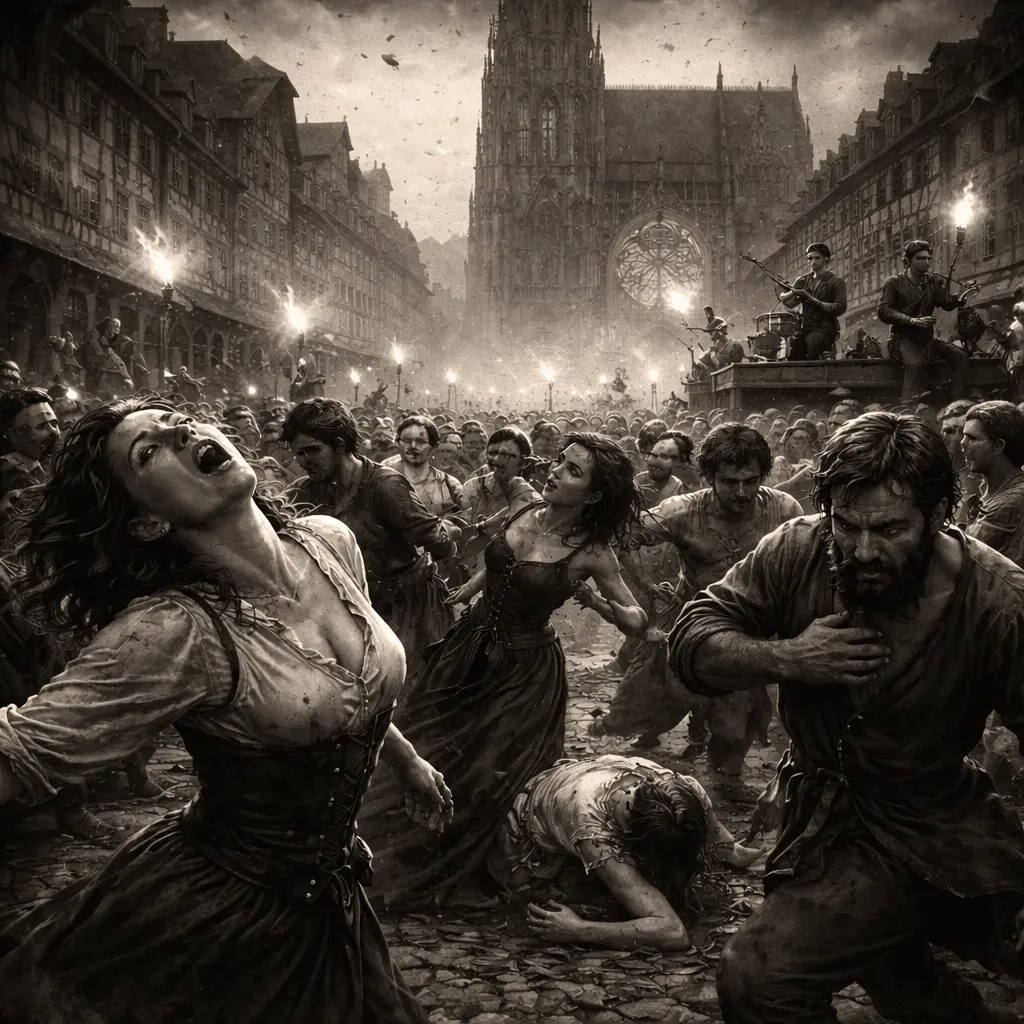
When you think of Strasbourg today, you likely picture an entirely different scene. It is an orderly European city where everything is meticulously organized—home to the European Parliament, courts, politicians, meetings, documents, and translators. It is a city where decisions are made about human rights, laws, and how the whole of Europe will live. Everything seems rational, calculated, and controlled.
And then a historical fact emerges that throws everything a bit off balance. Because this same city was once the site where people danced en masse until they died. Not metaphorically. They simply danced until their bodies could no longer endure it.
How the dancing plague of 1518 began and spread so quickly
In the summer of 1518, Strasbourg became the epicenter of a bizarre mass hysteria. The event, which we now call the dancing plague of 1518, sounds as if someone mixed medical history with a dark legend.
It all started with one person. A woman stepped out into the street and began to dance. Not at a festival, not to music, nothing of the sort. She just danced. And she did not stop. For one day, a second, a third. At first, it seemed like an isolated incident—perhaps a health issue or a psychological crisis, which would not be unusual by today's standards.
The problem is that it did not end there. A few days later, others joined her. This is the moment that remains difficult to explain logically even now. No one invited them, there was no event, and there was no explanation. People simply started doing the same thing. One after another.
Within a few weeks, there were hundreds of them. In the center of the city, people danced without stopping, collapsed, got back up, and danced again. No one fully understood what was happening. The human body, of course, has its limits. People began to drop from exhaustion; according to accounts of the time, some suffered heart attacks and some simply never got back up, although historians still debate how many actually died.
Why people danced to death and the theories scientists suggest
To this day, there is no single clear explanation for what actually happened, leading many to ask: the dancing plague of 1518, was it real? Historical records confirm it was, but the cause remains debated. Some experts point to a mass psychological reaction. People were living under immense stress, facing famine, disease, and fear of the future. At some point, all that tension simply erupted—not through words, but through the body.
Another theory suggests ergotism, which is poisoning from ergot. This is a fungus that grows on grains and can cause hallucinations and spasms. It is sometimes referred to as a kind of natural LSD of the Middle Ages. While it sounds intriguing, it does not fully explain why people danced for so long and in such a relatively coordinated manner.
Then there is the question of belief. At the time, there was a strong conviction that a person could be struck by St. Vitus's curse. In this context, the dancing was seen not as a symptom, but as a punishment. When an entire community shares such a belief, the line between reality and conviction can easily blur.
The reaction of the authorities is also fascinating. Officials decided that the afflicted people needed to "dance it out." They hired musicians and organized spaces where the crowds could dance. Today, this sounds counterproductive, but at the time, it seemed perfectly logical. Naturally, it did not help.
Are such mass phenomena possible today?
The most interesting part is that we love to think we are different now. We assume such things could only happen back then because people were less educated and more superstitious. But if you look at the world today, that feeling quickly fades.
We might not dance to death in city squares, but mass phenomena have not disappeared. Social media waves, sudden trends, and episodes of panic occur where everyone does the same thing without really understanding why. Around the globe, we see similar patterns—sometimes a single message or video is enough to make a behavior spread like wildfire.
Psychologists call this social contagion. Emotions and behaviors transfer from person to person, sometimes completely unnoticed. This makes the contrast with modern-day Strasbourg even more compelling. The city where European legal and political issues are now resolved was once a place where people stood and watched their neighbors, unable to comprehend why they were dancing to death. And perhaps, they even joined them.
Ultimately, the event vanished just as suddenly as it began. The exact dancing plague of 1518 end date is hard to pinpoint, as the phenomenon simply faded out by late summer without a clear resolution or cure. This is probably why the story remains so captivating. It is not just about the past; it is a stark reminder of how human beings react when the pressure becomes too much to bear.
Frequently asked questions
The dancing plague of 1518: was it real?
Yes, historical records confirm that in the summer of 1518, hundreds of people in Strasbourg engaged in uncontrollable, non-stop dancing that lasted for weeks. Contemporary accounts report deaths from exhaustion, although historians debate how many people died.
What caused the dancing plague?
Experts propose several theories, including mass psychological hysteria triggered by extreme stress, famine, and disease. Another theory is ergotism, a type of food poisoning from a fungus on grains that causes hallucinations and spasms.
What was the dancing plague of 1518 end date?
There is no exact end date. The phenomenon simply faded away by late summer as suddenly as it had begun, without any clear medical or political resolution.
Log in to comment
No comments yet. Be the first.