DeepSeek V4 Pro Price Cut, Huawei Chips & $9B US AI Intel Plan
- Huawei unveiled the "Tau Scaling Law" to design 1.4-nanometer equivalent chips and bypass US sanctions.
- DeepSeek permanently reduced the API usage price for its flagship DeepSeek V4 Pro AI model by 75 percent.
- The White House requested $9 billion to fund Nvidia Grace Blackwell AI chips for US intelligence agencies.
- A halted US executive order on AI oversight highlights the tension between national security and tech competition.
- SpaceX successfully tested its Starship V3 configuration, deploying satellites and gathering crucial flight data.
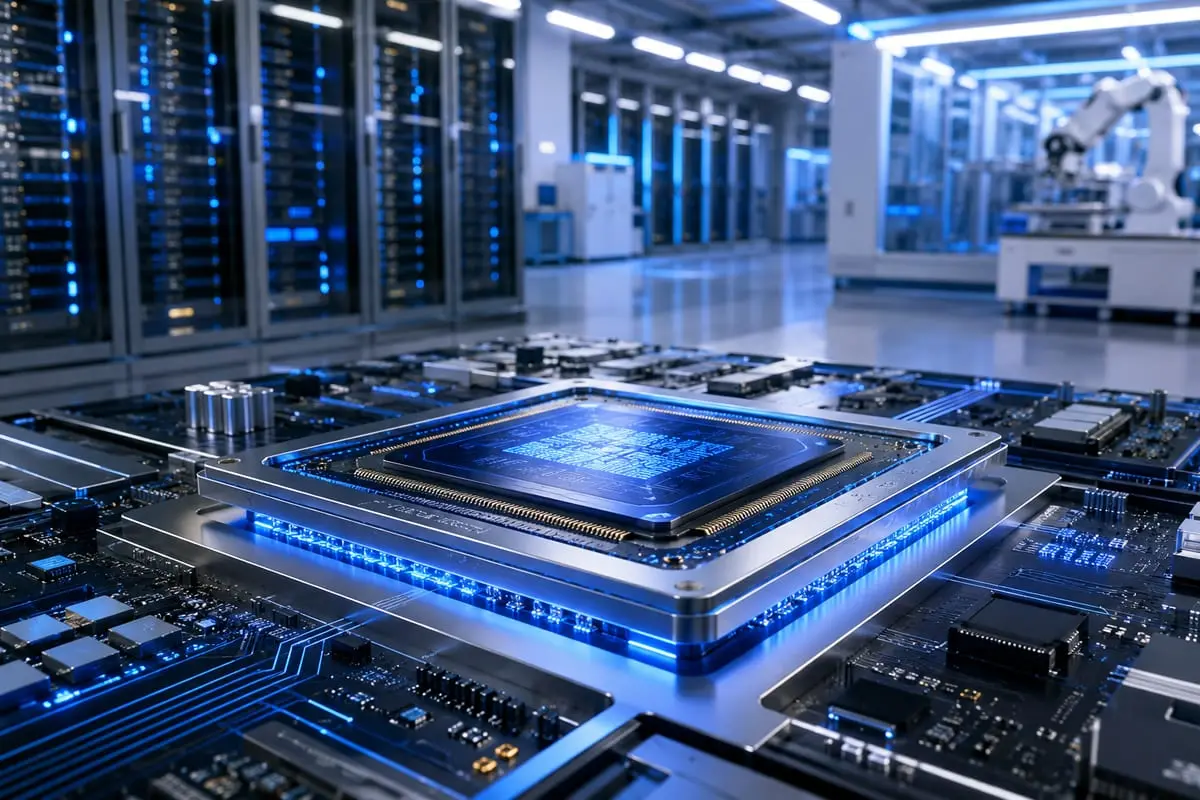
- Huawei announces new chip development path to bypass US sanctions
- He Tingbo becomes the main symbol of China's semiconductor self-reliance
- DeepSeek V4 Pro price permanently cut by 75 percent
- US intelligence agencies request $9 billion for AI chips and infrastructure
- Halted US AI oversight order reveals struggle between security and competition
- SpaceX Starship V3 test strengthens the space infrastructure race
Huawei announces new chip development path to bypass US sanctions
Chinese tech giant Huawei Technologies presented a new chip design principle called the "Tau Scaling Law" at a semiconductor symposium in Shanghai. The company claims this method should allow the creation of high-end chips with a transistor density equivalent to a 1.4-nanometer technological process within five years. This is a highly ambitious goal, as TSMC currently uses 2-nanometer technology and plans to begin 1.4-nanometer mass production in 2028.
The key detail is that Huawei is not relying on the traditional path of increasing performance solely by shrinking transistors. The Tau Scaling Law focuses on shortening the signal and data paths within the chip itself and in computing systems. Analyst He Hui from Omdia described this as a transition from node shrinkage to systemic efficiency improvements—shorter connections, lower latency, and faster data movement.
Huawei also announced that its Kirin chips, arriving later in 2026, will be the first to use the related LogicFolding architecture. The company notes that under the Tau Scaling Law, it has already designed and mass-produced 381 chips over six years for use in smartphones and AI computing.
He Tingbo becomes the main symbol of China's semiconductor self-reliance
Huawei's semiconductor business head, He Tingbo, has become one of the most important figures in the Chinese technology industry. She has led Huawei's chip development since 2003, when she was allocated a $400 million annual budget. Today, He Tingbo is the president of Huawei's semiconductor business, director of the scientists' committee, and one of two women on the company's 17-member board.
He Tingbo's career is closely tied to the development of HiSilicon. This Huawei chip design division was officially established in 2004 and grew from an internal department into one of the most extensive semiconductor design structures in China. Following the 2019 US sanctions, the team led by He Tingbo became a central part of Huawei's survival strategy.
Huawei states that its team has mass-produced 381 chip models based on the new design principle over the past six years. This information is significant globally: it shows that while US sanctions restricted access to the most advanced manufacturing technologies, they simultaneously spurred the search for alternative architectures.
DeepSeek V4 Pro price permanently cut by 75 percent
Chinese AI company DeepSeek announced a permanent 75 percent reduction in the DeepSeek V4 Pro price for its flagship model. The API usage cost has been drastically reduced, translating to roughly $0.0035 to $0.83 per million tokens depending on the query type.
DeepSeek did not directly confirm whether the price cut is related to greater availability of Huawei Ascend 950 chips. However, the company previously indicated that the DeepSeek V4 Pro version cost up to 12 times more than the lighter V4-Flash model due to limited high-end computing capacity.
This is a major signal for the entire AI market. If DeepSeek can drastically lower the cost of using a more powerful model, the pressure will mount not only on Western services but also on local competitors. A price war in the AI model market is becoming a reality, driven not just by software, but by chip supply.
US intelligence agencies request $9 billion for AI chips and infrastructure
The US White House approved a request to allocate $9 billion for advanced AI chips and infrastructure dedicated to intelligence agencies. The Verge, citing The New York Times, reports that the CIA and NSA lack the computing power to run the latest AI models, prompting plans to purchase advanced chips and build infrastructure for Nvidia Grace Blackwell superchips. The funding still requires final approval from Congress.
This decision demonstrates that AI infrastructure is becoming a core component of national security. The focus is not on standard servers or office software, but on the massive computing power required for intelligence analysis, cyber defense, and big data processing.
The Grace Blackwell architecture is crucial because it combines a central processing unit and a graphics processing unit into a single high-performance platform designed for massive AI workloads. If the funding is approved, US intelligence agencies will become yet another major client in a market where the most advanced AI chips are already in short supply.
Halted US AI oversight order reveals struggle between security and competition
US President Donald Trump unexpectedly canceled the signing of a sweeping executive order on AI oversight. According to the Times of India, based on information from The New York Times and Politico, the order would have required companies like Google, Meta, OpenAI, and Microsoft to submit their most advanced AI models for federal security reviews before public release.
Trump explained the decision by stating he did not want to hinder US leadership in the AI sector. His comments highlight a clear political conflict: one side pushes for stricter security checks, while the other fears that regulation will slow down US companies in their competition with China.
A leaked draft of the order included provisions for faster cyber defense of federal systems, the use of AI to detect vulnerabilities, and broader cooperation with the private sector. Even if the document remains unsigned for now, the debate itself shows that AI security has moved to the highest levels of US politics.
SpaceX Starship V3 test strengthens the space infrastructure race
SpaceX conducted the 12th test flight of Starship, testing the upgraded Starship V3 configuration for the first time. The rocket launched from the Starbase facility in Texas, successfully separated its stages, and deployed 20 test Starlink satellites along with two modified diagnostic satellites that scanned the heat shield during flight. The upper stage performed a controlled splashdown in the Indian Ocean after more than an hour of flight.
The test was not without issues: one of the six upper-stage engines failed, preventing a planned in-space engine relight test, and the Super Heavy booster failed to execute its scheduled return burn. Nevertheless, the primary objectives were achieved, providing SpaceX with vital engineering data needed for future iterations.
SpaceX has already spent over $15 billion on the Starship project. This system is critical not only for Starlink satellite launches but also for NASA's Artemis program, where Starship is expected to play a key role in future lunar missions. For the technology market, this is yet another signal that space infrastructure is becoming just as competitive an arena as AI chips and data centers.
Frequently asked questions
What is Huawei's Tau Scaling Law?
It is a new chip design principle focused on shortening signal and data paths for systemic efficiency, aiming to achieve 1.4-nanometer equivalent performance within five years without relying solely on shrinking transistors.
How much does the DeepSeek V4 Pro cost now?
Following a permanent 75 percent price cut, the API usage cost for the DeepSeek V4 Pro model is roughly $0.0035 to $0.83 per million tokens, depending on the query type.
Why is the US government requesting $9 billion for AI?
The funding is intended to purchase advanced AI chips, such as Nvidia's Grace Blackwell superchips, to build massive computing infrastructure for intelligence agencies like the CIA and NSA.
Sources
- Reuters: Huawei proposes new path for chip development amid US sanctions
- Reuters: Huawei's 'chip queen' etches her name in China's tech folklore
- Reuters: China's DeepSeek to make permanent 75% price cut on flagship V4-Pro AI model
- The Verge: The White House is asking for $9 billion to buy AI chips for spies
- Times of India: Read AI oversight order that President Donald Trump said 'didn't like certain aspects of it'
- Reuters: SpaceX's upgraded Starship V3 blasts off in debut test flight in Texas
- Reuters. (2026). China's Huawei reveals chip design breakthrough amid US sanctions
- Reuters. (2026). Huawei's 'chip queen' etches her name in China's tech folklore
- Reuters. (2026). China's DeepSeek to make permanent 75% price cut on flagship V4-Pro AI model
- The Verge. (2026). The White House is asking for $9 billion to buy AI chips for spies
- Times of India. (2026). Read AI oversight order that President Donald Trump said 'didn't like certain aspects of it'
- Reuters. (2026). SpaceX's Starship flight hits most targets in pre-IPO test
Log in to comment
No comments yet. Be the first.