Haghpat Monastery, Armenia: The Stone Academies of Sanahin
- Haghpat and Sanahin are UNESCO World Heritage sites representing the pinnacle of medieval Armenian religious architecture.
- These complexes uniquely blend traditional Caucasian building techniques with Byzantine architectural elements.
- Founded in the 10th century, both sites served as vital centers for spiritual life, education, and manuscript illumination.
- The properties feature remarkably preserved churches, scriptoriums, belfries, and intricately carved stone crosses known as khachkars.
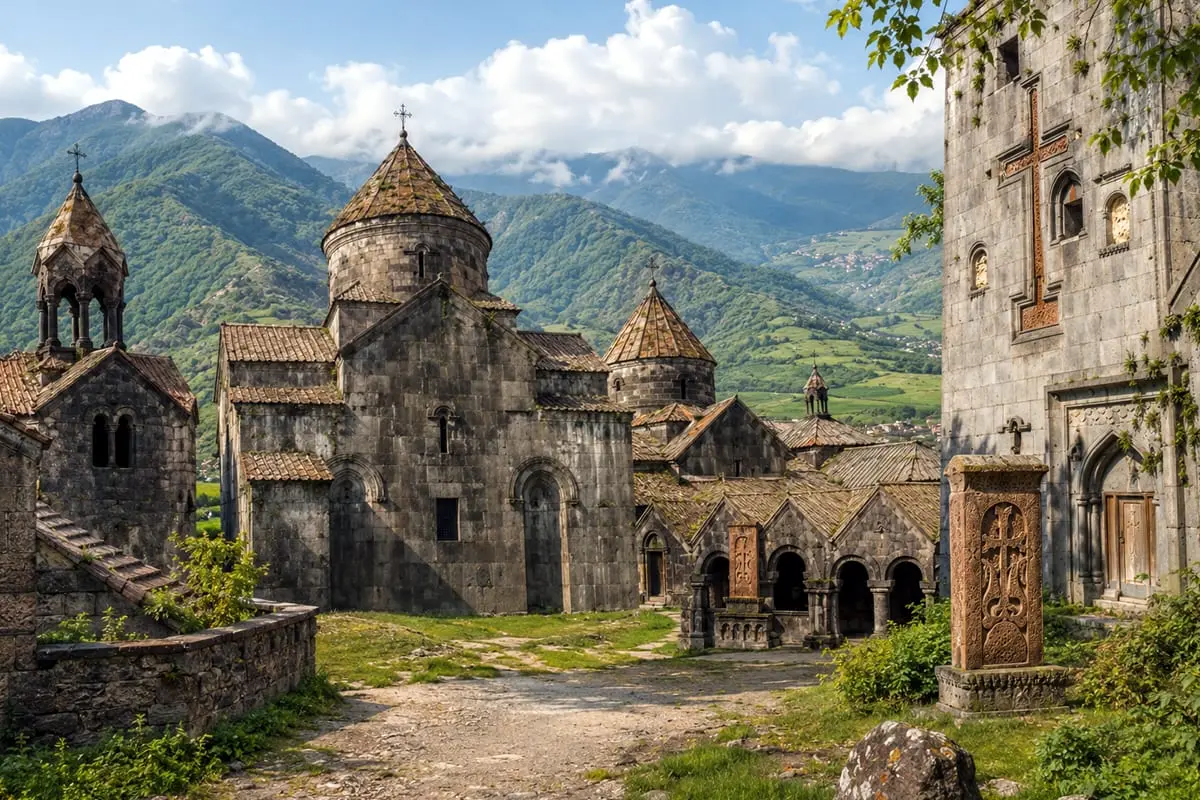
- Haghpat monastery, Armenia, and the Sanahin monastery complex preserve the peak of 10th–13th century Caucasian Christian architecture
- Queen Khosrovanuysh founded Haghpat monastery in 976, with the Church of St. Nshan as its core
- The Sanahin monastery complex served as a center for learning, manuscripts, and Bagratid dynasty memory
- Khachkars, belfries, and stone bridges reveal the mastery of medieval Armenia
- UNESCO status protects not just buildings, but the entirety of landscape, faith, and historical continuity
Haghpat monastery, Armenia, and the Sanahin monastery complex preserve the peak of 10th–13th century Caucasian Christian architecture
Haghpat and Sanahin form a UNESCO World Heritage site in the Lori region of Armenia. This serial cultural property consists of two distinct monastery complexes that developed between the 10th and 13th centuries. They reflect a period when Northern Armenia experienced a profound flourishing of religious architecture, learning centers, and manuscript culture. UNESCO describes these complexes as some of the highest achievements of Armenian religious architecture. [1]
The uniqueness of these monasteries lies in more than just their age. Haghpat and Sanahin blended Byzantine church architecture elements with local Caucasian building traditions. As a result, their form is not simply an imported style—it is a distinct response of Armenian mountain architecture to the influence of the Byzantine world. For this reason, UNESCO recognized the property under criteria II and IV.
The property was inscribed on the UNESCO World Heritage List in 1996, and its boundaries were significantly modified in 2000. The inscribed area covers 6.5 acres (2.65 hectares), with a buffer zone of 58.8 acres (23.8 hectares). It is a small territory in terms of size, but incredibly dense in historical content: churches, gavit-style vestibules, belfries, scriptoriums, refectories, chapels, tombs, khachkars, and stone bridges form a cohesive map of medieval Armenia's spiritual and intellectual culture.
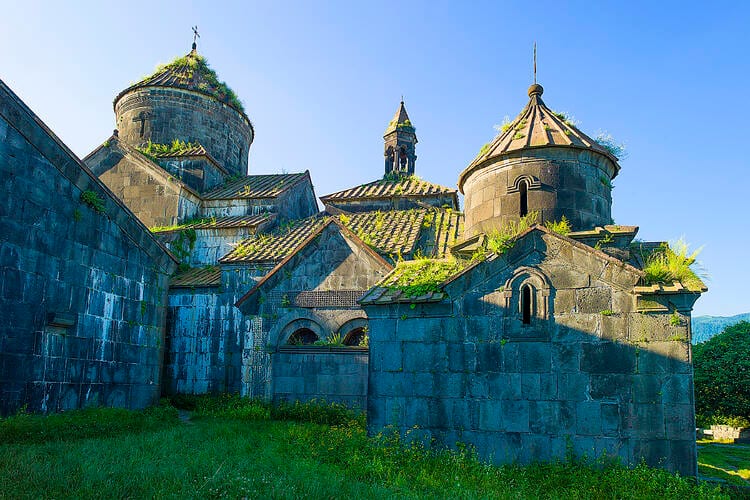
Queen Khosrovanuysh founded Haghpat monastery in 976, with the Church of St. Nshan as its core
Haghpat monastery was founded in 976 on the initiative of Queen Khosrovanuysh, wife of King Ashot III the Merciful of Armenia. The complex includes a narthex, two corridor-style tomb structures, a refectory, a scriptorium, the Hamazasp chapel, a belfry, several burial chapels, and khachkars—traditional Armenian stone crosses. The entire complex is surrounded by a fortified wall with towers, and its approaches were historically monitored from the 13th-century Kayanberd fortress.
The oldest building in the Haghpat complex is the Church of St. Nshan, built between 976 and 991 based on the design of the architect Trdat. It features a rectangular domed plan, slightly elongated along the east–west axis, with a cruciform interior layout. The central dome rests on four massive pillars built into the side walls, making the church's space feel compact, monumental, and precisely balanced.
Haghpat preserves the earliest layers of frescoes in its main apse. Their composition depicts Christ in Majesty seated on a throne, while the lower section originally featured scenes of the Annunciation, Nativity, and Baptism. On the eastern facade, bas-reliefs of Kings Smbat and Gurgen holding a model of the church are considered highly significant examples of medieval Armenian sculpture.
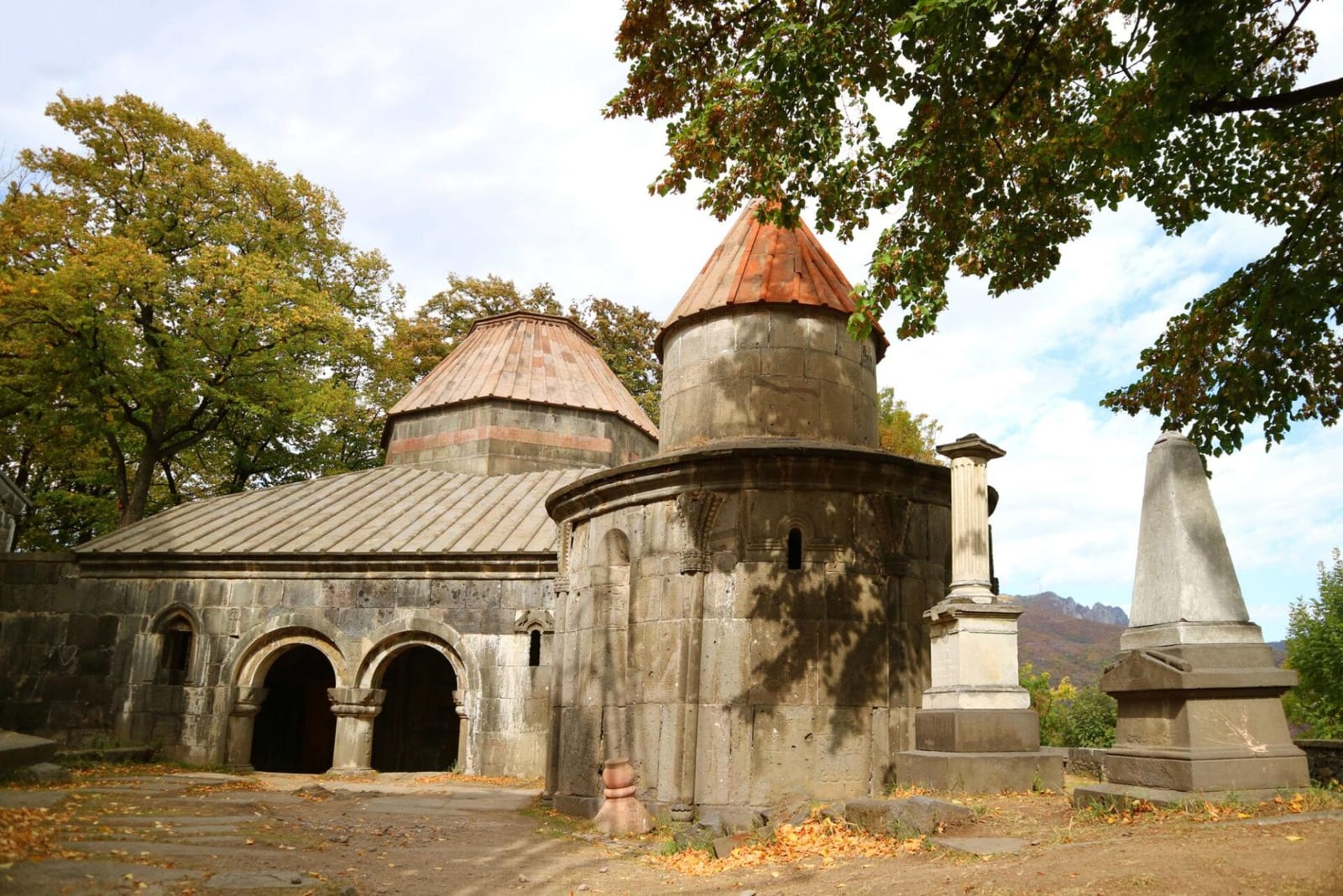
The Sanahin monastery complex served as a center for learning, manuscripts, and Bagratid dynasty memory
The Sanahin monastery was more than just a religious space during the Middle Ages. UNESCO notes that it served as the administrative center and family burial site of the Kyurikid Bagratids in the 10th and 11th centuries, as well as the bishop's residence until the 11th century. This means that Sanahin combined multiple functions: the representation of power, dynastic memory, spiritual life, and education.
The Sanahin monastery complex includes the churches of St. Astvatsatsin, St. Amenaprkich, and St. Grigor, along with narthexes, a forechurch, a scriptorium, a belfry, and an academy. The Church of St. Astvatsatsin dates back to 928–944, while the Church of St. Amenaprkich was built between 957 and 966 under the patronage of Queen Khosrovanuysh. These structures demonstrate how medieval Armenian architecture sought a balance between a central dome, a square base, and a clear interior space.
Particularly important is the Sanahin scriptorium, built in 1063. It had a square plan, was vaulted, and featured niches for storing codices and books. UNESCO describes Sanahin as a site renowned for its school of illuminators and calligraphers. Such scriptoriums were not merely book repositories—they were centers of knowledge reproduction, where a manuscript became a text, a work of art, and a form of political and religious memory.
Khachkars, belfries, and stone bridges reveal the mastery of medieval Armenia
One of the most striking features of Haghpat and Sanahin is the presence of khachkars, Armenian stone crosses where a religious symbol transforms into intricate stone ornamentation. Sanahin has preserved more than 50 khachkars, with the Grigor Tuteordi and Sargis khachkars considered the most valuable. UNESCO ranks them among the finest examples of medieval Armenian sculpture.
The Haghpat belfry, built in 1245, is considered the earliest example of this type of structure. Its architectural design is highly unusual: a cruciform first-floor plan supports an octagonal second floor, topped by a belfry resting on seven columns. The Sanahin belfry, built between 1211 and 1235, is also among the oldest surviving examples of Armenian belfries.
The UNESCO property also includes a monumental single-arch stone bridge over the Debed gorge. It has survived in its original form since the 13th century. This bridge is significant not only as a marvel of engineering but also as a reminder that these monasteries were not isolated stone islands in the mountains. They functioned within active networks of roads, settlements, trade, and pilgrimage.
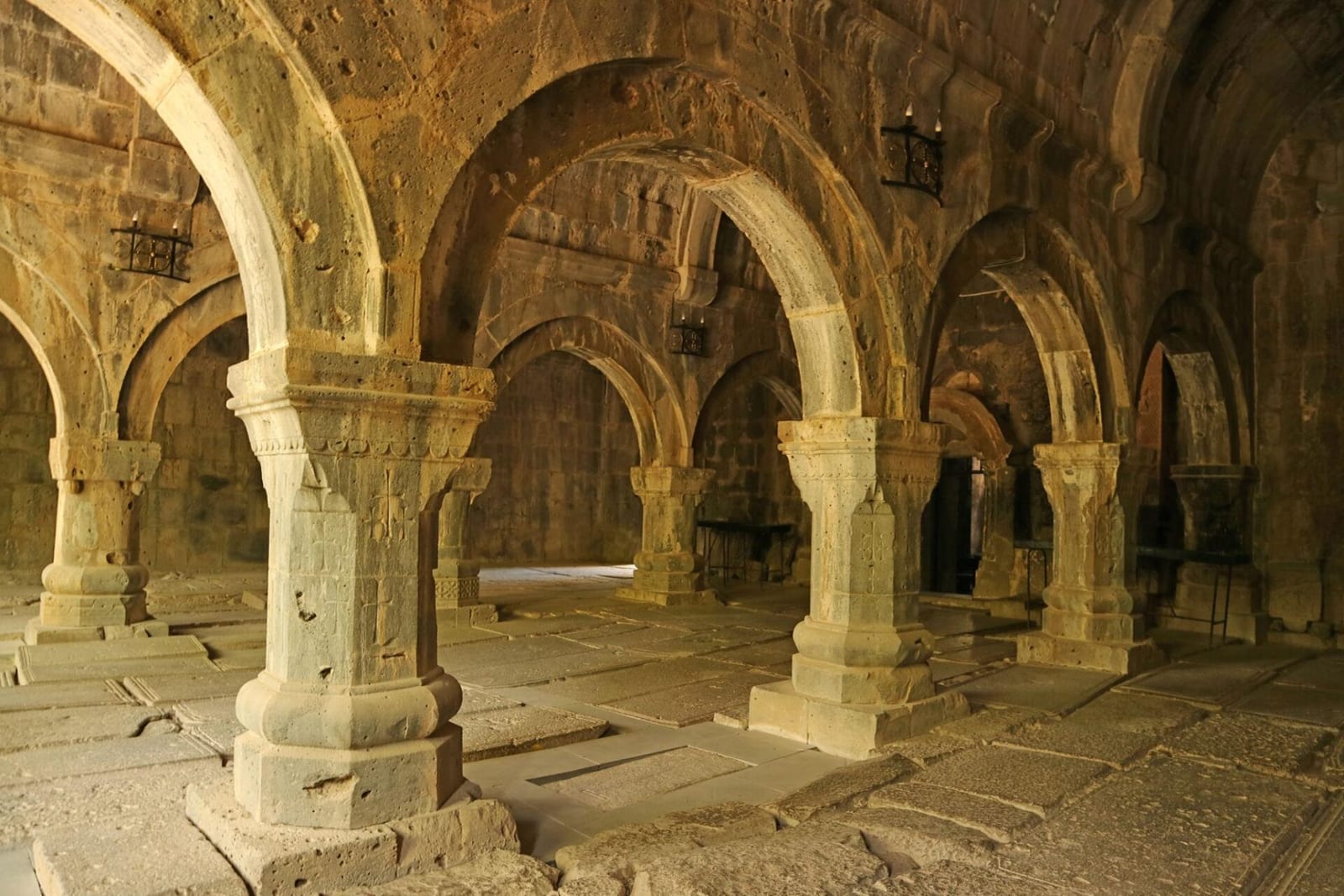
UNESCO status protects not just buildings, but the entirety of landscape, faith, and historical continuity
UNESCO emphasizes that the Haghpat and Sanahin complexes have maintained sufficient integrity to convey their outstanding universal value. According to UNESCO assessments, their authenticity remains intact, even though the structures have endured damage and undergone restorations over the centuries. The current layout of the complexes illustrates the organic growth of monastic ensembles—each new extension or reconstruction emerged in response to practical, liturgical, and historical needs.
The primary threats to this property stem from its location in an active seismic and industrial zone, environmental pollution, tourism pressures, and the natural decay of the structures. Protection is grounded in Armenian legislation, and the complexes themselves belong to the Armenian Apostolic Church. Maintenance involves Armenian cultural institutions, Church structures, specialized councils, and heritage protection agencies.
Haghpat and Sanahin remain vital because their value extends far beyond architecture. They represent the history of the Armenian Christian state, its dynasties, schools, manuscripts, wars, restorations, and resilience, all carved into stone. These monasteries serve as a testament to a time when faith, power, and scholarship could converge in a single complex in the Caucasus mountains—under a heavy dome, by the niches of a scriptorium, and beside a stone cross meant to outlast the name of the person who carved it.
Frequently asked questions
Why is Haghpat monastery, Armenia, famous?
Haghpat monastery is famous for being a masterpiece of medieval Caucasian Christian architecture, blending Byzantine elements with local traditions, and for its well-preserved churches, scriptoriums, and intricately carved khachkars.
When was the Sanahin monastery complex built?
The Sanahin monastery complex was primarily developed between the 10th and 13th centuries, with its oldest surviving structures, like the Church of St. Astvatsatsin, dating back to the years 928–944.
Are Haghpat and Sanahin recognized by UNESCO?
Yes, both Haghpat and Sanahin were inscribed as a joint UNESCO World Heritage site in 1996, recognized for their exceptional architectural, cultural, and historical value.
Log in to comment
No comments yet. Be the first.