Oath Ceremony: What to Expect at Your Naturalization
- The ceremony may be held the same day as your interview. Otherwise USCIS sends the date on Form N-445. USCIS does not publish an average wait.
- At check-in an officer reviews your N-445 questionnaire and collects your green card. You receive the Certificate of Naturalization after the oath.
- A first passport costs $130 plus a $35 acceptance fee, with routine processing of 4 to 6 weeks as of October 2026. Replacing a lost certificate costs $505 to $555.
- Oath ceremony basics
- How long after the interview is the oath ceremony?
- Form N-445: the notice and the questionnaire
- What to bring and what to wear
- What happens at the ceremony
- The Oath of Allegiance: full text
- Your Certificate of Naturalization
- Your first week as a citizen
- If something goes wrong before the oath
- Where this fits in the process
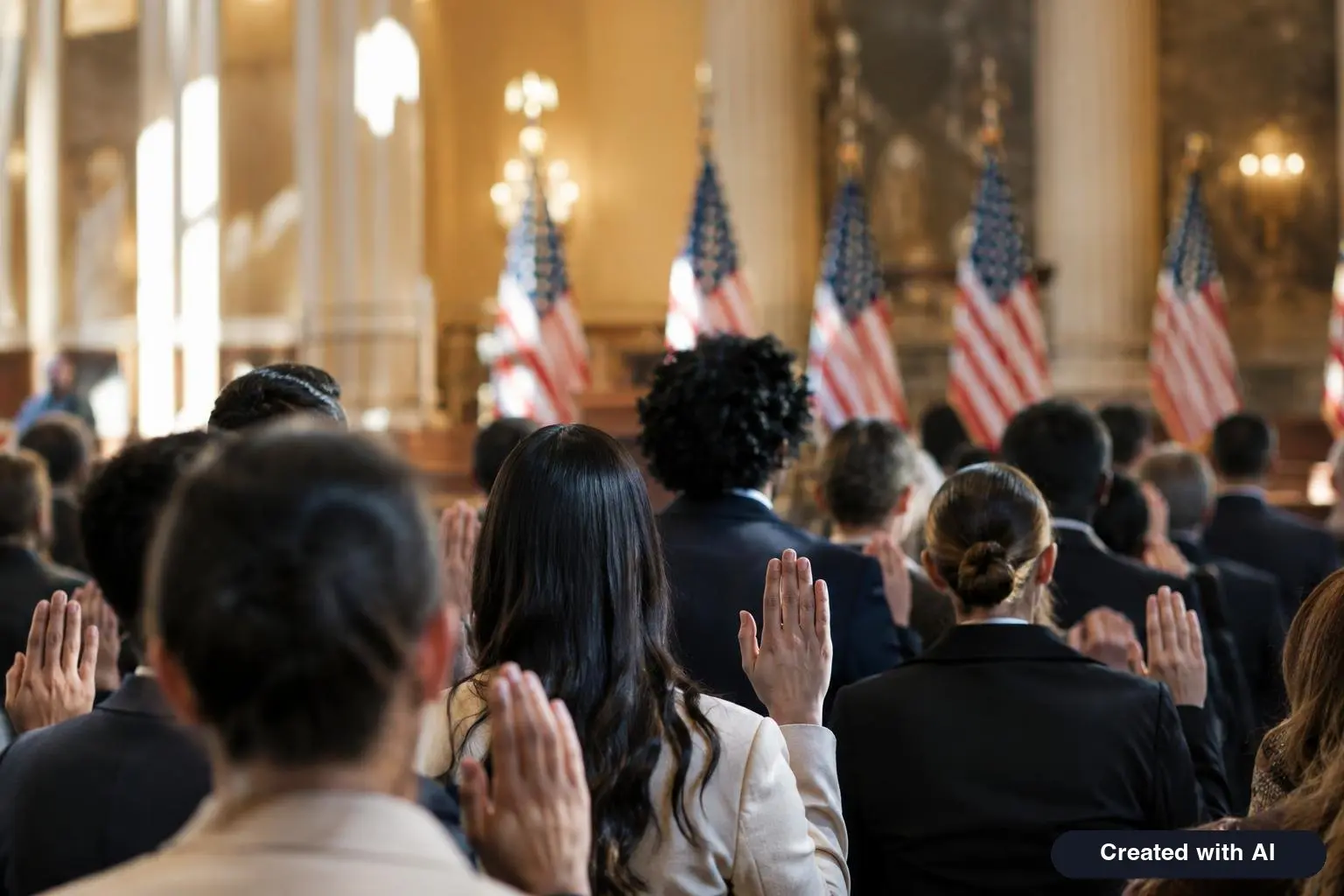
The oath ceremony is the last step of naturalization and the moment you legally become a U.S. citizen. After USCIS approves your Form N-400, you are scheduled to take the Oath of Allegiance at a public ceremony, either the same day as your interview or on a later date sent to you on Form N-445. At the ceremony you check in, hand in your green card, take the oath with the other candidates and receive your Certificate of Naturalization. Until you have said the oath, you are still a permanent resident.
This guide explains how the ceremony is scheduled, what the notice asks, what happens on the day, how to read and protect your certificate, and what to do first as a new citizen. It is general information, not legal advice. The official form and instructions are at uscis.gov/n-400.
Oath ceremony basics
| Question | Answer |
|---|---|
| Who is scheduled | Applicants whose N-400 has been approved |
| How you are notified | Form N-445, Notice of Naturalization Oath Ceremony, by mail and in your USCIS online account, unless the ceremony is the same day as the interview |
| Who administers the oath | USCIS at an administrative ceremony, or a judge at a judicial ceremony |
| What to bring | Form N-445 with the questionnaire completed, your green card, any USCIS travel documents, photo ID |
| What you receive | Certificate of Naturalization (Form N-550) and a welcome packet |
| Cost | Nothing. It is covered by the N-400 fee |
| If you miss it twice without good cause | USCIS treats the application as abandoned and can deny it |
How long after the interview is the oath ceremony?
It can be the same day. USCIS says an approved applicant "may be able to participate in a naturalization ceremony on the same day as your interview," and its Policy Manual notes that some offices run daily ceremonies where the examination, the decision and the oath all happen in one visit. Where that is not available, USCIS mails a notice with the date, time and location.
USCIS does not publish an average wait between the interview and the ceremony, so any specific number of weeks you see quoted is an estimate, not an official figure. The wait depends on three things:
- Your field office's schedule. The Policy Manual says offices hold administrative ceremonies "at regular intervals as frequently as is necessary." Busy offices hold them several times a week. Smaller ones may hold them monthly.
- Administrative or judicial. In some districts the federal court has the authority to administer the oath, and court calendars set the pace. If you requested a legal name change on your N-400, you need a judicial ceremony, because only a court can grant the change.
- Final review. USCIS may recheck the file before scheduling. If new negative information appears after approval, the agency must hold the oath until the matter is resolved.
For the overall timeline from filing to decision, including figures for every field office, see N-400 processing time.
What "Oath Ceremony Will Be Scheduled" means
This is a case status message that appears in your online account after approval. It means your application has been approved and you are in the queue for a ceremony date. No action is needed. The next thing you should receive is Form N-445. If your address has changed, update it right away so the notice reaches you.
Cancellations and holds in 2025 and 2026
Some approved applicants had ceremonies canceled after USCIS issued two policy memoranda, dated December 2, 2025 and January 1, 2026, placing a hold on pending applications from citizens or natives of the 39 countries listed in two presidential proclamations, or the Palestinian Authority. The Boston Globe reported on December 8, 2025 that four approved applicants had their oath ceremonies at Faneuil Hall in Boston canceled on December 4, according to Project Citizenship, the legal aid group that represented them, which said people were asked to step out of line before the ceremony. The Christian Science Monitor reported on December 19, 2025, also citing Project Citizenship, that USCIS officers denied entry to several people who arrived for that ceremony, each from one of the 19 countries covered by the hold at that point.
On August 24, 2026, the U.S. District Court for the Northern District of California enjoined both memoranda in Red Eagle Law, L.C. v. Edlow and ordered USCIS to adjudicate applications in the normal course. In an alert dated August 28, 2026, USCIS said it disagrees with the order but will follow it pending possible further review, and that it will issue updated instructions as the litigation develops. If your ceremony was canceled for this reason and has not been rescheduled, check the USCIS alerts page, contact the agency through your online account or the Contact Center, and consider speaking with an immigration attorney, since the court certified a class of affected applicants.
Form N-445: the notice and the questionnaire
Form N-445 does two jobs. The first page gives the date, time and location of the ceremony and lists what to bring. A later page is a short questionnaire about what has happened since your interview. The form's own instructions say to answer it on the day of the ceremony, before you attend, in black ink. You then sign it, print the date and the city and state where you completed it, and give it to a USCIS employee at the ceremony.
USCIS does not post the N-445 on its public forms page, because the agency fills it in and sends it to you. What follows is taken from the copy USCIS placed in its public docket on September 8, 2025 (edition 11/02/22). If the notice you receive is worded differently, follow your notice.
That edition has eight yes-or-no questions. Each one begins with the words "Since your interview" and asks whether you have:
- Married, or been widowed, separated or divorced
- Traveled outside the United States
- Committed any crime or offense for which you have not been arrested
- Been arrested, cited, charged, indicted, convicted, fined or imprisoned for breaking or violating any law or ordinance, including traffic violations
- Joined, become associated or connected with any organization in any way, including the Communist Party, a totalitarian organization or a terrorist group
- Deserted from, claimed exemption from, or been separated or discharged from military service
- Had any change in your willingness to bear arms on behalf of the United States, to perform noncombatant service in the armed forces, or to perform work of national importance under civilian direction if the law requires it
- Practiced polygamy, received income from illegal gambling, been involved in prostitution, helped anyone enter the United States illegally, trafficked controlled substances, given false testimony to obtain immigration benefits, or been a habitual drunkard
The instructions stress that the questions cover only the period after your interview, not anything that happened before it. The form's example: if you were married at the interview and nothing has changed, the answer to the first question is no. The privacy notice on the form states the purpose, which is to determine whether you have maintained good moral character and continued eligibility for naturalization from the interview until the ceremony.
Answer truthfully. You sign the questionnaire under penalty of perjury. If you answer yes to any question, the form tells you to bring documents that support the answer: a marriage certificate or divorce decree, travel-related documents, arrest records and court dispositions, or a DD-214 or other discharge papers. If a yes involves an arrest, a citation or a charge, talk to an immigration attorney before the ceremony if you can.
If you cannot attend
USCIS instructs applicants to return Form N-445 to the local office with a letter explaining why they cannot attend and asking for a new date. Do this as soon as you know. Missing one ceremony delays you. Missing more than one is serious: under 8 CFR 337.10 and the Policy Manual, USCIS presumes you have abandoned the application, issues a motion to reopen, and may deny the N-400 if you do not respond within 15 days with good cause.
What to bring and what to wear
Bring
- Form N-445 with the questionnaire completed and signed
- Your Permanent Resident Card. You must turn it in at check-in. The requirement is waived only if you showed at your interview that the card was lost and that you tried to recover it, or if, because of military service, you never held one
- Any reentry permit or refugee travel document issued by USCIS, which the officer also collects
- A government-issued photo ID
- Any documents the notice asks for
Wear
USCIS asks participants to respect the dignity of the event, and ceremony notices commonly ask for proper attire. Think of it as a graduation or a court appearance: business or business-casual clothing is right. Many people wear something from their heritage or red, white and blue. Skip jeans with holes, shorts, flip-flops and clothing with slogans.
Guests
Ceremonies are public, and family and friends are usually welcome, but space decides how many. Some venues limit each candidate to one or two guests, and some small in-office ceremonies have no room for guests at all. Check the notice or any supplemental instructions from your office. Everyone entering a federal building goes through security screening.
What happens at the ceremony
- Check-in. A USCIS officer reviews your N-445 answers, confirms you are still eligible, and collects your green card and any USCIS travel documents.
- Opening. At administrative ceremonies the Policy Manual sets out a standard program: the "Faces of America" video, the national anthem, and welcoming remarks from the master of ceremonies.
- Call of countries. The countries of origin of the candidates are read out, and candidates often stand as theirs is named.
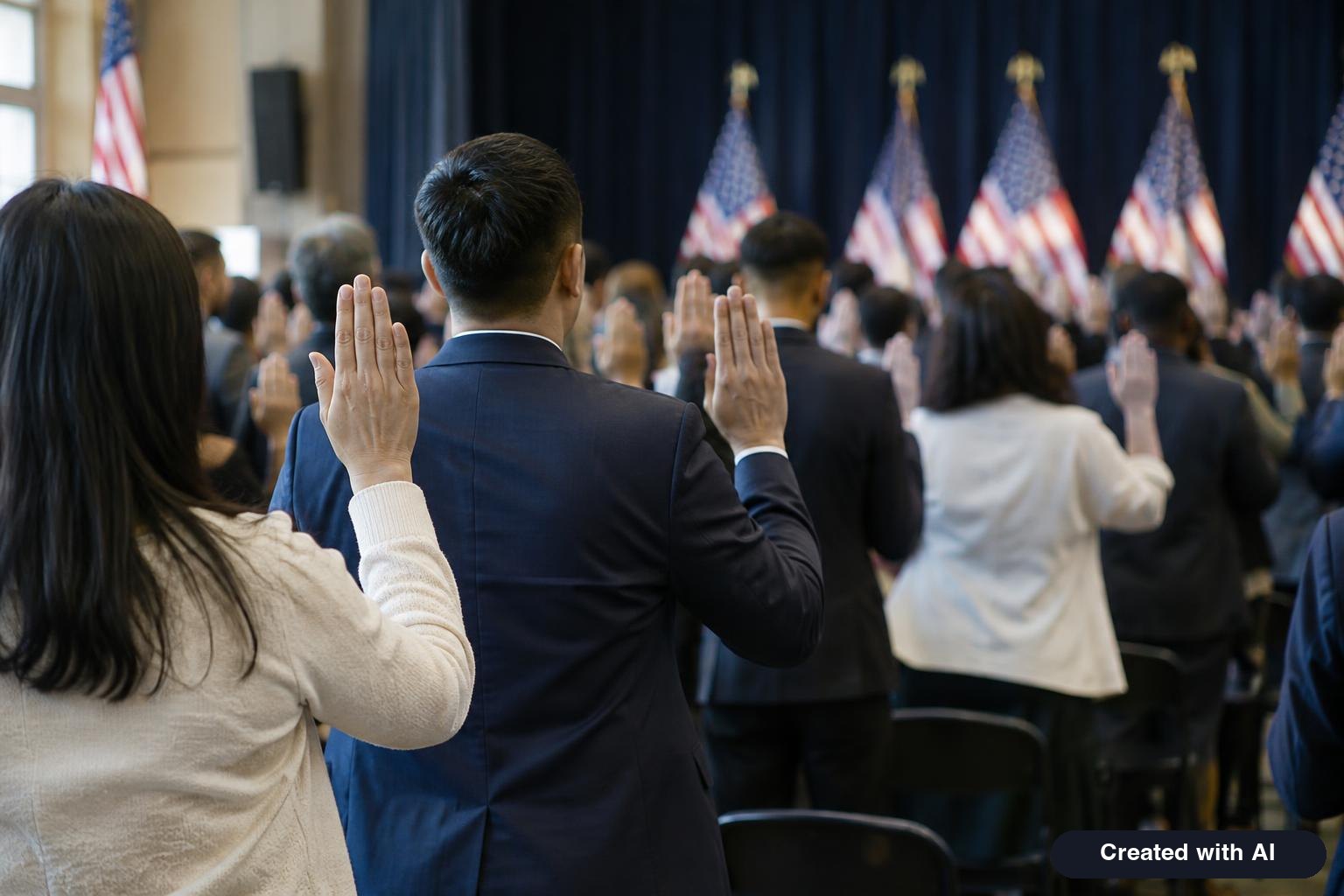
- The Oath of Allegiance. Everyone stands, raises the right hand and repeats the oath.
- Remarks. A keynote from USCIS leadership or a guest speaker, followed by recorded congratulatory remarks.
- The Pledge of Allegiance. Your first as a citizen.
- Certificates. Each new citizen is handed a Certificate of Naturalization.
USCIS does not publish a standard length. A small office ceremony can be brief, while a large one with hundreds of candidates takes considerably longer because of check-in and the handing out of certificates. Plan for a half day and avoid booking anything immediately afterward. Judicial ceremonies follow the court's own order of proceedings.
The Oath of Allegiance: full text
The wording is set by regulation at 8 CFR 337.1:
"I hereby declare, on oath, that I absolutely and entirely renounce and abjure all allegiance and fidelity to any foreign prince, potentate, state, or sovereignty, of whom or which I have heretofore been a subject or citizen; that I will support and defend the Constitution and laws of the United States of America against all enemies, foreign and domestic; that I will bear true faith and allegiance to the same; that I will bear arms on behalf of the United States when required by the law; that I will perform noncombatant service in the Armed Forces of the United States when required by the law; that I will perform work of national importance under civilian direction when required by the law; and that I take this obligation freely, without any mental reservation or purpose of evasion; so help me God."
What you are promising
- To give up allegiance to other countries
- To support and defend the Constitution and laws of the United States
- To bear arms, perform noncombatant military service or do civilian work of national importance if the law requires it
Modified oath
The law allows changes in certain circumstances. A person whose religious training and belief, or a deeply held moral or ethical code, prevents bearing arms or serving in the military can take the oath without those clauses. Those who cannot swear an oath, or who object to the closing words, can "solemnly affirm" and omit "so help me God." People with a hereditary title or order of nobility must renounce it at the ceremony. An applicant who is unable to understand the oath because of a physical or developmental disability or mental impairment may have the requirement waived. Raise any of these on the N-400 and at the interview, not for the first time on ceremony day.
Does the oath end your other citizenship?
The oath's language renounces foreign allegiance, but the United States does not require new citizens to surrender a foreign passport or prove they have given up another nationality. Whether you keep your original citizenship depends on the law of that country. Some permit dual nationality, some end citizenship automatically when a person naturalizes elsewhere, and some require a formal step. Ask that country's embassy or consulate before the ceremony if it matters to you.
Your Certificate of Naturalization
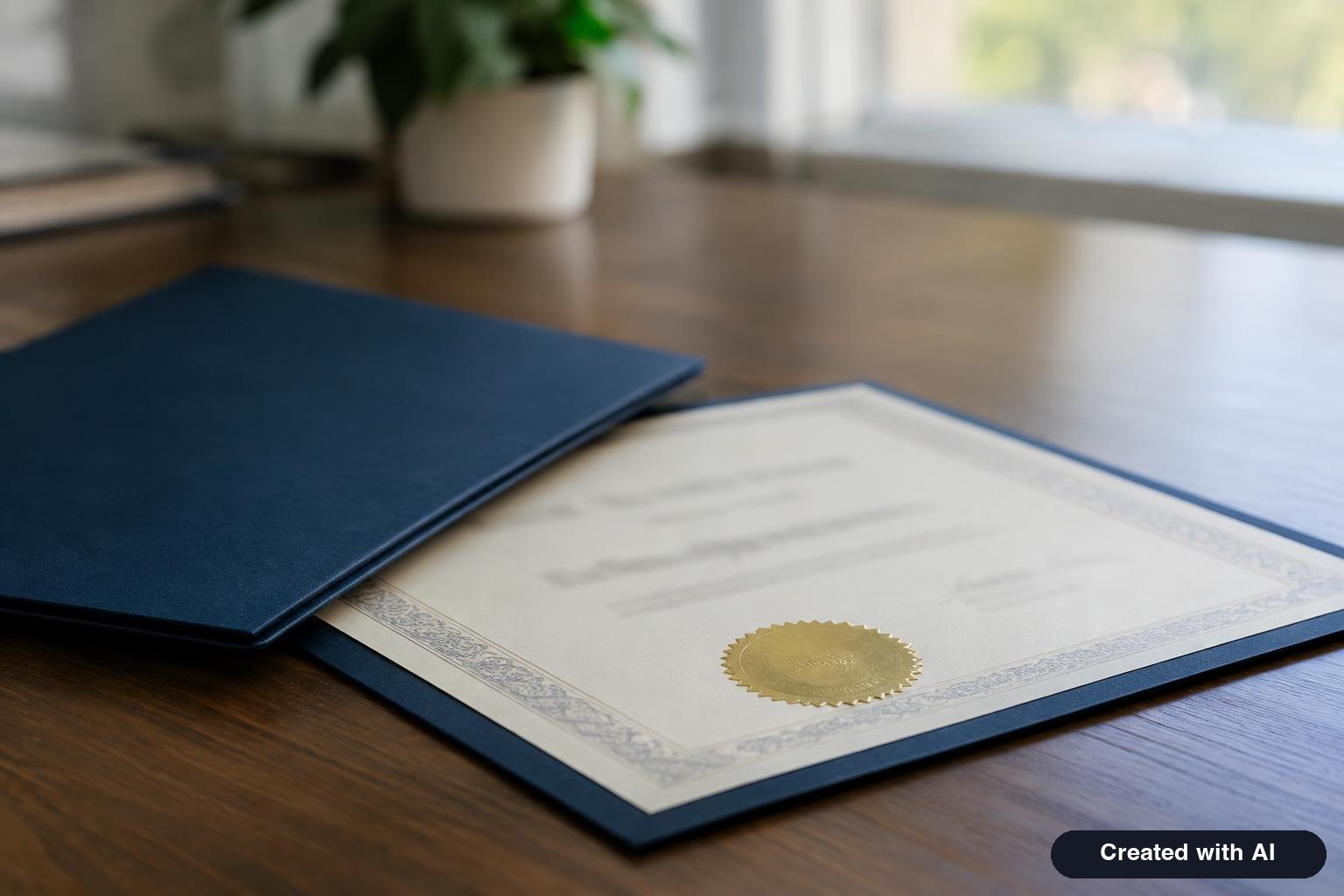
The certificate, Form N-550, is your primary proof of citizenship. It shows your A-number, full name, marital status, place of residence, country of former nationality, photograph, signature, sex, date of birth and height, plus a certificate number and the date of issuance. That date is the day you became a citizen.
Check it before you leave
USCIS tells new citizens to review the certificate and report any errors before leaving the ceremony site. Look at the spelling of every name, your date of birth, sex and country. A mistake caught on the spot is far easier to fix. One discovered later means filing Form N-565, which is free only when the error was made by USCIS.
Take care of it
- Sign it where indicated if you have not already.
- Do not laminate it. Lamination can damage the document and obscure its security features.
- Make photocopies for your records and store the original somewhere safe, such as a fireproof box or a bank safe deposit box.
- Do not carry it day to day. Once you have a U.S. passport, the passport serves as proof of citizenship for nearly every purpose.
Replacing a lost or damaged certificate
File Form N-565, Application for Replacement Naturalization/Citizenship Document. As of the fee schedule dated October 7, 2026, it costs $505 online or $555 on paper, and nothing if the certificate contains an error made by USCIS. The same form is used after a legal name change. The national median processing time for Form N-565 was 7.3 months in fiscal year 2026 through August 30, according to USCIS, which is another reason to get a passport early and keep the original safe.
Your first week as a citizen
| Task | How | Timing and cost (October 2026) |
|---|---|---|
| Apply for a U.S. passport | In person with Form DS-11 at a passport acceptance facility, such as a post office, with your original certificate, a photo ID and a photo | $130 for a book plus a $35 acceptance fee. Routine service 4 to 6 weeks, expedited 2 to 3 weeks for $60 more, not counting mailing |
| Update Social Security | Form SS-5 by mail or at a local office, unless you consented on your N-400 for USCIS to notify SSA | USCIS says to wait at least 10 days after the ceremony. Free |
| Register to vote | With the application handed out at the ceremony, or through your state or county election office | Free. Check your state's registration deadline before the next election |
| Update your employer's records | Tell your employer's HR office your status has changed | Optional but useful |
| Check your children's status | Children under 18 with green cards who live with you may have become citizens automatically | Apply for their passports or file Form N-600 for a certificate |
Passport figures are from the State Department's fee and processing time pages, last updated March 19, 2026 and October 5, 2026. The department notes that mailing can add up to two weeks each way and that you should not book international travel until you have the passport. Your certificate is mailed back separately from the new passport, so do not worry if they arrive on different days.
One practical point about travel: you surrender your green card at the ceremony, and a naturalized citizen should enter the United States on a U.S. passport. If you have a trip planned soon after the ceremony, use expedited service or, for travel within 14 days, an appointment at a passport agency.
If something goes wrong before the oath
Approval at the interview is not final until the oath. If USCIS receives disqualifying information afterward, it will not schedule you, or will take you off the schedule, and sends a written motion to reopen. You have 15 days to respond. If you overcome the concern, the application is approved again and the oath is scheduled. If not, the application is denied, and you can request a hearing on Form N-336.
If months pass after a recommended approval with no ceremony notice and no explanation, the usual steps are a case inquiry through your online account or the Contact Center at 800-375-5283, a request for help from your U.S. representative's or senator's office, and, as a last resort, legal action. Federal law gives USCIS 120 days after the interview to decide an application, and an attorney can tell you whether a court petition makes sense in your situation.
Where this fits in the process
The ceremony is step six of six. The earlier steps are covered in how to become a U.S. citizen, the N-400 form guide, the N-400 fee guide, the citizenship interview and the U.S. citizenship test. If you are writing a card for someone taking the oath, our congratulations messages can help.
Frequently asked questions
How long after the interview is the oath ceremony?
It can be the same day at offices that offer same-day ceremonies. Otherwise USCIS mails Form N-445 with a date. USCIS does not publish an average wait, which depends on the field office schedule and on whether the ceremony is run by USCIS or by a court.
How long does the oath ceremony take?
USCIS does not publish a standard length. A small in-office ceremony can be brief, while a large ceremony with hundreds of candidates takes much longer because of check-in and certificate distribution. Plan for about half a day.
What should I wear to the oath ceremony?
Dress as you would for a graduation or court appearance: business or business-casual clothing. Ceremony notices commonly ask for proper attire. Avoid shorts, flip-flops and clothing with slogans.
What do I need to bring to the oath ceremony?
Bring Form N-445 with the questionnaire completed and signed, your Permanent Resident Card, any reentry permit or refugee travel document, a photo ID and anything else your notice requests.
What does "Oath Ceremony Will Be Scheduled" mean?
It is a USCIS case status showing that your N-400 has been approved and you are waiting for a ceremony date. No action is needed. The next step is receiving Form N-445 by mail and in your online account.
Can family come to my oath ceremony?
Usually yes, because ceremonies are public, but space limits apply. Some venues allow only one or two guests per candidate and some small office ceremonies allow none. Check your notice or contact your field office.
What happens if I miss my oath ceremony?
Return Form N-445 to your local USCIS office with a letter explaining why and asking for a new date. If you miss more than one ceremony without good cause, USCIS presumes you abandoned the application and may deny it.
How soon can I get a passport after the oath ceremony?
You can apply the same day with Form DS-11 and your original Certificate of Naturalization. As of October 2026 the State Department lists routine processing at 4 to 6 weeks and expedited at 2 to 3 weeks, plus mailing time.
Sources
- USCIS: Naturalization Ceremonies
- USCIS: Naturalization Oath of Allegiance to the United States of America
- USCIS: 10 Steps to Naturalization
- USCIS Policy Manual, Vol. 12, Part J, Ch. 4: General Considerations for All Oath Ceremonies
- USCIS Policy Manual, Vol. 12, Part J, Ch. 5: Administrative Naturalization Ceremonies
- USCIS Policy Manual, Vol. 12, Part K, Ch. 3: Certificate of Naturalization
- USCIS alert: Recent Court Order on Hold Policies, Aug. 28, 2026
- USCIS: Policy Memoranda
- USCIS: Form N-565, Application for Replacement Naturalization/Citizenship Document
- USCIS: Form G-1055, Fee Schedule
- USCIS: Historical National Median Processing Time by Fiscal Year
- eCFR: 8 CFR Part 337, Oath of Allegiance
- eCFR: 8 CFR Part 335, Examination on Application for Naturalization
- U.S. Department of State: Passport Fees
- U.S. Department of State: Get Your Processing Time
- U.S. Department of State: Apply for Your Adult Passport
- USCIS Contact Center
- USCIS: Form N-445, Notice of Naturalization Oath Ceremony (edition 11/02/22, posted to docket USCIS-2006-0055 on Sept. 8, 2025)
- The Boston Globe: Citizenship ceremonies at Faneuil Hall canceled for some, Dec. 8, 2025
- The Christian Science Monitor: The next step was citizenship. Then these immigrants were pulled out of line, Dec. 19, 2025
Log in to comment
No comments yet. Be the first.