SNAP Eligibility 2027: Income Limits, Rules and Who Qualifies
- USDA's FY 2027 limits apply from October 1, 2026, to September 30, 2027: gross monthly income up to $1,729 for one person and $3,575 for four (130% of poverty); net income up to $1,330 and $2,750 (100% of poverty).
- Maximum monthly benefit in the 48 states and D.C.: $306 for one person, $1,023 for a family of four. Your benefit is the maximum minus 30% of your net income.
- Asset limit: $3,000, or $4,750 if someone in the household is 60+ or disabled. Many states waive or raise it through broad-based categorical eligibility.
- The 2025 budget law (One Big Beautiful Bill Act) extended the work time limit to adults 18 to 64, narrowed the parent exemption to children under 14, and limited eligibility for many noncitizens.
SNAP eligibility comes down to four checks: your household size, your gross monthly income, your net income after deductions, and in some states your assets. A few non-financial rules then apply on top: work requirements, student rules and immigration status. USDA updates the money limits every October 1. The figures below are the official limits for October 1, 2026, through September 30, 2027 (federal fiscal year 2027).
USDA's food assistance agency, now called the Food and Nutrition Administration (FNA), sets the federal rules. You apply through your state. Once you are approved, our SNAP payment schedule shows which day of the month your state loads benefits.
SNAP income limits for 2027
Most households must pass both tests: gross income at or below 130% of the federal poverty level, and net income at or below 100%. These limits apply in the 48 contiguous states, D.C., Guam and the U.S. Virgin Islands.
| Household size | Gross monthly income (130%) | Net monthly income (100%) |
|---|---|---|
| 1 | $1,729 | $1,330 |
| 2 | $2,345 | $1,804 |
| 3 | $2,960 | $2,277 |
| 4 | $3,575 | $2,750 |
| 5 | $4,191 | $3,224 |
| 6 | $4,806 | $3,697 |
| 7 | $5,421 | $4,170 |
| 8 | $6,037 | $4,644 |
| Each additional member | +$616 | +$474 |
For comparison, the FY 2026 limits for one person were $1,696 gross and $1,305 net. Limits are higher in Alaska ($2,162 gross and $1,663 net for one person) and Hawaii ($1,989 and $1,530).
Maximum SNAP benefits, FY 2027
| Household size | Maximum monthly allotment (48 states and D.C.) |
|---|---|
| 1 | $306 |
| 2 | $562 |
| 3 | $808 |
| 4 | $1,023 |
| 5 | $1,217 |
| 6 | $1,463 |
| 7 | $1,616 |
| 8 | $1,841 |
| Each additional person | +$225 |
A family of four received at most $994 in FY 2026, so the maximum rose by $29 a month on October 1, 2026.
SNAP eligibility calculator: work it out step by step
You can estimate your own case with the same arithmetic the state uses. Online "SNAP eligibility calculators" do exactly this, but doing it by hand shows you where each deduction comes from.
- Count your household. Everyone who lives together and buys and prepares food together is one SNAP household. Spouses and most children under 22 are always in the same household.
- Add up gross monthly income from wages, self-employment, Social Security, unemployment and other sources. Compare it with the 130% column.
- Subtract deductions to get net income:
- 20% of earned income;
- the standard deduction: $217 for 1 to 3 people, $229 for 4, $268 for 5, $308 for 6 or more;
- dependent care costs needed for work, training or school;
- legally owed child support paid (in some states this is an income exclusion instead);
- medical costs above $35 a month for members who are 60+ or disabled;
- the excess shelter deduction: housing and utility costs above half of your income after the other deductions, capped at $769 unless someone is elderly or disabled. Homeless households can take a $205.66 shelter deduction instead.
- Compare net income with the 100% column.
- Estimate the benefit: maximum allotment minus 30% of net income, with the 30% rounded up.
Worked example
A single worker earns $1,200 a month before tax and pays $700 a month in rent with utilities included.
| Step | Calculation | Result |
|---|---|---|
| Gross income test | $1,200 is below $1,729 | Pass |
| Earned income deduction | $1,200 minus 20% ($240) | $960 |
| Standard deduction | $960 minus $217 | $743 |
| Excess shelter | $700 minus half of $743 ($371.50) | $328.50 deduction |
| Net income | $743 minus $328.50 | $414.50 (below $1,330: pass) |
| Benefit | $306 minus 30% of $414.50 ($125, rounded up) | About $181 a month |
Real cases vary. Many states use a standard utility allowance instead of actual utility bills, which can raise the shelter deduction. Treat the result as an estimate, not a decision.
Assets and resources
The federal asset limit for FY 2027 is $3,000 in countable resources, or $4,750 if at least one household member is 60 or older or disabled. Cash and bank accounts count. Your home and lot, most retirement and pension plans, and the resources of household members who receive SSI or TANF do not.
Vehicles are counted under state rules. Federal rules exclude, for example, a vehicle used to produce income or to transport a disabled household member, and count the fair market value above $4,650 for other licensed vehicles.
Most states use broad-based categorical eligibility (BBCE). It lets a household that qualifies for a TANF-funded service or benefit skip or loosen the asset test, and in some states it also raises the gross income limit. You still have to pass the net income test to receive a benefit.
Special rules for seniors and people with disabilities
- Only the net income test applies. The gross income test is skipped.
- Out-of-pocket medical costs above $35 a month can be deducted.
- The excess shelter deduction has no cap.
- The asset limit is $4,750.
- A person 60+ who cannot buy and prepare meals separately because of a permanent disability can be a separate household (with their spouse) if the others they live with have income at or below 165% of poverty: $2,195 a month for one person in FY 2027.
Work requirements after the 2025 law changes
The One Big Beautiful Bill Act, signed July 4, 2025, changed SNAP's work rules. USDA told states to apply the new rules at application and recertification.
- General work rules apply to most adults: register for work, do not quit a job or cut hours without good cause, accept a suitable job, and take part in employment and training if assigned. People 60 and older remain exempt from these general rules.
- The time limit for able-bodied adults without dependents (ABAWDs) now covers ages 18 to 64, up from 18 to 54. Unless they work, volunteer or train at least 20 hours a week (80 hours a month), they can receive SNAP for only 3 months in a 36-month period.
- The parent exemption now applies only to adults living with a child under 14 in the SNAP household.
- Exemptions removed: the temporary exceptions for veterans, people experiencing homelessness and young adults who aged out of foster care, added in 2023, were ended.
- Exemptions added: members of federally recognized tribes and certain other American Indians are exempt from the time limit.
- Waivers for high-unemployment areas are now harder to get. USDA says areas generally need an unemployment rate above 10%.
Students and noncitizens
College students aged 18 to 49 enrolled at least half time are generally ineligible unless they meet an exemption, such as working at least 20 hours a week, caring for a dependent child under the age limits set in the rules, or participating in state or federal work-study.
Noncitizens: under the 2025 law, SNAP is limited to U.S. citizens, U.S. nationals, lawful permanent residents (green card holders), Cuban and Haitian entrants, and citizens of the Compact of Free Association nations. Green card holders generally still face a five-year wait, with exceptions for children under 18, people with 40 qualifying quarters of work and people receiving disability benefits. USDA says refugees and asylees are no longer eligible based on that status alone, though those who later become permanent residents may qualify without waiting. Undocumented immigrants have never been eligible. Eligible children in a mixed-status family can still receive benefits.
SNAP-eligible items
SNAP can buy food for the household to eat at home: fruit and vegetables, meat, fish and poultry, dairy, bread and cereals, snacks and non-alcoholic drinks, and seeds and plants that produce food. It cannot buy alcohol, tobacco, vitamins and supplements, hot prepared foods, pet food or household goods. Several states now have USDA waivers that also exclude soda or candy, so check your state agency's list.
How to apply in your state
Apply through your state SNAP agency online, by phone or at a local office. In Massachusetts that is the Department of Transitional Assistance (DTA); in New York it is the Office of Temporary and Disability Assistance (OTDA), through myBenefits or your local social services district. You will have an interview, usually by phone, and need to provide proof of identity, income, housing costs and household members.
States must decide most applications within 30 days, and benefits are paid back to the date you applied. Households with very little money can get expedited SNAP within 7 days, for example with under $150 in monthly gross income and under $100 in cash and bank accounts.
Bottom line
For FY 2027, a one-person household generally qualifies with gross income up to $1,729 a month and net income up to $1,330, and a family of four with $3,575 and $2,750. The maximum benefit is $306 for one person and $1,023 for four. Seniors and people with disabilities get looser rules, while working-age adults face a tighter time limit after the 2025 law. If you are near the limits, apply anyway: deductions often bring net income well under the line.
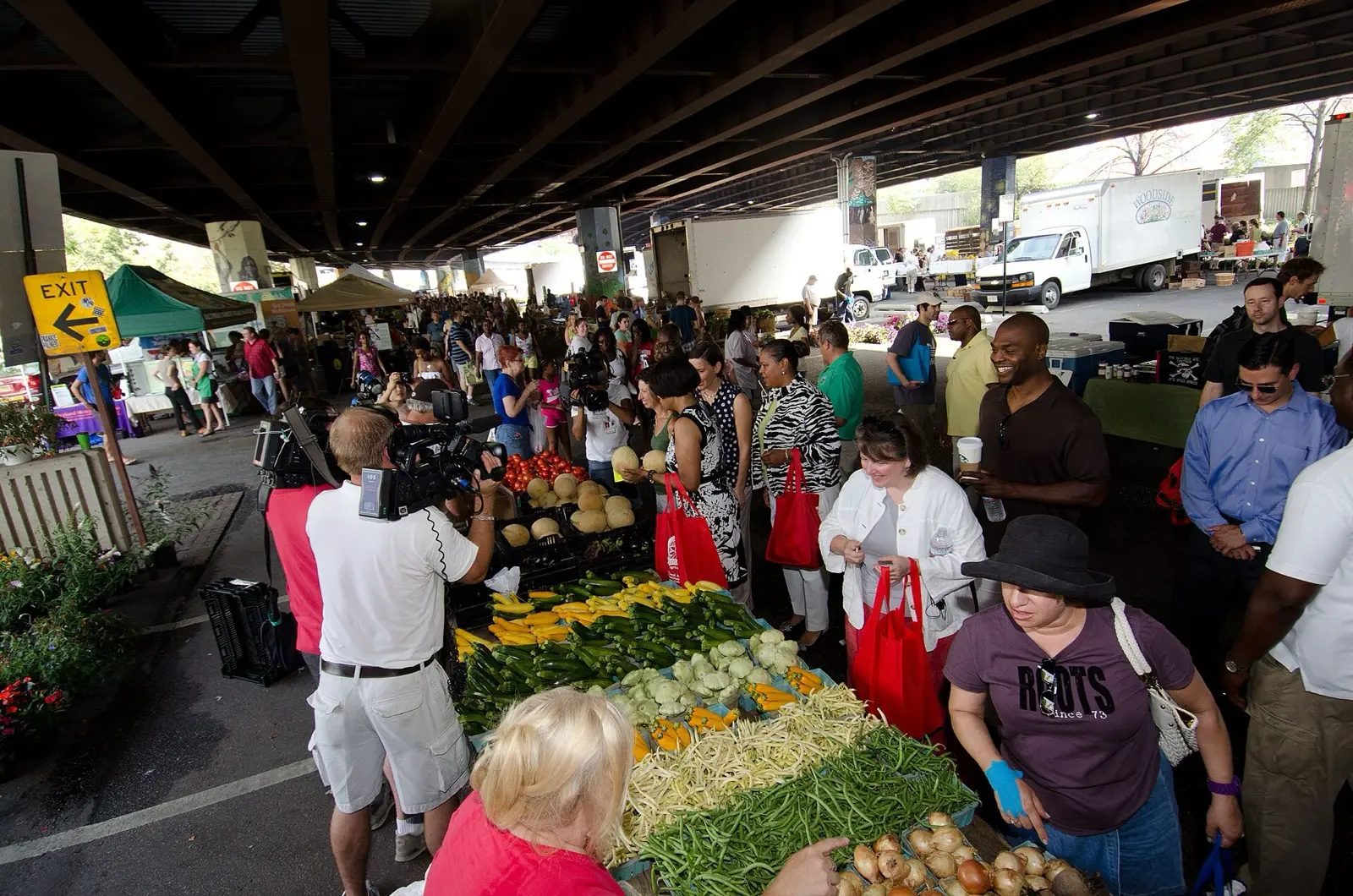
Cover photo: shoppers at the Baltimore Farmers' Market during the launch of wireless EBT payments, 2012. U.S. Department of Agriculture, public domain, via Wikimedia Commons.
Frequently asked questions
What is the income limit for SNAP in 2027?
For October 1, 2026, through September 30, 2027, gross monthly income must generally be at or below 130% of the poverty line: $1,729 for one person, $2,345 for two, $2,960 for three and $3,575 for four in the 48 states and D.C. Net income must be at or below 100% of poverty: $1,330, $1,804, $2,277 and $2,750. Alaska and Hawaii have higher limits.
How much SNAP will I get?
Take the maximum allotment for your household size ($306 for one person, $1,023 for four in FY 2027) and subtract 30% of your net monthly income, rounded up. A household with zero net income gets the maximum.
Do seniors and people with disabilities have different SNAP rules?
Yes. Households with a member 60 or older or disabled only need to pass the net income test, can deduct medical costs above $35 a month, have no cap on the excess shelter deduction and have a higher asset limit of $4,750.
Does SNAP count my car or savings?
Federal rules count cash and bank accounts against the $3,000 or $4,750 limit, but not your home, most retirement accounts, or the resources of people who get SSI or TANF. States set their own vehicle rules, and most states use broad-based categorical eligibility, which can remove or raise the asset test.
Can college students get SNAP?
Students aged 18 to 49 enrolled at least half time are generally not eligible unless they meet an exemption, such as working at least 20 hours a week, caring for a young child or participating in certain work-study or training programs.
What are the SNAP work requirements in 2027?
Most adults must register for work and accept suitable jobs. Able-bodied adults without dependents, now defined as ages 18 to 64 without a child under 14 in the household, can get only 3 months of SNAP in 36 months unless they work or train at least 20 hours a week or qualify for an exception.
How fast can I get SNAP?
States must decide most applications within 30 days. Households with very little money can get expedited benefits within 7 days, for example if they have less than $150 in monthly gross income and less than $100 in liquid resources.
When will my SNAP benefits arrive each month?
Each state sets its own issuance calendar, usually based on case number, name or birth date. Our SNAP payment schedule lists the deposit days for every state.
Sources
- USDA FNA: SNAP eligibility (Oct. 1, 2026, through Sept. 30, 2027)
- USDA FNA: SNAP cost-of-living adjustment information, FY 2027 standards, allotments and deductions
- USDA FNA: SNAP special rules for the elderly or disabled
- USDA FNA: SNAP work requirements
- USDA: OBBB ABAWD exceptions implementation memo (Oct. 3, 2025)
- USDA: SNAP provisions of the One Big Beautiful Bill, alien eligibility memo
- USDA: Alien SNAP eligibility questions and answers #1
- USDA FNA: One Big Beautiful Bill Act of 2025
- Wikimedia Commons: Wireless EBT launch at Baltimore Farmers' Market, USDA photo (public domain)
Log in to comment
No comments yet. Be the first.