SSDI vs SSI: Differences, 2027 Amounts and Who Qualifies
- SSDI is based on your work record (work credits), with no asset limit. SSI is based on financial need, with a $2,000 resource limit for an individual and $3,000 for a couple.
- Both programs use the same medical definition of disability for adults. SSI also covers people 65 and older without a disability.
- Official 2027 figures after the 3.6% COLA: SSI federal payment $1,029 a month for an individual and $1,544 for a couple; average SSDI disabled-worker benefit about $1,701.
- You can get both at once if your SSDI is low. Then the total from the two programs is usually $1,049 a month in 2027 at the federal level, plus any state supplement.
SSDI vs SSI in one sentence: SSDI is insurance you earned by working and paying Social Security taxes, while SSI is a needs-based payment for people with very little income and almost no savings. Both are run by the Social Security Administration (SSA), and both use the same medical definition of disability for adults. That shared office and shared application are why the two are so often confused.
The figures below are the official 2027 amounts SSA published on October 14, 2026, after the 3.6% cost-of-living adjustment. Our COLA 2027 page has the full table of changes.
SSDI vs SSI at a glance
| SSDI | SSI | |
|---|---|---|
| Full name | Social Security Disability Insurance | Supplemental Security Income |
| Who it is for | Disabled workers (and some family members) | People who are disabled, blind or 65+ with limited income and resources |
| Work history needed | Yes, enough recent work credits | No |
| Asset limit | None | $2,000 individual, $3,000 couple |
| How the amount is set | Based on your lifetime earnings | Flat federal amount minus countable income |
| 2027 amount | Average disabled worker about $1,701/mo | Up to $1,029/mo individual, $1,544/mo couple (federal) |
| Funded by | Social Security payroll taxes | General U.S. Treasury funds |
| Waiting period | 5 full months after disability onset | None (paid from the month after you apply, if eligible) |
| Health coverage | Medicare after 24 months of benefits | Medicaid in most states, usually right away |
| Family benefits | Yes, for eligible spouses and children | No; each eligible person qualifies separately |
| Payment day | 2nd, 3rd or 4th Wednesday by birth date (some on the 3rd) | 1st of the month |
Who qualifies for SSDI
SSDI has two tests: a work test and a medical test.
The work test. You earn Social Security credits by working in jobs covered by Social Security. In 2027 one credit takes $1,970 of earnings (up from $1,890 in 2026), and you can earn up to four credits a year. SSA's general rule is that you need 40 credits, 20 of them earned in the last 10 years ending with the year you became disabled. Younger workers can qualify with fewer credits because they have had less time to work.
The medical test. You must be unable to do substantial work because of a medical condition that has lasted or is expected to last at least 12 months, or is expected to result in death. "Substantial" is measured by substantial gainful activity (SGA): $1,770 a month in 2027 for non-blind people and $2,950 for people who are blind.
SSDI does not care about savings, a house, a spouse's income or a retirement account. It is insurance, so what matters is whether you paid into it long enough.
Who qualifies for SSI
SSI is for people who are 65 or older, blind, or disabled, and who have limited income and limited resources. Children with disabilities can qualify too, and in that case part of the parents' income and resources is counted.
- Resources: countable assets must be $2,000 or less for an individual and $3,000 or less for a couple. Your home, one car and some other items are not counted.
- Income: almost all income reduces SSI. SSA ignores the first $20 of most income, the first $65 of monthly earnings and half of earnings above that.
- Living arrangements: if someone else provides your food or shelter, SSI can be reduced.
- Citizenship and residence: you generally must be a U.S. citizen or a qualifying noncitizen and live in the United States.
The medical rules for adults are identical to SSDI. Only the money rules differ.
SSI and SSDI amounts for 2027
| Figure | 2026 | 2027 |
|---|---|---|
| SSI federal payment, individual | $994/mo | $1,029/mo |
| SSI federal payment, couple | $1,491/mo | $1,544/mo |
| SSI resource limit, individual / couple | $2,000 / $3,000 | $2,000 / $3,000 |
| Average SSDI benefit, all disabled workers | $1,642/mo | $1,701/mo (estimate after COLA) |
| Average SSDI benefit, disabled worker, spouse and children | $2,970/mo | $3,077/mo (estimate after COLA) |
| Substantial gainful activity, non-blind | $1,690/mo | $1,770/mo |
| Substantial gainful activity, blind | $2,830/mo | $2,950/mo |
| Trial work period month | $1,210/mo | $1,270/mo |
The first SSI payment at the new rate is dated December 31, 2026, because January 1 is a holiday. SSDI recipients see the 3.6% increase in their January 2027 payment.
Can you get SSDI and SSI at the same time?
Yes. SSA calls this "concurrent" benefits. It happens when someone qualifies for SSDI but their work record produces a small benefit. SSA treats the SSDI check as unearned income for SSI purposes:
- Start with the SSDI amount.
- Subtract the $20 general income exclusion.
- Subtract what is left from the SSI federal payment.
Example for 2027: your SSDI benefit is $700 a month and you have no other income. Countable income is $700 minus $20, or $680. SSI is $1,029 minus $680, or $349. You receive $700 from SSDI plus $349 from SSI, for a total of $1,049.
That is why the answer to "how much does SSI and SSDI pay together" is usually $1,049 a month in 2027 at the federal level, as long as the SSDI benefit is below that figure and there is no other income. A state supplement can add to it. Once SSDI reaches $1,049 or more, SSI stops, though SSA notes that Medicaid may continue in some cases.
SSI can also fill the gap during SSDI's five-month waiting period. If you qualify financially, SSI may start before SSDI does.
How do I know if I get SSI or SSDI?
- Check the payment date. A payment on the 1st is SSI. A payment on a Wednesday is SSDI. A payment on the 3rd is usually SSDI for long-time beneficiaries or people receiving both.
- Read your award letter or log in to my Social Security. The letter names the program. Your online account shows benefit details and lets you download a benefit verification letter.
Working while on disability benefits
Both programs let you try working, but the rules differ.
SSDI gives a trial work period: nine months (not necessarily in a row) within a rolling 60-month window in which any month you earn more than $1,270 in 2027 counts. You keep full benefits during those months. After that, SSA compares your earnings to SGA.
SSI phases out gradually. After the first $65 of monthly earnings, SSI drops by $1 for every $2 you earn. Section 1619(b) can keep Medicaid going even when earnings stop your SSI cash payment.
How to apply
You can apply for SSDI online at SSA.gov, by phone at 1-800-772-1213, or at a local office. One application can be screened for both programs, so tell SSA if you have limited income and resources. Have your medical records, a list of doctors and medications, your work history for the last five years and your bank details ready. Processing takes months, so apply as soon as you expect your condition to last a year or more.
If you are turned down, you have 60 days from receiving the notice to appeal. Many approvals come at the reconsideration or hearing stage.
Bottom line
SSDI rewards your work record and ignores your savings. SSI ignores your work record and looks hard at your income and savings. For 2027 the SSI federal payment is $1,029 for an individual, the average SSDI disabled-worker benefit is about $1,701, and people with a small SSDI benefit can receive both programs together, typically totalling $1,049 a month. If you are not sure which you qualify for, apply anyway and let SSA screen you for both.
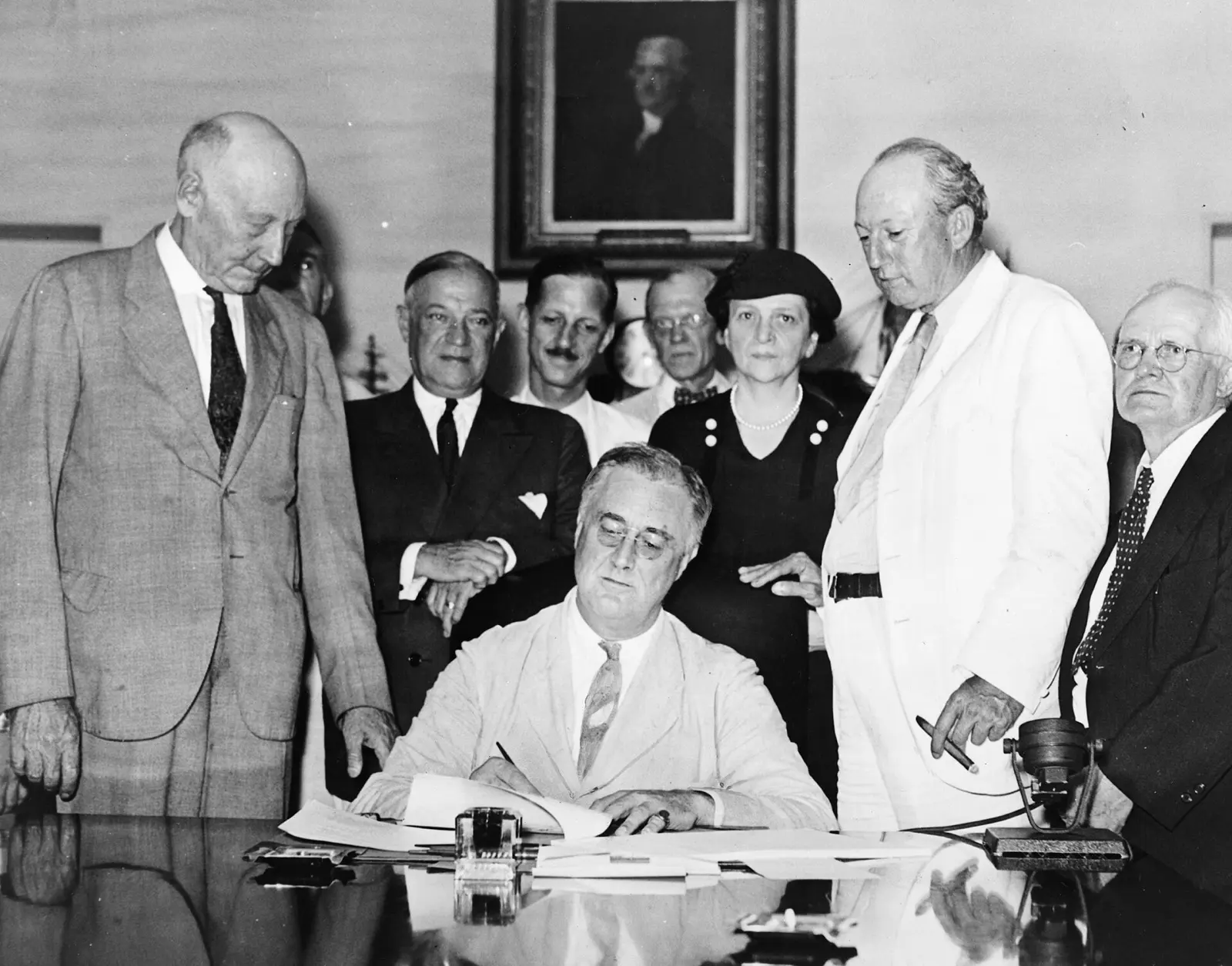
Cover photo: President Franklin D. Roosevelt signs the Social Security Act, August 14, 1935. Public domain, via Wikimedia Commons.
Frequently asked questions
What is the main difference between SSDI and SSI?
SSDI (Social Security Disability Insurance) pays disabled workers who have earned enough Social Security work credits, and the amount depends on past earnings. SSI (Supplemental Security Income) pays a flat federal amount to people who are disabled, blind or 65 and older and have very limited income and resources, regardless of work history.
Can you get SSDI and SSI at the same time?
Yes, if your SSDI benefit is lower than the SSI federal payment plus the $20 general income exclusion. SSA counts SSDI as unearned income, subtracts $20, and reduces SSI by the rest. In 2027 that usually brings the combined federal total to $1,049 a month.
How much does SSI pay in 2027?
The maximum federal SSI payment in 2027 is $1,029 a month for an individual and $1,544 for an eligible couple, up from $994 and $1,491 after the 3.6% COLA. Many states add a supplement. The first 2027 payment arrives on December 31, 2026, because January 1 is a holiday.
How much does SSDI pay in 2027?
It depends on your lifetime earnings. SSA's 2027 COLA fact sheet estimates the average monthly benefit for all disabled workers at $1,701 after the increase, up from $1,642. Your own amount is on your Social Security statement at my Social Security.
Is it harder to get SSI or SSDI?
The medical test is the same for adults. The difference is the non-medical test: SSDI requires enough recent work credits, while SSI requires income and resources under strict limits. Someone with a long work history but savings may qualify only for SSDI; someone who never worked and has almost nothing may qualify only for SSI.
Do SSDI and SSI come with health insurance?
SSDI leads to Medicare after 24 months of disability benefits (immediately for ALS, and on a different schedule for end-stage renal disease). SSI usually comes with Medicaid right away in most states.
How much can I earn while on SSDI or SSI?
For SSDI, earnings above substantial gainful activity, $1,770 a month in 2027 for non-blind people ($2,950 if blind), can end benefits after work incentives are used. For SSI, SSA ignores the first $65 of monthly earnings plus half of the rest, then reduces SSI by the remainder.
When are SSDI and SSI paid?
SSI is paid on the 1st of the month (earlier if the 1st is a weekend or holiday). SSDI is paid on the second, third or fourth Wednesday depending on your birth date, except for people who started benefits before May 1997 or who also get SSI, who are paid on the 3rd.
Sources
- SSA: 2027 COLA fact sheet
- SSA: Press release on the 2027 COLA (Oct. 14, 2026)
- SSA: SSI federal payment amounts
- SSA: Substantial gainful activity
- SSA Red Book: Overview of our disability programs
- SSA Red Book: Example of concurrent benefits with work incentives
- SSA: You may be eligible for SSI and Social Security benefits (blog, Jan. 16, 2025)
- SSA: Supplemental Security Income (publication EN-05-11000)
- SSA: Disability benefits (publication EN-05-10029)
- SSA: What you could get from disability
- Wikimedia Commons: Signing of the Social Security Act, 1935 (public domain)
Log in to comment
No comments yet. Be the first.