Why Are Most People Right Handed? Science Explains
- Around 90% of humans are right-handed, making us an evolutionary exception among primates.
- A new study links this strong hand dominance to two major evolutionary shifts: walking on two legs and developing larger brains.
- Bipedalism freed the hands for complex tasks, while brain growth enhanced hemispheric specialization.
- Extinct hominins like the "hobbit" (<em>Homo floresiensis</em>) likely had weaker hand dominance due to smaller brains.
- The exact reason why some people remain left-handed is still an open evolutionary question, though culture may have reinforced right-handedness.
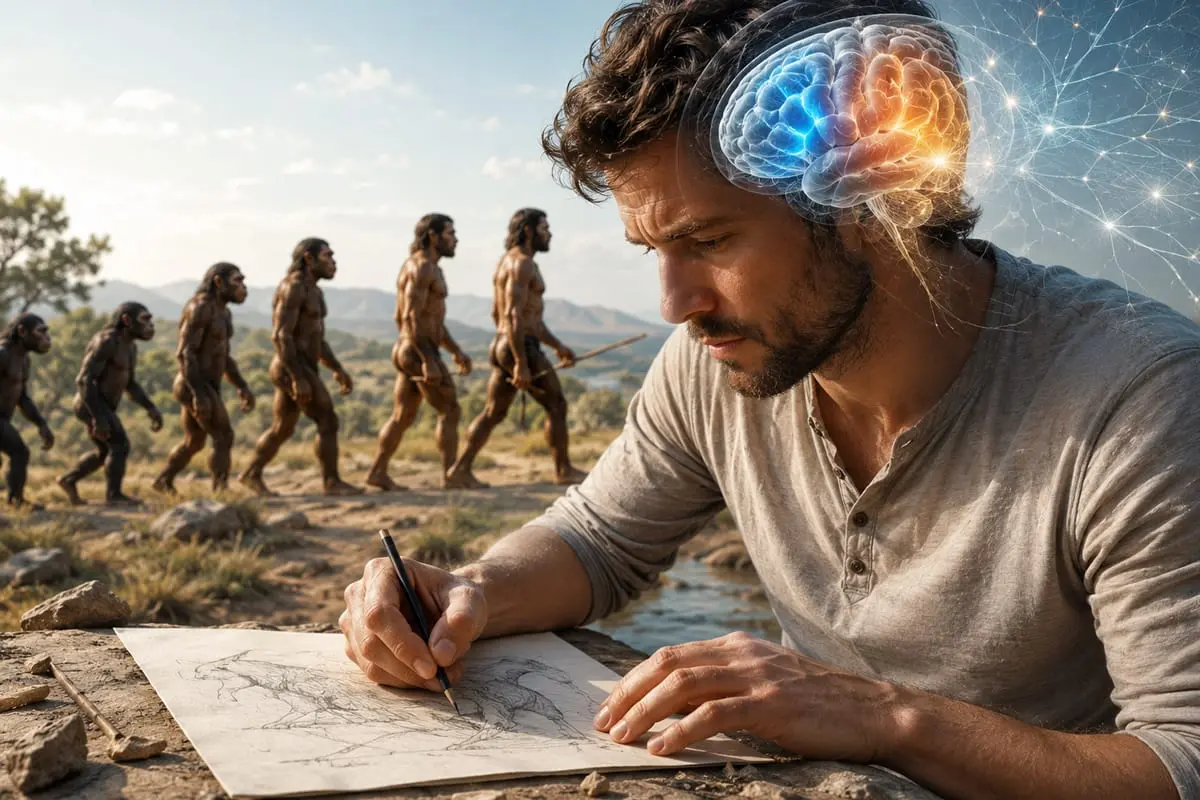
- Human right-handedness stands out from all other primate behavior
- Bipedalism freed the hands for new tasks
- Larger brains reinforced hand dominance through hemispheric specialization
- Extinct hominins like the "hobbits" may have had weaker right-hand dominance
- Why are most people right handed? The study unites key hypotheses
- Why are some people left-handed? The question remains open
Human right-handedness stands out from all other primate behavior
About 90% of people across all cultures use their right hand more often, but such a strong dominance of one hand is not characteristic of other primates. A new study published in the journal PLOS Biology suggests that human right-handedness may be linked to two fundamental evolutionary changes: walking on two legs and the development of larger brains.
Scientists analyzed 2,025 monkeys and apes belonging to 41 different species. The study found that while some species, such as spider monkeys and langurs, also exhibit a certain direction of hand preference, this phenomenon is significantly stronger in humans.
The study authors call humans an evolutionary exception because our reliance on one hand is much more pronounced than would be expected based solely on our relationship to other primates. However, this exception disappears when two metrics are included in the analysis: brain size and the ratio of arm to leg length.
Bipedalism freed the hands for new tasks
One of the main arguments of the study is that bipedalism—the ability to walk on two legs—changed the role of the arms. When human ancestors stopped using their arms for locomotion, their hands became free for tool use, gestures, fine motor skills, and other tasks.
The researchers used the intermembral index, which is the ratio of arm length to leg length. Human legs are longer than their arms, which clearly distinguishes us from long-armed apes adapted to climbing and moving through trees.
According to the study authors, once the upper limbs were freed from their locomotive function, conditions emerged for one hand to specialize. Such specialization could have provided an advantage in performing precise actions, especially when using tools or coordinating complex movements.
Larger brains reinforced hand dominance through hemispheric specialization
The second important factor is brain enlargement and cortical reorganization. The study argues that as the brain grew, hemispheric specialization likely strengthened, allowing certain movements and behavioral patterns to be controlled more efficiently by one side of the brain.
This process is particularly important after the emergence of the genus Homo. Scientific models indicate that early bipedal hominins, such as Ardipithecus and Australopithecus, likely did not yet possess the strong hand dominance seen in modern humans.
Hand dominance probably strengthened gradually as brain volume increased. The study authors point out that the direction of right-handedness may have already been quite pronounced in Homo erectus and Neanderthals, reaching its highest level in Homo sapiens.
Extinct hominins like the "hobbits" may have had weaker right-hand dominance
Researchers used archaeological data on the body proportions and brain volumes of extinct hominins to reconstruct the likely strength of hand dominance at different stages of human evolution. This analysis allows for the evaluation of not only modern humans but also our extinct relatives.
Modeling shows that Homo floresiensis, often called "hobbits" due to their small body size, probably had weaker hand dominance. This is attributed to their smaller brain volume and a partially arboreal lifestyle.
This example is important because it aligns with the overall logic of the study: the more a species was adapted to full bipedalism and the larger its brain, the stronger the dominance of one hand could be.
Why are most people right handed? The study unites key hypotheses
Study author Dr. Thomas A. Püschel stated that this is the first work to test several major hypotheses of human hand dominance within a single unified framework. The analysis included various factors: tool use, diet, habitat, body mass, social organization, brain size, and mode of locomotion.
According to Dr. Püschel, the results indicate that right-handedness is likely linked to the fundamental traits that define humans—walking upright and the evolution of larger brains. He noted that by comparing many primate species, it is possible to distinguish which hand dominance traits are ancient and shared, and which are uniquely human.
The study does not provide a simple, single answer as to why the right hand specifically became dominant. Instead, it reveals an evolutionary mechanism: when human ancestors stood up on two legs and their brains expanded, the conditions were set for pronounced hand specialization.
Why are some people left-handed? The question remains open
While the study explains why humans as a species are so strongly inclined toward one-handed dominance, it does not answer why a small percentage of the population remains left-handed. This is one of the most important open questions, as evolutionary pressure seems to have pushed humans in favor of the right hand.
The study authors also do not rule out that culture may have reinforced the prevalence of right-handedness. Tool making, learning, writing, social imitation, and standardized working methods could have helped stabilize a previously established biological direction.
Current data suggest that right-handedness is not a random human trait. When exploring left-handed vs right handed facts, it becomes clear that this dominance is likely the result of a long evolutionary process that combined body anatomy, locomotion, brain structure, and the increasingly complex use of the hands.
Frequently asked questions
Why are most people right handed?
Scientists believe right-handedness evolved due to bipedalism and larger brains. Walking upright freed our hands for complex tasks, while brain growth led to hemispheric specialization, making one hand dominant.
Why are some people left-handed?
The exact evolutionary reason why a small percentage of people remain left-handed is still an open question. Researchers suggest that while evolution favored the right hand, genetic diversity and cultural factors play a role in maintaining left-handedness.
What are some left-handed vs right handed facts in primates?
While humans show a strong 90% preference for their right hand, most other primates do not have such extreme population-level dominance. Some species like spider monkeys show slight hand preferences, but humans are an evolutionary exception.
Log in to comment
No comments yet. Be the first.