Two Weeks Notice Letter: 6 Templates and How to Write One
- A two weeks notice letter needs only four things: that you are resigning, your last day, a short thank-you, and an offer to help with the handover.
- Most U.S. jobs are at-will, so two weeks' notice is a professional norm rather than a legal requirement, unless your contract or company policy says otherwise.
- Keep it short and neutral. Leave out complaints, salary details and long explanations; the letter goes into your personnel file.
- Before you send it, check how your state handles the final paycheck and unused vacation, and when your health coverage ends.
- What to include in a two weeks notice letter
- Template 1: two weeks notice letter, short and sweet
- Template 2: formal two weeks notice letter
- Template 3: how to write a two week notice email
- Template 4: resignation for a new job
- Template 5: resignation for personal reasons
- Template 6: when you cannot give a full two weeks
- Two weeks notice template in Word or PDF
- How to deliver your notice
- Money to check before your last day
- Common mistakes
- Bottom line
A good two weeks notice letter is short. It tells your employer you are resigning, names your last day, says thank you and offers help with the handover. That is it. The six templates below cover the most common situations. Copy one, fill in the brackets and send it.
In most U.S. jobs, two weeks' notice is a professional courtesy rather than a legal duty, because employment is usually at-will. Giving it anyway protects your references, keeps the door open for rehire and, at some companies, is required to get unused vacation paid out. Check your offer letter, contract or employee handbook before you choose your last day.
What to include in a two weeks notice letter
| Include | Leave out |
|---|---|
| The date and your manager's name | Complaints about colleagues, pay or management |
| A clear statement that you are resigning | Your new salary or the name of your new employer (optional at most) |
| Your exact last working day | Long explanations or apologies |
| A brief thank-you | Anything you would not want in your personnel file |
| An offer to help with the transition | Demands or ultimatums |
| Your signature and contact details | Emoji, jokes or sarcasm |
Template 1: two weeks notice letter, short and sweet
[Date]
Dear [Manager's name],
Please accept this letter as my formal resignation from my position as [job title] at [company]. My last day will be [date, two weeks from today].
Thank you for the opportunity to work here. I am happy to help with the transition over the next two weeks.
Sincerely,
[Your name]
Use this when the relationship is fine and there is nothing else to say. It is about 60 words and covers everything that matters.
Template 2: formal two weeks notice letter
[Your name]
[Address]
[Email] | [Phone][Date]
[Manager's name]
[Title]
[Company]
[Address]Dear [Mr./Ms./Dr. Last name],
I am writing to formally notify you of my resignation from the position of [job title], effective [last working day].
I appreciate the opportunities I have had during my [number] years with [company], in particular [one specific project, skill or person]. I am grateful for the support of the team.
During my remaining two weeks I will complete [key tasks], document my current projects and help train my replacement or the colleague taking over my work. Please let me know how I can make the handover as smooth as possible.
I wish you and the company continued success.
Respectfully,
[Signature]
[Typed name]
Use this for traditional workplaces, government jobs or when HR asks for a printed, signed letter.
Template 3: how to write a two week notice email
Subject: Resignation, [Your name], last day [date]
Hi [Manager's name],
As we discussed today, I am resigning from my role as [job title]. My last day will be [date].
Over the next two weeks I will wrap up [project], hand over [accounts or responsibilities] to [colleague or "whoever you choose"] and write up notes on open items.
Thank you for your support during my time here. I have learned a lot and enjoyed working with the team.
Best regards,
[Your name]
[Phone]
Copy HR if your company requires it. Put the last day in the subject line so nobody has to search for it later.
Template 4: resignation for a new job
Dear [Manager's name],
I am writing to let you know that I have accepted a position with another organization, and I am resigning from my role as [job title]. My last day will be [date].
This was not an easy decision. I am grateful for what I have learned here, especially [specific example], and for your guidance.
I will do everything I can to make the transition smooth, including finishing [task] and preparing handover notes.
Thank you again,
[Your name]
You do not have to name the new employer. If your new job is with a competitor, check any non-compete, non-solicitation or confidentiality agreement you signed before you say more.
Template 5: resignation for personal reasons
Dear [Manager's name],
Due to personal circumstances, I have decided to resign from my position as [job title]. My last day of work will be [date].
I appreciate your understanding and the support I have received here. I will make sure my work is up to date and documented before I leave.
Sincerely,
[Your name]
"Personal circumstances" covers health, family, relocation or caregiving. You do not owe more detail. If the reason is medical or family leave, ask HR first whether leave under the Family and Medical Leave Act or a state program could be an alternative to quitting.
Template 6: when you cannot give a full two weeks
Dear [Manager's name],
Please accept this letter as my resignation from my position as [job title]. Because of [a new role starting sooner than expected / a family matter], my last day will be [date], which is less than the usual two weeks' notice. I apologize for the short timeline.
Before I leave I will [complete or hand over specific tasks] and remain available by email at [address] for questions until [date].
Thank you for your understanding,
[Your name]
Short notice can affect a vacation payout or rehire status at some companies. Being specific about the handover softens the impact.
Two weeks notice template in Word or PDF
You do not need a special file. Paste the template you chose into a blank document, use a standard font such as Arial or Times New Roman at 11 or 12 points, keep one-inch margins and fit everything on one page. Save a PDF if you email it, and sign a printed copy if your workplace still uses paper. Keep a copy for yourself.
How to deliver your notice
- Tell your manager first, in person or on a video call. Do not let them hear it from a colleague.
- Hand over or send the letter right after the conversation, the same day.
- Send a copy to HR if that is company practice.
- Agree on a handover plan: who takes your work, what must be finished, and when you return equipment.
- Ask practical questions: final pay date, unused vacation, benefits end date and how to roll over your 401(k).
Money to check before your last day
- Final paycheck. The U.S. Department of Labor says federal law does not require employers to pay former employees immediately; some states do. In California, an employee who quits with at least 72 hours' notice must be paid on the last day, and one who quits without notice within 72 hours.
- Unused vacation. Federal law does not require paid vacation, so payout depends on state law and your employer's policy.
- Health insurance. Ask when coverage ends. At employers with 20 or more workers, COBRA generally lets you stay on the group plan temporarily, usually at full cost.
- Retirement savings. Check your vesting schedule and whether you can roll the account over. The 401(k) contribution limit is per person, not per employer, so track what you contributed if you start a new plan in the same year.
- New pay, new taxes. A raise can move part of your income into a higher bracket. See the 2027 tax brackets and, for hourly roles, your state's minimum wage.
Common mistakes
- Resigning before you have a signed offer and a confirmed start date.
- Giving a vague last day such as "in two weeks or so".
- Using the letter to air grievances. Save honest feedback for the exit interview, and keep even that constructive.
- Deleting files or taking company documents. Return everything you were given.
- Telling coworkers before your manager.
Bottom line
A two weeks notice letter is a short, dated statement that you are leaving, when, and that you will help with the handover. Pick the template that fits, keep it under a page, tell your manager in person first and keep a copy. Then check your final pay, vacation and benefits so your last paycheck holds no surprises.
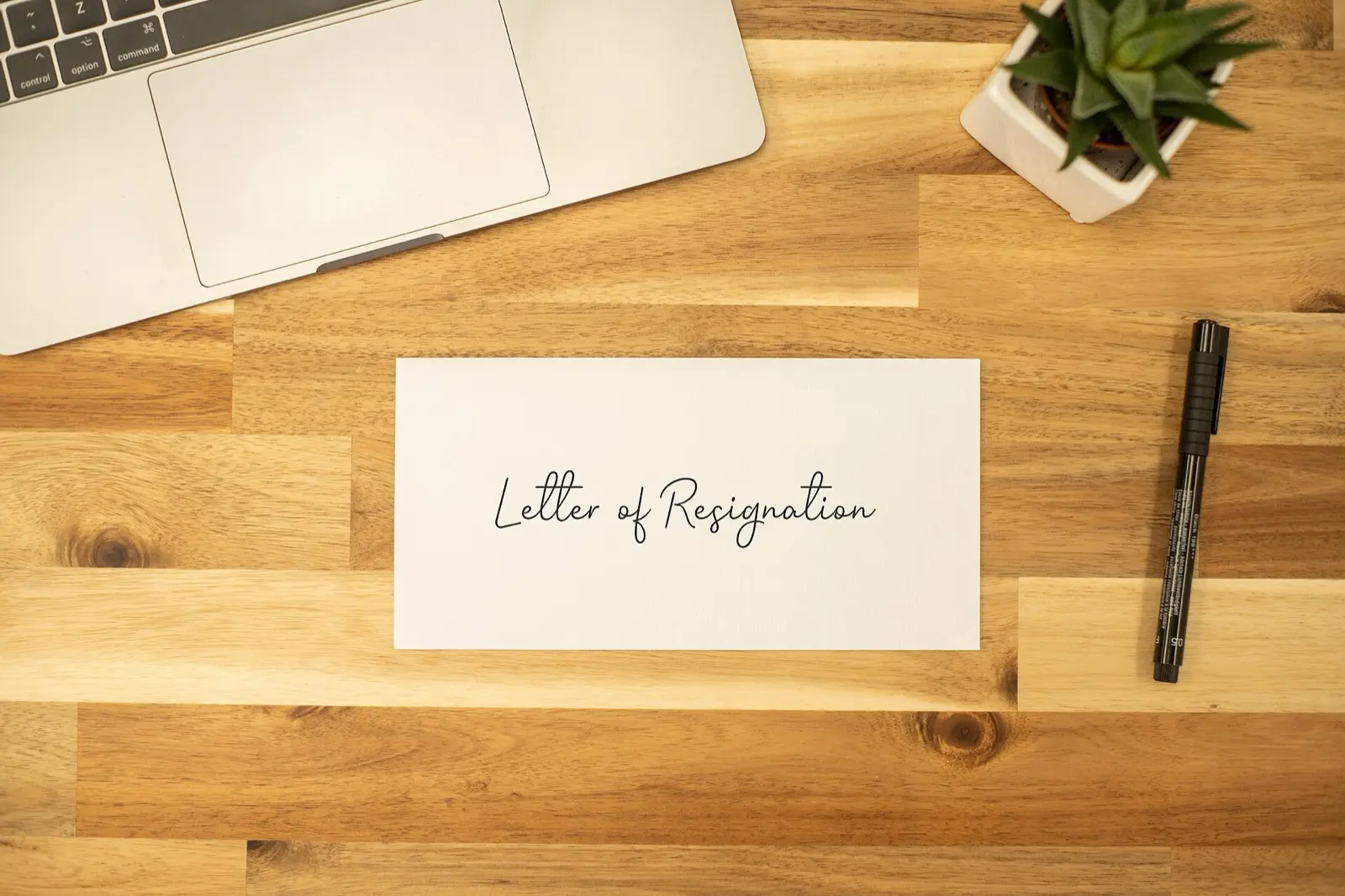
Cover photo: "Letter of Resignation on Desk" by CIPHR Connect, CC BY 2.0, via Wikimedia Commons.
Frequently asked questions
What should a two weeks notice letter say?
State that you are resigning, give your last working day, thank your employer briefly, and offer to help with the transition. Date it and sign it. Everything else is optional.
Is two weeks notice required by law?
Usually not. Most U.S. employment is at-will, so either side can end it without notice. An employment contract, union agreement or company policy can require notice, and leaving without it may affect a payout of unused leave or your eligibility for rehire.
Can I send my two weeks notice by email?
Yes, especially for remote jobs. Ideally tell your manager in a conversation first, then send the email the same day so there is a written record with the date.
Do I have to say why I am leaving?
No. "I have decided to resign" is enough. If you want to give a reason, keep it to one positive or neutral sentence, such as accepting a new position or personal circumstances.
When do the two weeks start?
From the day you give notice. If you resign on Monday, October 19, your last day two weeks later would typically be Friday, October 30. State the exact date in the letter to avoid confusion.
What if my employer tells me to leave immediately?
It happens. Federal law does not require an employer to keep you on for the notice period. Ask whether you will be paid for the two weeks; some employers do it voluntarily, and your state's final pay rules then apply.
When will I get my final paycheck?
It depends on your state. The U.S. Department of Labor says federal law does not require immediate payment, but some states do. In California, for example, an employee who gives at least 72 hours' notice must be paid on the last day of work.
Log in to comment
No comments yet. Be the first.