Apple Strudel: Classic Austrian Recipe with Stretched Dough
- Stretched dough requires only flour, water, oil, and salt—the secret lies in the kneading and resting time.
- Butter-toasted breadcrumbs prevent the thin dough from getting soggy from the apple juices.
- A quick version using store-bought puff pastry is included, complete with exact measurements and calorie counts.
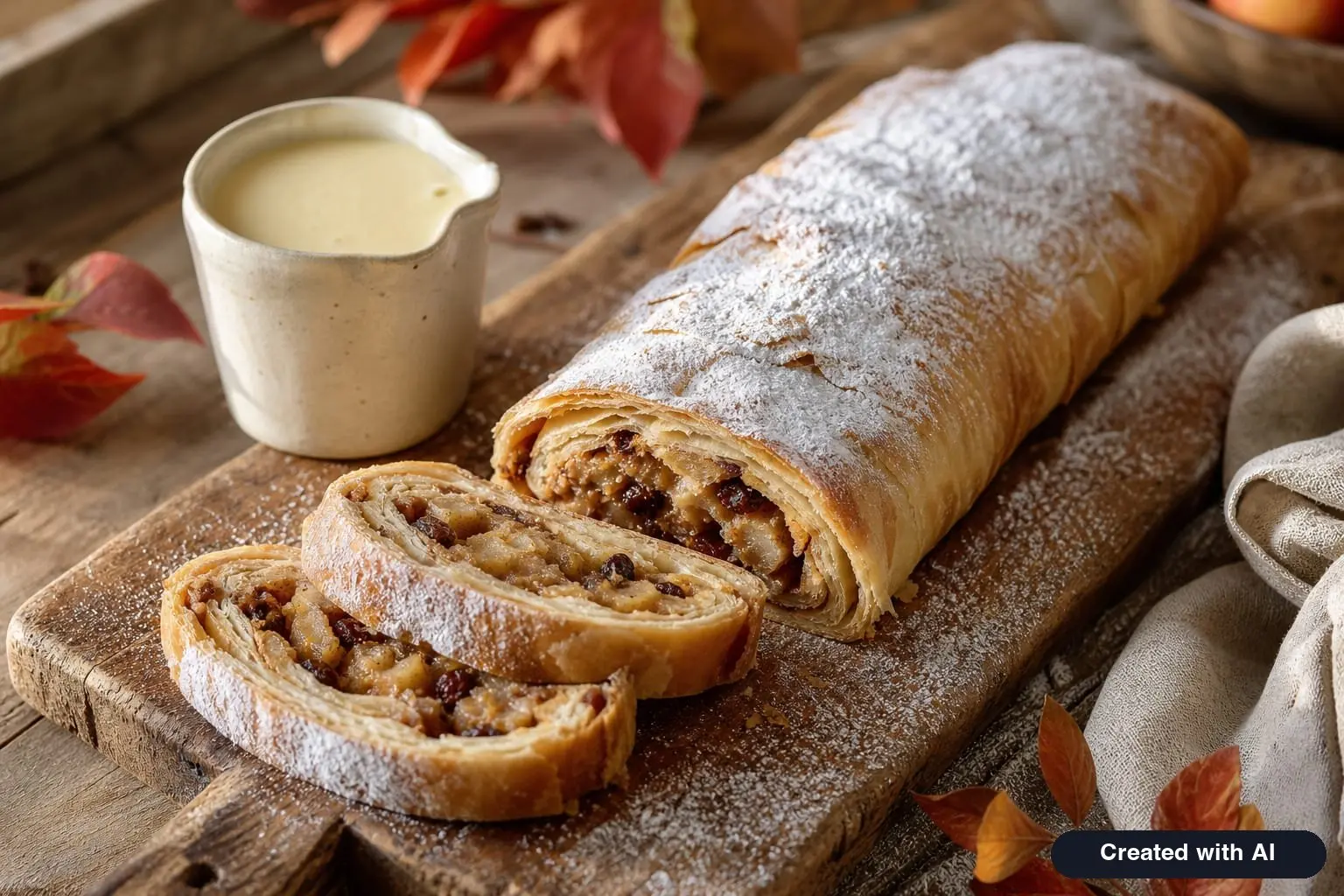
Apple strudel is one of the most famous desserts in Austrian cuisine, known in German as Apfelstrudel. It is not a pie in a pan, but a roll of paper-thin dough wrapped around a large amount of thinly sliced apples with cinnamon, raisins, and butter-toasted breadcrumbs. Once baked, the crust becomes crispy and flaky, while the apples soften and meld with their juices inside.
Strudel scares many home bakers for one reason: the stretched dough. In reality, it's simpler than it looks. The dough contains only flour, water, a little oil, and salt. The whole secret is a long kneading and resting period, after which the dough becomes elastic and easy to stretch. The first time might take a bit longer, and the dough might tear in places, but it doesn't matter—once rolled, the holes won't be visible.
If you're short on time, you'll find a quick strudel using store-bought puff pastry at the end of this article, complete with exact measurements and calories. All the other apple bakes, each with a full recipe, are in our apple pie guide.
The classic recipe is in the card below: you can adjust the quantities, check off completed steps, and print it. Below the card, each stage is described in detail.
Apple Strudel With Stretched Dough
No ratings yet – be the firstIngredients
For the dough
For the filling
For the breadcrumbs and brushing
To serve
Directions
- Dough. Knead the flour, salt, oil, vinegar, and lukewarm water for 8–10 minutes until the dough becomes smooth, elastic, and no longer sticky. Form a ball, brush with oil, cover with a bowl, and let rest for 30–60 minutes in a warm place.
- Breadcrumbs. Melt 3 tbsp (40 g) of butter in a skillet and toast the breadcrumbs in it, stirring constantly for 3–4 minutes until golden and nutty. Let cool.
- Filling. Peel, core, and cut the apples into very thin slices. Mix with sugar, cinnamon, lemon juice and zest, and drained raisins. Prepare the filling only right before stretching the dough so it doesn't release juices.
- Stretching. Preheat the oven to 375°F (190°C). Lay a clean cloth tablecloth on the table and dust with flour. Roll the dough out as thinly as possible, then slide your hands under it with knuckles facing up and carefully stretch from the center to the edges until it's so thin you can see the tablecloth pattern through it (about 24 × 32 inches / 60 × 80 cm). Trim the thick edges.
- Filling the dough. Brush the dough with a third of the melted butter. Sprinkle the breadcrumbs over a third of the dough along the short edge, and spoon the apple filling over them, leaving a 2-inch (5 cm) border.
- Rolling. Fold the side borders of the dough over the filling, then lift the tablecloth to roll the strudel up. Using the tablecloth, transfer it to a parchment-lined baking sheet, seam side down (a long strudel can be bent into a horseshoe shape).
- Baking. Brush with butter and bake for 35–40 minutes, until the surface is golden and crispy. Halfway through baking, brush with butter again.
- Serving. Let rest for 15–20 minutes, dust with powdered sugar, and slice with a sharp serrated knife. Traditionally served warm with vanilla sauce, whipped cream, or vanilla ice cream.
- Calories
- 236 kcal
- Protein
- 2.6 g
- Fat
- 9.4 g
- of which saturated
- 4.4 g
- Carbohydrates
- 36.8 g
- of which sugars
- 17.7 g
- Fiber
- 2.5 g
Calculated with the Firmus Medicus calorie database (USDA, Fineli).
Ingredients and how to choose them
Flour. Stretched dough requires a lot of gluten, so bread flour or a high-protein all-purpose flour (11–13% protein) works best. The more gluten, the more elastic the dough and the less it tears when stretched. Whole wheat and spelt flours are not suitable here—the dough will break.
Water, oil, and vinegar. Lukewarm water helps the gluten form faster, oil makes the dough soft and pliable, and a teaspoon of vinegar or lemon juice slightly relaxes the gluten—making the dough easier to stretch and less likely to shrink back.
Apples. Strudel requires tart baking apples that hold their shape, such as Granny Smith, Braeburn, or Honeycrisp. They soften as they bake but don't turn into mush, and their tartness balances the sugar. Very juicy apples release a lot of liquid and can make the dough soggy—if you use them, add more breadcrumbs. You need about 2.2 lb (1 kg) of apples; the strudel should be thick and full of filling.
Breadcrumbs. This is not an optional extra, but an essential part: butter-toasted breadcrumbs absorb the apple juices and prevent the dough from getting soggy, while also adding a nutty flavor. Plain wheat breadcrumbs or crushed stale white bread work perfectly.
Step-by-step preparation
Start with the dough: knead the flour, salt, oil, vinegar, and lukewarm water for 8–10 minutes by hand or 5–6 minutes with a stand mixer fitted with a dough hook. Initially, the dough will be sticky, but as you knead, it will become smooth and elastic. A well-kneaded dough, when cut with a knife, should have a smooth surface without small holes. Form a ball, coat it with oil, place it in a bowl, and cover it—let it rest for 30–60 minutes at room temperature. This step cannot be skipped: dough with unrelaxed gluten will not stretch and will just shrink back.
While the dough rests, melt 3 tbsp (40 g) of butter in a skillet and toast the breadcrumbs in it, stirring constantly for 3–4 minutes until they turn golden and smell nutty. Let them cool. Then prepare the apples: peel, core, and cut them into very thin slices, about ⅛ inch (2–3 mm) thick. Mix with sugar, cinnamon, lemon juice, grated zest, and drained raisins. Prepare the filling only right before stretching the dough—otherwise, the sugar will draw the juices out of the apples.
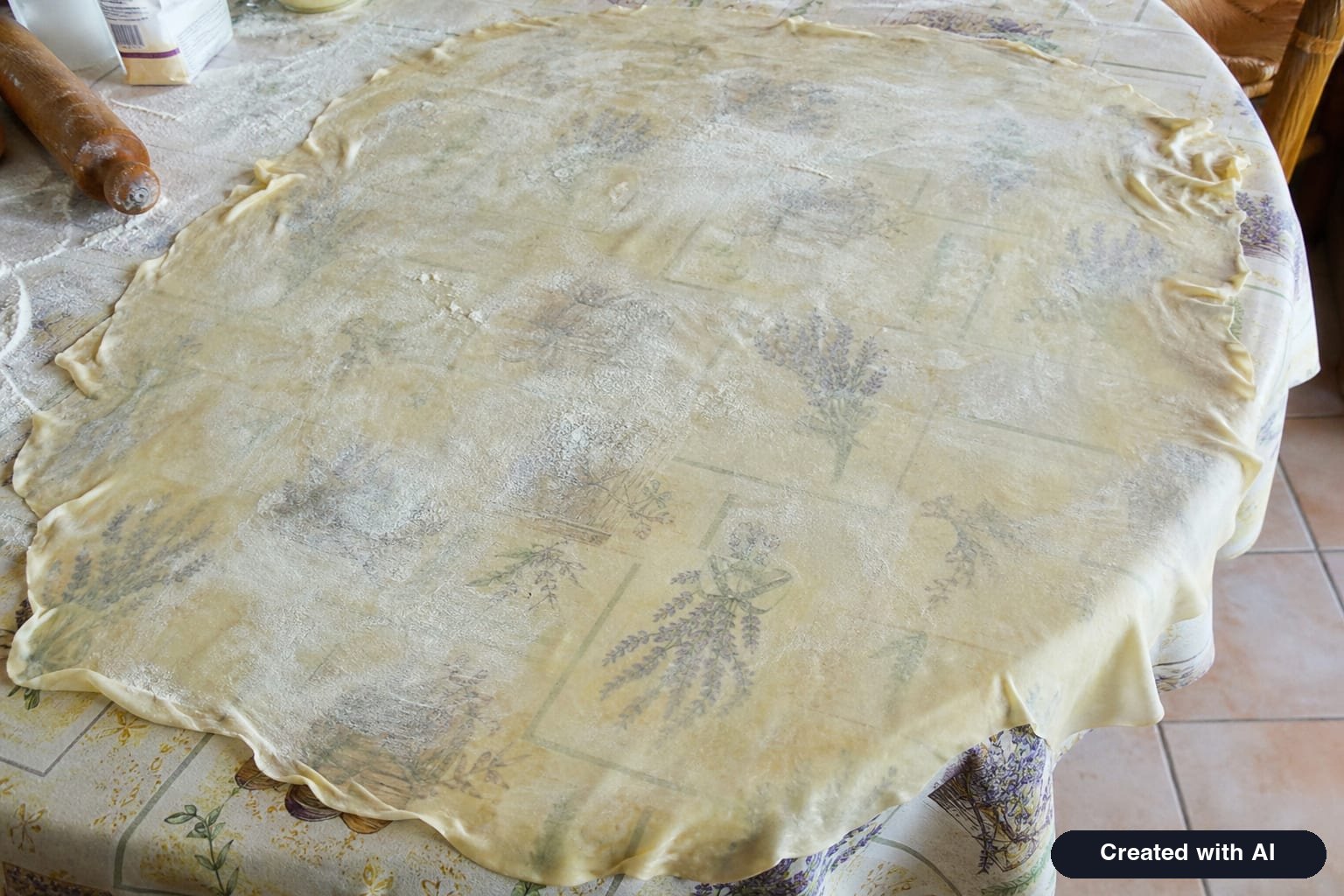
Preheat the oven to 375°F (190°C). Lay a clean cloth tablecloth or a large towel on the table and dust it generously with flour. First, roll the dough out as thinly as possible with a rolling pin. Then remove any rings from your fingers, slide your hands under the dough with your knuckles facing up, and, moving from the center to the edges, carefully stretch it. The dough should "flow" over your knuckles rather than being pulled by your fingers—fingertips would pierce it. Stretch until it becomes so thin that you can see the tablecloth pattern through it, about 24 × 32 inches (60 × 80 cm). Trim off the thick edges. Small holes are nothing to worry about.
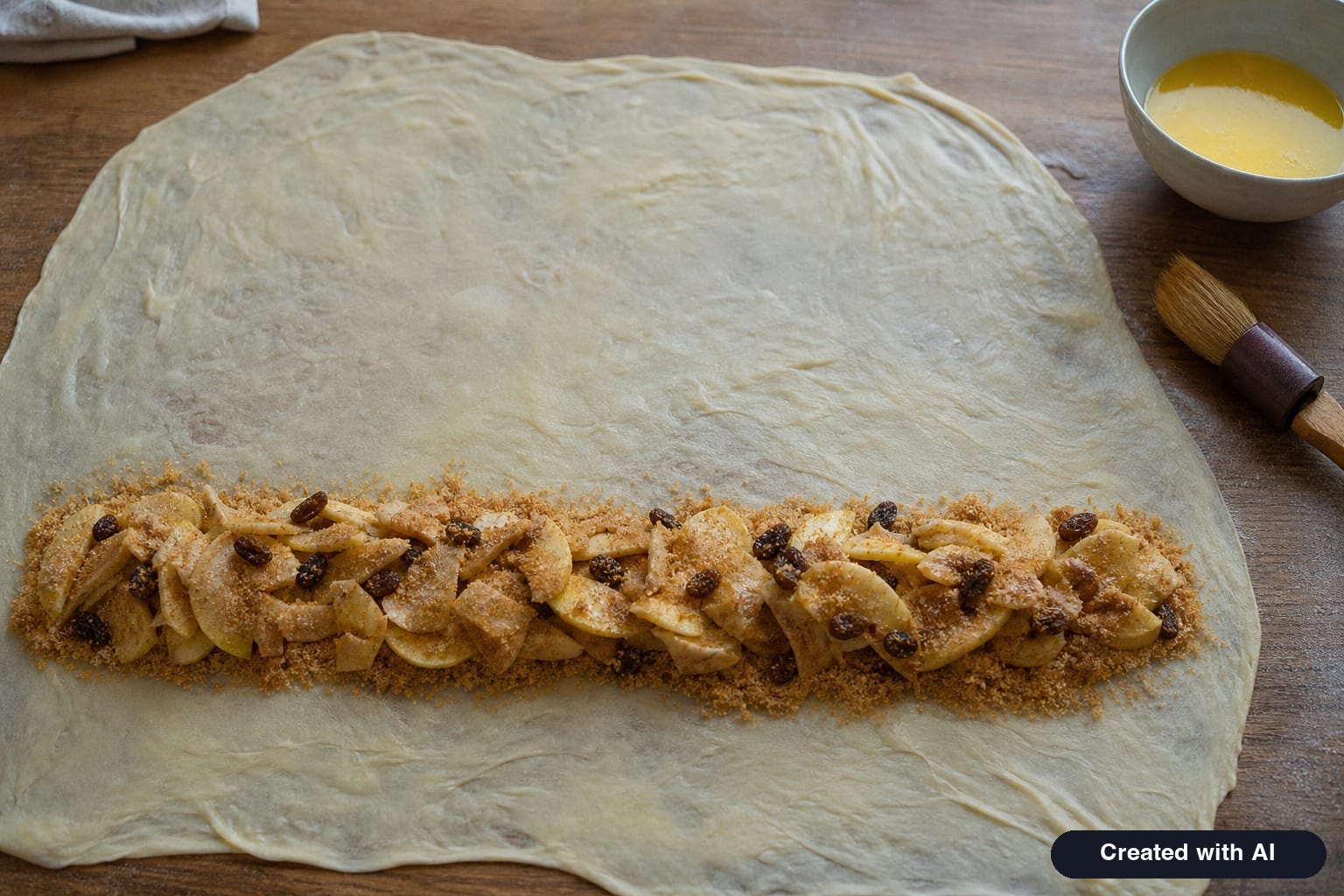
Brush or drizzle the stretched dough with a third of the melted butter. Along one edge of the dough, leaving a 2-inch (5 cm) border on the sides, sprinkle the toasted breadcrumbs in a wide strip, and spoon the apple filling over them. Do not pour in any juices that have pooled at the bottom of the bowl—they will make the dough soggy.
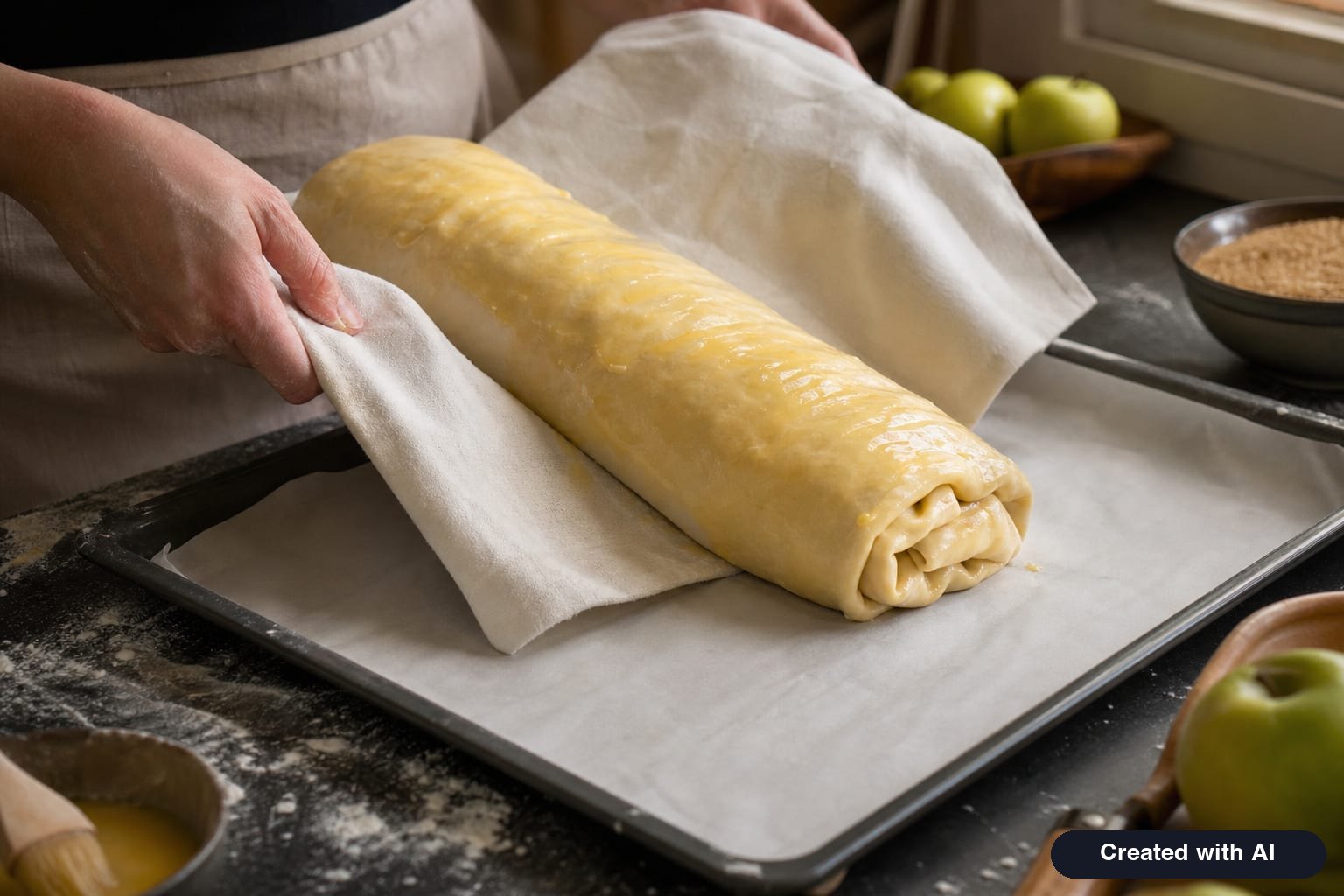
Fold the side borders of the dough over the filling. Then, by lifting the edge of the tablecloth, let the strudel roll itself up—you will barely touch the dough with your hands. Using the tablecloth, roll the strudel onto a parchment-lined baking sheet, seam side down. If the strudel is too long for the pan, bend it into a horseshoe shape.
Brush the strudel with butter and bake for 35–40 minutes. Halfway through baking, brush it again with the remaining butter—this is what gives the crust its flakiness and golden color. A baked strudel is golden and crispy, and you can hear the crust crackle when pressed. Let it rest for 15–20 minutes so the filling sets, dust with powdered sugar, and slice with a sharp serrated knife.
Common mistakes
Dough tears when stretched. The dough was kneaded for too short a time or didn't rest, the flour is too weak, or it was stretched with fingertips. Knead for at least 8 minutes, let it rest for an hour, and stretch only with your knuckles. Patch any occasional holes with a piece of dough from the edges.
Bottom is wet and mushy. Too few breadcrumbs, the apples released their juices because the filling was prepared too early, or the juices from the bowl were poured into the strudel. Prepare the filling right before rolling, do not pour in the juices, and use ⅔ cup (80 g) of breadcrumbs for very juicy apples.
Crust is hard, not crispy. The dough was left too thick or the strudel wasn't brushed with enough butter. Stretched dough must be translucent, and it needs to be brushed with butter both before baking and halfway through.
Strudel burst while baking. Too much filling or the roll was wrapped too tightly. Roll it loosely and make a few slits on the top with a knife before baking to let the steam escape.
Quick strudel with puff pastry
When there's no time to stretch dough, you can bake a strudel using store-bought puff pastry. It's not a true Viennese Apfelstrudel, but it's a very delicious and simple apple roll. You will need: 1.1 lb (500 g) of puff pastry (two sheets), the same amount of apple filling (about 1.9 lb / 850 g peeled apples, ⅓ cup / 80 g sugar, ⅓ cup / 50 g raisins, cinnamon, lemon), ½ cup (60 g) breadcrumbs toasted in 3 tbsp (40 g) butter, and 1 egg for an egg wash.
Roll out the thawed sheets slightly, sprinkle half the breadcrumbs and half the filling lengthwise down the middle of each, fold the sides over, and roll up. Place seam side down, brush with beaten egg, make diagonal slits on top, and bake at 400°F (200°C) for 30–35 minutes until browned. This will yield two strudels, 6 slices each. Puff pastry is high in fat, so a slice has about 333 kcal—roughly 100 kcal more than the classic version.
Variations and substitutions
- With nuts. Add ½ cup (50 g) of chopped walnuts or almonds to the filling—this is very common in Austrian homes.
- Without raisins. If you don't like raisins, skip them or replace them with dried cranberries.
- With rum. Soak the raisins in 2 tablespoons of rum instead of water—this is a classic Viennese café flavor.
- With farmer cheese. Replace half the apples with 9 oz (250 g) of farmer cheese (or dry curd cottage cheese) mashed with an egg and a tablespoon of sugar—you'll get what's known as a cheese and apple strudel.
- With phyllo dough. Store-bought phyllo dough is the closest to stretched dough: layer 6–8 sheets, brushing each with butter, and roll like a classic strudel.
Lighter version: how many calories each change makes
A classic strudel has a lot of apples and relatively little dough, so it's not a heavy dessert. Here is how many calories are added or saved per slice (dividing the strudel into 12 slices) by the most common modifications.
| Change | How | kcal / slice | Difference |
|---|---|---|---|
| Main recipe | as written above | 236 | – |
| Half the sugar | 3 tbsp (40 g) sugar instead of ⅓ cup (80 g) – enough for sweeter apples | 223 | −13 |
| Less butter | toast breadcrumbs in a dry skillet, brush with only 3.5 tbsp (50 g) butter | 206 | −30 |
| No raisins | omit raisins | 223 | −13 |
| With walnuts | add ½ cup (50 g) chopped walnuts to the filling | 263 | +27 |
| Quick – with puff pastry | 1.1 lb (500 g) store-bought puff pastry instead of stretched dough, 3.5 tbsp (50 g) butter only for breadcrumbs | 333 | +97 |
Calculated with the Firmus Medicus calorie database, with the recipe divided into 12 slices.
The biggest savings come from reducing the butter (−30 kcal per slice): you can toast the breadcrumbs in a dry skillet and brush the strudel with only 3.5 tbsp (50 g) of butter. Skipping the sugar and raisins saves 13 kcal each. The biggest jump upwards is puff pastry: it's convenient, but a slice becomes almost a third higher in calories.
How many calories are in apple strudel
One slice of classic strudel (about 4 oz / 115 g) has about 236 kcal, and with breadcrumbs, which are not included in the calorie table, it's about 255 kcal. Most of the calories come from the butter and flour, while the apples, although making up more than half the weight, contribute only about a sixth. Below is the breakdown of each ingredient.
| Ingredient | Amount | kcal, whole recipe | Share |
|---|---|---|---|
| White wheat flour | 250 g | 910 | 32 % |
| Butter | 100 g | 717 | 25 % |
| Apple | 850 g | 442 | 16 % |
| Granulated sugar | 80 g | 310 | 11 % |
| Canola oil | 28 g | 248 | 9 % |
| Raisins | 50 g | 151 | 5 % |
| Powdered sugar | 10 g | 39 | 1 % |
| Cinnamon, ground | 3 g | 7 | 0 % |
| Lemon juice, raw | 15 g | 3 | 0 % |
| Table salt | 2 g | 0 | 0 % |
| Total | 1388 g | 2827 | 236 kcal / slice |
Ingredient values – Firmus Medicus calorie database.
Serving it with vanilla sauce or a scoop of vanilla ice cream adds another 70–130 kcal to the slice, depending on the portion.
How to store and can you freeze it
Strudel is best the same day, while the crust is crispy. Covered at room temperature, it can be kept for up to 2 days, or in the refrigerator for up to 4 days. Before serving, reheat it for 10 minutes in a 340°F (170°C) oven—the crust will become crispy again. In the microwave, it will get soft.
Strudel can be frozen in two ways. Tightly wrap an unbaked, rolled, and unbuttered strudel in plastic wrap and freeze for up to 2 months; bake without thawing, adding 10–15 extra minutes. A baked strudel can be frozen in slices for up to 3 months; thaw and reheat in the oven.
Strudel is a challenge that pays off. If you want something simpler, bake an easy apple cake, and if you loved the buttery, crispy crust, try an American apple pie with a double crust or an apple crumble pie.
Frequently asked questions
How is apple strudel different from apple pie?
Strudel is a roll made of paper-thin stretched dough filled with a large amount of apples, rather than a pie baked in a pan. Once baked, the crust is crispy and flaky, while the apples inside soften alongside butter-toasted breadcrumbs.
Why does strudel dough tear when stretched?
Usually, it hasn't been kneaded long enough or hasn't rested, the flour is too weak, or it's being stretched with fingertips. Knead for at least 8 minutes, let the dough rest for 30–60 minutes, and stretch it using your knuckles underneath, working from the center to the edges.
Why are breadcrumbs needed in a strudel?
Butter-toasted breadcrumbs absorb the apple juices and prevent the thin dough from getting soggy, while also adding a nutty flavor. Without them, the bottom of the strudel remains wet and mushy.
Can you bake apple strudel with puff pastry?
Yes. From 1.1 lb (500 g) of store-bought puff pastry and the same apple filling, you can make two rolls; bake at 400°F (200°C) for 30–35 minutes. This strudel is easier but higher in calories—about 333 kcal per slice instead of 236 kcal.
How many calories are in apple strudel?
A slice of classic strudel with stretched dough (divided into 12 slices, about 4 oz / 115 g) has about 236 kcal, or 255 kcal with breadcrumbs. With puff pastry, it's about 333 kcal.
Can you freeze apple strudel?
Yes. Tightly wrap an unbaked, unbuttered roll and freeze for up to 2 months; bake without thawing for 10–15 extra minutes. A baked strudel can be frozen in slices for up to 3 months.
Log in to comment
No comments yet. Be the first.