French Apple Tart: Tarte aux Pommes and Upside-Down Tatin
- The buttery shortcrust pastry is blind-baked so the base doesn't get soggy
- Thin, unpeeled apple slices are arranged in concentric circles over applesauce
- Includes a separate recipe for an upside-down caramel tarte Tatin
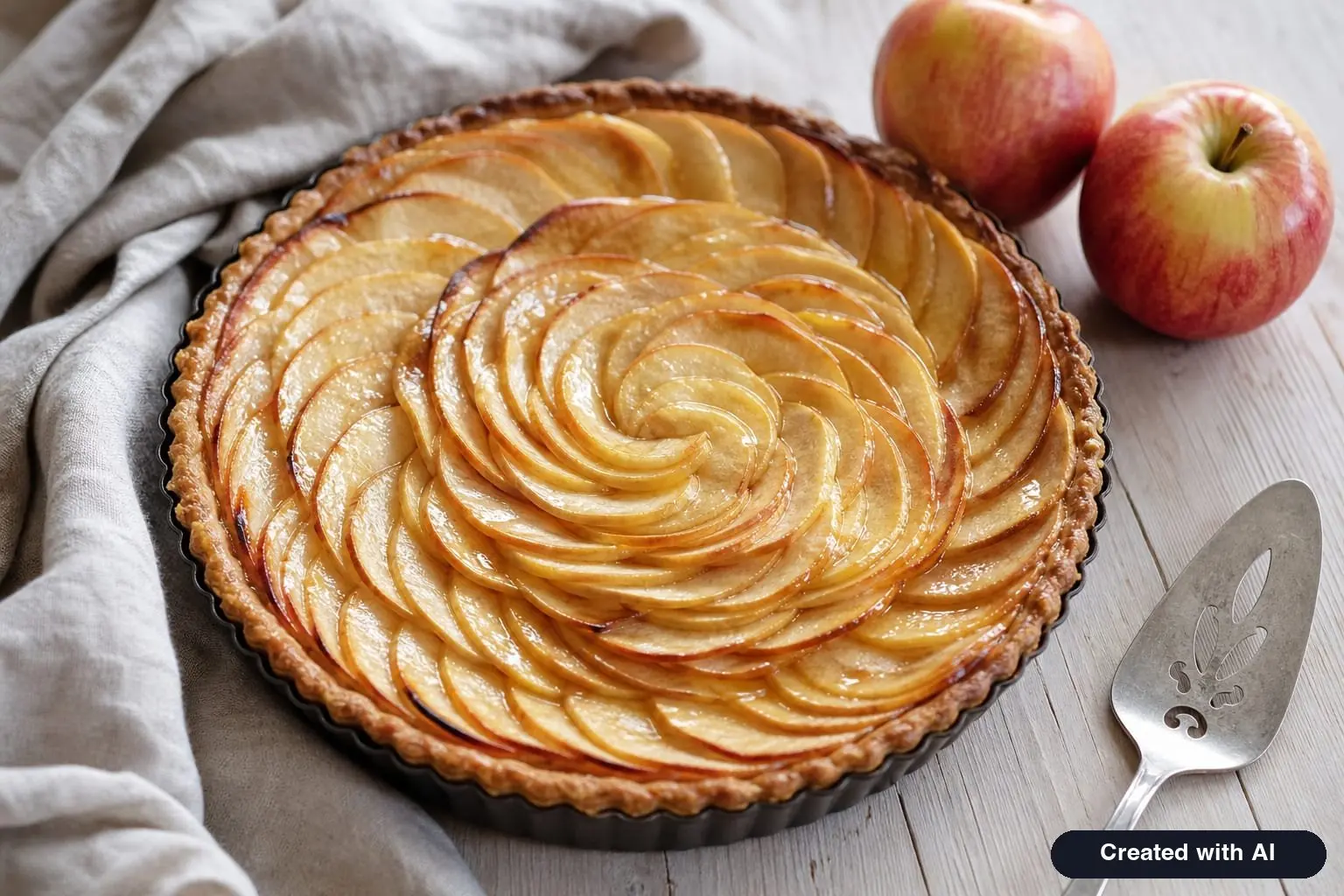
A French apple tart looks like it came straight from a pastry shop window: a thin shortcrust base, a smooth layer of applesauce underneath, and thin apple slices arranged in dense circles on top, which brown at the edges in the oven and then shine under an apricot glaze. In France, this pastry is called tarte aux pommes.
"French apple tart" isn't one specific recipe. The name usually covers two bakes: an open tart with a shortcrust base and beautifully arranged apples (which we describe in the recipe card) and an upside-down caramel apple tart, tarte Tatin, which gets its own section with specific measurements. Both share what sets them apart from a standard sponge cake: there is very little dough, it is thin and crumbly, and the apples play the main role.
This tart requires a bit more patience than a simple apple cake—the dough needs to be chilled and blind-baked, and the apples thinly sliced. However, each step is simple, and the result is perfect for both a festive table and weekend coffee.
Below is the full recipe in one card: you can recalculate the amounts for a different pan size, check off what you've already added, and print it out. After the card, there is a detailed explanation of how to get a crisp, tender crust and a beautiful apple pattern, and at the end of the article—the upside-down tart recipe.
French Apple Tart (Tarte aux Pommes)
No ratings yet – be the firstIngredients
For the shortcrust pastry
For the filling
For the glaze (optional)
Directions
- Pastry. Mix the flour, powdered sugar, and salt, add the cold butter cubes, and rub into crumbs with your fingers or a pastry blender. Stir in the egg yolk and enough ice water for the dough to come together. Do not knead—press into a disk, wrap in plastic wrap, and chill in the refrigerator for 30 minutes.
- Crust. Roll out the dough to ⅛ inch (3 mm) thick, line a 9½-inch (24 cm) pan, trim the edges, prick the bottom with a fork, and chill in the refrigerator for another 10 minutes.
- Blind baking. Preheat the oven to 375°F (190°C). Line the crust with parchment paper, fill with pie weights or dried beans, and bake for 15 minutes, then remove the paper and weights and bake for another 5 minutes until the bottom is matte.
- Apples. Do not peel the apples; core them and cut into ⅛-inch (2–3 mm) slices. Immediately drizzle with lemon juice to prevent browning.
- Layers. Spread the thick applesauce over the blind-baked crust. Arrange the slices tightly, overlapping each other, in concentric circles from the edge to the center.
- Baking. Brush the apples with melted butter, sprinkle with sugar, and bake at 375°F (190°C) for about 30–35 minutes, until the edges of the slices brown and the pastry edge turns golden.
- Glaze and cooling. Brush the still-warm tart with warmed, strained apricot jam. Let it cool in the pan for at least 20 minutes before removing.
- Calories
- 297 kcal
- Protein
- 3.3 g
- Fat
- 14.2 g
- of which saturated
- 8.5 g
- Carbohydrates
- 40.7 g
- of which sugars
- 18.7 g
- Fiber
- 2.4 g
Calculated with the Firmus Medicus calorie database (USDA, Fineli).
Ingredients and how to choose them
Pastry. This is a classic shortcrust pastry (pâte sucrée): all-purpose flour, cold butter, powdered sugar, and an egg yolk. Powdered sugar, unlike granulated sugar, dissolves without crystals, making the dough smooth and finely crumbly. The butter must be real and cold—margarine or soft butter makes the dough greasy and hard to roll out, and it shrinks more during baking.
Applesauce. It prevents the crust from getting soggy from the apple juices and adds softness to the tart. Unsweetened store-bought applesauce works, or you can make it at home from 3–4 tart baking apples: simmer peeled and chopped apples with a tablespoon of water for 10–15 minutes until they break down, then mash them. The applesauce must be thick—if it's runny, boil it uncovered a bit longer, otherwise the crust will become wet.
Apples for the top. Choose firm, crisp varieties: Granny Smith or Golden Delicious. Soft, mealy apples such as McIntosh are not suitable for this tart—their thin slices will fall apart during baking and the pattern will disappear. Unpeeled red apples provide a beautiful red edge, while peeled ones give a solid golden color.
Pan. The best option is a shallow 9½-inch (24 cm) fluted tart pan with a removable bottom. A simple 9½-inch (24 cm) springform pan also works, just form the edges about 1 inch (2–3 cm) high.
Step-by-step preparation
Pastry and blind baking
Mix the flour with the powdered sugar and salt, add the cold butter cubes, and quickly rub them in with your fingertips or a pastry blender until the mixture resembles damp sand. Stir in the egg yolk and add ice water a tablespoon at a time until the dough comes together into a ball. Do not knead: the longer the dough is warmed by your hands, the more gluten develops, and the tougher it will be. Press it into a disk, wrap it in plastic wrap, and chill in the refrigerator for at least 30 minutes.
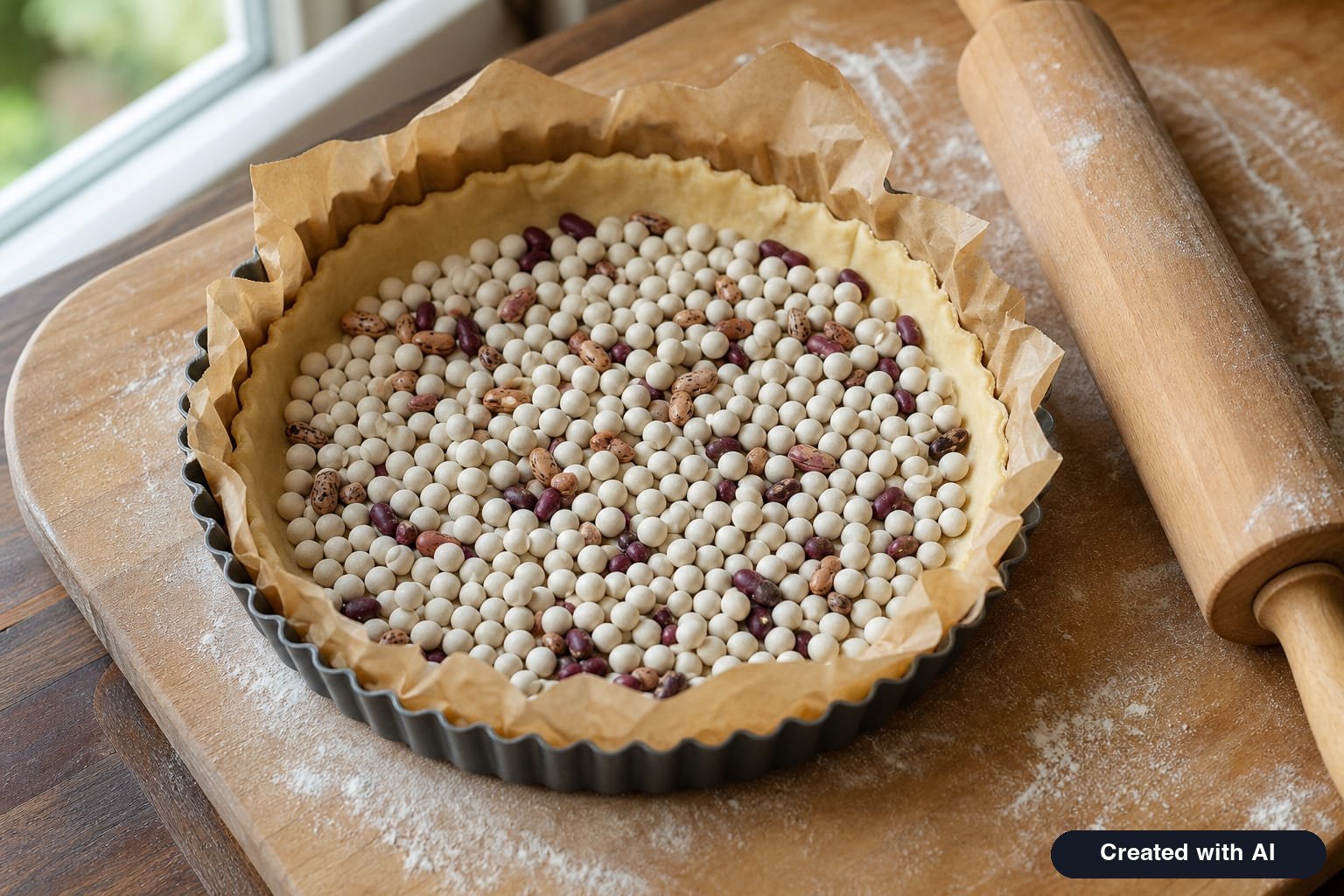
Roll out the chilled dough between two sheets of parchment paper to about ⅛ inch (3 mm) thick and line the pan. Do not stretch the edges—stretched dough will shrink back during baking. Prick the bottom with a fork and chill the pan in the refrigerator for another 10 minutes. Then line the crust with parchment paper, fill it with dried beans or pie weights, and bake at 375°F (190°C) for 15 minutes. Remove the paper and weights and bake for another 5 minutes or so until the bottom is matte and dry.
This blind baking is the most important rule of a French tart. Raw shortcrust pastry will not bake through under a moist filling and will remain gummy, while a pre-baked crust stays crumbly even the next day.
Apple pattern
While the crust is baking, cut the apples in half, core them, and cut them into ⅛-inch (2–3 mm) slices. You will get the thinnest and most uniform slices with a mandoline slicer. Immediately drizzle with lemon juice and toss gently—this will keep the apples from browning while you arrange them.
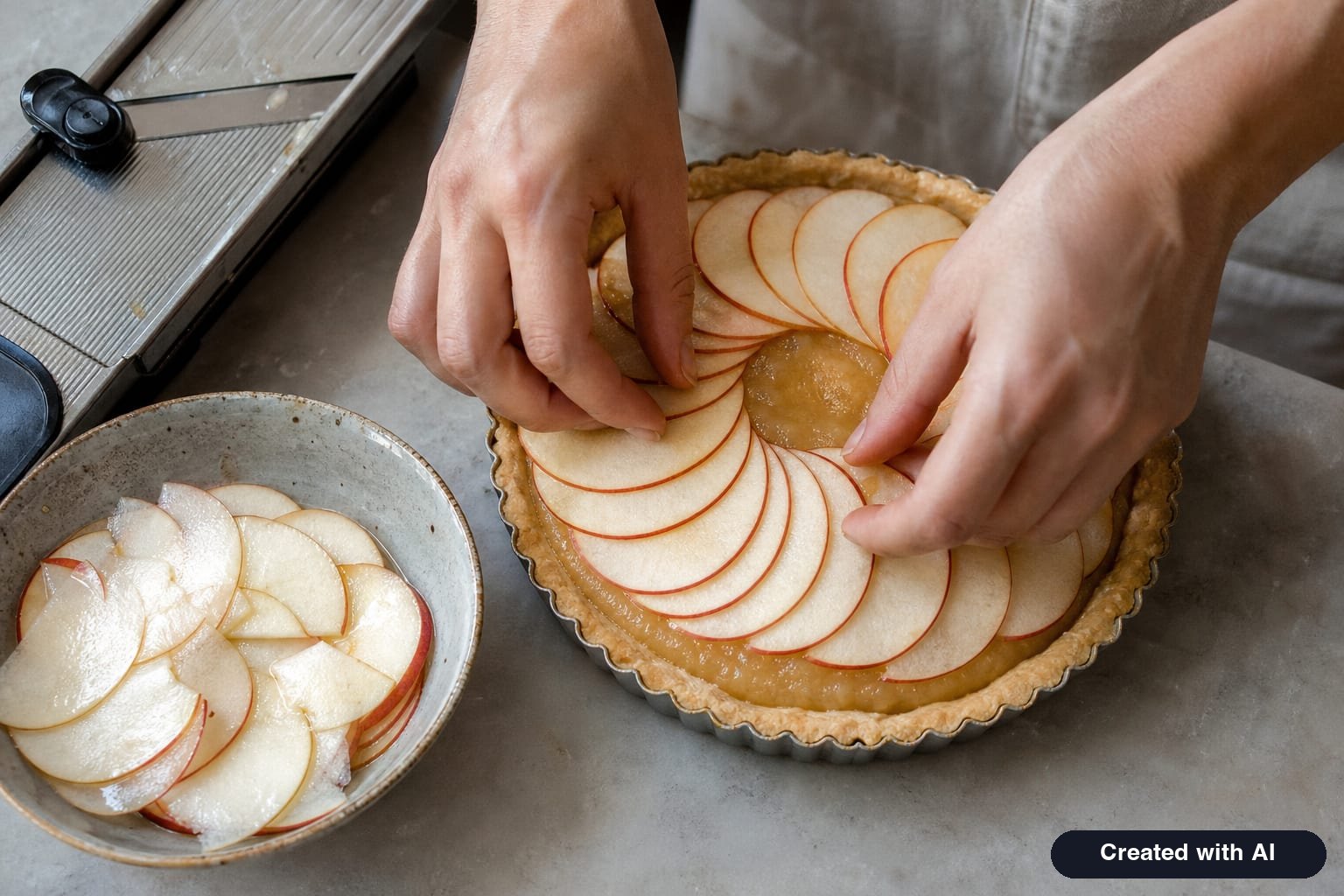
Spread the applesauce in an even layer over the slightly cooled crust. Start arranging the slices from the edge: place each subsequent slice over the previous one so that only a narrow strip is visible. When the outer circle is finished, arrange the inner one in the opposite direction, and fill the very center with the smallest slices rolled into a "rose". Pack them tightly—apples lose water and shrink as they bake.
Baking and glaze
Brush the apples with melted butter and sprinkle evenly with sugar. Bake at 375°F (190°C) for about 30–35 minutes: the apples should soften, and the edges of the slices should brown. If the pastry edge browns too early, cover it with a strip of foil.
While the tart is still warm, brush it with warmed and strained apricot jam. The glaze not only adds shine but also protects the apples from drying out. Let the tart cool in the pan for at least 20 minutes before removing it—a hot crust is still fragile and can break.
Upside-down apple tart (tarte Tatin)
This is the second famous French apple tart: the apples are caramelized in a skillet, covered with pastry, baked, and the tart is flipped onto a plate. On top are apples cooked in amber caramel, and on the bottom is a crispy crust.
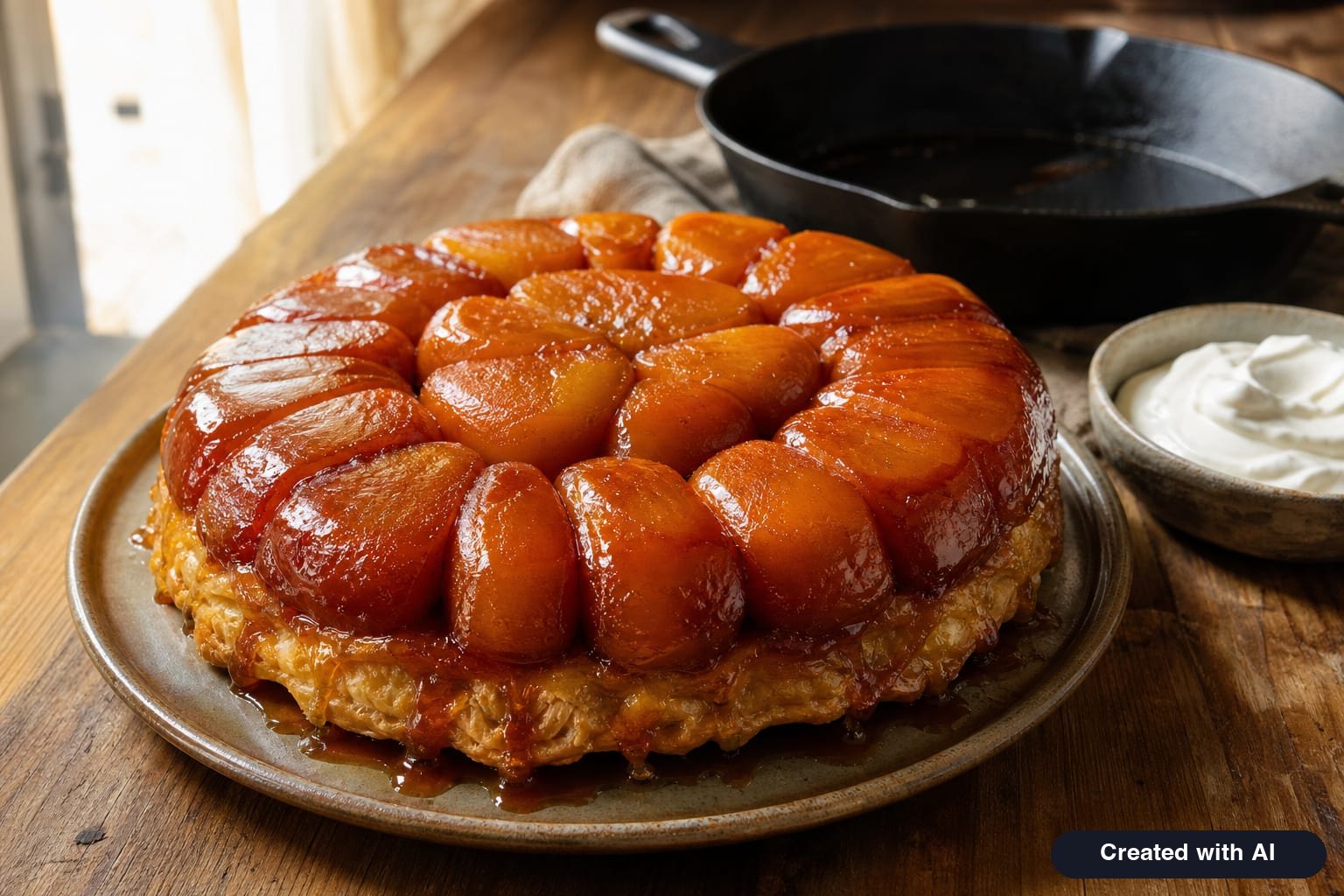
For a 9½-inch (24 cm) oven-safe skillet (preferably cast iron), you will need:
- 6–7 firm apples (about 2.6 lb / 1.2 kg), peeled and cut into halves or quarters;
- ½ cup (100 g) sugar;
- 4 tbsp (60 g) butter;
- 1 sheet (about 9.7 oz / 275 g) of puff pastry or half the amount of shortcrust pastry listed in the recipe card;
- a pinch of salt.
Melt the sugar in the skillet over medium heat and, without stirring, just swirling the pan, heat until it turns a light brown caramel color. Toss in the butter and salt, and stir. Arrange the apple halves tightly, cut side up—they will shrink as they bake, so add more than you think you need. Simmer for 15–20 minutes until the apples are coated in caramel and the bottom turns amber.
Cover the apples with the pastry circle, tuck the edges down around the apples into the skillet, and cut a few slits in the dough for steam to escape. Bake in the oven at 400°F (200°C) for 25–30 minutes until the pastry is golden. Wait 3–5 minutes, place a large plate on top, and flip it in one motion. If a few apples stay in the skillet—just pop them back into place. Serve warm with sour cream, whipped cream, or vanilla ice cream.
For a simpler apple pie made with puff pastry, see the variation in our shortcrust apple pie recipe.
Common mistakes
The crust is wet and gummy under the filling. Blind baking was skipped or the applesauce was too runny. Always blind-bake the crust with pie weights, and reduce the applesauce until a line drawn through it with a spoon doesn't fill back in.
The pastry edges slid down to the bottom. The dough was too warm, stretched, or not chilled in the pan. Chill the lined pan in the refrigerator before baking and bake with pie weights filled all the way to the top.
The dough cracks when rolling. Too little liquid or too cold. Let it sit at room temperature for 5 minutes, and simply pinch any cracks together with your fingers—shortcrust pastry is easy to "patch".
The apple pattern thinned out after baking. The slices were too thick or spaced too far apart. Cut them no thicker than ⅛ inch (3 mm) and arrange them so each one covers the previous one.
The apples are pale, even though the crust is baked. Not enough butter and sugar on top. You can turn on the broiler for the last 3–4 minutes, keeping a close eye so the edges don't burn.
The caramel for the upside-down tart turned bitter. It was heated too long. Remove the skillet from the heat when the caramel is just light brown—it will darken further when you add the apples.
Variations and substitutions
- Instead of applesauce – use almond cream (frangipane): 4 tbsp (60 g) butter, ⅓ cup (60 g) sugar, 1 egg, and ½ cup (60 g) almond flour. The tart will be richer and more like a bakery pastry.
- Without apricot jam – light honey or apple jelly, warmed with a tablespoon of water, works well. You can also skip the glaze entirely, but the apples won't be as shiny.
- More fragrant – mix a little vanilla or a pinch of cinnamon into the applesauce, and sprinkle a teaspoon of brown sugar over the apples before baking.
- Quicker – instead of shortcrust pastry, use a sheet of store-bought puff pastry, roll it out, prick it, and bake without the applesauce, just with the apple slices at 400°F (200°C) for about 25 minutes.
Lighter version
In a French tart, most of the calories hide in the pastry, not the apples. Therefore, the biggest difference comes not from reducing sugar, but from a thinner crust. Here is how many calories each change saves per slice (when dividing the tart into 8 servings):
| Change | How | kcal / slice | Difference |
|---|---|---|---|
| Main recipe | as written above | 297 | – |
| No sugar on top | do not sprinkle the apples with sugar—the butter and glaze are enough | 285 | −12 |
| Pastry without powdered sugar | unsweetened shortcrust pastry (pâte brisée), the apples provide the sweetness | 272 | −25 |
| Thinner crust | ¾ of the dough amount: 1 ¼ cups (150 g) flour, 5 tbsp (75 g) butter, ⅓ cup (38 g) powdered sugar, rolled out to 1/16 inch (2 mm) | 246 | −51 |
| Half whole wheat flour | heaping ¾ cup (100 g) all-purpose + heaping ¾ cup (100 g) whole wheat flour: same calories, more fiber | 293 | −4 |
| All three lighter swaps combined | no sugar on top, unsweetened pastry, and ¾ of the dough | 215 | −82 |
Calculated with the Firmus Medicus calorie database, with the recipe divided into 8 slices.
A thinner crust made from ¾ of the dough reduces the energy value of a slice by 51 kcal—more than all the sugar on top and in the dough combined. Combining all three lighter swaps brings a slice down to about 215 kcal instead of 297. Whole wheat flour barely changes the calories, but gives the dough a nuttier flavor and more fiber.
How many calories are in a French apple tart
One slice, when dividing the tart into 8 servings (about 5.3 oz / 150 g), has about 300 kcal. This is more than an easy apple cake, because the slice is larger and the shortcrust pastry contains a lot of butter. Below is how many calories each ingredient contributes.
| Ingredient | Amount | kcal, whole recipe | Share |
|---|---|---|---|
| White wheat flour | 200 g | 728 | 31 % |
| Butter | 100 g | 717 | 30 % |
| Apple | 450 g | 234 | 10 % |
| Butter | 30 g | 215 | 9 % |
| Powdered sugar | 50 g | 195 | 8 % |
| Applesauce | 300 g | 126 | 5 % |
| Granulated sugar | 25 g | 97 | 4 % |
| Egg yolk, raw | 18 g | 58 | 2 % |
| Lemon juice, raw | 15 g | 3 | 0 % |
| Table salt | 1 g | 0 | 0 % |
| Total | 1189 g | 2373 | 297 kcal / slice |
Ingredient values – Firmus Medicus calorie database.
How to store
At room temperature, the tart is best on the first day while the crust is crispiest. Covered, it stays delicious for 1–2 days, and in the refrigerator for up to 3 days, though the crust will gradually soften. Before serving a chilled tart, warm it for 8–10 minutes in a 320°F (160°C) oven—the crust will become crisp again.
It's best to freeze the dough rather than the baked tart: wrapped in plastic wrap, it keeps in the freezer for up to 3 months and can be thawed overnight in the refrigerator. A baked tart can be frozen in slices for up to 1 month, but the apples will be softer after thawing. An upside-down tart is best eaten the same day.
If you want a simpler bake without rolling out dough, try an easy apple cake—you can prep it in just a few minutes. And if you like apples in a flaky crust, it's worth trying an American apple pie with a lattice top or a thin, crispy apple strudel.
Frequently asked questions
How is a French apple tart different from a regular apple cake?
In a regular apple cake, apples are mixed into a fluffy sponge batter. A French tart has very little dough—just a thin shortcrust base topped with a layer of applesauce and densely packed thin apple slices.
Do you need to blind-bake the crust?
Yes. Bake the crust with parchment paper and pie weights at 375°F (190°C) for 15 minutes, then without them for about 5 minutes. An unbaked shortcrust base will stay gummy under a moist filling.
What are the best apples for a French apple tart?
Firm, crisp varieties like Granny Smith or Golden Delicious. Soft, mealy apples such as McIntosh fall apart when sliced thinly and baked, ruining the pattern.
How do you make tarte Tatin (upside-down apple tart)?
Cook a light caramel in a skillet with ½ cup (100 g) of sugar and 4 tbsp (60 g) of butter, add about 2.6 lb (1.2 kg) of apple halves, and simmer for 15–20 minutes. Cover with pastry, bake at 400°F (200°C) for 25–30 minutes, wait 3–5 minutes, and flip onto a plate.
How many calories are in a slice of French apple tart?
When dividing the tart into 8 servings, a 5.3 oz (150 g) slice has about 300 kcal. With a thinner crust, no sugar in the dough, and no sugar on top, it drops to about 215 kcal.
What can I substitute for apricot jam glaze?
Light honey or apple jelly, warmed with a tablespoon of water, works well. The glaze is optional—it adds shine and protects the apples from drying out.
Log in to comment
No comments yet. Be the first.