Games Like Wordle: 12 Daily Puzzles to Play Next, Mostly Free
- Daily Word on 77.today is the closest free match: one five-letter word a day, six guesses, no sign-up.
- Quordle (4 words, 9 guesses) and Octordle (8 words, 13 guesses) keep Wordle's rules but add boards.
- Wordle, Connections and Strands are free on the New York Times site; Spelling Bee is limited and Letter Boxed needs a subscription.
- Contexto and Semantle score guesses by meaning, while Worldle and Nerdle use countries and equations.
- A two- or three-game routine covering letters, meaning and logic fits into five to ten minutes.

- What makes a game "like Wordle"
- 1. Daily Word (77.today) – the closest match
- 2. Quordle and Octordle – more boards, same rules
- 3. Connections and Strands – the New York Times word family
- 4. Spelling Bee and Letter Boxed – building words, not guessing them
- 5. Waffle – a swapping puzzle instead of a guessing one
- 6. Contexto and Semantle – guessing by meaning
- 7. Worldle and Nerdle – the same mechanic, different subject
- Comparison table: games like Wordle at a glance
- Which game should you try first?
- Free games like Wordle: what "free" really means
- Guessing games like Wordle: why they hook us
- Building a five-minute daily puzzle routine
The best games like Wordle are the ones that keep its best idea – one short puzzle a day, the same for everyone, finished in a few minutes – and change one thing about it. Some multiply the boards (Quordle, Octordle), some swap letters for meaning (Contexto, Semantle), some swap words for countries or numbers (Worldle, Nerdle), and some turn the grid into a sorting or swapping puzzle (Connections, Waffle). If you just want another five-letter guessing game with a fresh daily word, start with our own Daily Word: six guesses, a new word at midnight New York time, free and without sign-up.
Below is a curated list of daily games like Wordle that we checked are live and free (or free with limits) in October 2026. For each one you will find what it is, how it differs from Wordle, who it suits and what it costs, followed by a comparison table and a few tips on building a daily puzzle routine that does not eat your whole morning.
What makes a game "like Wordle"
Wordle, created by software engineer Josh Wardle and released to the public in October 2021, gives you six tries to guess a five-letter mystery word. After every guess, the tiles tell you which letters are in the right spot, which are in the word but misplaced, and which are not in the word at all. The New York Times Company acquired the game on January 31, 2022, for a price it described as "in the low-seven figures", and Wordle still sits among the free daily games on the Times site.
When people search for games like Wordle, they usually want at least three of these five ingredients:
- A daily rhythm. One puzzle per day, shared by every player, so you can compare results with friends.
- Feedback after each attempt. Colors, numbers or rankings that turn a blind guess into a deduction.
- A short session. Two to ten minutes, not an hour.
- A spoiler-free share. A grid or score you can post without giving away the answer.
- No cost or a light cost. Playable in a browser, ideally without an account.
Every game in this list ticks most of those boxes. Where a game asks for a subscription for full access, we say so.
1. Daily Word (77.today) – the closest match
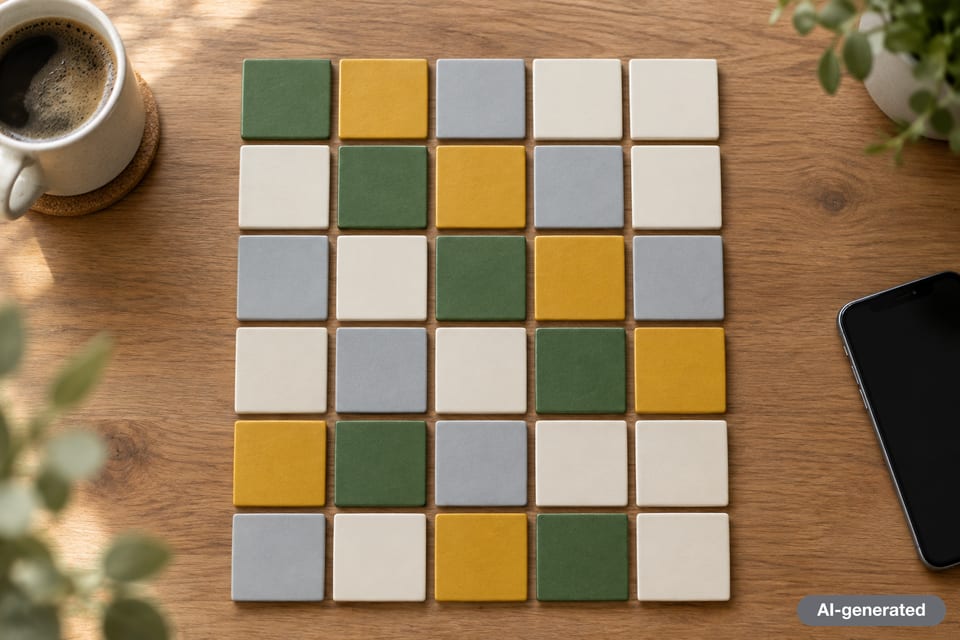
Daily Word is our own free five-letter word game, and it is the closest thing to the original format on this list. There is one secret word per day, the same for every player, and a new one arrives at midnight Eastern Time. You get six guesses. A green tile means the right letter in the right spot, yellow means the letter is in the word but somewhere else, and gray means it is not in the word. The on-screen QWERTY keyboard colors letters too, so you can see at a glance what is left.
Guesses must be real English words – the game checks them against the public-domain ENABLE word list – while the answers are always common everyday words (a pool of about 1,500+), never names, plurals or offensive words. When you finish, you see the word with a short meaning, your stats (games played, win percentage, current streak and best streak, stored in your browser) and a share button that copies only the colored grid, with no letters and no spoilers.
How it differs from Wordle: a separate answer list and a short definition after each game. There is no hard mode and no unlimited replay – one puzzle a day, by design. Daily Word #1 goes live on October 18, 2026.
Who it suits: anyone who finishes Wordle and wants a second five-letter word with the same rules. Cost: free, no account, no app, works on phone and desktop.
If you are new to the format, our guides on how to play Wordle and the best starting words apply directly.
2. Quordle and Octordle – more boards, same rules
If one word a day feels too short, the multi-board games are the natural next step. Both are now published by Merriam-Webster and played in the browser.
Quordle
Quordle shows four Wordle-style boards at once. Every guess you type is entered on all four boards, and you have nine guesses to solve all four words. Merriam-Webster also offers a tougher variant with eight guesses and more unusual words. The challenge shifts from finding one word to managing information: a guess that is perfect for board one may be wasted on board three.
Who it suits: confident Wordle players who usually solve in three or four guesses and want a longer puzzle. Cost: free daily play, supported by ads.
Octordle
Octordle doubles the pressure: eight boards, thirteen guesses. With so many words in play, your first four or five guesses are almost pure letter-hunting, and the endgame becomes a careful order-of-operations problem. A full Octordle takes ten to twenty minutes.
Who it suits: players who enjoy long, methodical sessions. Cost: free daily play with ads.
In Quordle and Octordle, spend your first three guesses on words with no repeated letters and as many common consonants as possible (R, S, T, L, N). Only start solving individual boards once each board has at least two confirmed letters. The same logic is explained in more depth in our Wordle strategy guide.
3. Connections and Strands – the New York Times word family
Two of the most popular games like Wordle and Connections come from the same publisher. According to the New York Times Help Center, Wordle, Connections and Strands can all be played for free without a Games subscription.
Connections
Connections gives you sixteen words and asks you to sort them into four groups of four that share a hidden link. The catch is that several words look as if they belong to more than one group, and you are allowed only four mistakes. There is no letter feedback at all; the "feedback" is whether a group of four is accepted.
How it differs from Wordle: it tests vocabulary breadth and lateral thinking rather than spelling and letter frequency. Who it suits: trivia fans and people who like puns and double meanings. Cost: free.
Strands
Strands is a themed word search. You get a grid of letters and a cryptic theme clue, and you trace words by connecting adjacent letters. One special word, the "spangram", describes the theme and stretches from one side of the board to the other. Every letter in the grid belongs to exactly one answer.
Who it suits: people who enjoy word searches but want a bit more thinking. Cost: free.
4. Spelling Bee and Letter Boxed – building words, not guessing them
Not every Wordle fan wants another guessing game. Some prefer to make words from a fixed set of letters, which is what these two Times puzzles do.
Spelling Bee
Spelling Bee shows seven letters in a honeycomb. Every word you make must be at least four letters long and must use the center letter; letters can be reused. Each puzzle has at least one "pangram" that uses all seven letters. You climb ranks as you find more words. The Help Center lists Spelling Bee among the free games with limited access; reaching the top ranks and seeing the full answer list requires a Games subscription.
Letter Boxed
Letter Boxed places twelve letters around the sides of a square, three per side. You chain words together so that each word starts with the last letter of the previous one, and you cannot use two letters from the same side back to back. The goal is to use every letter in as few words as possible. Letter Boxed is part of the paid Games subscription and is not on the Times list of free games.
Who they suit: people who like anagrams and building long words at their own pace. If you want a free daily alternative in the same spirit, a daily crossword exercises a similar vocabulary muscle.
5. Waffle – a swapping puzzle instead of a guessing one
Waffle is a daily word game played on a waffle-shaped five-by-five grid. All the right letters are already on the board, just in the wrong places. You swap pairs of tiles until six words read correctly (three across, three down), with Wordle-style green and yellow hints, and you have a limited budget of swaps – each puzzle can be solved in 10 swaps, and you are allowed 15.
How it differs from Wordle: there is no guessing of new letters, only rearranging. It rewards spatial reasoning and planning several moves ahead. Who it suits: players who like sliding puzzles or Sudoku as much as words. Cost: free in the browser.
6. Contexto and Semantle – guessing by meaning
These are the games for people who find letter games too mechanical. Instead of telling you which letters are right, they tell you how close your guess is in meaning to the secret word.
Contexto
In Contexto, every guess gets a rank: the secret word is number 1, and words that appear in similar contexts get low numbers. If "ocean" comes back with a rank in the hundreds and "sand" with a rank in the dozens, you know you are getting warmer. Guesses are unlimited, so the puzzle is about direction, not survival.
Semantle
Semantle works on the same principle but shows a similarity score instead of a rank, and it gives a hint about how similar the nearest words are. Most players find it harder than Contexto, because a raw score is less intuitive than a rank, and solves that take dozens of guesses are normal. Like Wordle, it is a daily game with one word per day.
Who they suit: people who think in associations, writers, and anyone who enjoys a puzzle that can take twenty minutes of wandering. Cost: both free in the browser.

7. Worldle and Nerdle – the same mechanic, different subject
Worldle
Worldle swaps words for geography. You see the silhouette of a country or territory and type guesses; each wrong answer tells you the distance and direction to the target. It is a daily game, so everyone sees the same shape. Who it suits: map lovers and travelers. Cost: free.
Nerdle
Nerdle is Wordle for arithmetic. The answer is an equation such as 3*4+5=17, and you guess equations using the digits 0–9 and the symbols for add, subtract, multiply, divide and equals. As in Wordle, the tiles show whether each character is in the right spot, somewhere else in the equation, or not in it at all. The usual order of operations applies (multiply and divide before add and subtract), and commutative answers are accepted. The site now offers more than twenty variants, including mini and maxi versions. Who it suits: people who like numbers more than letters. Cost: free daily play.
If you like the logic side of Nerdle, our daily Sudoku is another number puzzle with no arithmetic at all – just deduction, from easy to hard.
Comparison table: games like Wordle at a glance
| Game | Type | Daily or unlimited | Difficulty | Cost |
|---|---|---|---|---|
| Daily Word (77.today) | 5-letter word guessing, 6 tries | Daily | Easy to medium | Free, no sign-up |
| Quordle | 4 words at once, 9 guesses | Daily | Medium | Free with ads |
| Octordle | 8 words at once, 13 guesses | Daily | Hard (long) | Free with ads |
| Connections | Sort 16 words into 4 groups | Daily | Medium to hard | Free |
| Strands | Themed word search | Daily | Medium | Free |
| Spelling Bee | Make words from 7 letters | Daily | Easy start, hard to finish | Free with limits; full access paid |
| Letter Boxed | Chain words using 12 letters | Daily | Medium | Subscription |
| Waffle | Swap letters to fix 6 words | Daily | Medium | Free |
| Contexto | Guess by meaning (rank) | Daily, unlimited guesses | Medium | Free |
| Semantle | Guess by meaning (score) | Daily, unlimited guesses | Hard | Free |
| Worldle | Guess the country shape | Daily | Easy to medium | Free |
| Nerdle | Guess the equation | Daily | Medium | Free |
Difficulty ratings are our editors' judgment based on typical solve times and how often a reasonable player fails, not an official measure.
Which game should you try first?
The quickest way to choose is to ask what you enjoy most about Wordle, then pick the game that amplifies it.
- You love the color feedback and the five-letter format: play Daily Word right after Wordle, then step up to Quordle when two words a day feel easy.
- You love the deduction more than the vocabulary: try Waffle, Nerdle or a medium Sudoku.
- You love knowing lots of words: Spelling Bee, Strands and the daily crossword reward a wide vocabulary.
- You love talking about the puzzle with friends: Connections produces the best arguments, because groups are often debatable until the reveal.
- You want something calm with no fail state: Contexto and Semantle let you guess as long as you like.
- You want to learn something on the side: Worldle teaches geography by accident, and Daily Word shows a short meaning for each answer.
Free games like Wordle: what "free" really means
Almost every game here is free to play, but the business models differ, and it is worth knowing what you are signing up for.
- Fully free, no account: Daily Word, Waffle, Worldle, Contexto, Semantle and Nerdle can all be played in a browser without registering.
- Free with ads: Quordle and Octordle carry display advertising on the publisher's site.
- Free with a paid tier: The New York Times makes Wordle, Connections and Strands free, offers Spelling Bee with limited access, and keeps Letter Boxed, the full crossword archive and tools such as WordleBot for Games subscribers.
Be wary of copycat apps in phone stores that use popular names, show heavy ads or ask for unnecessary permissions. A browser bookmark to the official site is usually the safest way to play.
Guessing games like Wordle: why they hook us
The appeal of guessing games like Wordle is not mysterious. A daily puzzle has a natural stopping point, so it never becomes a time sink. The feedback loop is tight: each guess is rewarded with new information within a second. Streaks add gentle motivation without punishment beyond a reset number. And because everyone plays the same puzzle, a spoiler-free grid becomes a small social ritual – a way to say good morning to a group chat.
The best alternatives preserve all of that. The weaker clones tend to drop the daily limit and offer endless random puzzles, which sounds generous but removes the shared moment. If you notice you are playing out of habit rather than fun, one puzzle a day is plenty.
Building a five-minute daily puzzle routine
You do not need to play everything. A balanced routine of two or three games covers different skills and still fits into a coffee break:
- A letter game to wake up: Daily Word or Wordle (three to five minutes).
- A meaning game for variety: Connections or Contexto (three to ten minutes).
- A logic game on lighter days: a quick Sudoku or Nerdle.
On weekends, swap one of those for a longer puzzle such as Octordle or a full crossword. And when you want a laugh instead of a challenge, our jokes page has a new set every day.
For a wider look at word puzzles beyond the daily-guessing genre – party games, pen-and-paper classics and board games – read our guide to word games for adults.
Wordle and the other New York Times games named here are trademarks of The New York Times Company. Quordle and Octordle belong to their publisher. 77.today and Daily Word are not affiliated with or endorsed by The New York Times or any other game mentioned in this article.
Frequently asked questions
What is the best free game like Wordle?
For the same rules with a different word, Daily Word on 77.today is the closest match: one five-letter word a day, six guesses, green, yellow and gray tiles, free and without sign-up. For a bigger challenge, Quordle runs four boards at once.
Are there daily games like Wordle and Connections?
Yes. Strands from the New York Times is free and daily, Waffle is a daily swapping puzzle, and Contexto and Semantle are daily meaning-based guessing games. Daily Word gives you a second five-letter word every day.
Is Wordle still free?
Yes. According to the New York Times Help Center, Wordle is among the games you can play without a Games subscription. Companion tools such as WordleBot require a subscription.
What is the hardest game like Wordle?
Octordle, with eight words and thirteen guesses, is the longest, and Semantle is widely considered the hardest, because it scores guesses only by meaning and can take dozens of attempts.
Can I play more than one Daily Word a day?
No. Daily Word is one puzzle per day, the same for everyone, with a new word at midnight New York time. There is no unlimited mode, which keeps streaks and shared grids meaningful.
Sources
- The New York Times Company – The New York Times Company acquires Wordle (press release, Jan. 31, 2022)
- NPR – The New York Times buys Wordle
- The New York Times Help Center – New York Times Games Subscription
- Merriam-Webster – Quordle
- Merriam-Webster – Octordle
- Waffle – daily word game
- arXiv – Mathematics of the daily word game Waffle
- Nerdle – how the game works
- Semantle – daily word guessing game
- Contexto – daily game
Log in to comment
No comments yet. Be the first.