Word Games for Adults: Free Games, Party Classics and Tips
- Word games for adults range from five-minute daily puzzles to party classics that need only paper.
- Different games train different skills: deduction, vocabulary recall, spelling, speed or strategy.
- Daily Word, the 77.today crossword and Sudoku are free online with no sign-up.
- A 2022 trial found crosswords did better than computerized games in older adults with mild cognitive impairment, but word games are not a medical treatment.
- Letter frequency, word patterns, short reviews after each game and timed drills are the fastest ways to improve.
- The main types of word games for adults
- Party and pen-and-paper word games
- Word games by time, players and skills
- Free word games for adults online, apps and printables
- Vocabulary word games for adults
- Word games for groups
- Word games for seniors and brain health
- How to get better at word games
- Choosing the right word game for you
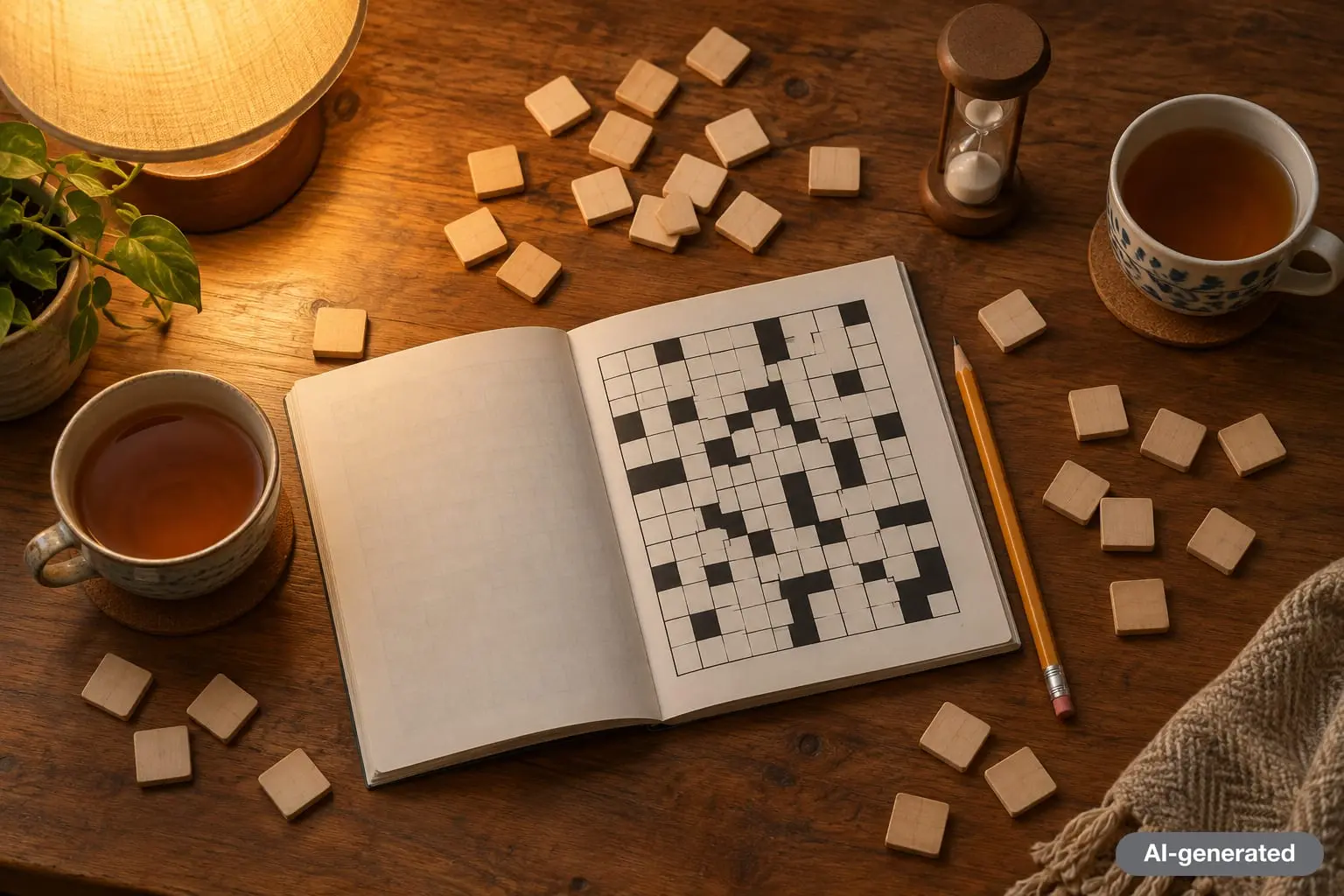
The best word games for adults fall into a handful of families: daily guessing games you finish in five minutes, crosswords, word searches, anagram and spelling games, letter grids, Scrabble-style board games, and old party games that need nothing but paper or your voice. Most of them are free. If you want one to start with today, play Daily Word, a free five-letter guessing game with one new word a day, then add a daily crossword when you want something longer.
This guide sorts word games by type, explains what each one actually trains, compares free online games with apps and printables, suggests options for groups and for older players, and ends with concrete ways to get better at word games – the drills that actually move your scores.
The main types of word games for adults
Daily guessing games
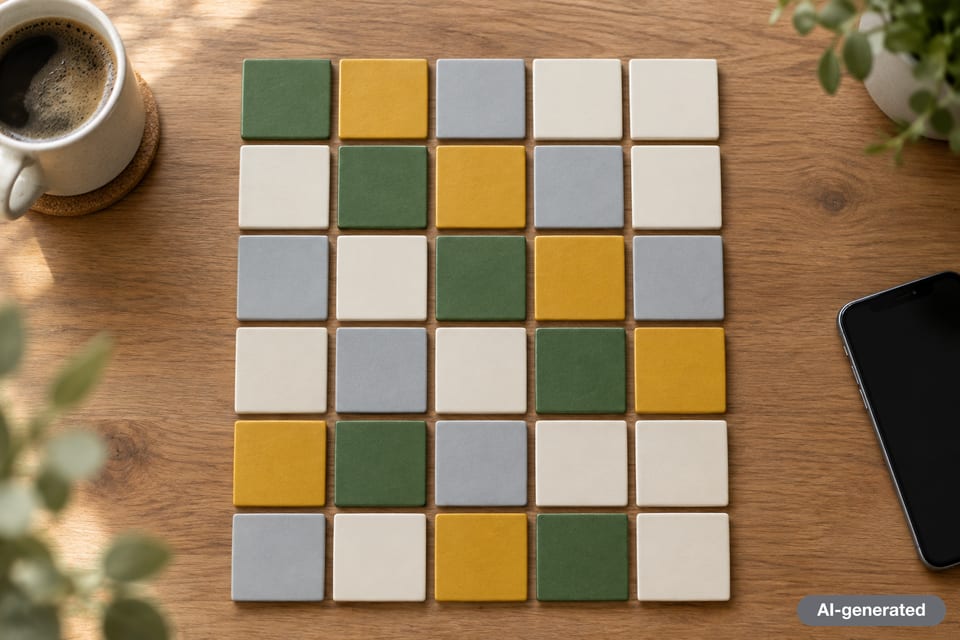
The format popularized by Wordle: a hidden word, a fixed number of guesses, and colored feedback after each one. Our Daily Word follows the classic rules – six guesses, green for the right letter in the right spot, yellow for a letter that belongs elsewhere, gray for a letter that is not in the word – and adds a short meaning of the answer when you finish. Spin-offs multiply the boards or change the subject; our list of games like Wordle covers a dozen of them.
What it trains: letter-frequency knowledge, deduction, and working memory for which letters are ruled out.
Crosswords
A grid of interlocking answers, each with a clue. American-style crosswords use dense grids and wordplay clues; mini crosswords shrink the grid to five-by-five for a two-minute solve. Cryptic crosswords, popular in Britain, hide the answer inside a clue that is part definition and part wordplay.
What it trains: vocabulary retrieval, general knowledge, and flexible thinking when a clue means something other than it seems.
Word search
A letter grid with words hidden in straight lines – across, down, diagonal and backward. Modern themed versions remove the word list and ask you to work out the theme instead.
What it trains: visual scanning and pattern recognition more than vocabulary. Good for relaxing, less demanding than a crossword.
Anagram and spelling games
You get a set of letters and make as many words as you can. Some versions require a central letter in every word, others ask you to use all the letters in one long word, or to chain words so the last letter starts the next one.
What it trains: spelling, morphology (prefixes, suffixes, word roots) and fluency – how fast words come to you.
Letter-grid games (Boggle-style)
A grid of random letters, usually four-by-four, and a time limit, often three minutes. Players write down every word they can trace through adjacent letters. In the classic scoring, words found by more than one player are crossed out, so rare words win.
What it trains: speed, visual search and vocabulary under time pressure.
Tile-placement board games (Scrabble-style)
Players draw letter tiles and place words on a shared board, scoring by letter values and bonus squares. Scrabble is the best-known brand, and there are many look-alike apps and variants with different board layouts.
What it trains: strategy and probability as much as vocabulary – strong players memorize short, high-value words and manage which tiles they keep.
Party and pen-and-paper word games
Some of the best word games for adults have no box at all. They need a pen, a notepad or nothing but conversation, which makes them ideal for road trips, dinner tables and power cuts.
Ghost
Players take turns adding one letter to a growing fragment of a word. The goal is to avoid being the one who completes a real word (usually of four letters or more). You can challenge the previous player if you think no real word starts with the current fragment; if they cannot name one, they lose the round. Each loss earns a letter of G-H-O-S-T, and five letters knocks you out. It sounds simple and becomes surprisingly tactical, because you are always thinking several letters ahead.
Botticelli-style guessing
One player thinks of a famous person and reveals only the first letter of the surname. Others ask indirect questions ("Are you a Russian novelist?") and the answerer must name someone who fits with that letter, or the questioner earns a direct yes-or-no question. It rewards general knowledge and quick recall of names.
Categories (Scattergories-style)
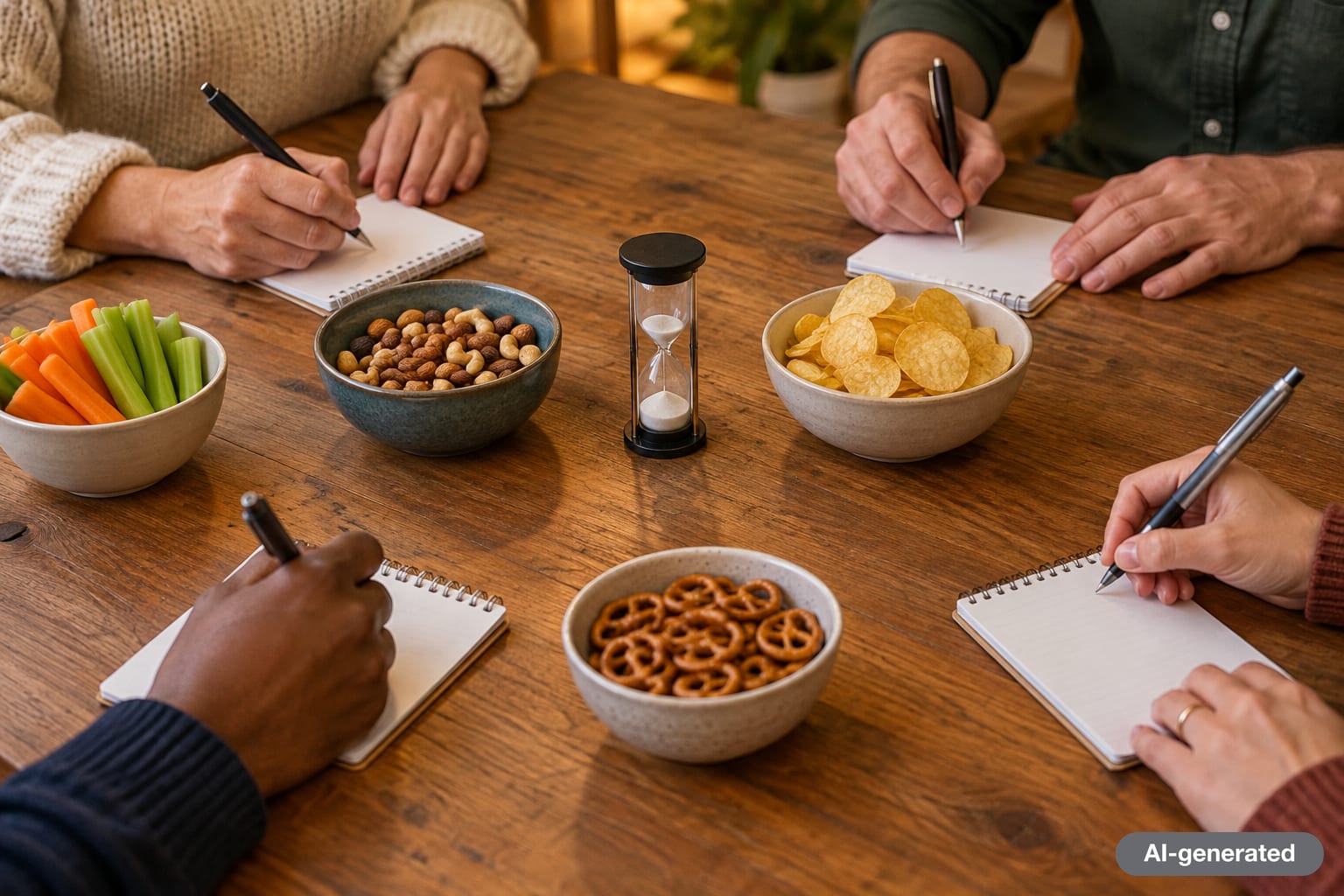
Pick a letter and a list of categories – a fruit, a city, a movie, a job – and give everyone a couple of minutes to write one answer per category starting with that letter. Answers that nobody else wrote score points. The commercial version, Scattergories, adds dice and printed lists, but a notepad and a timer work just as well.
Hangman and its variants
One player picks a word and draws blanks; the others guess letters one at a time, and wrong guesses add parts to a drawing. Adult variants make it harder: use phrases or movie titles, limit wrong guesses to six, or ban vowels for the first three guesses. Daily guessing games are, in a sense, Hangman with better feedback.
Word association and chain games
Each player says a word linked to the previous one, or a word that begins with the last letter of the previous word. Add a category ("only animals", "only places") and a short time limit to keep it lively.
Word games by time, players and skills
Use this table to match a game to the time and company you have. Times are typical session lengths, not rules.
| Game type | Time needed | Players | Main skills | Format |
|---|---|---|---|---|
| Daily guessing game (e.g. Daily Word) | 2–5 min | 1 | Deduction, letter patterns | Free online |
| Mini crossword | 2–5 min | 1 | Vocabulary recall | Online or print |
| Full daily crossword | 15–60 min | 1–2 | Vocabulary, knowledge, wordplay | Online or print |
| Word search | 5–15 min | 1 | Visual scanning | Print or online |
| Anagram / spelling game | 5–30 min | 1 | Spelling, fluency | Online or app |
| Letter grid (Boggle-style) | 3 min per round | 2–6 | Speed, visual search | Board game or app |
| Tile board game (Scrabble-style) | 45–90 min | 2–4 | Vocabulary, strategy | Board game or app |
| Ghost | 5–20 min | 2–6 | Spelling, planning ahead | Spoken, no equipment |
| Categories (Scattergories-style) | 2–3 min per round | 3–8 | Fluency, originality | Pen and paper |
| Botticelli-style | 15–30 min | 3–8 | General knowledge | Spoken |
| Hangman variants | 5–10 min | 2+ | Letter frequency, guessing | Pen and paper |
Free word games for adults online, apps and printables
You do not need to pay to play good word games. Each format has its own trade-offs.
Free online games in the browser
Browser games load instantly, work on any phone or laptop and usually need no account. Daily Word, our daily crossword and Sudoku are all free on 77.today with no sign-up. The New York Times offers Wordle, Connections and Strands for free and Spelling Bee with limited access; other games and its crossword archive are part of a paid subscription. Merriam-Webster hosts free daily multi-board games such as Quordle and Octordle.
Best for: a short daily habit, playing on a work break, and sharing results with friends.
Apps
Apps add offline play, notifications and multiplayer – useful for turn-based Scrabble-style games with friends far away. The downside is that many free apps are funded by heavy advertising, in-app purchases or data collection. Check the developer, read the permissions, and prefer the official app of a publisher you know.
Printables and paper
Paper puzzles have a real advantage: no screen, no notifications, and you can hand them to someone who does not like apps. Print a crossword or word search, keep a notepad for Categories, or buy a puzzle book for travel. The kids' crossword is a good shared puzzle if you play with children or grandchildren.
For a balanced routine that costs nothing, play Daily Word for deduction, the crossword for vocabulary and a medium Sudoku for pure logic. Together they take about fifteen to twenty minutes, and each exercises a different kind of thinking.
Vocabulary word games for adults
Not every word game builds vocabulary. Word searches mostly train your eyes, and daily guessing games use a fairly small pool of common words. If learning new words is your goal, choose games that expose you to unfamiliar ones and tell you what they mean.
- Crosswords are the strongest choice: over time you meet the same less-common words again and again, which is exactly how vocabulary sticks.
- Spelling and anagram games that reveal the full answer list afterward show you words you missed. Read the list, not just your score.
- Scrabble-style games teach short, unusual words, though often without meanings – look them up.
- Daily Word shows a short meaning of each answer after the game, a small daily reminder that even common words have precise definitions.
A simple habit multiplies the effect: keep a running note of every new word you meet in a puzzle, with its meaning and an example sentence. Reviewing that list once a week does more for your vocabulary than playing twice as many games.

Word games for groups
For groups, the best word games are short, loud and forgiving. A few that work well:
- Categories for dinner parties – everyone plays at once, so nobody waits for a turn, and arguing over whether an answer counts is half the fun.
- Ghost for car rides – no equipment, and it scales from two players to six.
- Boggle-style grids for competitive friends – three-minute rounds keep the energy up.
- Shared daily puzzles for remote friends and family – everyone plays the same Daily Word, then posts the spoiler-free colored grid in the group chat.
- Team crosswords for mixed ages – one person holds the pen, everyone calls out answers.
Mix in something lighter between rounds: our daily jokes are a quick reset when a game gets too heated.
Word games for seniors and brain health
Word games are popular with older adults for good reasons: they are social, cheap, easy to start and can be scaled up or down in difficulty. Large-print puzzle books, tablet games with adjustable text size and spoken party games all work well.
What about brain health? The evidence is encouraging but limited, and it is worth being precise. In a randomized trial published in NEJM Evidence in 2022, researchers at Columbia and Duke assigned 107 older adults with mild cognitive impairment to home-based training with either web-based crossword puzzles or computerized cognitive games for 78 weeks. On the main cognitive measure, scores improved slightly in the crossword group and worsened slightly in the games group. The authors themselves called for a larger trial with an inactive control group before firm conclusions are drawn.
What this means in practice: puzzles are a reasonable, enjoyable part of an active life, and crosswords look at least as useful as commercial "brain training" games. They are not a treatment for memory loss, and no word game has been shown to prevent dementia. Physical activity, sleep, social contact and medical care matter at least as much. We look at the research in more detail in Are crosswords good for your brain?
Be skeptical of any game or app that promises to "make you smarter" or "prevent Alzheimer's". Enjoyment and regular mental challenge are real benefits; medical claims need medical evidence. If you notice changes in memory, talk to a doctor rather than a puzzle.
How to get better at word games
Getting better at word games is less about raw intelligence and more about a few deliberate habits. Here are practice methods that work across most formats.
1. Learn letter frequency
In English, E, T, A, O, I, N, S, R and H are among the most common letters, while J, Q, X and Z are rare. In guessing games this tells you which letters to test first; in Boggle-style grids it tells you which corners to scan. Our guide to the best Wordle starting words turns that into concrete openers.
2. Study common patterns, not single words
Strong players think in chunks: endings such as -ING, -TION, -ER, -ED and -LY; beginnings such as RE-, UN-, PRE- and DIS-; and letter pairs like CH, SH, TH, ST and CK. When you see a jumble of letters, look for chunks first. Word lists sorted by pattern, such as 5-letter words ending in E or 5-letter words starting with S, make good study material.
3. Review every game, especially the losses
After a daily puzzle, spend thirty seconds asking which guess gave the least information and what you would have played instead. After a spelling game, read the full answer list. This short review is where most improvement happens.
4. Use a consistent opening
In guessing games, a fixed first guess removes decision fatigue and lets you compare results over time. Our Wordle strategy guide explains how to pick a second guess based on the first.
5. Practice under a timer
For Boggle-style and Categories-style games, speed matters. Set a two-minute timer and write down every word you can make from a random set of letters, or every animal starting with B. Do it a few times a week and count your results.
6. Read widely and write down new words
Crossword and Scrabble-style players with the biggest vocabularies tend to be heavy readers. Keep a list of new words with meanings, and review it weekly.
7. Mix game types
Each game exercises a different skill. A week that combines Daily Word, a crossword, a word search and one round of Ghost with friends trains deduction, recall, scanning and planning – and keeps the habit fun.
8. Keep it short and regular
Ten minutes a day beats a two-hour binge on Sunday. Daily puzzles are built for this: one game, one result, done until tomorrow.

Choosing the right word game for you
If you have five minutes and want a daily habit, choose a guessing game or a mini crossword. If you want to grow your vocabulary, choose full crosswords and spelling games and review the answers. If you are with friends, choose Categories, Ghost or a letter grid. If you want calm, choose a word search or a printable. And if you want variety, rotate – the point of word games is that there is always another one.
Wordle is a trademark of The New York Times Company; Scrabble, Boggle and Scattergories are trademarks of their respective owners. 77.today and Daily Word are not affiliated with or endorsed by The New York Times or any game publisher mentioned here.
Frequently asked questions
What are the best free word games for adults?
Free daily options include Daily Word and the daily crossword on 77.today, plus Wordle, Connections and Strands on the New York Times site. Pen-and-paper games such as Ghost, Categories and Hangman cost nothing at all.
Which word games improve vocabulary?
Crosswords are the strongest choice because they repeatedly expose you to less common words. Spelling and anagram games that reveal the full answer list help too, especially if you note new words and their meanings.
Are word games good for seniors?
They are social, inexpensive and adjustable in difficulty. A 2022 randomized trial found crossword training outperformed computerized cognitive games in older adults with mild cognitive impairment, but researchers say larger studies are needed, and word games are not a treatment for memory loss.
What word games can a group play without equipment?
Ghost, word association chains and Botticelli-style guessing need only conversation. Categories needs just paper, pens and a timer.
How can I get better at word games quickly?
Learn the most common letters and word endings, use a consistent opening in guessing games, review every game for a minute afterward, practice under a timer, and keep a list of new words you meet.
Sources
- NEJM Evidence – Computerized Games versus Crosswords Training in Mild Cognitive Impairment (Devanand et al., 2022)
- PubMed – Computerized Games versus Crosswords Training in Mild Cognitive Impairment
- NewYork-Presbyterian – Crossword Puzzles Beat Computerized Games in Slowing Memory Loss
- The New York Times Help Center – New York Times Games Subscription
- Merriam-Webster – Quordle
Log in to comment
No comments yet. Be the first.