How to Quit a Job: Steps, What to Say and Money to Check
- Secure your next step first: a signed offer, a start date or enough savings to cover the gap.
- Tell your manager in a short private conversation, then confirm in writing the same day with your last working day.
- In most U.S. jobs, notice is a courtesy, not a legal duty, but it protects references, rehire status and sometimes a vacation payout.
- Quitting usually rules out unemployment benefits, because states generally pay only people who are unemployed through no fault of their own. Check final pay, health coverage and your 401(k) before you go.
How to quit a job well: line up your next step, tell your manager first in a short private conversation, give a clear last day, put it in writing, and spend your final weeks handing over cleanly. Before you say anything, check the money side: your final paycheck, unused vacation, health coverage and retirement account. This article walks through each step, with scripts you can use.
Before you quit: a checklist
- Have a plan. A signed offer with a start date, or savings to cover the gap. Do not resign on a verbal offer.
- Read your paperwork. Your offer letter, contract and handbook may set a notice period, require repayment of a signing bonus or tuition aid, or include a non-compete or confidentiality clause.
- Check vacation payout rules. Federal law does not require paid vacation, so whether unused days are paid out depends on your state and your employer's policy. Some policies pay only if you give notice.
- Look at benefits timing. Coverage often ends on your last day or at the end of that month. Know the date.
- Check vesting. Employer 401(k) contributions may vest on a schedule. A few more weeks can sometimes make a difference.
- Save personal files (only your own, not company data) and contacts before you resign. Some employers end access on the spot.
When to resign
Timing can be worth real money. Resigning right after a bonus or commission payout, rather than just before, keeps money you have already earned under most plans; read the bonus terms, because some require you to be employed on the payment date. If your health coverage ends at the end of the month, a last day on the 1st instead of the 30th can cost you a month of coverage. And if a vesting date for employer retirement contributions is close, check whether staying a few extra weeks changes what you keep. Once you know the date, count back two weeks and plan the conversation.
How to quit a job in person
- Ask for a few minutes in private with your direct manager. Early in the week and early in the day works best.
- Say it in the first sentence. Do not build up to it.
- Give your last day and offer to help with the transition.
- Thank them for something specific.
- Stay calm if they push back or make a counteroffer. You can say you will think about it, but decide in advance whether anything would change your mind.
- Follow up in writing the same day.
What to say when quitting a job
Standard script:
"Thanks for making time. I wanted to tell you first that I've decided to resign. My last day will be Friday, [date]. I've learned a lot here, especially [specific example], and I want to make the handover as easy as possible. I'll put together notes on my projects this week."
If you are asked why:
"I've accepted a role that's a good next step for me." Or: "It's a personal decision, and I'd rather keep the details private."
If you get a counteroffer you do not want:
"I appreciate that, but I've made my decision. I'd like to focus on leaving things in good shape."
Avoid criticizing your boss, coworkers or the company, even if it is deserved. Former managers are often asked for references, and industries are smaller than they look.
How to quit a job via email
Use email when you work remotely, when your manager is traveling, or as the written follow-up to your conversation.
Subject: Resignation, [Your name], last day [date]
Hi [Manager],
I'm writing to confirm my resignation from my position as [title]. My last day will be [date]. Thank you for the support during my time here. I'll prepare handover notes for [projects] and I'm happy to help train whoever takes over.
Best,
[Name]
For more versions, including formal and short notice letters, see our two weeks notice letter templates.
How to quit a job through text
Text is generally reserved for hourly or shift jobs where the manager communicates by text, or for emergencies. Keep it professional and include the essentials:
"Hi [Name], I'm writing to let you know I'm resigning from my position. My last shift will be [date]. Thank you for the opportunity. I'll follow up by email with a formal notice."
How to quit a job you just started
It happens: the job is not what was described, or a better offer arrived. Act early rather than letting it drag on.
- Tell your manager honestly but briefly: "I've realized this role isn't the right fit, and I don't want to waste the team's time."
- Give as much notice as you reasonably can, even a few days.
- Check your offer letter for clawbacks of a signing bonus or relocation payments.
- Return equipment, badges and documents promptly.
- On your resume, a job of a few weeks can usually be left off. Be truthful if an application asks for all employers.
How to quit a job without notice
Most U.S. employment is at-will, so you can usually leave without notice legally. Walking out has costs: a weaker reference, being marked ineligible for rehire, and, under some employer policies, forfeited vacation payout. It is justified when the job is unsafe, when you are being harassed or not paid, or when staying would harm your health. If you leave for one of those reasons, document what happened. In some states it can matter for an unemployment claim.
If your reason is a serious health condition or family care, ask HR about job-protected leave under the Family and Medical Leave Act, or a state program, before you resign. FMLA applies to eligible employees of covered employers and can provide up to 12 weeks of unpaid, job-protected leave.
Money to sort out when you quit
| Item | What to know |
|---|---|
| Final paycheck | No federal deadline; some states require fast payment. In California, 72+ hours' notice means pay on your last day. |
| Unused vacation | Depends on state law and company policy. |
| Health insurance | COBRA generally lets you stay on the group plan temporarily (employers with 20+ workers), usually at full cost. Losing job-based coverage also opens a Special Enrollment Period on HealthCare.gov. |
| 401(k) | Leave it, roll it into a new plan or IRA, or cash out (taxes and possibly a 10% penalty if under 59½). A direct rollover avoids withholding. |
| Unemployment | Usually not available after quitting; states pay people unemployed through no fault of their own, with some good-cause exceptions. |
| Taxes | Changing jobs mid-year can mean over- or under-withholding. Review your W-4 at the new job. See our 2027 tax brackets. |
If you are moving to a new employer's 401(k) in the same year, remember the annual contribution limit applies per person across all plans, and the new payroll system does not know what you have already contributed.
Your last two weeks
- Write handover notes: open tasks, contacts, passwords handled through proper channels, and where files live.
- Finish what you can and be clear about what you cannot.
- Take the exit interview seriously but keep feedback constructive.
- Ask for references or a LinkedIn recommendation while relationships are fresh.
- Return equipment and get a receipt.
- Update your address with HR so your W-2 reaches you in January.
Bottom line
To quit a job well, secure your next step, tell your manager first, put your last day in writing and leave a clean handover. Check the money before you speak: final pay rules in your state, vacation payout, the date your health coverage ends and what happens to your 401(k). Most jobs do not legally require notice, but giving it is the cheapest way to keep a good reference.
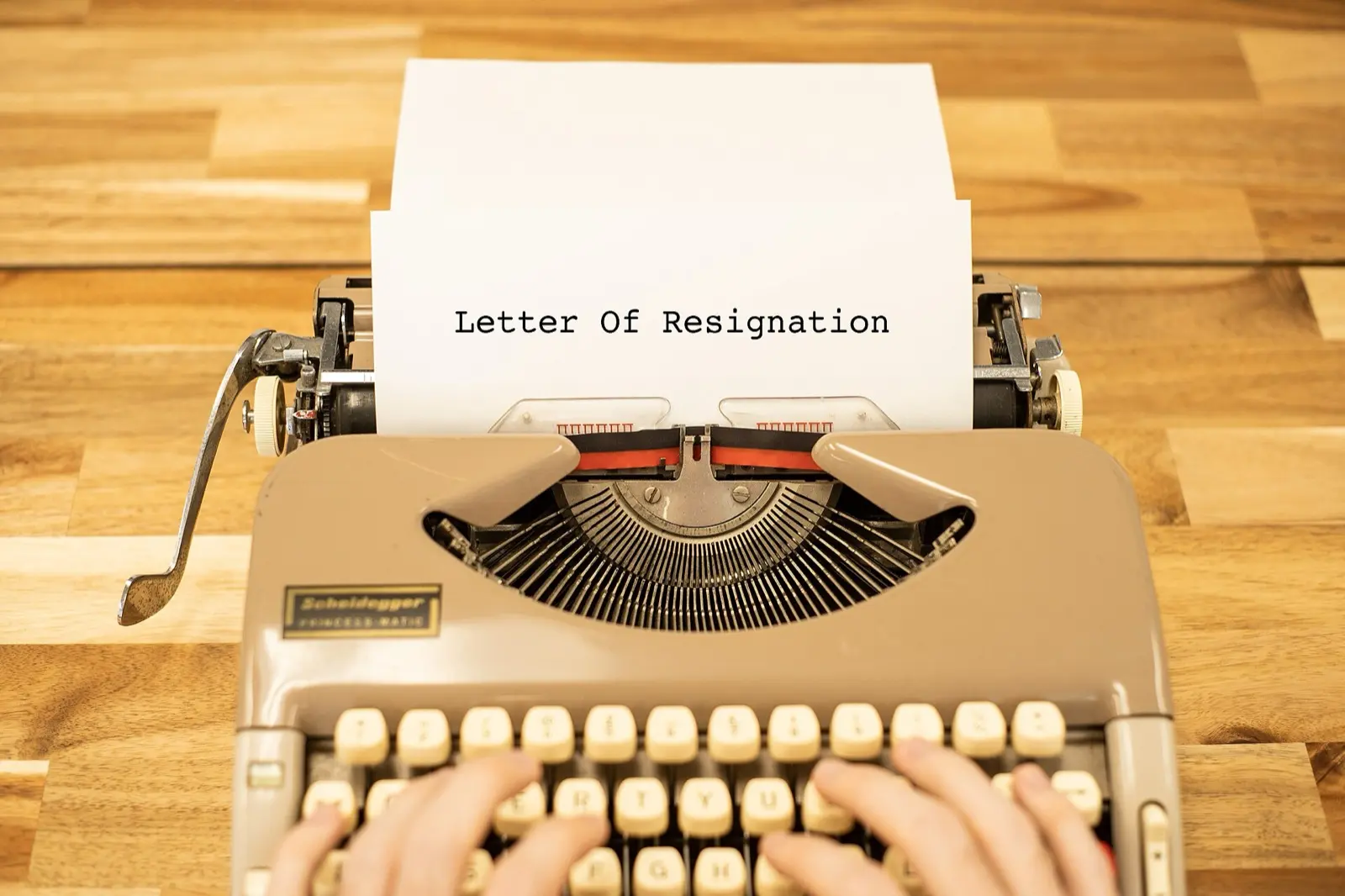
Cover photo: "Typing Letter of Resignation on Typewriter" by CIPHR Connect, CC BY 2.0, via Wikimedia Commons.
Frequently asked questions
What is the best way to quit a job?
Tell your manager privately, in person or by video call, give a clear last day (usually two weeks out), thank them, offer to help with the handover, and follow up the same day with a short written resignation.
What should I say when quitting a job?
Keep it simple: "I wanted to let you know I've decided to resign. My last day will be [date]. I've appreciated working here and I'll make sure my work is handed over properly." You do not have to explain why.
Can I quit a job without notice?
In most at-will jobs, yes, legally. It can cost you a good reference, rehire eligibility and, under some employer policies, payout of unused vacation. Leaving immediately makes sense when the job is unsafe, abusive or you are not being paid.
How do I quit a job I just started?
Do it quickly and honestly. Tell your manager the role is not the right fit, give whatever notice you can, return equipment and check whether you must repay a signing bonus or relocation money under your offer letter.
Is it okay to quit by text or email?
A conversation is better, but email is normal for remote jobs and acceptable when your manager is unavailable. Text is generally reserved for shift work or emergencies. Whatever channel you use, include your last day and keep a copy.
Can I get unemployment if I quit?
Usually not. The U.S. Department of Labor says unemployment insurance is for workers who are unemployed through no fault of their own, and each state sets its own rules. Some states accept good cause for quitting, such as unsafe conditions; apply and let the state decide.
What happens to my 401(k) when I quit?
Your own contributions are always yours. Employer contributions depend on the plan's vesting schedule. You can usually leave the money in the plan, roll it into a new employer's plan or an IRA, or cash out, which can trigger taxes and penalties.
When will I get my last paycheck?
It depends on the state. Federal law does not require immediate payment, but some states set short deadlines. In California, an employee who gives at least 72 hours' notice must be paid on the last day.
Sources
- U.S. Department of Labor: Unemployment insurance
- U.S. Department of Labor: Last paycheck
- U.S. Department of Labor: COBRA continuation coverage
- U.S. Department of Labor: Family and Medical Leave Act
- IRS: Rollovers of retirement plan and IRA distributions
- IRS: Retirement topics, vesting
- California Department of Industrial Relations: Final wages FAQ
- HealthCare.gov: Special Enrollment Period after losing job-based coverage
- Wikimedia Commons: Typing Letter of Resignation on Typewriter, CIPHR Connect (CC BY 2.0)
Log in to comment
No comments yet. Be the first.