Voynich Manuscript: The Mystery That Defies Decoding
- Acquired in 1912, the Voynich manuscript is a 240-page text written in an unknown language or complex cipher.
- Radiocarbon dating places the creation of the parchment between 1404 and 1438, ruling out a modern hoax.
- Despite efforts by military cryptographers and modern AI, the text remains completely undecoded.
- The manuscript features bizarre illustrations of unidentified plants, astronomical charts, and biological systems.
- The Voynich manuscript has baffled the world's best cryptographers for over a century
- Radiocarbon dating shows the Voynich manuscript is not a modern hoax
- The plants depicted in the Voynich manuscript often do not match any known species
- Why Voynich manuscript AI analysis has also failed to crack the text
- The Voynich manuscript remains one of history's greatest unsolved puzzles
The Voynich manuscript has baffled the world's best cryptographers for over a century
In 1912, Polish-born antiquarian Wilfrid Voynich purchased a strange illustrated book in Italy that would later become one of the world's most famous historical puzzles. The book was written in an unknown language or code, which no one has yet managed to decipher.
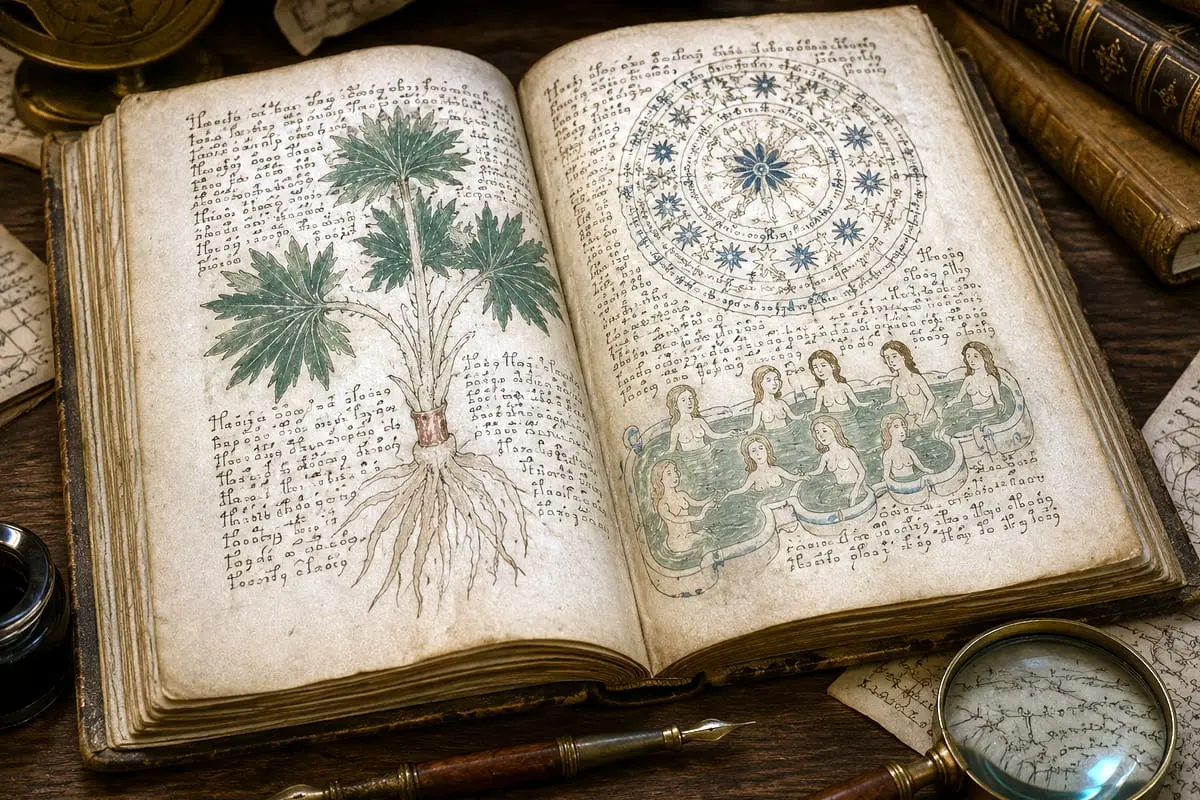
The manuscript consists of about 240 pages filled with unusual symbols, botanical drawings, astronomical diagrams, and bizarre scenes with people. The writing flows consistently and clearly follows a specific structure, leading most researchers to believe it is not a random collection of characters.
For more than a century, military cryptographers, linguists, historians, and even artificial intelligence specialists have tried to crack the code. This includes experts who worked on codebreaking during World War II. Yet, to this day, there is no universally accepted translation, leaving the question of who wrote the Voynich manuscript completely unanswered.
Today, the Voynich manuscript is housed in the Beinecke Rare Book and Manuscript Library at Yale University and is widely considered one of history's greatest unsolved puzzles.
Radiocarbon dating shows the Voynich manuscript is not a modern hoax
For a long time, it was suspected that the text might be a 19th- or 20th-century fraud designed to swindle collectors. However, radiocarbon dating of the parchment conducted in 2009 revealed that it was produced between 1404 and 1438.
This means the document genuinely dates back to the late Middle Ages or early Renaissance. Analysis of the ink and illustrations also matched the technologies of that era, making the theory of a modern forgery highly unlikely.
The core problem is that no known European language matches the structure used in the manuscript. The text displays patterns typical of natural languages: certain symbols appear more frequently than others, there is a clear "word" structure, and specific sequences repeat.
Some researchers believe it could be a complex cipher, while others argue it is an unknown or artificially constructed language. However, there is still no definitive evidence to completely validate any single theory.
The plants depicted in the Voynich manuscript often do not match any known species
A large portion of the book is dedicated to botanical illustrations. At first glance, they resemble medieval medical herbals, but most of the drawings do not correspond to real plants.
Some plants feature the roots of one species, the leaves of another, and the flowers of a third. Because of this, some researchers suspect the author intentionally created nonexistent flora or deliberately obscured their true identities.
The manuscript is also filled with astronomical charts, unusual zodiac wheels, and drawings that resemble biological systems. Illustrations showing naked women inside strange, tube-like structures or organs have sparked particularly intense debate.
The true purpose of the book remains entirely unclear. It is speculated that it could have been a compendium of medicine, alchemy, astronomy, or even secret knowledge, but no single hypothesis has definitive proof.
Why Voynich manuscript AI analysis has also failed to crack the text
In recent years, artificial intelligence systems and advanced linguistic models have begun analyzing the Voynich manuscript. Some studies have attempted to link the writing to Hebrew, Latin, or ancient Asian languages.
There have been several high-profile claims of the Voynich manuscript being decoded, but none have gained widespread acceptance within the scientific community. It usually turns out that these translations fail to align with the structure of the entire manuscript or rely on overly loose interpretations.
Interestingly, the text possesses the statistical structure characteristic of a natural language. The word lengths and character distributions appear far too orderly to be completely random. This is one of the primary reasons why most researchers believe the manuscript actually holds meaning.
However, a camp of skeptics argues that it might be a brilliantly crafted, meaningless text designed to give the illusion of a real language. So far, neither side has conclusive evidence.
The Voynich manuscript remains one of history's greatest unsolved puzzles
Despite the advancement of modern technology, supercomputers, and artificial intelligence, the secret of the manuscript remains unsolved. This is especially surprising given that humanity has already deciphered ancient Egyptian hieroglyphs, the Mayan script, and countless complex historical codes.
The book stands out because it looks like a genuine, coherent text, yet no one to this day understands its contents. The more it is studied, the more questions arise.
If the text is ever successfully translated, it could fundamentally change our understanding of medieval science, secret societies, or early cryptography. Yet, it is equally possible that it will turn out to be one of the most elaborate intellectual pranks in history.
Frequently asked questions
Has the Voynich manuscript been decoded?
No, despite efforts by military cryptographers, linguists, and modern artificial intelligence, the Voynich manuscript remains completely undecoded.
When was the Voynich manuscript written?
Radiocarbon dating of the parchment indicates that the manuscript was created between 1404 and 1438, during the late Middle Ages or early Renaissance.
What language is the Voynich manuscript written in?
The text is written in an unknown language or complex cipher. While it shares statistical similarities with natural languages, it does not match any known European language.




Log in to comment
No comments yet. Be the first.