Smoked Turkey: How Long to Smoke It, Temps and Recipe
- USDA: keep the smoker at 225 to 300°F and estimate 20 to 30 minutes per pound; Traeger estimates 30 to 40 minutes per pound at 225 to 250°F.
- Use a fully thawed, unstuffed turkey, ideally 12 pounds or less, and check that it is past 140°F within 4 hours.
- Smoked turkey is done at 165°F in the thigh, wing and breast; pink meat under the skin is normal.
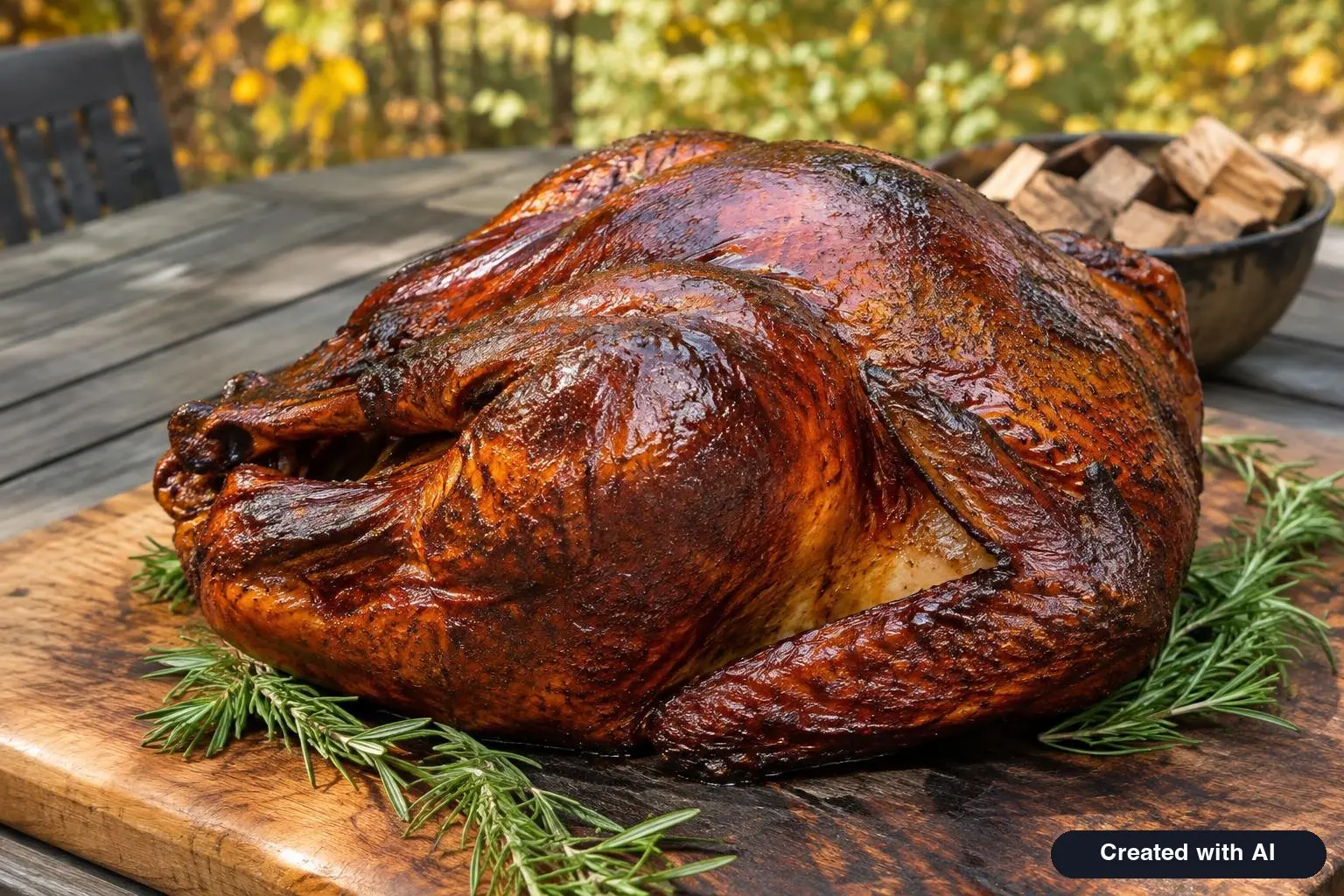
- How long to smoke a turkey
- The size limit and the 4-hour rule
- Smoked turkey temperature: when it is done
- Before smoking: brine, dry and season
- Which wood to use
- How to smoke a turkey, step by step
- Notes by smoker type
- Smoked turkey breast
- Gravy from a smoked turkey
- Storing and reheating smoked turkey
- Timing a smoked turkey for Thanksgiving 2026
Simple Smoked Whole Turkey
No ratings yet – be the firstIngredients
Directions
- Brine. One to two days ahead, rub the thawed turkey with the 2 tablespoons kosher salt and refrigerate. The night before, leave it uncovered on a rack so the skin dries.
- Heat the smoker. Bring the smoker to 250 to 275°F (120 to 135°C). Fill the water pan if there is one and place a thermometer at grate level.
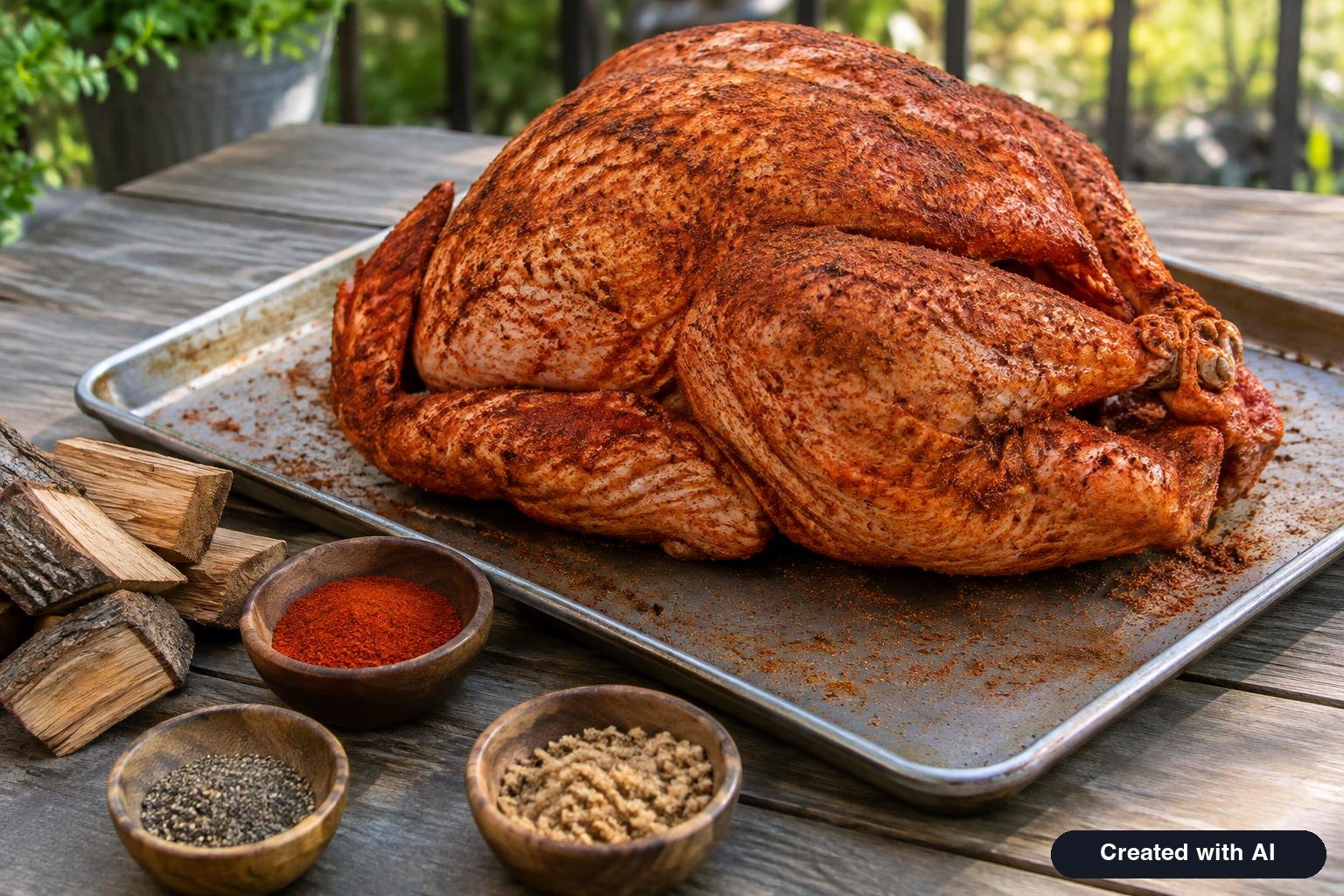
- Season. Mix the brown sugar, paprika, pepper, garlic powder, onion powder and thyme. Rub the turkey with the 2 tablespoons (30 ml) oil, then the spice mix. Tuck the wing tips. Do not stuff.
- Smoke. Place the turkey breast side up on the grate and smoke with the lid closed, holding 250 to 275°F (120 to 135°C), for 4 to 6 hours.
- Safety check. At 3½ hours the meat should read above 140°F (60°C). If it does not, finish the turkey in a 325°F (165°C) oven.
- Finish. Optional: when the breast reaches about 150°F (66°C), raise the heat to 325 to 350°F (165 to 175°C) to brown the skin.
- Done. The turkey is done at 165°F (74°C) in the innermost thigh, innermost wing and thickest part of the breast.
- Rest. Rest 20 to 30 minutes before carving. Refrigerate leftovers within 2 hours.
To smoke a turkey, hold the smoker between 225 and 300°F and plan on 20 to 30 minutes per pound, the figures from the USDA Food Safety and Inspection Service (FSIS). A 12-pound turkey takes roughly 4 to 6 hours in that range, and longer at the low end: Traeger's guide estimates 30 to 40 minutes per pound at 225 to 250°F, or 6 to 8 hours for 12 pounds. The turkey is done when a thermometer reads 165°F in the innermost thigh, the innermost wing and the thickest part of the breast.
Smoking is slower than roasting and less predictable, because outdoor temperature, wind and the smoker itself all change the pace. This guide covers time and temperature for whole birds and breasts, the food safety rules that are specific to low-heat cooking, a basic rub, and a step-by-step method that works on a pellet grill, an electric smoker or a charcoal smoker.
How long to smoke a turkey
| Turkey weight | Traeger rule of thumb: 30 to 40 min per lb at 225 to 250°F | USDA estimate: 20 to 30 min per lb, smoker at 225 to 300°F |
|---|---|---|
| 8 lb | 4 to 5¼ hours | 2¾ to 4 hours |
| 10 lb | 5 to 6¾ hours | 3¼ to 5 hours |
| 12 lb | 6 to 8 hours | 4 to 6 hours |
| 14 lb | 7 to 9¼ hours | 4¾ to 7 hours |
These are planning ranges calculated from the two per-pound rules. Butterball's smoking chart, written for a charcoal water smoker held around 250°F, is broader still: 4 to 8 hours for 8 to 12 pounds and 6 to 10 hours for 12 to 18 pounds. Give yourself the long end of the range and a cushion. A smoked turkey that finishes early can rest, loosely tented, while the sides cook. One that finishes late cannot be hurried except by moving it to a hot oven.
How long to smoke a turkey at 225, 250 and 275
- At 225°F: the most smoke flavor and the longest cook, 30 to 40 minutes per pound. This is the setting where the 4-hour safety rule below matters most. Best for birds of 12 pounds or less.
- At 250°F: a reasonable middle setting and the one Butterball uses for charcoal water smokers. Butterball's chart at that heat gives 4 to 8 hours for 8 to 12 pounds and 6 to 10 hours for 12 to 18 pounds.
- At 275 to 300°F: expect the faster end of USDA's 20 to 30 minutes per pound, with noticeably better skin. Traeger's own whole-turkey recipe runs at 300°F and puts a 12-pound bird at 3 to 4 hours.
Traeger also notes that above 5,000 feet of elevation, smoking takes about 10 to 15 minutes more per pound.
The size limit and the 4-hour rule
Low-temperature cooking raises one concern that oven roasting does not. A big, cold bird in a 225°F smoker warms slowly, and the meat can spend too long between 40 and 140°F, the range USDA calls the Danger Zone, where bacteria multiply quickly.
- USDA's size guidance for smoking is 8 to 12 pounds. Butterball allows 8 to 18 pounds. Traeger suggests staying at 16 pounds or less. For a crowd, smoke two small turkeys rather than one large one.
- The 4-hour check. Butterball's instructions say the turkey must pass through the 40 to 140°F range in 4 hours or less. Check the internal temperature at 3½ hours; if it is low, take the turkey off the smoker and finish it in the oven.
- Never smoke a frozen or partly frozen turkey. USDA says the bird must be completely thawed. Allow 24 hours in the refrigerator per 4 to 5 pounds; see how long to thaw a turkey.
- Do not stuff it. USDA: at smoking temperatures it takes too long for stuffing to reach 165°F, and smoked stuffing does not taste good anyway.
- Keep the smoker at 225°F or higher. USDA's range is 225 to 300°F. Put an appliance thermometer on the grate next to the bird; lid gauges are often inaccurate.
Spatchcocking is the simplest way around the size problem. A flattened turkey cooks much faster and gets through the Danger Zone quickly. The cutting method is in spatchcock turkey.
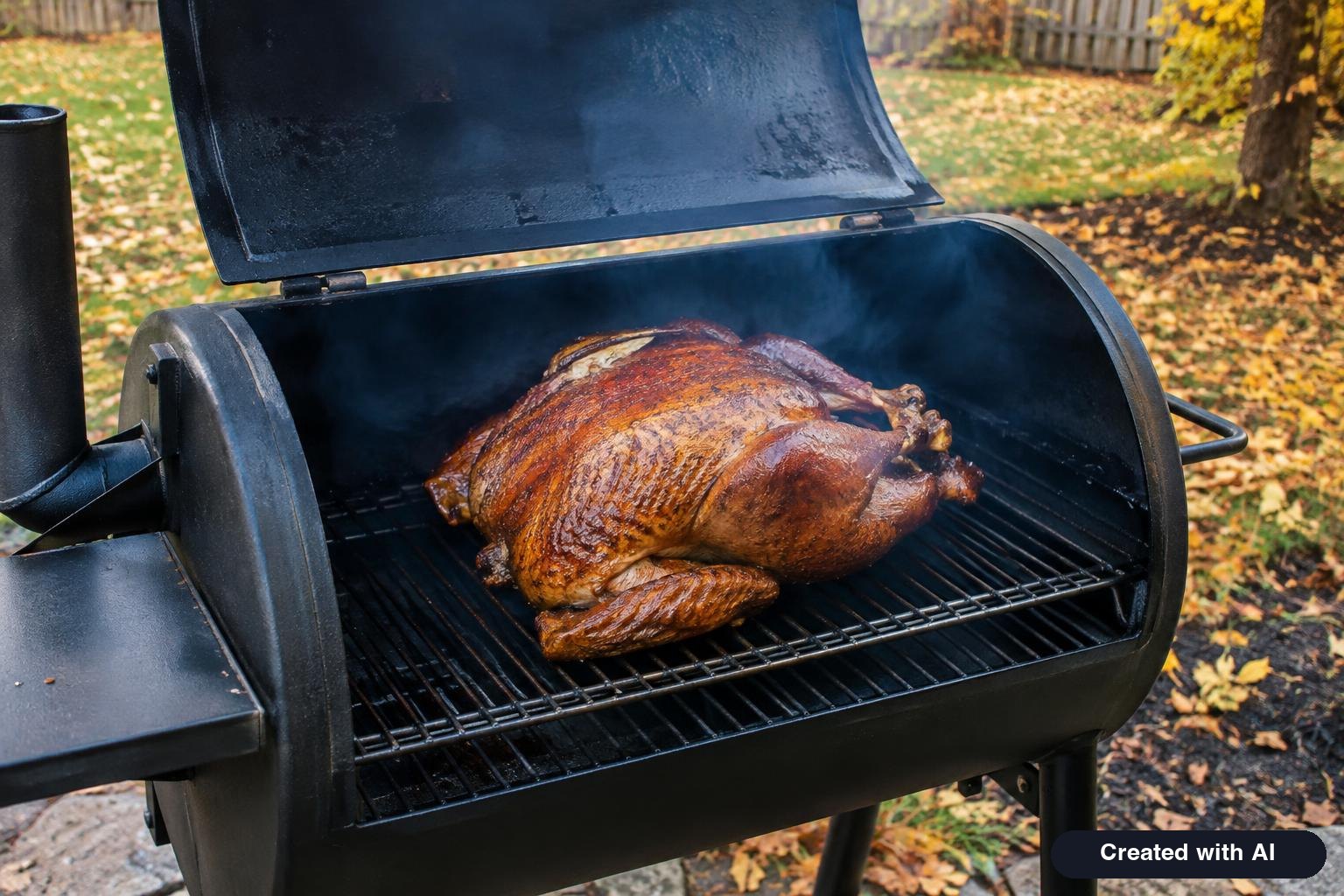
Smoked turkey temperature: when it is done
The safe minimum is 165°F in three places: innermost thigh, innermost wing, thickest part of the breast. Traeger's guide aims for 165°F in the breast and 175°F in the thighs, where dark meat is more tender, and notes the breast can come off at 160°F because it rises 5 to 10 degrees as it rests. If you pull early, confirm 165°F before carving. Butterball's smoking instructions use 170°F in both breast and thigh.
Pink meat is normal
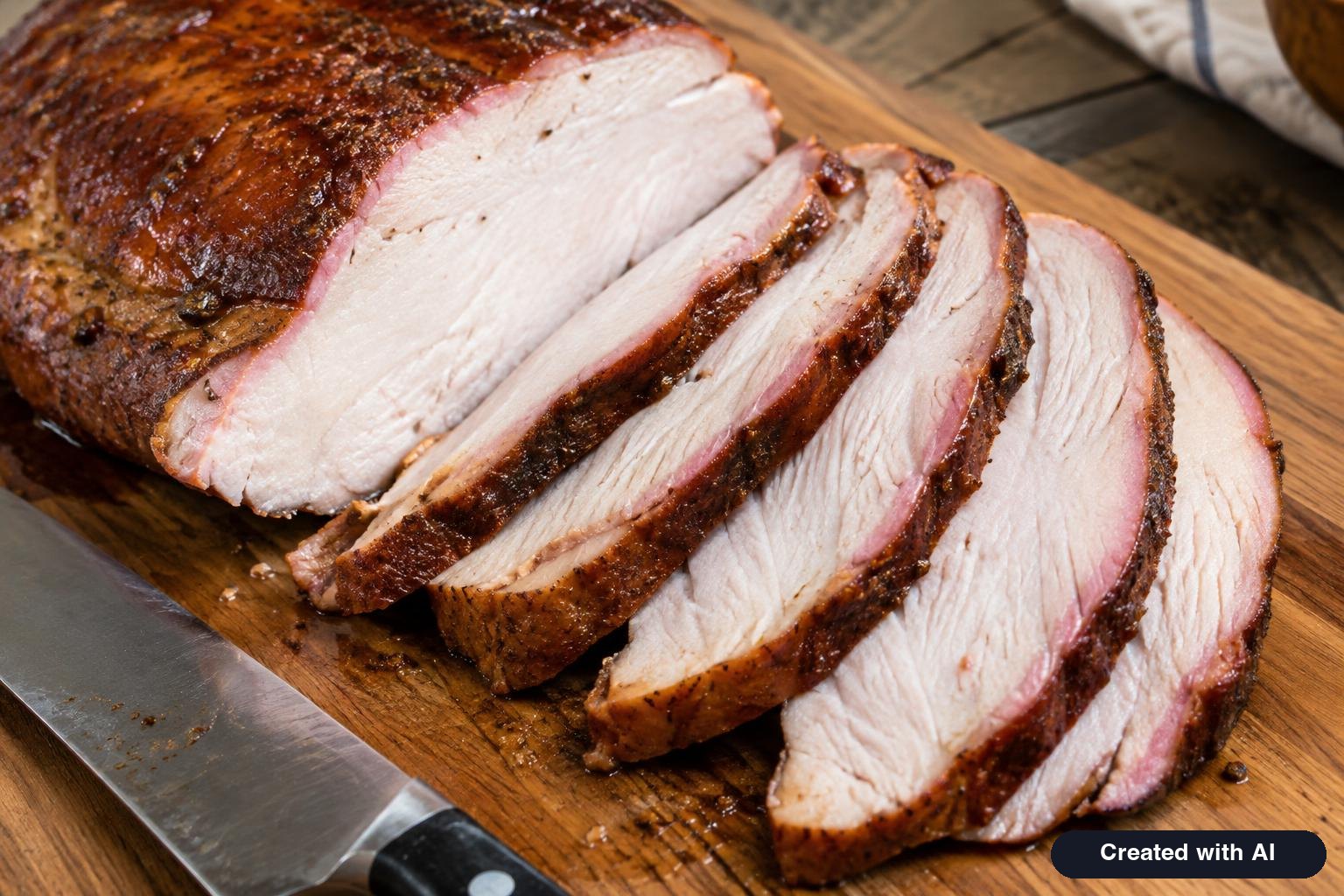
Smoked turkey often has a pink layer just under the skin, the "smoke ring," and can be rosy near the bones. USDA explains that pink color in safely cooked turkey comes from hemoglobin in the tissue forming a heat-stable color, and that it happens with smoking and grilling in particular. If the thermometer says 165°F, pink smoked turkey is safe. More on reading temperatures is in turkey temperature.
Before smoking: brine, dry and season
Brine
Hours of dry heat are hard on lean breast meat, so most smoked turkey recipes start with a brine. A wet brine at USDA's ratio is ¾ cup of salt per gallon of water, refrigerated overnight. A dry brine is 1 tablespoon of kosher salt per 5 pounds, refrigerated 1 to 2 days. Traeger recommends applying a dry rub or injection 12 to 24 hours ahead. Do not brine a kosher, basted or self-basting turkey. Details are in turkey brine.
Dry the skin
Smoked turkey skin tends to come out leathery because the temperature is too low to render the fat. Two things help: pat the bird completely dry and leave it uncovered on a rack in the refrigerator overnight, and finish hot (see the steps below).
A basic rub for smoked turkey
Enough for one 10- to 12-pound turkey:
- 2 tablespoons kosher salt (leave it out if the turkey was brined)
- 1 tablespoon brown sugar
- 1 tablespoon paprika
- 2 teaspoons ground black pepper
- 2 teaspoons garlic powder
- 1 teaspoon onion powder
- 1 teaspoon dried thyme
Rub the skin with 2 tablespoons of vegetable oil, then apply the mixture all over, including under the breast skin where you can reach. Keep sugar modest; a heavy sugar rub darkens to bitter over a long smoke.
Which wood to use
Turkey takes on smoke easily, so mild woods are the usual choice. USDA's advice is to use hardwood or fruitwood and never softwood such as pine, fir, cedar or spruce, which gives food a turpentine flavor and coats it with resin.
| Wood | Character |
|---|---|
| Apple | Sweet and mild; the safest choice for a first smoked turkey |
| Cherry | Mild, slightly fruity; gives the skin a deep red-brown color |
| Pecan | Nutty, medium strength |
| Hickory | Strong, classic barbecue flavor; best blended with a fruitwood |
| Mesquite | Very strong; easy to overdo on poultry |
Traeger's suggested blends are apple and pecan in equal parts for a balanced, slightly sweet smoke, or cherry with hickory for something bolder.
How to smoke a turkey, step by step
This method suits a 10- to 12-pound turkey and matches the recipe card. It serves 8 to 10.
- Thaw and brine. Thaw completely. Dry brine with 2 tablespoons of kosher salt for 1 to 2 days, or wet brine overnight. Remove the giblets and neck.
- Dry. Pat the turkey dry. If you have time, refrigerate it uncovered overnight.
- Heat the smoker to 250 to 275°F. Fill the water pan if your smoker has one; USDA notes that liquid is needed to create the moist, hot smoke that cooks the bird. Set the smoker out of the wind.
- Season. Rub the skin with 2 tablespoons of oil and the rub above (without the salt if the bird was brined). Tuck the wing tips behind the shoulders. Do not stuff the cavity; a halved onion and a few herb sprigs are fine.
- Smoke. Place the turkey breast side up on the grate, or in a shallow foil pan if you want drippings for gravy. Close the lid and leave it closed. Plan on 4 to 6 hours for 10 to 12 pounds.
- Check at 3½ hours. The meat should already be well above 140°F. If it is not, move the turkey to a 325°F oven to finish.
- Finish hot for better skin (optional). When the breast reaches about 150°F, raise the smoker to 325 to 350°F, or transfer the turkey to an oven at that temperature, until the skin is browned and the meat reaches 165°F.
- Confirm 165°F in the thigh, wing and breast.
- Rest 20 to 30 minutes before carving. Carving steps are in how to carve a turkey.
Notes by smoker type
Pellet grill (Traeger and similar)
Set the temperature and let the controller hold it. Traeger's guidance is 225 to 250°F for most of the cook, raised to 275°F near the end for crisper skin, or 350°F for a browner finish. Keep the hopper full; a 6-hour smoke uses a good share of a bag of pellets, and running out mid-cook drops the temperature.
Electric smoker
Butterball's directions for an electric smoker are 225°F for 8 to 12 hours for an 8- to 18-pound bird, with the same 3½-hour temperature check. Electric smokers run cool and moist, so the skin stays soft. A finish in a hot oven fixes that.
Charcoal or water smoker
USDA's method: fill the liquid pan, light good-quality charcoal, and put the turkey on once the smoker reaches 225 to 300°F. Add charcoal every 1 to 2 hours to hold that range and top up the liquid as needed. Butterball suggests adding soaked hardwood chunks after the first 1½ hours and feeding 12 to 14 briquettes every 1½ hours to stay near 250°F.
Kettle or gas grill
Set up for indirect heat with a drip pan under the bird. USDA's estimate for a covered grill at 225 to 300°F is 15 to 18 minutes per pound for turkeys of 8 to 16 pounds.
Smoked turkey breast
A bone-in breast is the most forgiving way to start. It is small, so it clears the Danger Zone quickly, and there are no thighs to wait for.
- Time. Published figures for breasts are thin and do not agree, so plan loosely. Traeger's recipe for a 5- to 6-pound bone-in breast smoked at 225°F gives 1½ to 2 hours to 165°F. Traeger's whole-turkey rule of thumb, 30 to 40 minutes per pound at 225 to 250°F, would put the same breast at 2½ to 4 hours; that rule was written for whole birds, not breasts. Start checking the temperature at 1½ hours, have the rest of the meal flexible, and let the thermometer decide.
- Temperature. 165°F in the thickest part.
- Brine. Use the same ratios: about 1¼ tablespoons of kosher salt for a 6-pound breast as a dry brine, overnight.
- Rest. 15 to 20 minutes, then slice across the grain.
Oven, air fryer and slow cooker methods for breast are in turkey breast.
Smoked turkey legs and wings
Drumsticks and wings are done at 165°F but are better taken to 175°F or higher, where the connective tissue softens. At 250 to 275°F, large turkey legs generally need a few hours; check with a thermometer in the thickest part without touching bone. The pink, ham-like turkey legs sold at fairs are cured before smoking, which is a different process from smoking a fresh leg at home.
Gravy from a smoked turkey
Set the turkey in a shallow disposable pan for the last half of the cook to catch drippings, or place a pan under the grate. Smoked drippings are strong; use them half and half with unsalted stock, and taste before adding salt if the bird was brined.
Storing and reheating smoked turkey
- Refrigerate within 2 hours of taking the turkey off the smoker. Smoke flavors the meat; home hot-smoking does not preserve it.
- Use refrigerated leftovers within 3 to 4 days, or freeze. USDA suggests 2 to 6 months for best quality.
- To reheat slices: place them in a baking dish with a few spoonfuls of broth, cover tightly with foil, and warm in an oven set no lower than 325°F until they reach 165°F.
- To reheat a whole, fully cooked smoked turkey bought from a store or smokehouse: follow the package. Butterball's instructions for its fully cooked turkeys are a 350°F oven, breast side up on a rack in a shallow pan, for ¾ to 1½ hours for 8 to 10 pounds, 1 to 1½ hours for 10 to 14 pounds, and 1½ to 2 hours for 14 to 18 pounds.
Timing a smoked turkey for Thanksgiving 2026
Thanksgiving is Thursday, November 26, 2026. For a 12-pound turkey and a 4:00 p.m. dinner:
- Saturday, November 21: move the frozen turkey to the refrigerator.
- Tuesday, November 24: dry brine.
- Wednesday night: leave the turkey uncovered in the refrigerator to dry the skin.
- Thursday 8:00 a.m.: light the smoker.
- 8:45 a.m.: turkey on at 250 to 275°F.
- 12:15 p.m.: the 3½-hour check.
- 1:00 to 3:00 p.m.: turkey reaches 165°F. Rest it, tented with foil, while the oven handles the sides.
- 3:30 p.m.: carve.
The wide finish window is deliberate. With the turkey outdoors, the oven is free all day; the standard oven timings for comparison are in how long to cook a turkey.
Frequently asked questions
How long does it take to smoke a 12 pound turkey?
About 4 to 6 hours at 250 to 300°F, using USDA's 20 to 30 minutes per pound, or 6 to 8 hours at 225 to 250°F, using Traeger's 30 to 40 minutes per pound. Go by the thermometer: 165°F in the thigh, wing and breast.
Is it better to smoke a turkey at 225 or 250?
250°F or a little higher is the safer and more practical choice for a whole turkey. It moves the meat through the 40 to 140°F range faster and gives better skin. Use 225°F only for small birds or turkey breasts.
How long to smoke a turkey at 250?
There is no single tested figure. USDA estimates 20 to 30 minutes per pound for a smoker held between 225 and 300°F, and Butterball's chart for a charcoal water smoker near 250°F gives 4 to 8 hours for 8 to 12 pounds. Start checking well before the end of that range and go by the thermometer: 165°F in the thigh, wing and breast.
Do you need to brine a turkey before smoking?
It is not required, but it helps keep the breast moist through a long cook. Dry brine with 1 tablespoon of kosher salt per 5 pounds for 1 to 2 days, or wet brine overnight. Do not brine kosher or self-basting turkeys.
Why is my smoked turkey pink?
Smoke reacts with the meat and leaves a pink layer under the skin, and USDA notes that safely cooked turkey can stay pink, especially when smoked or grilled. If the thermometer reads 165°F in the thigh, wing and breast, it is safe to eat.
Can you smoke a 20 pound turkey?
It is not recommended. USDA's guidance for smoking is 8 to 12 pounds, because a very large bird warms too slowly at smoking temperatures. Smoke two smaller turkeys, or spatchcock the large one and cook it at 275 to 300°F.
How do you get crispy skin on a smoked turkey?
Dry the skin overnight in the refrigerator, smoke at 275°F or higher, and finish at 325 to 350°F on the smoker or in the oven once the breast is around 150°F.
How do you reheat a smoked turkey without drying it out?
Slice it, add a little broth, cover tightly with foil and warm it in an oven set no lower than 325°F until it reaches 165°F. A store-bought fully cooked smoked turkey should be reheated according to its package.
Sources
- USDA FSIS – Turkey: Alternate Routes to the Table (smoking and grilling)
- USDA FSIS – Turkey from Farm to Table (pink color in cooked turkey)
- USDA FSIS – Poultry: Basting, Brining, and Marinating
- USDA FSIS – Leftovers and Food Safety
- USDA FSIS – Let's Talk Turkey (storing and reheating)
- Butterball – How to Smoke a Turkey
- Butterball – How to Roast a Turkey (fully cooked and smoked turkeys)
- Traeger – Best Smoked Turkey Guide
- Traeger – Cajun Brined Maple Smoked Turkey Breast (bone-in, 225°F)
Log in to comment
No comments yet. Be the first.