Turkey Temperature: 165°F and Where to Check It
- USDA's safe minimum internal temperature for turkey, stuffing and reheated leftovers is 165°F.
- Check three places with a food thermometer: innermost thigh, innermost wing and thickest part of the breast, without touching bone.
- The oven should be 325°F or hotter; thighs are safe at 165°F but many cooks take them to 175 to 180°F for tenderness.
- Turkey temperature chart
- Where to put the thermometer in a turkey
- Why 165°F
- What temperature to cook a turkey
- Choosing and checking a thermometer
- When to start checking
- If the turkey is undercooked when you carve it
- The other temperatures that matter on Thanksgiving
- Reheating and holding turkey
- Help on the day
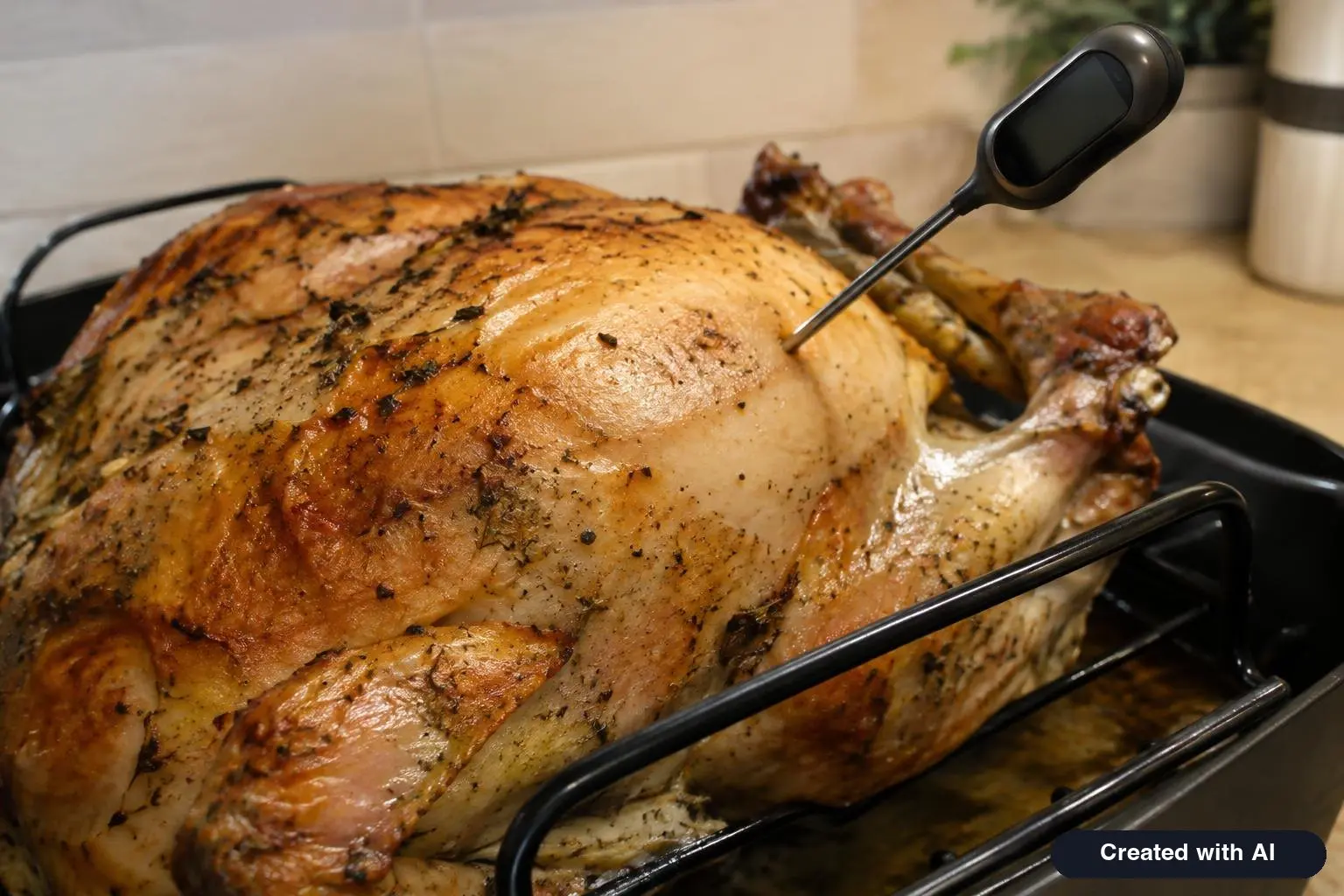
A turkey is done when its internal temperature reaches 165°F. That is the safe minimum set by the USDA Food Safety and Inspection Service (FSIS), and it has to be measured with a food thermometer in three places: the innermost part of the thigh, the innermost part of the wing and the thickest part of the breast. If the bird is stuffed, the center of the stuffing must read 165°F too. The oven itself should be set no lower than 325°F.
Those are two different numbers answering two different questions, and this page covers both: the temperature the meat has to reach, and the temperature to cook it at. It also shows exactly where the probe goes, which is where most mistakes happen.
Turkey temperature chart
| What you are measuring | Target | Notes |
|---|---|---|
| Whole turkey, breast | 165°F | Thickest part, probe not touching bone |
| Whole turkey, thigh | 165°F minimum | Innermost part; many cooks prefer 175 to 180°F for texture |
| Whole turkey, wing | 165°F | Innermost part, where the wing meets the body |
| Stuffing inside the bird | 165°F | Center of the cavity |
| Turkey breast (bone-in or boneless) | 165°F | Thickest part |
| Ground turkey, turkey burgers | 165°F | Center of the patty or loaf |
| Legs, thighs, wings cooked separately | 165°F minimum | Thickest part, away from bone |
| Leftover turkey, reheated | 165°F | Gravy should come to a rolling boil |
| Smoked, grilled or deep-fried turkey | 165°F | Same three places as a roast turkey |
Source: USDA FSIS, "Turkey Basics: Safe Cooking," "Let's Talk Turkey" and "Leftovers and Food Safety."
Where to put the thermometer in a turkey
A turkey is an uneven shape, and the three USDA checkpoints are the three spots that heat reaches last.
1. The thigh
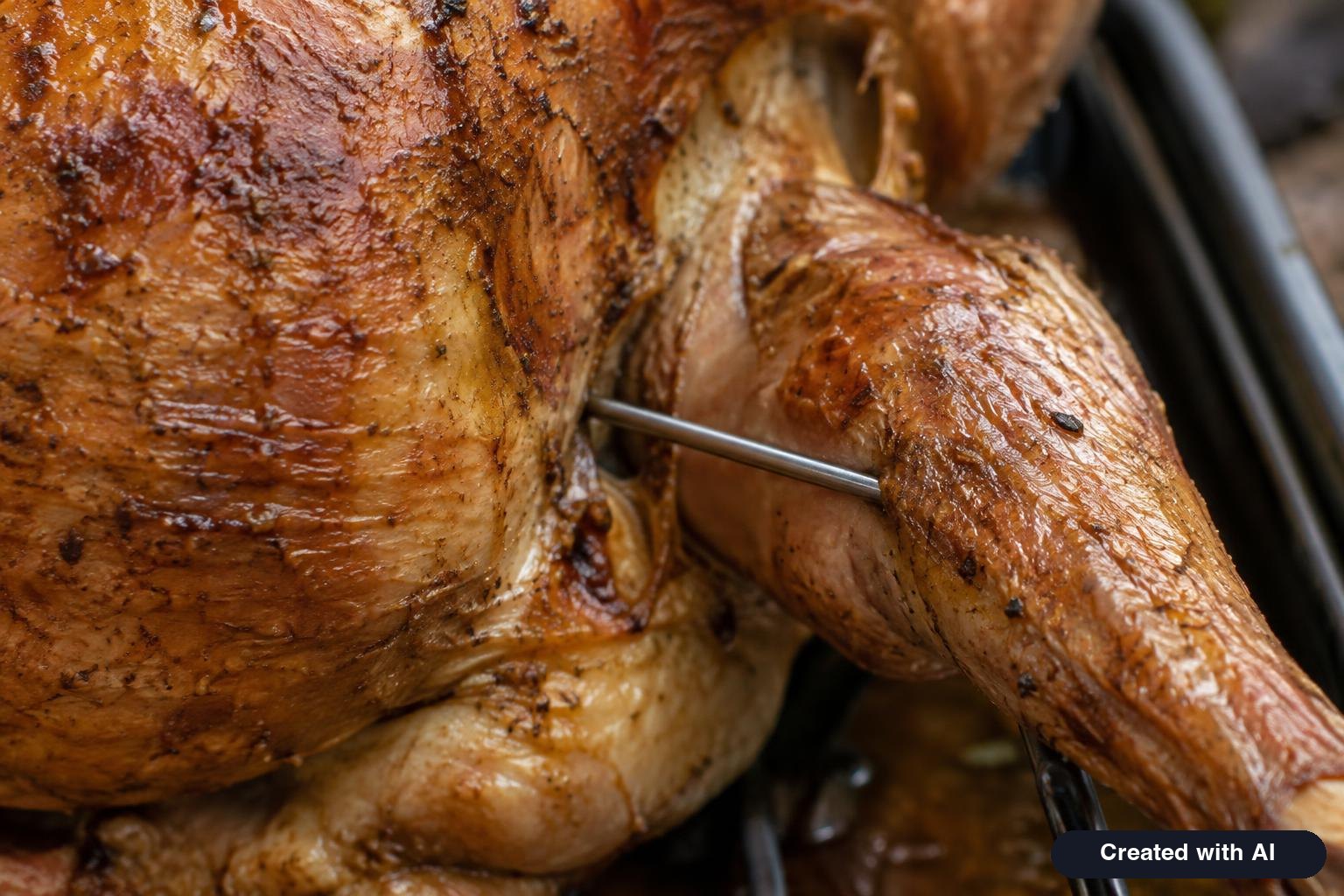
Find the crease where the drumstick meets the body. Push the probe into the thickest part of the inner thigh, angling it toward the body and parallel to the bird, until the tip is in the middle of the meat. If you hit bone, pull back about half an inch. Bone conducts heat and gives a falsely high reading. The thigh is the slowest part of a whole roast turkey, so check it first.
2. The breast
Insert the probe horizontally from the neck end, or from the side just above the wing, into the thickest part of the breast. Slide it in until the tip sits at the center of the muscle, not near the surface and not against the breastbone or ribs. Check both sides; ovens have hot spots, and one breast often runs several degrees behind the other.
3. The wing
Probe the innermost part of the wing, where it joins the body. This joint is tucked against the breast and can lag behind.
4. The stuffing, if there is any
Push the probe into the very center of the stuffing in the main cavity. If the turkey is at 165°F but the stuffing is not, the bird has to stay in the oven, which is the main reason USDA recommends baking stuffing in a separate dish.
USDA adds one practical tip for leave-in probes: for a whole turkey, place an oven-safe thermometer in the thickest part of the inner thigh at the start. When the thigh reaches 165°F, check the wing and the breast before taking the bird out.
Why 165°F
At 165°F, Salmonella and other bacteria that raw poultry can carry are destroyed essentially instantly. A single number that needs no timer is the simplest safe instruction for a home kitchen, which is why USDA uses it for all poultry: whole birds, parts, ground turkey, stuffing and leftovers.
USDA also notes that a correctly cooked turkey can still look pink. Hemoglobin in the tissue can form a heat-stable color, especially near the bone and in smoked or grilled birds. Color is not a doneness test. If the thermometer reads 165°F in all three places, the turkey is safe regardless of a rosy tinge. The reverse is also true: meat can look white before it is safe.
Why some recipes pull the breast earlier
You will see test-kitchen recipes that take a turkey out when the breast reads 150 to 160°F. Serious Eats, for instance, roasts its spatchcocked turkey to 150°F in the breast and 165°F in the thigh. Two things are going on.
First, carryover cooking. A large roast keeps heating after it leaves the oven as the hot outer layers pass heat inward. A whole turkey typically rises several more degrees during a 30-minute rest.
Second, bacterial kill depends on time as well as temperature. The tables FSIS publishes for meat and poultry processors show that turkey held at lower temperatures reaches the same level of safety if it stays there long enough:
| Internal temperature | Minimum holding time for turkey |
|---|---|
| 150°F | About 3.7 to 4.9 minutes, depending on fat content |
| 155°F | About 1.2 to 1.3 minutes |
| 160°F | About 26 to 27 seconds |
| 165°F | Under 10 seconds |
Source: FSIS time-temperature tables for cooking ready-to-eat poultry products (7-log reduction of Salmonella).
Those tables are written for commercial plants with calibrated equipment and continuous monitoring. At home it is hard to prove that every part of a 14-pound bird stayed at 150°F for the full time. USDA's advice to consumers remains 165°F, and that is the right target for anyone cooking for young children, older adults, pregnant guests or people with weakened immune systems. If you want juicier white meat without going below the USDA number, take the turkey out when the breast first reads 165°F rather than letting it climb to 175°F, shield the breast with foil, or spatchcock the turkey so the legs finish at the same time as the breast.
Why dark meat is better hotter
Thighs and drumsticks are safe at 165°F but often still chewy and a little pink at the joint. They contain more connective tissue, which softens as the temperature climbs. Many cooks aim for 175 to 180°F in the thigh. Butterball's roasting instructions call for 170°F in both the thigh and the breast. USDA allows for this: "for reasons of personal preference, consumers may choose to cook turkey to higher temperatures."
The practical problem is that breast meat dries out at the temperatures where thighs taste best. The usual fixes are a foil shield over the breast for part of the cooking time, starting the bird with the legs toward the back of the oven where it is hottest, or carving off the legs and returning them to the oven for 10 to 15 minutes while the breast rests.
What temperature to cook a turkey
The oven setting is a separate question. USDA's rule is a floor: set the oven no lower than 325°F. Its roasting timetable is based on 325°F, and so is Butterball's.
| Oven temperature | What it does | Approximate time, 12 to 14 lb unstuffed |
|---|---|---|
| 325°F | Even, forgiving, the USDA standard | 3 to 3¾ hours |
| 350°F | Slightly faster, better browning | About 2½ to 3 hours (13 minutes per pound, per The Kitchn) |
| 450°F then 350°F | Hot start to crisp the skin, then moderate heat | About 2½ to 3 hours |
| 325°F convection | Fan speeds cooking by roughly 30 percent | 2 to 2½ hours (Butterball, 10 to 18 lb) |
| 450°F, spatchcocked only | Fast, crisp skin all over | About 80 minutes (Serious Eats) |
Do not roast a whole turkey below 325°F, including overnight at 200 or 250°F. A big, dense bird heated that gently spends too long between 40 and 140°F, the range USDA calls the Danger Zone. Complete timing by weight is in how long to cook a turkey.
Temperatures for other methods
| Method | Cooking temperature | Meat is done at |
|---|---|---|
| Deep-frying | Oil held at 350°F (USDA) | 165°F |
| Smoking | Smoker air at 225 to 300°F (USDA) | 165°F |
| Covered grill, indirect heat | Air at 225 to 300°F (USDA) | 165°F |
| Electric roaster oven | At least 325°F | 165°F |
| Air fryer, turkey breast | 400°F (Butterball) | 165°F |
| Slow cooker, turkey parts only | Appliance should hold 170 to 200°F (USDA) | 165°F |
Details for each are in deep-fried turkey, smoked turkey and turkey breast.
Choosing and checking a thermometer
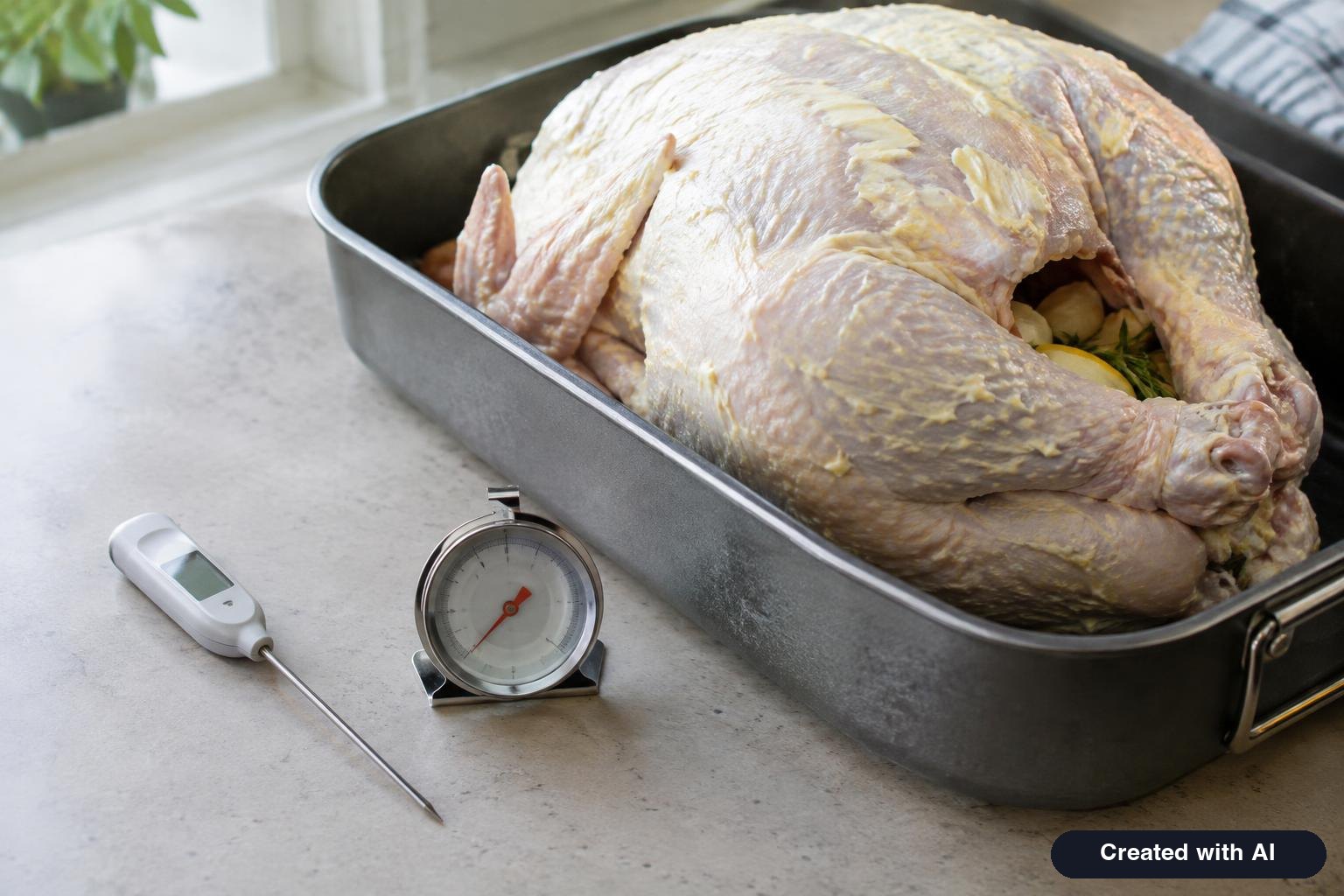
- Digital instant-read. The most useful tool for a turkey. It gives a reading in a few seconds, so you can check several spots quickly with the oven door open only briefly.
- Leave-in probe with a cable or wireless base. Stays in the thigh or breast throughout and sounds an alarm at your target. Useful for tracking, but it measures one spot. Confirm the other two places by hand.
- Oven-safe dial thermometer. Works, but it is slow and the sensing area is long, so it needs to be inserted 2 inches or more into the meat.
- Pop-up timer. The plastic button that comes in some turkeys. USDA recommends checking with a food thermometer in the thigh, wing and breast even when the turkey has one.
How to check accuracy
Fill a glass with ice, top it up with cold water, stir and wait a couple of minutes. Put the probe in the center without touching the glass. It should read 32°F. If it is off by more than a degree or two, recalibrate it if the model allows, or add or subtract the difference when you read it. Do this before Thanksgiving, not while the turkey is resting.
When to start checking
Start well before the chart says the turkey should be done. For a 12- to 14-pound unstuffed bird at 325°F, with a 3- to 3¾-hour estimate, take the first reading at about 2½ hours. After that:
- Thigh below 140°F: check again in 30 to 40 minutes.
- Thigh at 150 to 155°F: check every 10 to 15 minutes. The last 10 degrees go quickly.
- Breast at 165°F but thigh behind: tent the breast with foil and keep roasting, or carve off the legs and finish them alone.
- All three spots at 165°F: take it out and rest it at least 20 minutes, the USDA minimum. Most cooks rest a whole bird 30 minutes.
Wash the probe with hot soapy water between checks if any reading was below 165°F, so you do not carry bacteria from undercooked meat back into the bird.
If the turkey is undercooked when you carve it
It happens: the breast slices fine, then the thigh joint is pink and the juices are red. Do not serve it and do not panic.
- Take a temperature reading in the suspect area.
- If it is under 165°F, cut the legs and thighs off, put them on a sheet pan, and return them to a 375 to 400°F oven until they reach 165°F, usually 10 to 20 minutes.
- If the breast is under, slice it off the bone in two whole pieces and return those as well, covered loosely with foil and with a little broth in the pan.
- Do not partially cook the turkey, refrigerate it and finish it later. USDA says never to brown or partly cook turkey and finish it at another time.
The other temperatures that matter on Thanksgiving
| Temperature | Why it matters |
|---|---|
| 0°F | Freezer. A frozen turkey is safe indefinitely; best within a year. |
| 26°F | A turkey labeled "fresh" has never been below this. |
| 40°F or below | Refrigerator. Thaw here; raw thawed turkey keeps 1 to 2 days. |
| 40 to 140°F | The Danger Zone. Perishable food should not spend more than 2 hours here (1 hour above 90°F). |
| 165°F | Turkey, stuffing, casseroles and all reheated leftovers. |
| 325°F | Minimum oven temperature for roasting or reheating turkey. |
| 350°F | Oil temperature for deep-frying, per USDA. |
Thawing is where the first temperature mistake usually happens; the schedule is in how long to thaw a turkey.
Reheating and holding turkey
Leftover turkey is safe to eat cold. If you reheat it, USDA says to bring it to 165°F, in an oven set no lower than 325°F or in the microwave, covered, with a little broth or water to keep it moist. In the microwave, stir or rotate the food and check more than one spot, because microwaves heat unevenly. Sauces, soups and gravies should come to a rolling boil.
Refrigerate leftovers within 2 hours of the turkey coming off the heat, in shallow containers, and use them within 3 to 4 days.
Help on the day
For a temperature question you cannot settle, the USDA Meat and Poultry Hotline is 1-888-MPHotline (1-888-674-6854), open weekdays 10 a.m. to 6 p.m. Eastern. It has been staffed on Thanksgiving Day from 8 a.m. to 2 p.m. Eastern in recent years, including 2025; hours for Thanksgiving 2026 (Thursday, November 26) had not been posted as of October 14, 2026.
Frequently asked questions
Is turkey done at 165 or 180?
It is safe at 165°F, which is the USDA minimum for every part of the bird. The 180°F figure is an older recommendation for the thigh and is now a matter of preference: dark meat is more tender at 175 to 180°F, while breast meat is juiciest when it is taken out as soon as it reaches 165°F.
Where do you put the thermometer in a turkey?
In the thickest part of the inner thigh, angled toward the body and not touching bone. Then check the innermost part of the wing and the thickest part of the breast. All three should read at least 165°F.
What temperature should I cook a turkey at, 325 or 350?
Either. USDA's minimum oven temperature is 325°F and its time chart is based on it. At 350°F a turkey cooks a little faster, about 13 minutes per pound unstuffed. Never roast below 325°F.
Can you eat turkey at 160 degrees?
USDA advises cooking turkey to 165°F. Meat taken out at 160°F will usually climb to 165°F as it rests, but you should confirm that with a thermometer before carving rather than assume it.
Is it okay if turkey is a little pink?
Yes, if a thermometer shows 165°F in the thigh, wing and breast. USDA says safely cooked turkey can stay pink because of hemoglobin in the tissue, especially near bones and in smoked or grilled birds. Color alone does not show doneness.
What temperature should turkey breast be?
165°F in the thickest part, for both bone-in and boneless breasts. Take it out promptly at that point; breast meat has little fat and dries quickly above 170°F.
Can I trust the pop-up timer?
Use it as a signal to start checking, not as proof. USDA recommends verifying 165°F with a food thermometer in the thigh, wing and breast even if the turkey has a pop-up indicator.
What temperature should stuffing be inside a turkey?
165°F in the center of the stuffing. If the turkey reaches temperature first, keep roasting or scoop the stuffing into a baking dish and finish it in the oven.
Sources
- USDA FSIS – Turkey Basics: Safe Cooking
- USDA FSIS – Let's Talk Turkey: A Consumer Guide to Safely Roasting a Turkey
- USDA FSIS – Turkey from Farm to Table (pink color, partial cooking)
- USDA FSIS – Turkey: Alternate Routes to the Table
- USDA FSIS – Leftovers and Food Safety
- USDA FSIS – Cooking Guideline for Meat and Poultry Products (Revised Appendix A)
- FSIS – Time-Temperature Tables for Cooking Ready-to-Eat Poultry Products (PDF, hosted by Michigan State University)
- Butterball – How to Roast a Turkey
- The Kitchn – How to Cook a Turkey
- Serious Eats – Crisp-Skinned Spatchcocked (Butterflied) Roast Turkey With Gravy
Log in to comment
No comments yet. Be the first.