Halloween Candy: Most Popular Picks and How Much to Buy
- Chocolate is the favorite Halloween treat in NCA's 2026 survey; Reese's Peanut Butter Cups top Instacart's 2026 sales in 40 states.
- Buy 2–3 fun-size pieces per expected trick-or-treater plus 20% extra; count pieces, not bags.
- A teal pumpkin means non-food treats for kids with food allergies; check all candy at home before anyone eats it.
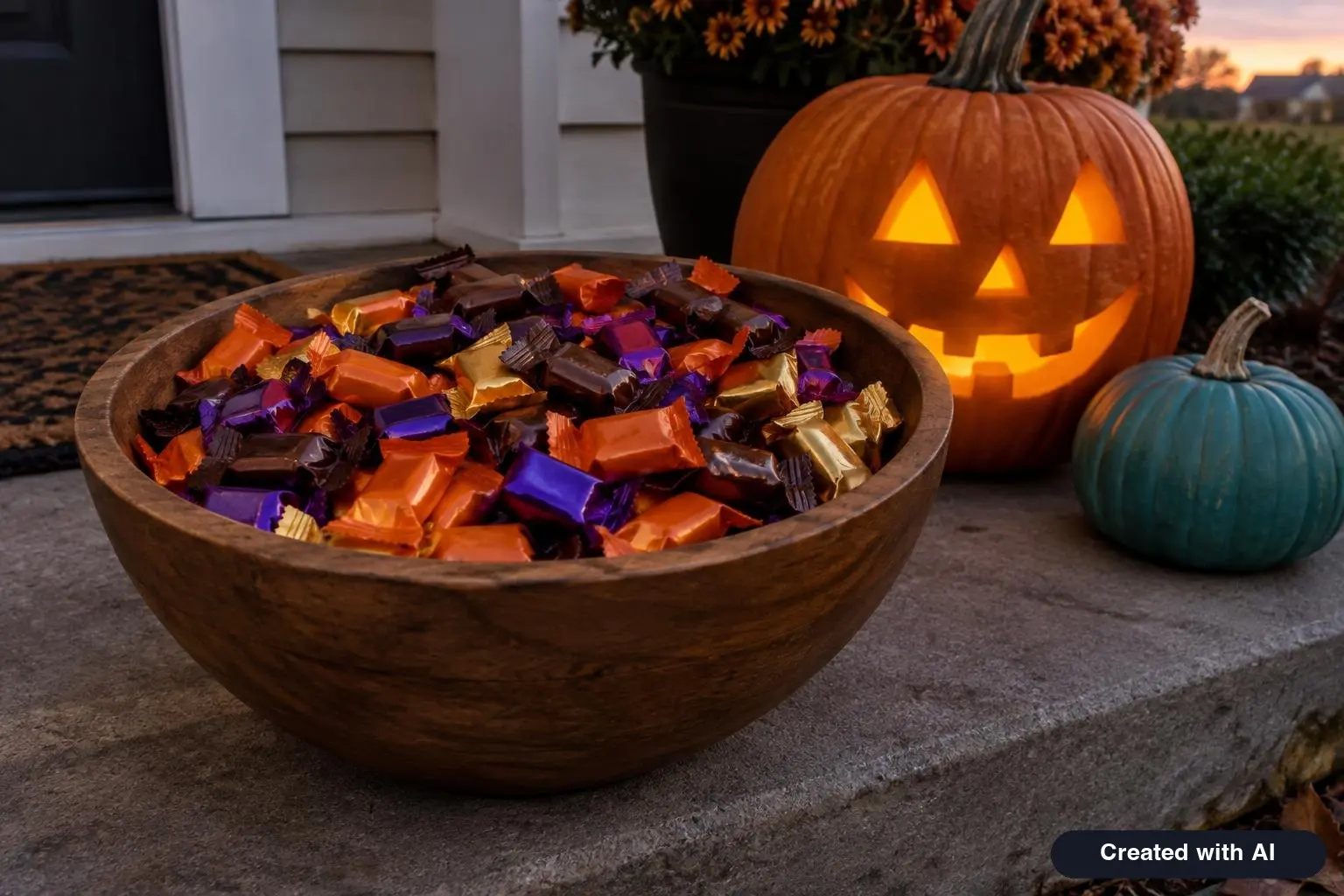
Chocolate is America's favorite Halloween candy, and Reese's Peanut Butter Cups are the single best seller. In the National Confectioners Association's 2026 Halloween survey, chocolate ranked first, followed by gummy candy, hard candy and candy corn. Instacart's 2026 sales data puts Reese's Peanut Butter Cups at number one in 40 states. For your own porch, plan on two to three fun-size pieces per trick-or-treater, plus about 20% extra, and keep a small bowl of non-food treats for kids with food allergies.
Halloween 2026 is Saturday, October 31. A weekend Halloween usually means more kids at the door and a longer evening, so this is not the year to buy one bag and hope.
Halloween Candy by the Numbers in 2026
| Fact | Number | Source |
|---|---|---|
| Expected U.S. spending on Halloween candy | $4.1 billion (up from $3.9 billion in 2025) | National Retail Federation, 2026 survey |
| Halloween shoppers who plan to buy candy | 96% | NRF, 2026 |
| Total expected Halloween spending | $13.5 billion, or $115.14 per person | NRF, 2026 |
| People who plan to hand out candy | 61% of those celebrating (the most popular activity) | NRF, 2026 |
| Americans who plan to celebrate Halloween | 81% | National Confectioners Association, 2026 |
| Shoppers who buy Halloween treats before October | More than one-quarter | NCA, 2026 |
| Parents who admit sneaking candy from their kids' haul | 83% | NCA, 2026 |
You will also see a much larger figure quoted: the NCA has reported that Halloween-season chocolate and candy sales reached $7.4 billion in 2024, about 18% of the year's confectionery retail sales. The two numbers do not contradict each other. NRF asks consumers in September what they plan to spend; NCA counts seasonal retail sales over the whole Halloween selling period.
The Most Popular Halloween Candy
There is no single official ranking, because every list measures something different. The three below are the most useful, and they agree on the winner.
What Americans say they like (NCA survey)
The NCA's "Treats and Trends: The Data Behind Halloween 2026" survey of 1,000 people ranks candy types rather than brands:
- Chocolate
- Gummy candy
- Hard candy
- Candy corn
The same survey found that pumpkins, ghosts and skulls are the favorite shapes for seasonal treats.
What people actually buy (Instacart, 2026)
Instacart's annual Halloween "Sweet Tooth Report" ranks candy by ounces sold on its platform. The 2026 top five:
- Reese's Peanut Butter Cups (the top seller in 40 states)
- Peanut M&M's
- Hershey's Milk Chocolate
- M&M's
- Snickers
What gets delivered in October (DoorDash)
DoorDash's analysis of candy orders placed in October 2025 also put Reese's Peanut Butter Cups first, for the third year in a row, with Hershey's second and M&M's third. Fruity candy shows up further down that list: Nerds, Skittles, Sour Patch Kids, Airheads and Haribo all made the top 10, and several states' most-ordered candy was fruity rather than chocolate.
What this means for your shopping cart: a mixed bag of chocolate miniatures will please the most kids, and one bag of fruity, chewy candy covers the children who do not like chocolate or cannot eat it.
The candy corn question
Candy corn is fourth in the NCA ranking and first in arguments. The 2026 survey even measured how people eat it: 60% eat the whole piece in one bite, 28% start with the narrow white tip and 12% start with the wide yellow end. If you like it, buy a small bag for yourself; it is not individually wrapped, so it is a poor choice for the trick-or-treat bowl.
How Much Halloween Candy to Buy
The formula is simple:
Expected trick-or-treaters × pieces per child × 1.2 = pieces to buy.
- Pieces per child: 2 is standard, 3 is generous. If you hand out full-size bars, 1 is plenty.
- The 1.2: a 20% buffer for the second wave of older kids, the group that arrives all at once, and the pieces that disappear from the bowl before 6 p.m.
- Expected trick-or-treaters: use last year's count if you have it. If you are new to the street, ask a neighbor; nobody knows better.
| Trick-or-treaters you expect | 2 pieces each + 20% | 3 pieces each + 20% |
|---|---|---|
| 25 | 60 pieces | 90 pieces |
| 50 | 120 pieces | 180 pieces |
| 75 | 180 pieces | 270 pieces |
| 100 | 240 pieces | 360 pieces |
| 150 | 360 pieces | 540 pieces |
| 200 | 480 pieces | 720 pieces |
Do not count bags; count pieces. The piece count is printed on the front or back of every variety bag, and it varies widely between brands and bag sizes.
What changes the count
- A Saturday Halloween. No school night means families stay out longer and visit from other neighborhoods. Round up.
- Your town's schedule. In some places trick-or-treating is not on October 31 at all this year. Columbus, Ohio, and its suburbs hold it Thursday, October 29. Check the hours in our guide to trick-or-treating times.
- Your street. Flat, well-lit streets with sidewalks and houses close together draw crowds. Long driveways and rural roads do not.
- Weather. Cold rain can cut traffic sharply. Buy candy you would not mind eating or freezing.
- Local events. A big trunk-or-treat the same evening can pull families away from door-to-door routes.
How to stretch the supply
- Hand out candy yourself instead of leaving a bowl. A "take one" sign works until the first group of 12-year-olds.
- Start with 2 pieces per child and drop to 1 if the bowl is half empty by the midpoint of your town's hours.
- Keep one sealed bag in reserve. If you do not open it, some stores will take it back with a receipt.
- When you run out, turn off the porch light. Everyone understands the signal.
Allergy-Friendly Halloween Candy
About 33 million people in the United States have food allergies, according to Food Allergy Research & Education (FARE). For those families, a bowl of mixed chocolate is a bowl of question marks.
Know the nine major allergens
Federal law requires packaged foods to declare nine major allergens: milk, eggs, fish, crustacean shellfish, tree nuts, peanuts, wheat, soybeans and sesame. Halloween candy most often involves milk, peanuts, tree nuts, soy, wheat and egg.
Two label details matter:
- "May contain" statements are voluntary. The FDA says advisory lines such as "may contain peanuts" or "produced in a facility that also uses tree nuts" are not required by law. A missing warning does not prove a product is free of cross-contact.
- The label may be on the outer bag only. Miniature pieces often carry no ingredient list. If you hand out candy, keep the bag so a parent can check it. If your child has an allergy, compare each piece against the manufacturer's current information, and remember that a mini version of a candy can be made on different equipment than the full-size bar.
The American Academy of Pediatrics calls Halloween "one of the trickiest days of the year for children with food allergies" and advises that a child with a diagnosed allergy carry prescribed emergency medicine, such as an epinephrine auto-injector, while trick-or-treating.
Candy types that are easier for allergic kids
Recipes and factories change, so no list of "safe" brands stays accurate. As a general pattern, plain hard candies, lollipops and many fruity chews are made without milk, peanuts or tree nuts, while chocolate is the category most likely to contain or touch all three. Read every label, every year.
The Teal Pumpkin Project
A teal pumpkin on a doorstep means that house offers non-food treats in addition to, or instead of, candy. The idea started with a Tennessee mother, Becky Basalone, whose son has a severe food allergy; FARE took it national in 2014. In 2024 FARE's online map listed more than 12,500 participating locations across all 50 states and Washington, D.C.
Taking part costs a few dollars:
- Buy a bag of non-food treats.
- Keep them in a separate bowl from the candy so wrappers and residue do not mix.
- Put a teal pumpkin out front (paint a real one, or print FARE's free sign).
- Add your address to the Teal Pumpkin Project map so local families can plan a route.
- Let every child choose: candy, a toy, or one of each.
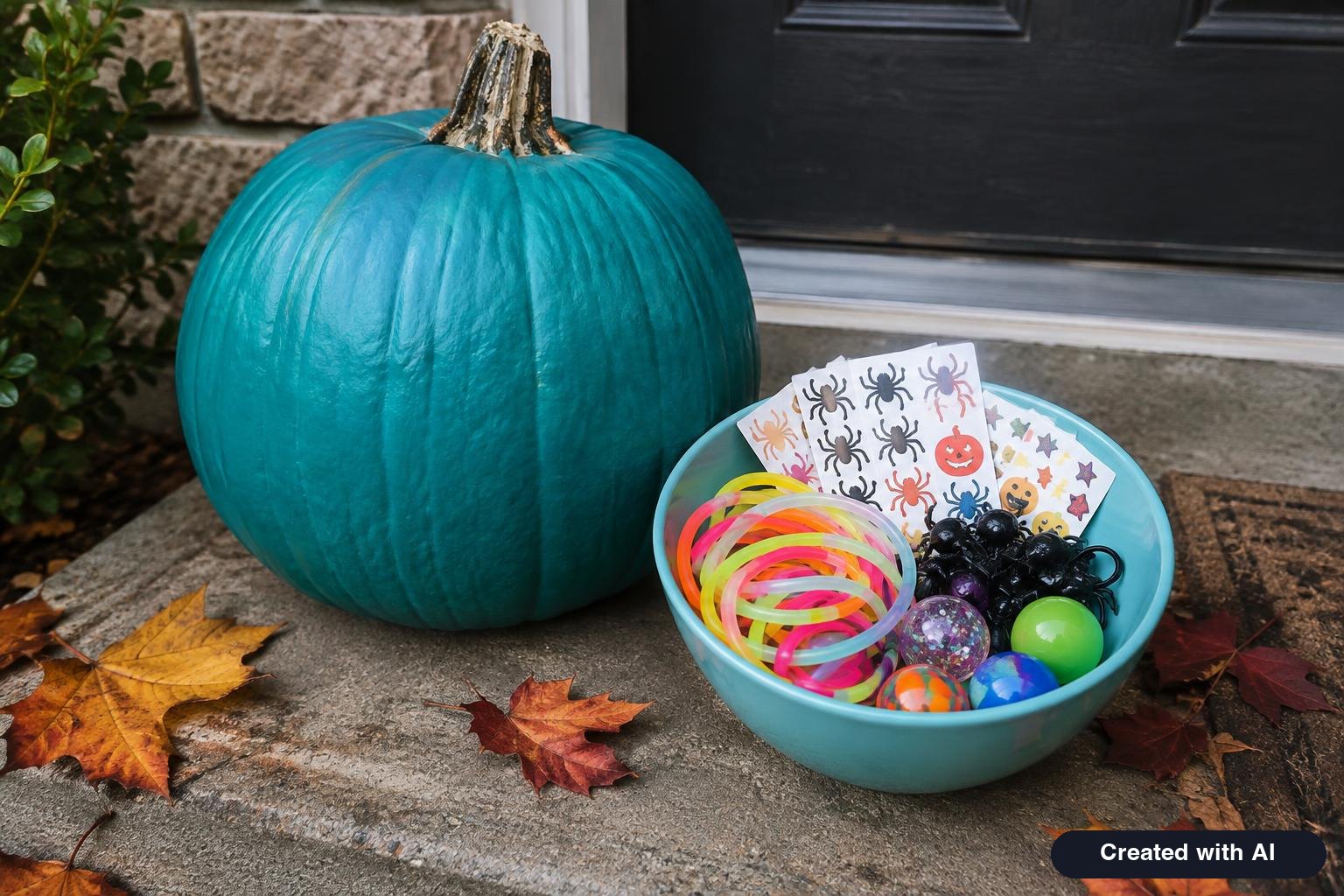
Non-Candy Halloween Treats Kids Actually Want
FARE and the American Academy of Pediatrics both publish lists of non-food ideas. Combined and sorted by what tends to go first:
| Treat | Why it works | Watch out for |
|---|---|---|
| Glow sticks, bracelets and necklaces | The clear favorite; also makes kids easier to see in the dark | Do not let small children chew them |
| Stickers and temporary tattoos | Cheap, flat, easy to hand out | Tattoos can be a choking hazard for toddlers |
| Bouncy balls | Popular with ages 5–10 | Not for children under 3 |
| Spider rings and vampire fangs | On theme and usually sold in big bags | Small parts |
| Mini slinkies, finger puppets | Feel like a real toy | Cost more per piece |
| Pencils, erasers, bookmarks | Useful; teachers approve | Less exciting to older kids |
| Bubbles | Great for toddlers | Check the caps are tight |
| Whistles, kazoos, noisemakers | Kids love them | Their parents may not |
| Coins | Teens will take a quarter over a sticker every time | Choking hazard for small children |
FARE suggests choosing latex-free items where you can, because some children are allergic to latex. For any child under 3, hand the treat to the parent.
Halloween Candy Safety
The Food and Drug Administration's Halloween advice is short and practical:
- Wait until you are home. Children should not eat treats until an adult has looked through the bag. A snack or dinner before going out makes waiting easier.
- Eat only commercially wrapped treats. Tell children not to accept, or eat, anything that is not in its original wrapper.
- Look for tampering. Check for an unusual appearance, discoloration, tiny pinholes or tears in wrappers. Throw away anything that looks suspicious.
- Check labels for allergens if your child has a food allergy.
- Remove choking hazards for little ones. For very young children, take out gum, peanuts, hard candies and small toys.
The American Academy of Pediatrics adds caramel apples, popcorn, jelly beans, gummy candy, pumpkin seeds and anything with whole nuts to the list of foods babies and toddlers should avoid.
Black licorice: a warning for adults
Real black licorice contains glycyrrhizin, a compound that can lower potassium levels. The FDA has warned that for people 40 or older, eating 2 ounces (about 57 g) of black licorice a day for at least two weeks could cause an irregular heart rhythm. An occasional piece is not a concern; a daily habit can be, particularly for anyone with heart disease or high blood pressure.
Keep candy away from pets
The ASPCA warns that chocolate, especially dark and baking chocolate, is dangerous to dogs and cats, and that sugar-free candy containing xylitol can cause serious problems. Keep the bowl and the kids' bags off the floor. If a pet eats candy, call your veterinarian or the ASPCA Animal Poison Control Center at (888) 426-4435.
How Long Halloween Candy Lasts and How to Store It
Candy keeps far longer than most people expect. These are the National Confectioners Association's storage guidelines:
| Candy | How long it keeps | Best storage |
|---|---|---|
| Dark chocolate | 1 to 2 years | Wrapped, in a cool, dark, dry place |
| Milk and white chocolate | 8 to 10 months | Cool, dark and dry |
| Hard candy and lollipops | Up to 1 year | Room temperature or cool and dry |
| Jellied and soft candy | About 12 months unopened; 6 to 9 months once opened | Covered, away from heat and light |
| Candy corn | About 9 months unopened; 3 to 6 months once opened | Covered, at room temperature |
| Caramel | 6 to 9 months | Covered, away from heat and light |
| Gum | 6 to 9 months sealed | Cool, dry, out of sunlight |
A few practical rules:
- A pantry or basement beats the top of the refrigerator, which is warm.
- Do not store hard candy or mints in the same container as fudge or creamy candy. One absorbs moisture from the other and the hard candy turns sticky.
- Chocolate with a white or gray film has "bloomed" from temperature swings. It looks odd but is fine for baking.
- Toffee and truffles can be frozen for up to two months; the NCA advises against freezing candy that contains fruit or nuts.
What to Do With Leftover Halloween Candy
- Bake with it. Chop chocolate bars into cookie dough, brownies or a batch of pumpkin muffins. Candy bark is the fastest way to use a mixed pile.
- Save it for decorating. Gumdrops, hard candy and candy-coated chocolates are exactly what a gingerbread house needs in December.
- Freeze chocolate miniatures in a zip-top bag and chop them into ice cream or milkshakes.
- Portion it. The AAP suggests setting realistic, consistent rules for how treats are rationed in the days and weeks after Halloween. One or two pieces in a lunch box lasts a long time.
- Donate it. Dentists' offices and charities that send care packages to service members often collect wrapped candy in the first week of November. Programs and deadlines change yearly, so confirm before you drop anything off.
- Take it to work. The oldest solution still works.
For the rest of the holiday, see our Halloween food ideas, the full list of Halloween safety tips, and the main Halloween 2026 guide.
Frequently asked questions
What is the most popular Halloween candy?
Chocolate is the favorite type of Halloween candy in the National Confectioners Association's 2026 survey, ahead of gummy candy, hard candy and candy corn. By brand, Reese's Peanut Butter Cups rank first in Instacart's 2026 sales data, followed by Peanut M&M's, Hershey's Milk Chocolate, M&M's and Snickers.
How much Halloween candy should I buy?
Multiply the number of trick-or-treaters you expect by 2 or 3 pieces each, then add 20%. For 50 kids, that is 120 to 180 pieces; for 100 kids, 240 to 360. Check the piece count printed on each bag, and round up in 2026 because Halloween is on a Saturday.
How many pieces of candy do you give each trick-or-treater?
Two fun-size pieces is standard and three is generous. If you hand out full-size bars, one per child is plenty. Drop to one piece if your bowl is half empty by the midpoint of your town's trick-or-treat hours.
What does a teal pumpkin mean on Halloween?
A teal pumpkin on a doorstep means the house offers non-food treats, such as glow sticks, stickers or small toys, so children with food allergies can take part. The Teal Pumpkin Project is run by Food Allergy Research & Education (FARE), which took it national in 2014.
What can I hand out instead of candy on Halloween?
Glow sticks and glow bracelets are the most popular, followed by stickers, temporary tattoos, bouncy balls, spider rings, vampire fangs, pencils, bubbles and mini slinkies. Keep them in a separate bowl from candy, choose latex-free items when possible and hand small items to the parents of toddlers.
How long does Halloween candy last?
According to the National Confectioners Association, dark chocolate keeps 1 to 2 years, milk and white chocolate 8 to 10 months, hard candy up to a year, soft and jellied candy 6 to 9 months once opened, and opened candy corn 3 to 6 months. Store candy in a cool, dark, dry place.
How do I check Halloween candy to make sure it is safe?
The FDA advises letting children eat only commercially wrapped treats after an adult has inspected them at home. Look for an unusual appearance, discoloration, tiny pinholes or tears in wrappers and throw away anything suspicious. Remove gum, hard candy, peanuts and small toys for very young children.
How much do Americans spend on Halloween candy?
The National Retail Federation's 2026 survey projects $4.1 billion in Halloween candy spending, up from $3.9 billion in 2025, with 96% of Halloween shoppers planning to buy candy. Total Halloween spending is expected to reach $13.5 billion.
Sources
- National Retail Federation – 2026 Halloween consumer survey (Sept. 22, 2026)
- National Confectioners Association – Treats and Trends: The Data Behind Halloween 2026
- Candy Industry – NCA releases consumer survey on Halloween (Sept. 29, 2026)
- Candy Industry – Survey: 94% of Americans mark Halloween with chocolate, candy (NCA, 2025)
- 9NEWS – Instacart's 2026 Halloween Sweet Tooth Report ranking
- Mental Floss – The Most Popular Halloween Candy in Every State for 2026 (DoorDash data)
- FARE – Teal Pumpkin Project
- FARE – Ideas for Non-Food Treats
- FDA – Halloween Safety Tips: Costumes, Candy, and Colored Contact Lenses
- FDA – Food Allergies (nine major allergens, advisory labeling)
- American Academy of Pediatrics (HealthyChildren.org) – Halloween Fun & Safety Tips
- American Heart Association News – Black licorice is a candy that should inspire caution (FDA warning)
- ASPCA – Halloween Safety Tips
- National Confectioners Association (Always A Treat) – Candy Storage Tips
Log in to comment
No comments yet. Be the first.