Pumpkin Muffins with Kefir, Plus Pumpkin Bread and Cookies
- Batter mixes with a spatula in 10 minutes—no mixer needed
- Baking times for standard and mini muffins, a loaf, and the air fryer
- Bonus recipes for leftover purée: pumpkin cookies, latte, smoothie, and cream
- Ingredients and How to Choose Them
- How to Bake Pumpkin Muffins: Step by Step
- Common Mistakes
- Variations: With Chocolate, Cottage Cheese, Carrots, and Sugar-Free
- Pumpkin Bread from the Same Batter
- Pumpkin Cookies
- Other Pumpkin Desserts: Latte, Smoothie, and Cream
- Lighter Version: What Each Substitution Changes
- How Many Calories Are in Pumpkin Muffins
- How to Store and Can You Freeze Them
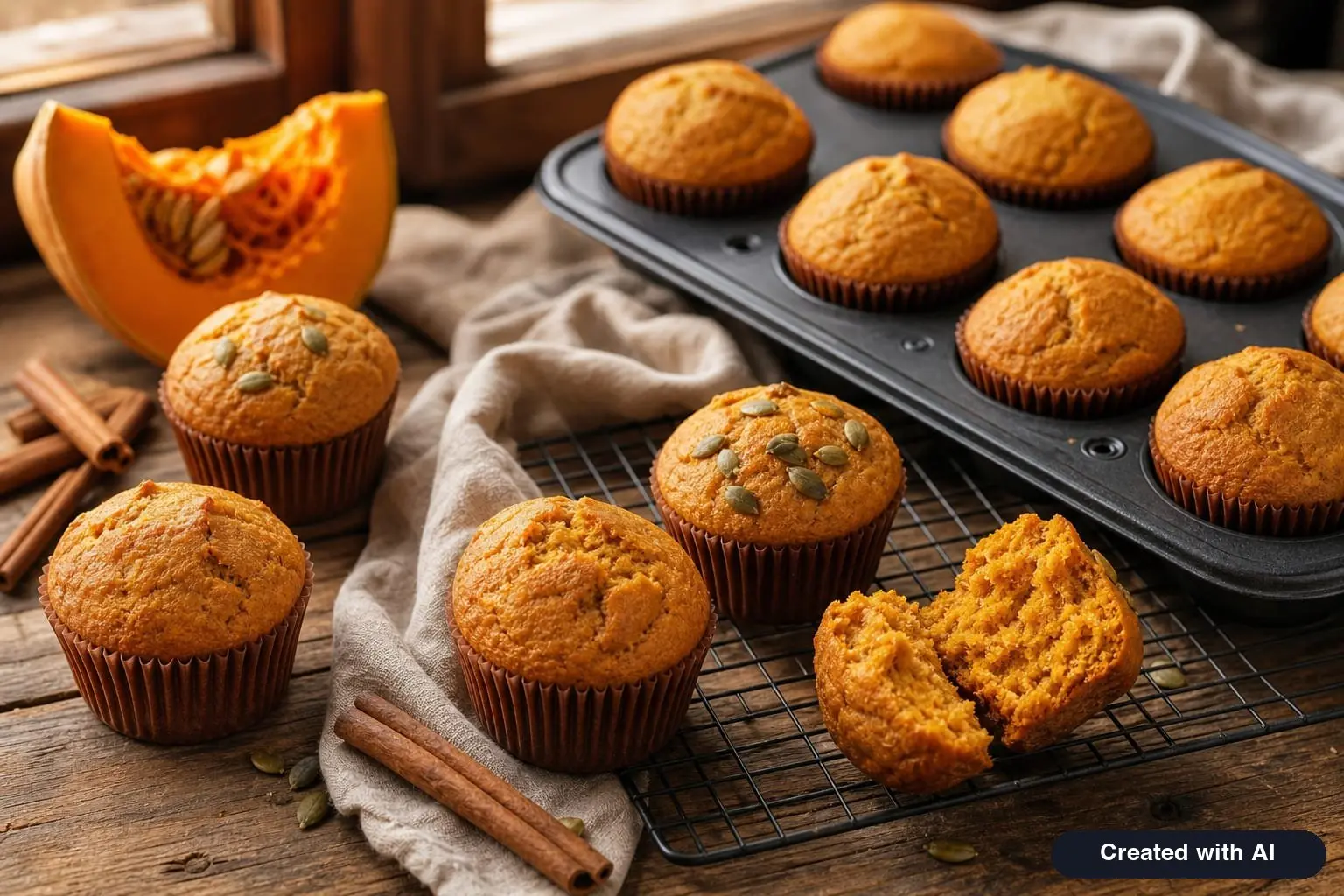
Pumpkin muffins are one of the most rewarding fall baked goods: the batter is mixed with a spoon in 10 minutes, no mixer needed, and the pumpkin does what butter and sour cream achieve in other muffins—it provides moisture, a bright orange color, and a mild sweetness. After a few days, they are still soft, making them perfect to bake ahead, pack in a lunchbox, or take to a gathering.
This recipe makes fluffy pumpkin muffins with kefir and oil. The acidity of the kefir reacts with the baking soda to lift the rather heavy, purée-filled batter, while the oil, unlike butter, doesn't harden in the fridge, so the muffins stay soft on the second and third days. The spices—cinnamon, a little ginger, and nutmeg—don't overpower the pumpkin but provide that warm fall baking aroma.
This batch makes 12 standard-sized muffins, each containing about 203 calories. Muffins with pumpkin purée are also great for beginners—it's hard to mess up as long as you don't overmix the batter. The same batter bakes up as pumpkin bread in a loaf pan, and below you'll also find measurements for pumpkin cookies, pumpkin latte, and a few quick pumpkin desserts.
The recipe is in the card: you can recalculate the amounts for a different number of muffins, check off what you've already added, and print it out. Below the card, each step is explained in more detail.
Pumpkin Muffins
No ratings yet – be the firstIngredients
Wet ingredients
Dry ingredients
Directions
- Preparation. Preheat the oven to 350°F (180°C), or 340°F (170°C) for convection. Line a 12-cup muffin pan with paper liners or grease the cups with oil.
- Dry ingredients. In a bowl, whisk together the flour, baking powder, baking soda, cinnamon, ginger, nutmeg, and salt until no lumps of baking soda remain.
- Wet ingredients. In another bowl, whisk the eggs with the sugar for half a minute. Pour in the oil and kefir, add the pumpkin purée, and mix until smooth.
- Batter. Add the dry ingredients to the wet ones and fold with a spatula in 10–12 strokes—only until no dry flour remains. The batter should remain thick and slightly lumpy.
- Filling the pan. Divide the batter among the 12 liners, filling them to three-quarters full (about 2.6 oz / 75 g each). If desired, sprinkle with pumpkin seeds or brown sugar.
- Baking. Bake on the middle rack for 22–25 minutes, without opening the oven for the first 15 minutes. They are done when the top springs back and a wooden toothpick comes out clean.
- Cooling. Leave the muffins in the pan for 5 minutes, then transfer to a wire rack and let cool completely.
- Calories
- 203 kcal
- Protein
- 3.7 g
- Fat
- 8.6 g
- of which saturated
- 0.9 g
- Carbohydrates
- 28 g
- of which sugars
- 11 g
- Fiber
- 0.8 g
Calculated with the Firmus Medicus calorie database (USDA, Fineli).
Ingredients and How to Choose Them
Pumpkin purée. You need 1 cup (250 g) of thick purée—this comes from about 14–16 oz (400–450 g) of peeled pumpkin. The best purée is from oven-roasted pumpkin: bake chunks at 400°F (200°C) for 30–40 minutes until tender, and blend. Roasted pumpkin loses some water, making the purée thick and sweeter. Boiled pumpkin purée is more watery—let it sit in a sieve for 10 minutes or use 1/4 cup plus 1 tbsp (70 ml) of kefir instead of 1/2 cup (100 ml). The best varieties are butternut, muscat, and Hokkaido (Red Kuri) squash: their flesh is dry, sweet, and stringless. You can read about their differences in our article on types of pumpkins, and how to make and freeze more purée in the article on pumpkin porridge and purée.
Flour and leavening. Regular all-purpose flour. Two things provide the lift: baking powder and a little baking soda. Baking soda is needed because the batter contains acidic kefir—they react immediately, while the baking powder activates in the oven. With just baking soda, the muffins would taste soapy; with just baking powder, they wouldn't rise as much.
Kefir. Any fat content kefir works, as well as buttermilk or plain yogurt thinned with a tablespoon of water. If you only have milk, add a teaspoon of lemon juice to 1/2 cup (100 ml) of milk and let it sit for 5 minutes.
Oil. Neutral-tasting canola or sunflower oil. Muffins made with oil are moister and stay fresh longer. If you prefer a buttery flavor, you can replace the oil with 7 tablespoons (100 g) of melted and cooled butter—the crumb will be slightly denser.
Sugar and spices. 1/2 cup (120 g) of sugar gives medium sweetness; with brown sugar, the muffins take on a light caramel flavor. Be generous with the spices: the pumpkin itself has a mild flavor, so without cinnamon, ginger, and nutmeg, the baked goods will taste bland. Instead of individual spices, you can use 2 teaspoons of pumpkin pie spice.
How to Bake Pumpkin Muffins: Step by Step
Preheat the oven to 350°F (180°C), or 340°F (170°C) for convection. Line a 12-cup muffin pan with paper liners or grease the cups with oil. The oven must be preheated before mixing the batter: the baking soda starts working as soon as it touches the kefir, so batter that sits around loses some of its fluffiness.
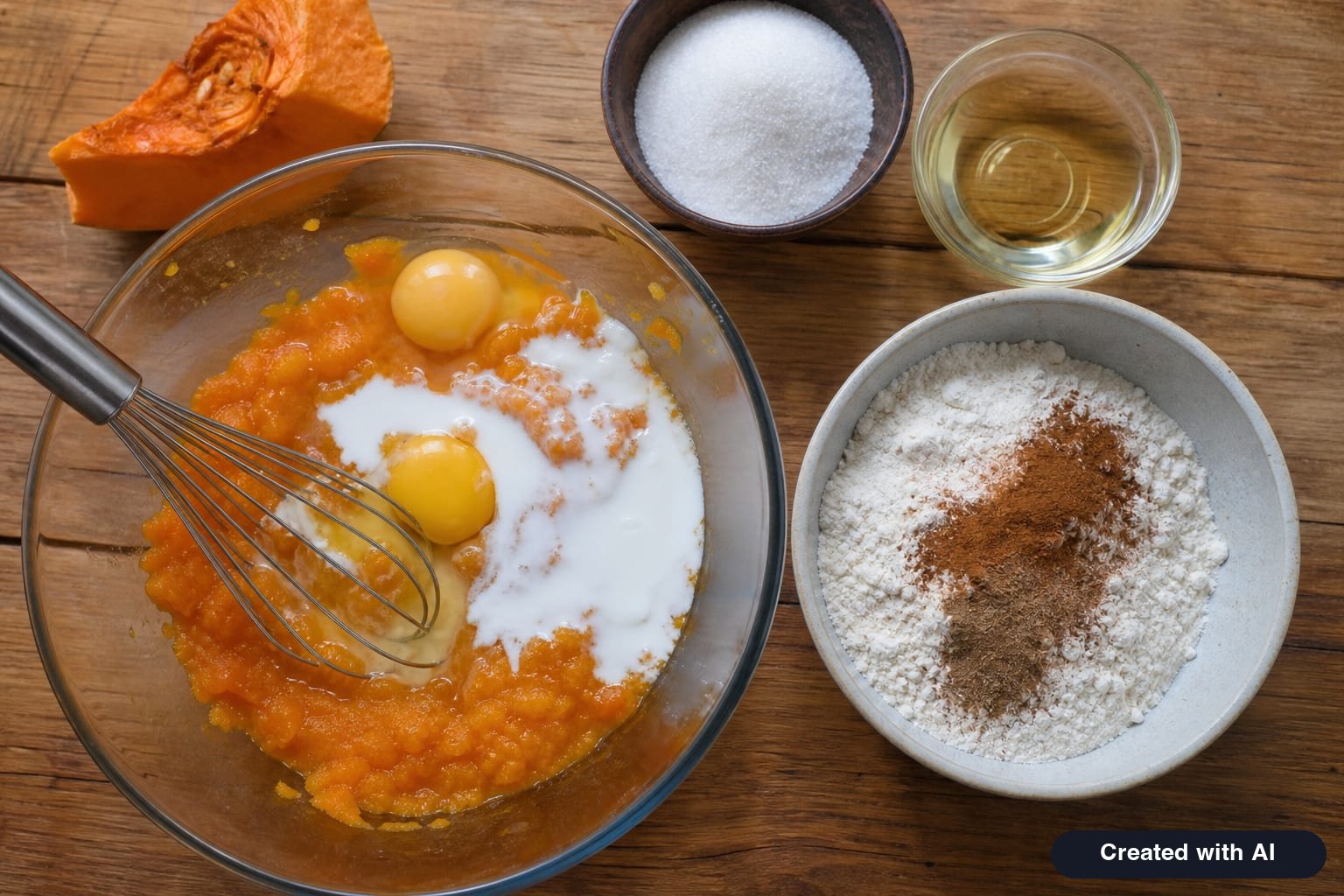
In one bowl, mix the dry ingredients: flour, baking powder, baking soda, cinnamon, ginger, nutmeg, and salt. Whisk well—if the baking soda remains in clumps, the muffins will have brown, bitter-tasting spots.
In another bowl, whisk the eggs with the sugar for half a minute until the mixture is smooth. You don't need to beat them until fluffy, as these muffins are lifted by the leavening agents, not egg foam. Pour in the oil, kefir, add the pumpkin purée, and mix until you have a uniform orange batter. All ingredients should be at room temperature: cold kefir and cold purée slow down the leavening process.
Add the dry ingredients to the wet ones and fold with a spatula in just 10–12 strokes—only until no dry flour remains. The batter should be thick and slightly lumpy. This is the most important part of the whole recipe: overmixing develops the gluten in the flour, resulting in tough, rubbery muffins with tunnels inside.
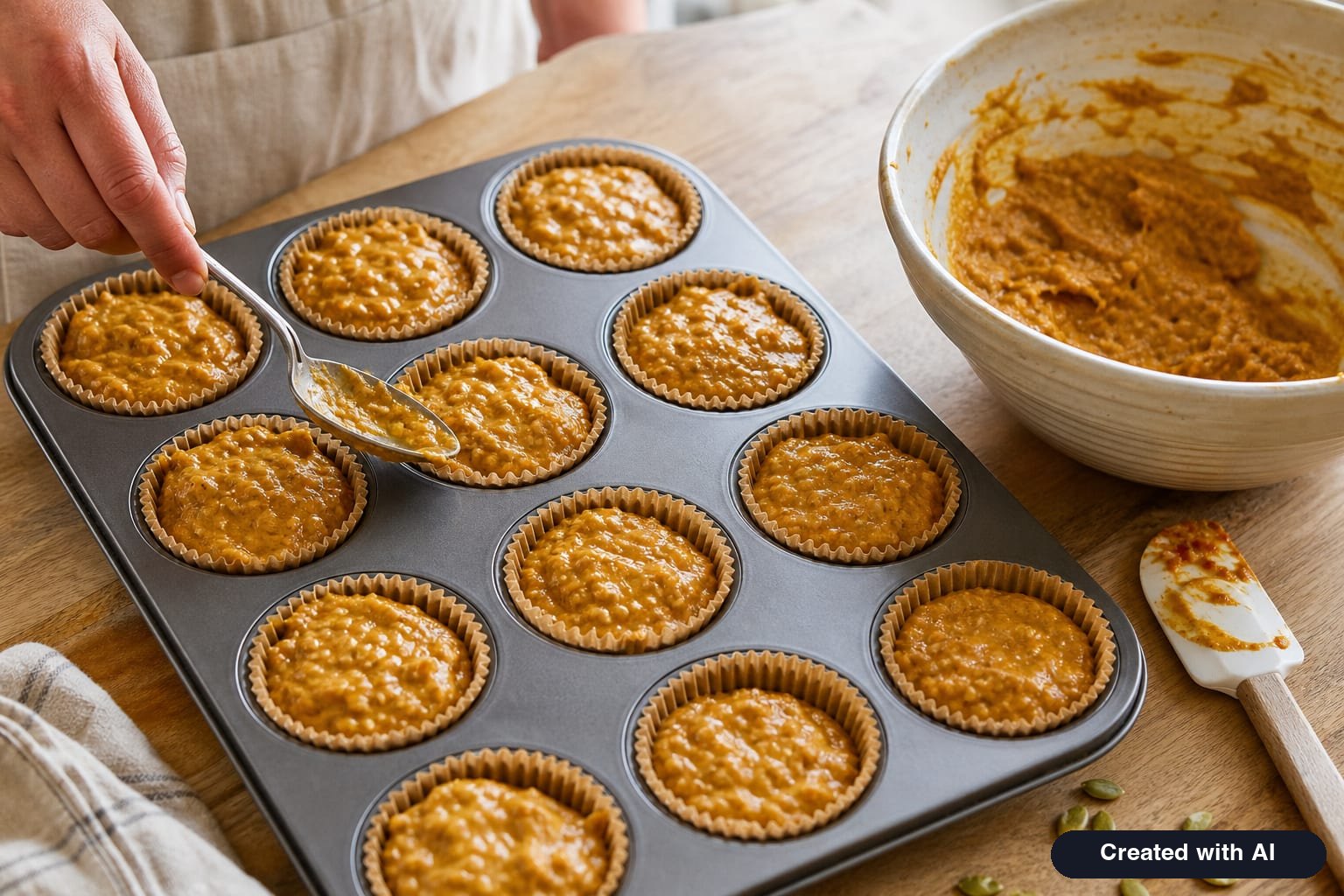
Divide the batter into the liners using two spoons or an ice cream scoop, filling them about three-quarters full—about 2.6 oz (75 g) of batter each. If you like, sprinkle the tops with pumpkin seeds or a pinch of brown sugar—it creates a crispy crust as it bakes.
Bake on the middle rack of the oven for 22–25 minutes. Do not open the oven for the first 15 minutes—the cold air will cause the unset muffins to collapse. They are done when the top springs back when pressed with a finger, and a wooden toothpick inserted into the center comes out clean or with a few moist crumbs.
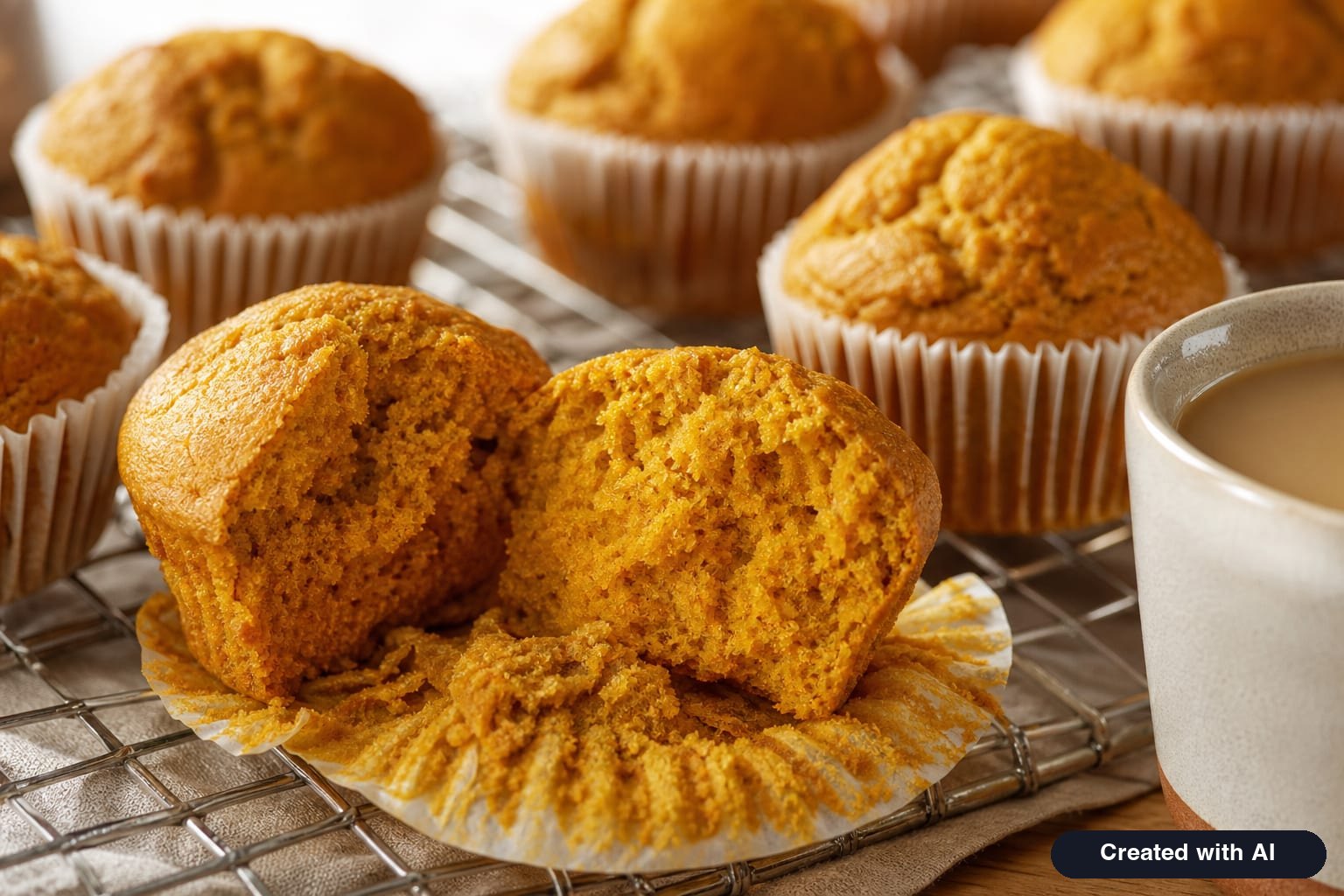
Leave the baked muffins in the pan for 5 minutes, then transfer them to a wire rack. If left in the hot pan longer, they will sweat, and the paper liners will start sticking to the bottom. Completely cooled muffins taste better than hot ones—the spice flavors develop over a few hours.
Baking Time by Pan Type
The same batter works for various pans—only the time and slightly the temperature change. The larger the baked good, the lower the temperature, so the edges don't burn before the center is done.
| Pan Type | Yield from one batch | Temperature | Time |
|---|---|---|---|
| Standard muffin liners | 12 muffins | 350°F (180°C) | 22–25 min. |
| Mini muffin liners | about 30 muffins | 350°F (180°C) | 12–15 min. |
| Jumbo muffin liners | 6 muffins | 345°F (175°C) | 30–35 min. |
| 10x4-inch (25x11 cm) loaf pan | 1 loaf, 12 slices | 340°F (170°C) | 55–65 min. |
| 9-inch (22–24 cm) bundt or tube pan | 1 cake | 340°F (170°C) | 45–50 min. |
| Silicone liners in an air fryer | 4–6 muffins at a time | 320°F (160°C) | 15–18 min. |
Common Mistakes
Muffins are tough and rubbery. The batter was overmixed. Combine the dry and wet ingredients with a spatula, not a mixer, and stop as soon as the dry flour disappears—the lumps will bake out.
Wet and sticky inside. The purée was too watery, or the baking time was too short. Drain watery purée in a sieve, and bake the muffins until a toothpick comes out clean. If the top is already brown but the inside is still raw, lower the temperature to 340°F (170°C) and bake for 5 minutes longer.
Didn't rise or collapsed. Expired baking powder, opening the oven too early, or the batter sat too long before baking. You can test baking powder by dropping a pinch into hot water—it should fizz immediately.
Bland. Too few spices or salt. A pinch of salt in a sweet baked good is not a mistake—it enhances both the sweetness and the pumpkin flavor.
Sticking to the paper. The muffins are still warm or sat in the pan too long. Wait until they are completely cool—then the paper peels off cleanly.
Variations: With Chocolate, Cottage Cheese, Carrots, and Sugar-Free
Pumpkin chocolate chip muffins. Fold 2.8 oz (80 g) of coarsely chopped dark chocolate or chocolate chips into the prepared batter; save a few pieces for the top. Toss the chips with a teaspoon of flour first so they don't sink to the bottom. One such muffin has about 242 calories.
Chocolate pumpkin muffins. Replace 1/4 cup (30 g) of the flour with 1/3 cup (30 g) of cocoa powder (1 3/4 cups / 220 g flour plus the cocoa) and fold in 2.1 oz (60 g) of chopped dark chocolate. Cocoa is drying, so use a generous 1/2 cup (120 ml) of kefir. You'll barely taste the pumpkin, but the muffins will be exceptionally moist—about 230 calories each.
Pumpkin and cottage cheese muffins. Replace the kefir with 3/4 cup (180 g) of cottage cheese or farmer cheese, pushed through a sieve or blended with the purée. The batter will be thicker, and the muffins will be more filling with more protein (about 5 g each, 214 calories). Bake for 25–28 minutes. If you want the cottage cheese and pumpkin combination in a large cake, check out the pumpkin cake variation with cottage cheese.
Pumpkin and carrot muffins. Instead of 1 cup (250 g) of purée, use 2/3 cup (150 g) of purée and 1 cup (100 g) of finely grated carrots, and add a handful of chopped walnuts or raisins. The calories are almost the same (about 204 calories), but the texture is more interesting—the carrots remain noticeable.
Muffins from grated pumpkin. If you don't have purée, finely grate 8.8 oz (250 g) of raw pumpkin and use it instead of the purée. These are quick pumpkin muffins—no need to roast or boil the pumpkin. Bake for 25–28 minutes; the crumb will be slightly coarser with visible orange strands.
Sugar-free pumpkin muffins. Replace the sugar with one large, very ripe banana (about 4.2 oz / 120 g peeled), mashed with a fork. The muffins will be less sweet, more like a sweet bread—about 173 calories. You can add sweetness with a handful of raisins or 4–5 chopped dates. Keep in mind that bananas and dried fruit also contain sugar, just not added sugar.
Healthy pumpkin muffins. Replace half the flour with whole wheat flour (1 cup / 125 g + 1 cup / 125 g), the sugar with 3 tablespoons (60 g) of honey, use 1/4 cup (55 ml) of oil, and 2/3 cup (150 ml) of kefir. One muffin will have about 148 calories, and the crumb will be darker and slightly denser. Whole wheat flour absorbs more liquid, so let the batter sit for 5 minutes before baking.
Pumpkin muffins for kids. For toddlers, bake the variation with banana instead of sugar, use 1/4 cup plus 1 tbsp (65 ml) of oil, halve the cinnamon, and omit the ginger and nutmeg. It's most convenient to bake them in mini muffin liners—12–15 minutes. One such muffin (calculating for 12 standard ones) has about 150 calories. Do not use honey for children under one year old.
With frosting. For holidays, you can decorate the muffins: beat 7 oz (200 g) of cream cheese with 1/3 cup (40 g) of powdered sugar and a teaspoon of lemon juice, and spread it on completely cooled muffins. For a Halloween table, tint the frosting orange with a tablespoon of pumpkin purée.
Pumpkin Bread from the Same Batter
Pumpkin bread is baked from the exact same batter—no changes needed. Line a 10x4-inch (25x11 cm) loaf pan with parchment paper so the edges hang over, pour in the batter, and smooth it out. Bake at 340°F (170°C) for 55–65 minutes. After 40 minutes, if the top is already quite brown, cover it with foil. The loaf is done when a toothpick inserted right into the center comes out clean.
For a beautiful crack down the middle of the loaf, score a lengthwise line with an oil-dipped knife after 10 minutes of baking. Leave the baked loaf in the pan for 15 minutes, then lift it out by the parchment onto a wire rack and slice only when cooled—warm cake crumbles. Cut into 12 slices, one slice has the same calories as a muffin—about 203 calories.
All the same variations work for the loaf: with chocolate chips, nuts, raisins, or dried cranberries (up to 3.5 oz / 100 g of add-ins). The simplest glaze is 2/3 cup (80 g) of powdered sugar mixed with 1–1½ tablespoons of orange juice. If you're looking for a larger, moist cake in a sheet pan or round pan, check out the pumpkin cake recipe.
Pumpkin Cookies
Pumpkin cookies aren't crispy—because of the purée, they turn out soft, puffy, and similar to little cakes. This amount makes about 24 cookies.
- 2/3 cup (150 g) thick pumpkin purée;
- 7 tablespoons (100 g) soft butter;
- 1/2 cup (120 g) sugar, preferably brown;
- 1 egg;
- 2 cups plus 1 tablespoon (260 g) all-purpose flour;
- 1 teaspoon baking powder and 1/2 teaspoon baking soda;
- 1½ teaspoons cinnamon, a pinch of salt.
Cream the butter with the sugar until light, beat in the egg, and stir in the purée—the mixture might look curdled, which is normal. Add the flour with the leavening agents and spices, and mix with a spatula. The dough will be soft and sticky, so chill it in the fridge for 30 minutes—it spreads less when cold. Drop mounds onto parchment paper with a spoon, leaving 1.5–2 inch (4–5 cm) gaps, and bake at 350°F (180°C) for 12–14 minutes until the edges are lightly browned and the center is no longer shiny. One cookie has about 94 calories.
You can fold 2.8 oz (80 g) of chocolate chips, chopped nuts, or pumpkin seeds into the dough. If you want firmer, chewier cookies, drain the purée before using: spread it on a few layers of paper towels and let it sit for 10 minutes.
Sugar-free oatmeal pumpkin cookies. Mix 2/3 cup (150 g) of pumpkin purée with one mashed ripe banana (about 4.2 oz / 120 g), 1 2/3 cups (150 g) of rolled oats, 3 tablespoons (30 g) of raisins, and a teaspoon of cinnamon. Let sit for 10 minutes for the oats to swell, form 14 patties, and bake at 350°F (180°C) for 15–18 minutes. One cookie has about 58 calories. They don't spread while baking, so shape them right away.
Other Pumpkin Desserts: Latte, Smoothie, and Cream
After using 1 cup (250 g) of purée for the muffins, there are often a few tablespoons left. Here's what to do with them.
Pumpkin latte. For two cups: 1 2/3 cups (400 ml) of milk, 3 tablespoons (about 60 g) of pumpkin purée, 2 teaspoons of sugar or maple syrup, 1/2 teaspoon of cinnamon, a pinch each of ginger and nutmeg, 2 shots of espresso (1/4–1/3 cup, 60–80 ml) or the same amount of strong black coffee. Heat the milk with the purée, sugar, and spices, stirring constantly, until it starts to steam, but don't boil. Froth with a whisk or blender, pour the coffee into mugs, and top with the pumpkin milk. One cup has about 128 calories. Without the coffee, it's a warm pumpkin milk for kids.
Pumpkin smoothie. For two glasses, blend 2/3 cup (150 g) of chilled pumpkin purée, one banana, 1 1/4 cups (300 ml) of kefir or milk, a teaspoon of honey, and a pinch of cinnamon. One glass has about 153 calories. With a frozen banana, the smoothie will be thick like ice cream.
Pumpkin cream in glasses. For four glasses: beat 8.8 oz (250 g) of cream cheese with 3/4 cup (200 g) of purée, 1/3 cup (40 g) of powdered sugar, and 1/2 teaspoon of cinnamon. Crumble 1.4 oz (40 g) of butter cookies into the bottom of the glasses, add the cream, and chill in the fridge for at least an hour. This is a rich dessert—about 317 calories per serving, so small glasses are enough.
You can find more pumpkin desserts and baked goods in other parts of the guide: sweet pumpkin porridge, pumpkin pancakes, pumpkin jam with oranges, and recipes for candied pumpkin and pumpkin juice in the article on pickled pumpkin.
Lighter Version: What Each Substitution Changes
The table shows how many calories each substitution adds or subtracts per muffin. Calculated based on actual ingredient amounts.
| Change | How | kcal / muffin | Difference |
|---|---|---|---|
| Main recipe | as written above | 203 | – |
| Less sugar | 1/3 cup (80 g) sugar instead of 1/2 cup (120 g) | 190 | −13 |
| Less oil | 1/4 cup (55 ml) oil instead of 1/2 cup (100 ml), and 2/3 cup (150 ml) kefir | 175 | −28 |
| Less sugar and oil | 1/3 cup (80 g) sugar, 1/4 cup (55 ml) oil, and 2/3 cup (150 ml) kefir | 162 | −41 |
| Applesauce instead of some oil | 2 tbsp (30 g) oil + 1/3 cup (80 g) unsweetened applesauce | 161 | −42 |
| Sugar-free, with banana | instead of sugar – 1 large ripe banana (4.2 oz / 120 g) | 173 | −30 |
| With chocolate chips | +2.8 oz (80 g) chopped dark chocolate | 242 | +39 |
Calculated with the Firmus Medicus calorie database, with the recipe divided into 12 muffins.
Most of the calories in the muffins come from the oil, not the sugar. By reducing it from 1/2 cup (100 ml) to 1/4 cup (55 ml) and replacing the missing liquid with kefir, a muffin has about 175 calories instead of 203. Applesauce saves even more: leaving just 2 tablespoons of oil brings it to about 161 calories. Reducing the sugar by a third cuts about 13 calories (leaving 190), and both substitutions together cut about 40 calories (leaving 162). Chocolate chips, on the other hand, add almost 40 calories. We don't recommend omitting the oil entirely: without fat, the muffins bake up rubbery and dry out the next day.
How Many Calories Are in Pumpkin Muffins
One muffin (about 2.6 oz / 75 g of batter) has about 203 calories, 3.7 g of protein, 8.6 g of fat, and 28 g of carbohydrates, of which 11 g are sugars. The pumpkin itself barely adds anything here: 1 cup (250 g) of purée adds only about 65 calories to the entire batch. Most of the calories come from the flour and oil.
| Ingredient | Amount | kcal, whole recipe | Share |
|---|---|---|---|
| White wheat flour | 250 g | 910 | 37 % |
| Canola oil | 90 g | 796 | 33 % |
| Granulated sugar | 120 g | 464 | 19 % |
| Egg | 100 g | 143 | 6 % |
| Pumpkin, raw | 250 g | 65 | 3 % |
| Kefir, low-fat | 100 g | 43 | 2 % |
| Cinnamon, ground | 4 g | 10 | 0 % |
| Table salt | 1 g | 0 | 0 % |
| Total | 915 g | 2431 | 203 kcal / muffin |
Ingredient values – Firmus Medicus calorie database.
Compared to store-bought muffins, homemade pumpkin muffins are not high in calories—mostly because the purée replaces some of the fat and sugar. However, it is still a dessert: two muffins are equivalent to a small lunch dish.
How to Store and Can You Freeze Them
Store cooled muffins in an airtight container at room temperature for up to 3 days. Place a paper towel on the bottom and top—it absorbs moisture, and the tops won't get sticky. In the fridge, the muffins keep for up to 5 days, just warm them in the microwave for 10 seconds before eating. Store muffins with cream cheese frosting only in the fridge.
You can freeze the muffins, the pumpkin bread, and the cookies—for up to 3 months. Freeze the muffins without frosting, placed in a bag; the loaf is easiest to freeze sliced, separated by parchment paper. Thaw at room temperature for 1–2 hours or warm in a 300°F (150°C) oven for 5–8 minutes.
Serve the muffins with tea, coffee, or that same pumpkin latte, and for breakfast—with plain yogurt. If you still have pumpkin left, make a creamy pumpkin soup for lunch, and bake a pumpkin cake or pumpkin pancakes on the weekend. You can find all the ideas in one place in the overview of what to make with pumpkin.
Frequently asked questions
How long do you bake pumpkin muffins?
Bake standard-sized muffins at 350°F (180°C) for 22–25 minutes, and mini muffins for 12–15 minutes. They are done when the top springs back and a wooden toothpick comes out clean.
How do you make pumpkin purée for muffins?
Cut peeled pumpkin into chunks, roast in a 400°F (200°C) oven for 30–40 minutes until tender, and blend. You get 1 cup (250 g) of purée from about 14–16 oz (400–450 g) of peeled pumpkin. Drain boiled pumpkin purée in a sieve before using.
Can you make muffins with grated instead of puréed pumpkin?
Yes. Replace the purée with 8.8 oz (250 g) of finely grated raw pumpkin and bake for 25–28 minutes. The crumb will be slightly coarser with visible orange strands.
How do you make sugar-free pumpkin muffins?
Replace the 1/2 cup (120 g) of sugar with one large, very ripe banana (about 4.2 oz / 120 g). For extra sweetness, add a handful of raisins or a few dates. This muffin has about 173 calories and is less sweet, more like a sweet bread.
How many calories are in a pumpkin muffin?
One muffin from this recipe has about 203 calories. With less sugar and oil, it's about 162 calories, and with chocolate chips, it's about 242 calories.
Can you bake pumpkin bread with the same batter?
Pour the batter into a parchment-lined 10x4-inch (25x11 cm) loaf pan and bake at 340°F (170°C) for 55–65 minutes. If the top gets too dark after 40 minutes, cover it with foil. Slice only when completely cooled.
Why are pumpkin cookies soft instead of crispy?
Pumpkin purée contains a lot of water, so the cookies bake up puffy and soft like little cakes. For a chewier texture, drain the purée on paper towels for 10 minutes and chill the batter for 30 minutes before baking.
Can you freeze pumpkin muffins?
Yes, without frosting, they keep in the freezer for up to 3 months. Thaw for 1–2 hours at room temperature or warm them in a 300°F (150°C) oven for 5–8 minutes.
Log in to comment
No comments yet. Be the first.