Pickled Pumpkin: Winter Preserves, Juices & More Recipes
- Pickled pumpkin: 2.2 lb (1 kg) pumpkin, 1 1/4 cups (300 ml) 9% vinegar, four 1-pint (0.5 l) jars
- Juice with oranges, candied pumpkin, and fermented pumpkin with exact quantities; garlic salad for the freezer
- Why purées, porridges, salads, and soups are not canned in jars and how to freeze them safely
- Which method is right for you
- Ingredients and how to choose them
- Pickled pumpkin step by step
- Common mistakes
- Pickling variations
- Garlic pumpkin salad
- Pumpkin juice for winter
- Purée, spread, porridge, and sauce
- Candied pumpkin
- Fermented pumpkin
- Frozen pumpkin
- Lighter version: less sugar
- How many calories are in pickled pumpkin
- What to serve with and how to store
Preserving pumpkin for winter isn't just one recipe, but several different methods, each suited for a different purpose. A healthy, undamaged pumpkin can last for months on its own, but once cut, it spoils within a week, and a single large fruit often weighs 11–18 lb (5–8 kg). So it's worth pickling the leftovers, making a salad, pressing juice, candying, fermenting, or simply freezing it.
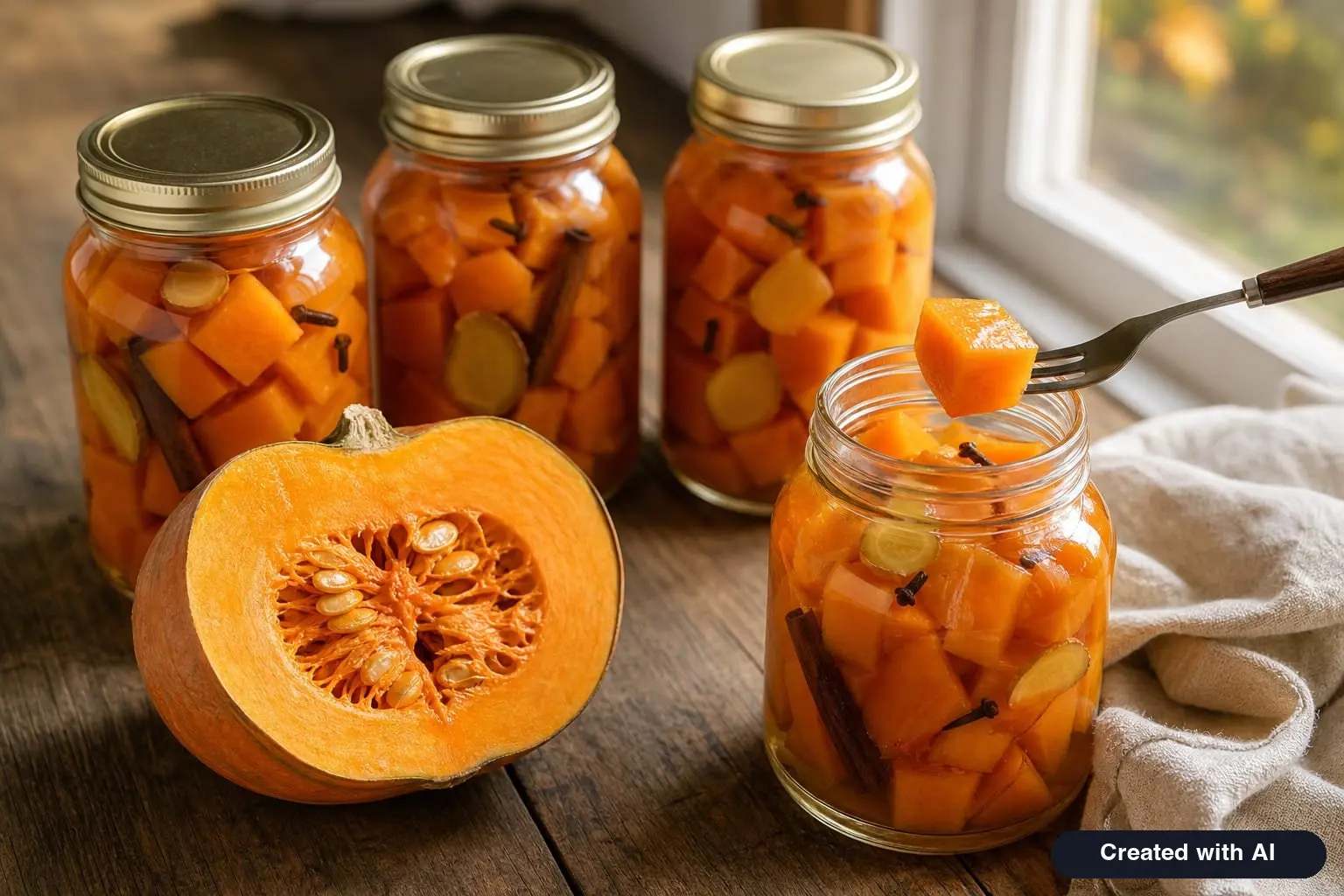
The main recipe on this page is sweet and sour pickled pumpkin with cloves, cinnamon, and ginger. The cubes remain firm, translucent, taste somewhat like canned pineapple, and pair well with meat, cheese, herring, or straight from the jar. From 2.2 lb (1 kg) of cleaned pumpkin, you get four 1-pint (0.5 l) jars, and it takes about an hour of work.
Before starting, it's important to know one thing: pumpkin is a low-acid vegetable (its pH is about 5–6). In such an environment, botulism-causing bacteria can multiply in a sealed jar, and boiling in a pot doesn't destroy them. That's why every recipe here meant to be stored in jars are acidified with vinegar, citric acid, or acidic juices. What cannot be reliably acidified at home (purée, porridge, soup, spread, thick salad with oil), we recommend freezing. Do not reduce the amounts of vinegar and acid in these recipes.
The pickled pumpkin recipe is in the card: you can recalculate the quantities for a larger harvest, check off what you've already added, and print it. Below the card, each step is explained in more detail, followed by other preservation methods with exact quantities.
Pickled Pumpkin for Winter
No ratings yet – be the firstIngredients
For the marinade
Directions
- Jars. Wash four 1-pint (0.5 l) jars and heat them in a 250°F (120°C) oven for 15 minutes, keep the lids in boiling water for 5 minutes.
- Pumpkin. Peel the pumpkin, scoop out the seeds and fibers, and cut the flesh into uniform 3/4-inch (2 cm) cubes.
- Marinade. In a wide pot, mix the water, vinegar, sugar, salt, cloves, cinnamon stick, and ginger. Bring to a boil and simmer for 3 minutes until the sugar dissolves.
- Parboiling. Add the cubes to the boiling marinade and simmer over low heat for 5–7 minutes, until the edges become translucent but the center remains firm.
- Filling. Using a slotted spoon, distribute the hot cubes into the jars. Bring the marinade to a boil again and pour it over the pumpkin so it is completely submerged, leaving a 1/2-inch (1 cm) headspace.
- Pasteurization. Cover the jars with lids (do not tighten), place them in a pot on a towel, pour warm water up to their shoulders, and hold for 15 minutes from a gentle simmer (about 195°F / 90°C).
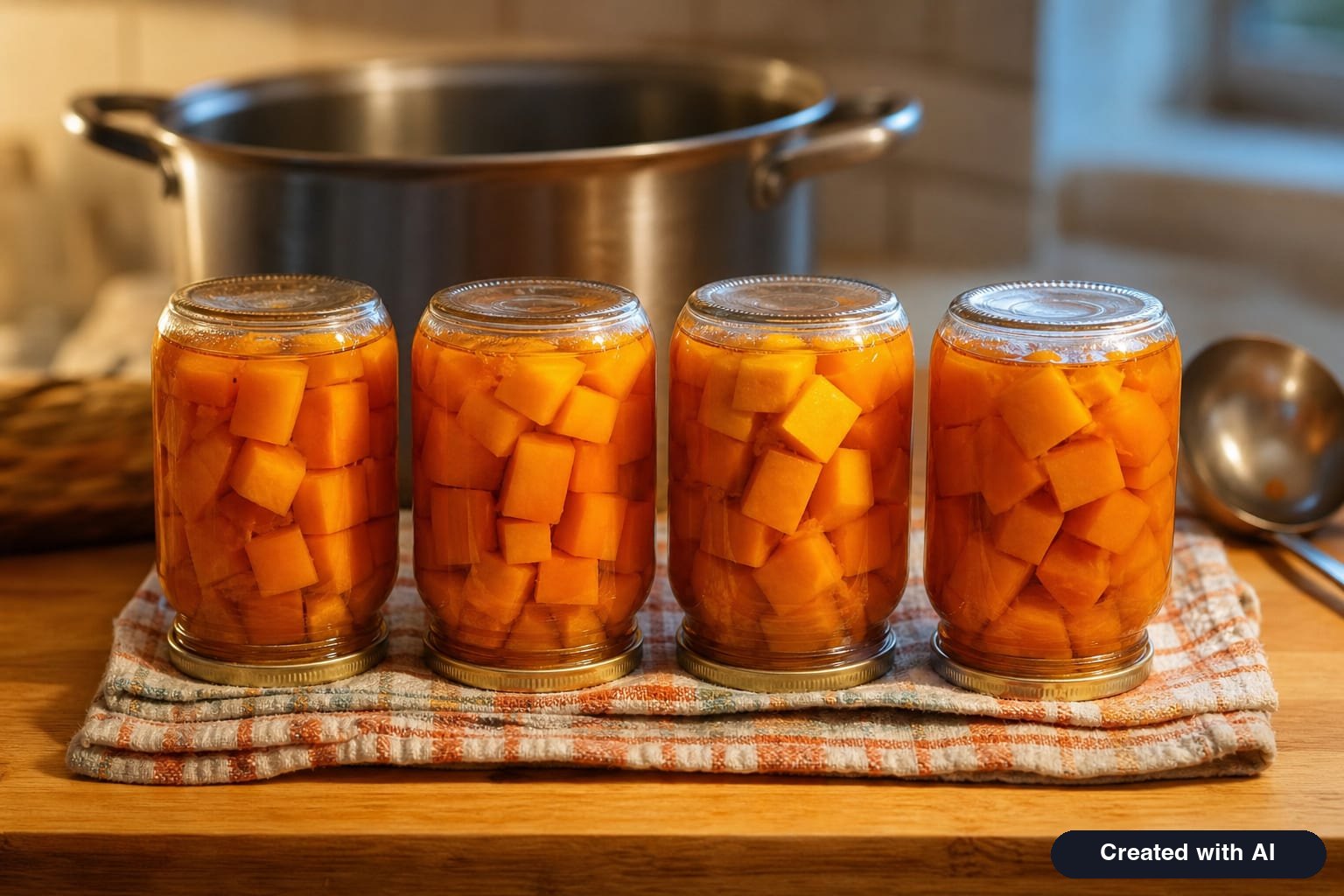
- Sealing. Tighten the lids, turn the jars upside down, and let them cool. Check if the center of the lids is concave, and store in a dark, cool place; taste after 2–3 weeks.
- Calories
- 105 kcal
- Protein
- 0.6 g
- Fat
- 0.1 g
- of which saturated
- 0 g
- Carbohydrates
- 26.1 g
- of which sugars
- 23.6 g
- Fiber
- 0.3 g
Calculated with the Firmus Medicus calorie database (USDA, Fineli).
Which method is right for you
| Method | What preserves the product | Where to store | How long it lasts |
|---|---|---|---|
| Whole, uncut pumpkin | Hard rind | Dry room, 50–59°F (10–15°C) | 2–6 months (depending on variety) |
| Pickled pumpkin | Vinegar, sugar, pasteurization | Basement, cool pantry | up to 12 months |
| Garlic pumpkin salad | Cold (not stored in jars in the pantry) | Freezer or fridge | up to 6 months in freezer, up to 2 weeks in fridge |
| Pumpkin juice with oranges | Citric acid, pasteurization | Basement, cool pantry | 6–8 months |
| Candied pumpkin | Sugar and drying | Airtight container at room temp | up to 6 months |
| Fermented pumpkin | Lactic acid, salt | Fridge | 2–3 months |
| Frozen pumpkin (cubes, grated, purée, porridge) | Cold, 0°F (−18°C) | Freezer | 10–12 months, purée – 6–8 months |
Ingredients and how to choose them
Pumpkin. For pickling, you need firm, dense flesh. Butternut and muscat pumpkins work best, as well as Hokkaido (Red Kuri) – their cubes don't fall apart when boiled. Large watery pumpkins also work, but cut them larger and boil them for a shorter time. Butternut squash is also convenient for winter preserves because its neck is solid flesh without seeds – it yields perfectly even cubes. For more on the differences between varieties, see the article on types of pumpkins and their benefits. You will get 2.2 lb (1 kg) of cleaned flesh from about 3 lb (1.4 kg) of pumpkin with rind and seeds.
Vinegar. The recipe is calculated for 9% white (spirit) vinegar. If you have 5–6% cider or wine vinegar (most US supermarket vinegar is 5%), use 2 cups (500 ml) of it and only 1 cup (250 ml) of water: the total amount of acid must stay the same. Vinegar isn't just for flavor here – it's what makes pickled pumpkin safe to store at room temperature.
Sugar. 1 3/4 cups (350 g) seems like a lot, but most of it stays in the marinade, which no one drinks. Sugar balances the vinegar's acidity and helps the cubes stay firm. You can reduce the amount to 1 1/4 cups (250 g) – it doesn't affect safety, but the taste will be more tart.
Spices. The classics are cloves, a cinnamon stick, and fresh ginger. Do not use ground spices: they make the marinade cloudy. If you want a savory, appetizer version, replace the cinnamon with a bay leaf, allspice, and mustard seeds.
Jars. The most convenient are 1-pint (0.5 l) jars with new twist-off lids. Wash the jars with baking soda and heat them in a 250°F (120°C) oven for 15 minutes or boil them for 10 minutes; keep the lids in boiling water for 5 minutes.
Pickled pumpkin step by step
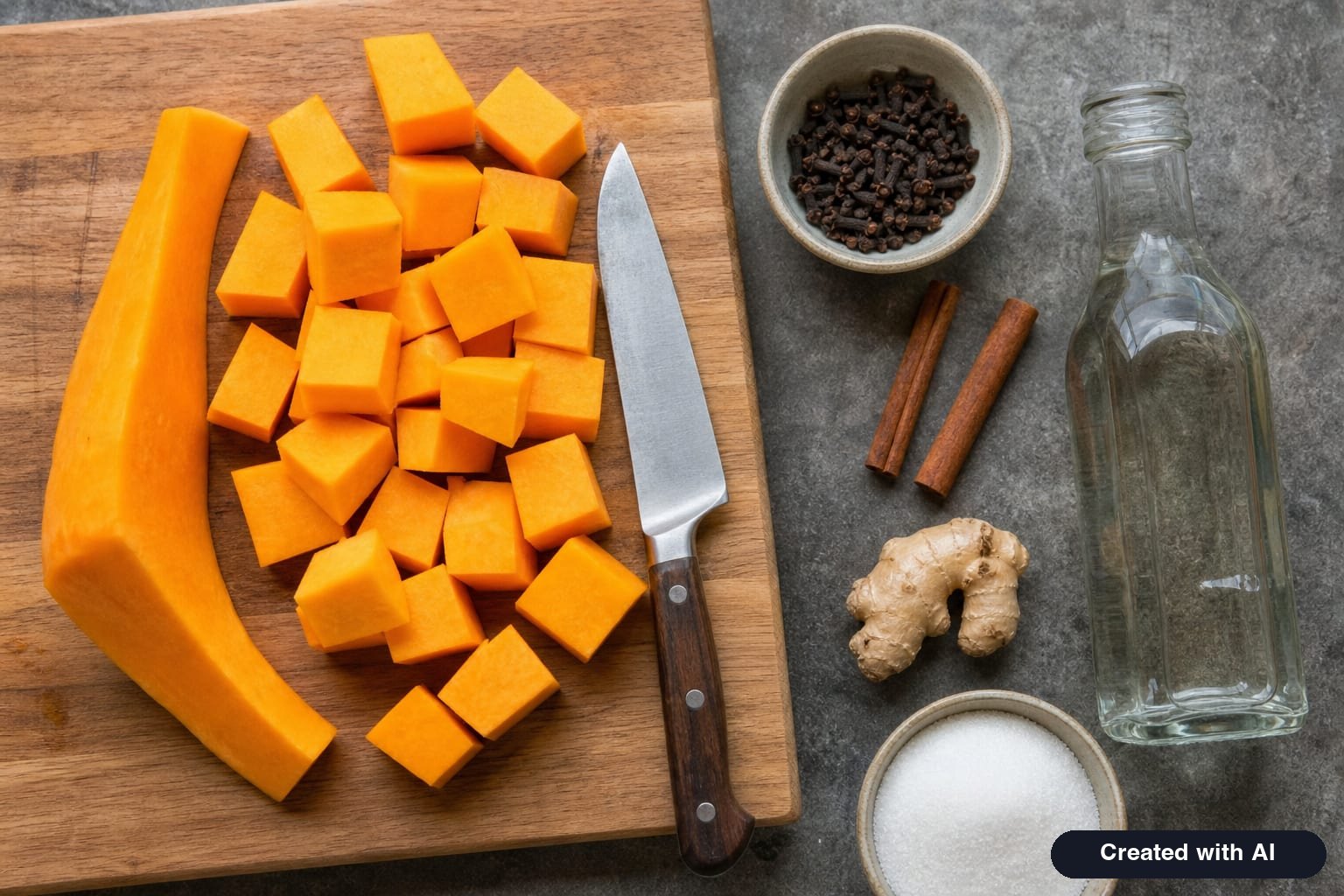
- Cut the pumpkin. Peel the rind, scoop out the seeds and fibers with a spoon, and cut the flesh into roughly 3/4-inch (2 cm) cubes. Uniform size is important: small cubes will turn to mush while large ones are still raw.
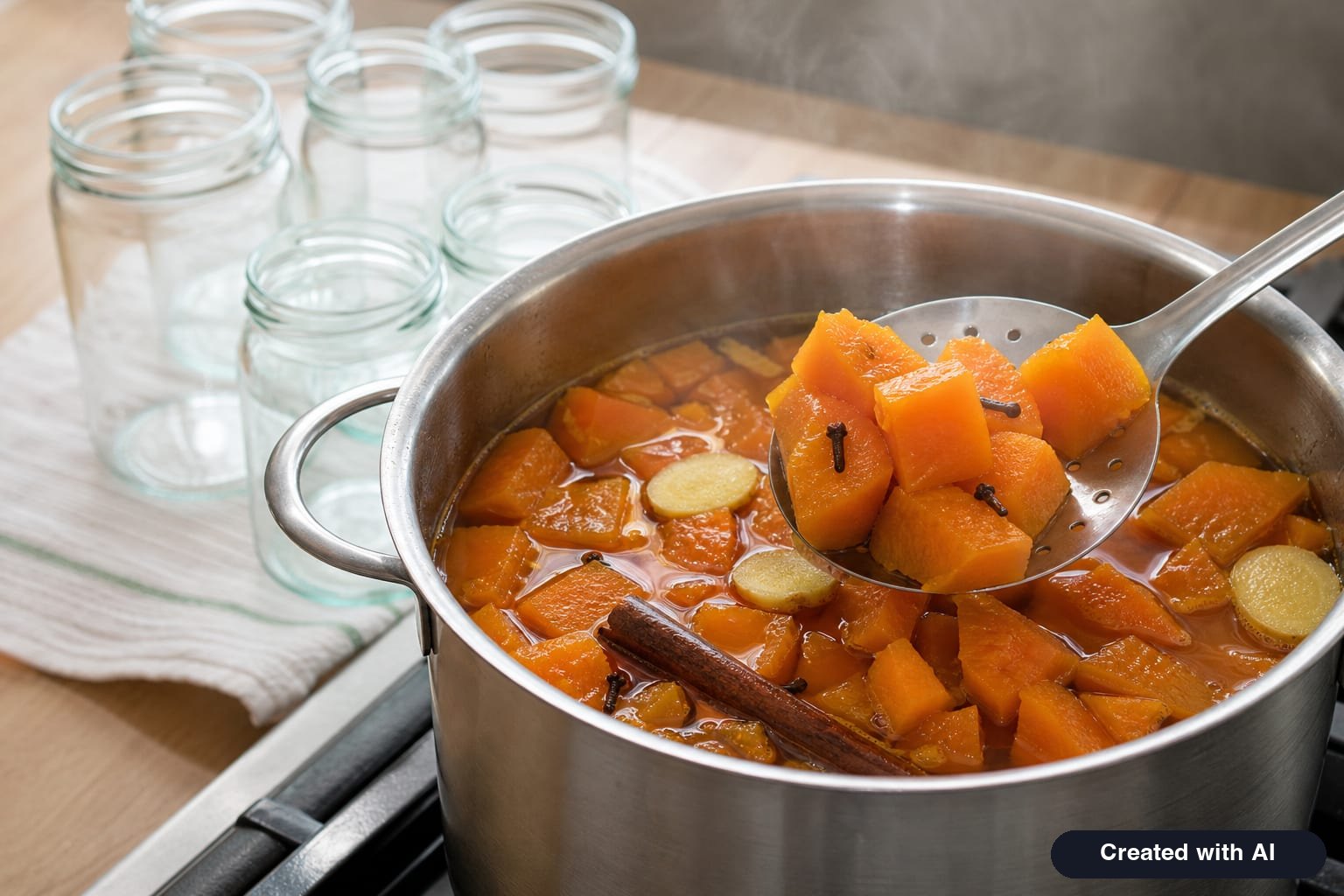
- Boil the marinade. In a wide pot, mix 1 3/4 cups (450 ml) of water, 1 1/4 cups (300 ml) of 9% vinegar, 1 3/4 cups (350 g) of sugar, a teaspoon of salt, cloves, a cinnamon stick, and ginger slices. Bring to a boil and simmer for 3 minutes until the sugar dissolves and the spices release their aroma.
- Parboil the cubes. Add the pumpkin to the boiling marinade and simmer over low heat for 5–7 minutes. The edges of the cubes should become translucent, while the center remains firm – a knife inserted should meet some resistance. Overcooked pumpkin will turn to mush in the jar because it will continue to soften during pasteurization.
- Pack into jars. Using a slotted spoon, distribute the hot cubes into the 4 prepared jars, adding a few cloves and a slice of ginger to each. Bring the marinade to a boil again and pour it over the pumpkin so it is completely submerged, leaving a 1/2-inch (1 cm) headspace. The cubes must be entirely under the liquid – anything sticking out will darken and spoil first.
- Pasteurize. Cover the jars with lids (do not tighten), place them in a pot on a towel, and pour warm water up to their "shoulders". Heat until the water starts to simmer gently (about 195°F / 90°C), and hold for 15 minutes from that point. Then tighten the lids, turn the jars upside down, and let them cool.
- Wait. Pickled pumpkin tastes best after 2–3 weeks, when the vinegar and spices have evenly penetrated to the center of the cubes.
Pasteurization time depends on jar size, because the heat has to reach the center.
| Jar | Pickled pumpkin, juice, chutney (185–195°F / 85–90°C) |
|---|---|
| 1/2 to 1 pint (0.3–0.5 l) | 15 min. |
| 1.5 pints (0.7–0.75 l) | 20 min. |
| 1 quart (1 l) | 25 min. |
Common mistakes
Reduced vinegar amount. The most common and dangerous mistake. In recipes where there are only a few tablespoons of vinegar per quart of water, the pumpkin remains too low in acid to be safely stored in the pantry. If you want a milder flavor, cook according to the same recipe with less vinegar, but store the jars exclusively in the refrigerator and consume within 3–4 weeks.
Cubes turned to mush. Boiled too long or the pumpkin was watery. Next time, boil for 4–5 minutes and cut into larger pieces.
Cloudy marinade. Ground spices or iodized salt were used, or the cubes were overcooked. This doesn't affect the taste, but if the marinade becomes cloudy during storage and the lid bulges – throw the jar away without tasting.
Lid didn't seal. Once the jar has cooled, the center of the lid should be concave and should not pop when pressed. If it pops, keep the jar in the fridge and eat it first.
Pickling variations
Pumpkin with pineapple juice for winter. This is the most popular "pumpkin like pineapple" variation. Pour 4 1/4 cups (1 l) of pineapple juice over 2.2 lb (1 kg) of pumpkin cubes, add 3/4 cup (150 g) of sugar and 1 teaspoon (5 g) of citric acid, and boil for 7–8 minutes. Pack the hot cubes into jars, pour the boiling juice over them, and pasteurize according to the table. Pineapple juice is acidic on its own, but don't skip the citric acid – it ensures there's enough acidity inside the pumpkin as well.
Pumpkin with bell pepper for winter. A savory variation: add 2–3 strips of red bell pepper, a garlic clove, a bay leaf, and 4 peppercorns to each jar. For the marinade, use the same amount of vinegar and water, but only 1/2 cup (100 g) of sugar and 1 tablespoon (20 g) of salt. It makes a crunchy snack to serve with meat and potatoes.
With orange or apple juice. Replace part of the water with juice (quantities are in the lighter version table below) and add a strip of orange peel. The amount of vinegar remains the same.
Pumpkin with jelly. Jellies and jams made with gelatin, pectin, or peach gelatin mix are a separate topic: you will find recipes in the article pumpkin jam, along with winter jam with oranges and lemons.
Garlic pumpkin salad
Garlic pumpkin salad is pumpkin cooked in tomato sauce with bell peppers and garlic, eaten cold with bread or heated as a side dish. Most importantly: we do not recommend sterilizing this salad and storing it in the pantry or basement. It is thick, contains oil, and pumpkins, carrots, peppers, and garlic are low-acid vegetables – it's impossible to check at home if the entire mass has become acidic enough, and the temperature of boiling water in a pot is not enough to destroy botulism spores. That's why pumpkin salad for winter goes into the freezer, and whatever you'll eat in the next few days goes into the fridge.
For about 3.5 quarts (3.5 l) of salad (about 7 pint/0.5 l containers) you need:
- 3.3 lb (1.5 kg) cleaned pumpkin, cut into 1/2-inch (1.5 cm) cubes;
- 2.2 lb (1 kg) ripe tomatoes (or 3 cups / 700 ml tomato purée);
- 14 oz (400 g) red bell peppers, 10.5 oz (300 g) onions, 10.5 oz (300 g) carrots;
- 1 large head of garlic (about 1.7 oz / 50 g of cloves);
- 1/3 cup (80 ml) oil, 1/4 cup (60 g) sugar, 1 1/2 tbsp (30 g) salt;
- 1/3 cup + 1 tbsp (100 ml) 9% vinegar, 1 teaspoon ground black pepper.
Blend the tomatoes, pour into a large pot, add the oil, sugar, and salt, and bring to a boil. Add the coarsely grated carrots and sliced onions, and boil for 10 minutes. Then add the pumpkin and peppers, and boil for another 20–25 minutes until the pumpkin softens but doesn't fall apart. 5 minutes before the end, pour in the vinegar and add the minced garlic and pepper – garlic added earlier loses its pungency. The vinegar here is for flavor, not for long-term storage.
How to store. Place the pot in a cold water bath and cool it down over 1–2 hours. Put what you will eat soon into clean jars and keep in the fridge for up to 2 weeks. Transfer the rest into freezer containers or bags in 10–18 oz (300–500 g) portions, leaving a 3/4-inch (2 cm) gap for expansion, and freeze – at 0°F (−18°C) the salad keeps for up to 6 months. Thaw overnight in the fridge; thawed salad is slightly softer, but the taste remains the same. Other pumpkin salads – with zucchini, eggplant, or beans – are prepared the same way: they are all frozen.
If you specifically want a jar that can be stored in the basement, choose pickled pumpkin with bell pepper and garlic instead of a salad (recipe above, in the pickling variations): in it, the vegetables float in an acidic marinade without oil, there is as much acid as in the main recipe, and the jars are pasteurized.
Pumpkin juice for winter
Pumpkin juice with oranges. This is juice with pulp, similar in thickness to nectar. For about 4.5 quarts (4.5 l) you need 4.4 lb (2 kg) of cleaned pumpkin, 8.5 cups (2 l) of water, 3 oranges, 1 1/2 cups (300 g) of sugar, and 1 tablespoon (15 g) of citric acid. Cut the pumpkin into chunks, cover with water, add a thinly peeled strip of zest from one orange, and boil for 20–25 minutes until completely soft. Remove the zest, blend the mass until smooth, pour in the squeezed orange juice, sugar, and citric acid, bring to a boil, and simmer for 5 minutes. Pour the boiling juice into hot jars or bottles and pasteurize according to the table. It keeps in a cool place for 6–8 months; shake before drinking, as the pulp settles.
Pumpkin and apple juice. If you have a juicer, extract 4 1/4 cups (1 l) of pumpkin juice and 4 1/4 cups (1 l) of tart apple juice, mix, add 1/2 cup (100 g) of sugar and 1 teaspoon (5 g) of citric acid, heat to 195°F (90°C) (do not boil – apple juice loses its flavor), pour into jars, and pasteurize. For apple-carrot-pumpkin juice, use 4 1/4 cups (1 l) of apple, 2 cups (0.5 l) of carrot, and 2 cups (0.5 l) of pumpkin juice with the same amount of acid. Carrots, like pumpkins, are low in acid, so do not can such juice without apples and citric acid.
Pumpkin juice to drink right away. Freshly squeezed juice is drunk on the same day: 1.1 lb (500 g) of pumpkin, 2 apples, and 1 carrot yield about 1 3/4 cups (400 ml). Keep it in the fridge for no longer than 24 hours.
Pumpkin juice: benefits. A glass of juice with pulp contains beta-carotene, which the body converts into vitamin A, potassium, and some fiber, with few calories if no sugar is added. People often ask what pumpkin juice cures – it cures nothing and doesn't replace medicine, it's simply a nutritious vegetable drink. If you have kidney disease or diabetes, consult your doctor due to the quantity and added sugar.
Purée, spread, porridge, and sauce
Pumpkin purée for winter. Do not can pure pumpkin purée in jars: it is too thick and too low in acid, and you cannot safely sterilize it at home. Freeze the purée – in 9–10 oz (250–300 g) portions in bags, pressed flat, it keeps for 6–8 months. How to boil or bake it is described in the article pumpkin porridge and purée. The same applies to pumpkin spread for winter with oil and garlic, and pumpkin soup for winter: cook without cream, cool, and freeze for up to 3 months.
Apple and pumpkin porridge for winter. Do not can apple and pumpkin porridge (purée) in jars either – freeze it. Apples are acidic, but pumpkin reduces the acidity, and exactly by how much depends on the apple variety and ratio, so the safety of the thick mass cannot be verified at home. Stew 2.2 lb (1 kg) of peeled apples and 1.1 lb (500 g) of pumpkin with 1/2 cup (100 ml) of water for 25 minutes until soft, blend, and stir in 1/4–1/2 cup (50–100 g) of sugar and a pinch of cinnamon to taste. Cool quickly, transfer to containers in 7–10 oz (200–300 g) portions, and freeze – it keeps for 6–8 months. Thawed in the fridge, the porridge is great with pancakes, cottage cheese, oatmeal, or for children – without sugar. The same rule applies to pure pumpkin porridge for winter.
Pumpkin sauce and relish for winter. A safe option is an acid-fortified chutney. Boil 2.2 lb (1 kg) of finely diced pumpkin, 10.5 oz (300 g) of tart apples, 7 oz (200 g) of onions, 1 1/4 cups (250 g) of sugar, 3/4 cup + 1 tbsp (200 ml) of 9% vinegar, 1 tablespoon (20 g) of grated ginger, 2 teaspoons (10 g) of salt, and a pinch of chili pepper uncovered for 45–50 minutes until the mass thickens. Pack hot into small jars and pasteurize for 15 minutes. It pairs well with roasts, cheese, and sandwiches.
Candied pumpkin
For candied pumpkin, you need 2.2 lb (1 kg) of firm pumpkin, 2 1/2 cups (500 g) of sugar, and the juice and zest of 1 lemon. Cut the pumpkin into 3/4-inch (2 cm) cubes, cover with sugar, and leave for 8–12 hours until the juices release. Then bring to a boil, simmer for 5 minutes, and let cool completely. Repeat the boiling and cooling 2 more times, adding the lemon juice and zest the last time. This step-by-step boiling allows the syrup to absorb gradually – the cubes become translucent and don't fall apart. Drain through a sieve (the syrup is great for tea and pancakes), spread on parchment paper, and dry in a 140°F (60°C) oven with the door slightly ajar for 3–4 hours, or for 2–3 days at room temperature. Finished candied pumpkin doesn't stick to your fingers; toss them in powdered sugar and store in an airtight jar for up to 6 months.
Fermented pumpkin
Fermented pumpkin is the only method without vinegar and without boiling: the product is acidified by lactic acid bacteria. For a 1-quart (1 l) jar, you need about 1.3 lb (600 g) of pumpkin cut into 1/2-inch (1 cm) thick strips, 3 garlic cloves, a dill umbel, a horseradish leaf or a piece of root, and brine: 2 cups (500 ml) of boiled, cooled water and 1 tablespoon (15 g) of non-iodized salt. Place the pumpkin and spices in the jar, pour the brine over them, weigh them down so everything is submerged, and cover with a loose lid. Keep at 64–72°F (18–22°C) for 4–6 days: the brine will become cloudy, bubbles will rise, and the smell will turn sour – this is normal. Then seal the jar and move it to the fridge, where fermented pumpkin keeps for 2–3 months. If colored mold appears on the surface or the smell is unpleasant – throw it away.
Frozen pumpkin
Freezing is the simplest and safest method. Peel the pumpkin, cut into 1-inch (2–3 cm) cubes, spread on a tray in a single layer, and freeze for 2–3 hours; only then transfer to bags in 14–18 oz (400–500 g) portions. This way, the cubes won't stick together in a clump. For pancakes, grate the pumpkin and freeze in 10 oz (300 g) portions. In the freezer (0°F / −18°C), cubes and grated pumpkin keep for 10–12 months.
Do not thaw frozen pumpkin: toss the cubes directly into the pot or baking sheet. Frozen pumpkin soup is cooked the same way as fresh, just 5 minutes shorter – the recipe is in the article pumpkin soup. Thawed pumpkin is softer, so it's not suitable for pickling or candying. Roasted pumpkin for winter is also frozen: cool the roasted pieces or their flesh and pack in portions; read how to roast it in roasted pumpkin.
Lighter version: less sugar
In pickled pumpkin, almost all the calories come from sugar, so only that can be lightened. The amount of vinegar remains 1 1/4 cups (300 ml) in all variations.
| Change | How | kcal / serving | Difference |
|---|---|---|---|
| Main recipe | as written above | 105 | – |
| Less sugar | 1 1/4 cups (250 g) of sugar instead of 1 3/4 cups (350 g) – more tart taste, same amount of vinegar | 81 | −24 |
| Part of sugar is honey | 1 cup (200 g) of sugar and 1/3 cup (100 g) of honey instead of 1 3/4 cups (350 g) of sugar | 88 | −17 |
| With apple juice | 1 3/4 cups (450 ml) of apple juice instead of water and 1 1/4 cups (250 g) of sugar | 94 | −11 |
| With orange juice | 3/4 cup (200 ml) of orange juice and 1 cup (250 ml) of water, 1 1/2 cups (300 g) of sugar | 99 | −6 |
| From butternut squash | 2.2 lb (1 kg) of butternut squash instead of regular pumpkin – firmer cubes, but more calories | 117 | +12 |
Calculated with the Firmus Medicus calorie database, with the recipe divided into 16 servings.
With 1 1/4 cups (250 g) of sugar, a serving has about 81 kcal instead of 105 kcal – this is the biggest saving, but the taste is noticeably more tart. Replacing part of the sugar with honey yields about 88 kcal, replacing water with apple juice and reducing the sugar – about 94 kcal, with orange juice – about 99 kcal. Butternut squash is inherently higher in calories than regular pumpkin, so a serving with it has about 117 kcal, but the cubes will be the firmest.
How many calories are in pickled pumpkin
Calculating the entire contents of the jars along with the marinade, one serving (about 4.7 oz / 133 g, one-sixteenth of the recipe) has about 105 kcal and about 24 g of sugar. Out of the 1,681 kcal of the whole recipe, 1,355 kcal comes from sugar, while the pumpkin itself is only 260 kcal. Since the marinade usually stays in the jar, eating the drained cubes means you consume less than this number indicates.
| Ingredient | Amount | kcal, whole recipe | Share |
|---|---|---|---|
| Granulated sugar | 350 g | 1355 | 81 % |
| Pumpkin, raw | 1000 g | 260 | 15 % |
| White vinegar, distilled | 300 g | 54 | 3 % |
| Ginger root | 15 g | 12 | 1 % |
| Water | 450 g | 0 | 0 % |
| Table salt | 5 g | 0 | 0 % |
| Total | 2120 g | 1681 | 105 kcal / serving |
Ingredient values – Firmus Medicus calorie database.
What to serve with and how to store
Pickled pumpkin pairs well with roast pork, duck, chicken, herring, aged cheese, in salads with beets or feta, and the sweet version – with cottage cheese and ice cream. Sealed jars keep in a dark, cool place for up to 12 months; keep opened jars in the fridge and consume within 2 weeks, using a clean fork to take the cubes.
Uncut pumpkin for winter is stored in a dry, ventilated room at 50–59°F (10–15°C), with the stem intact, not touching other fruits: muscat and butternut squashes last 4–6 months, Hokkaido – 2–4 months. A basement that is damp and colder than 46°F (8°C) is not suitable for pumpkins. Wrap cut pumpkin and keep it in the fridge for up to 5–7 days.
If you still have pumpkin left after canning, you can make pumpkin jam, bake a pumpkin cake or pumpkin pancakes, and you will find all pumpkin dishes for winter and autumn in one place in the pumpkin recipes overview.
Frequently asked questions
How do you preserve pumpkin for winter?
Firm pumpkin can be pickled in a sweet and sour marinade, juiced with oranges and citric acid, candied, fermented, or frozen in cubes. Only products acidified with vinegar or citric acid are stored in jars in the pantry, while purées, porridges, salads, and soups should be frozen.
How much vinegar is needed for pickled pumpkin?
For 2.2 lb (1 kg) of cleaned pumpkin, you need 1 1/4 cups (300 ml) of 9% vinegar, 1 3/4 cups (450 ml) of water, and 1 3/4 cups (350 g) of sugar. Do not reduce the vinegar—pumpkin is a low-acid vegetable, and vinegar allows the jars to be stored safely at room temperature.
How long should I pasteurize pickled pumpkin?
Keep 1-pint (0.5 l) jars in 185–195°F (85–90°C) water for 15 minutes, 1.5-pint (0.7 l) jars for 20 minutes, and 1-quart (1 l) jars for 25 minutes. Sealed jars keep in a cool, dark place for up to 12 months; once opened, keep in the fridge for 2 weeks.
How do you make pumpkin juice with oranges for canning?
Boil 4.4 lb (2 kg) of pumpkin in 8.5 cups (2 l) of water, blend, add the juice of 3 oranges, 1 1/2 cups (300 g) of sugar, and 1 tbsp (15 g) of citric acid. Boil for 5 minutes, pour hot into jars, and pasteurize for 15–25 minutes. Yields about 4.5 quarts (4.5 l) and keeps for 6–8 months in a cool place.
How do you store garlic pumpkin salad for winter?
Pumpkin salad with tomatoes, peppers, oil, and garlic is not stored in jars in the pantry—it is thick and low in acid. Cool the cooked salad quickly and freeze in 10–18 oz (300–500 g) portions for up to 6 months, or keep in the fridge for up to 2 weeks.
Can you can pumpkin purée or apple-pumpkin purée in jars?
No. Pumpkin purée and apple-pumpkin porridge are thick and too low in acid, so you cannot safely sterilize them at home. Freeze them in 7–10 oz (200–300 g) portions—they keep in the freezer for 6–8 months.
How do you freeze pumpkin?
Cut peeled pumpkin into 1-inch (2–3 cm) cubes, freeze on a tray in a single layer for 2–3 hours, and transfer to bags in 14–18 oz (400–500 g) portions. Frozen at 0°F (−18°C), pumpkin keeps for 10–12 months; do not thaw before cooking.
How many calories are in pickled pumpkin?
Including the marinade, a 4.7 oz (133 g) serving has about 105 kcal, almost all from sugar. With 1 1/4 cups (250 g) of sugar instead of 1 3/4 cups (350 g), it has about 81 kcal; eating only the drained cubes reduces the calorie intake even further.
Log in to comment
No comments yet. Be the first.