Pumpkin Porridge: Recipe with Rice & Homemade Pumpkin Purée
- Rice is first boiled in water with pumpkin—the porridge doesn't burn and cooks in 30 minutes.
- Table: porridge with rice, semolina, millet, rolled oats, and potatoes.
- Pumpkin purée three ways: yield from 2.2 lb (1 kg), how to freeze it, and what to make with it.
- Ingredients and How to Choose Them
- How to Cook Pumpkin Porridge Step by Step
- Common Mistakes When Cooking Pumpkin Porridge
- Pumpkin Porridge Recipes with Other Grains and Add-ins
- Pumpkin Purée: Recipe and Making It at Home
- Lighter Version
- How Many Calories Are in Pumpkin Porridge
- What to Serve With and How to Store
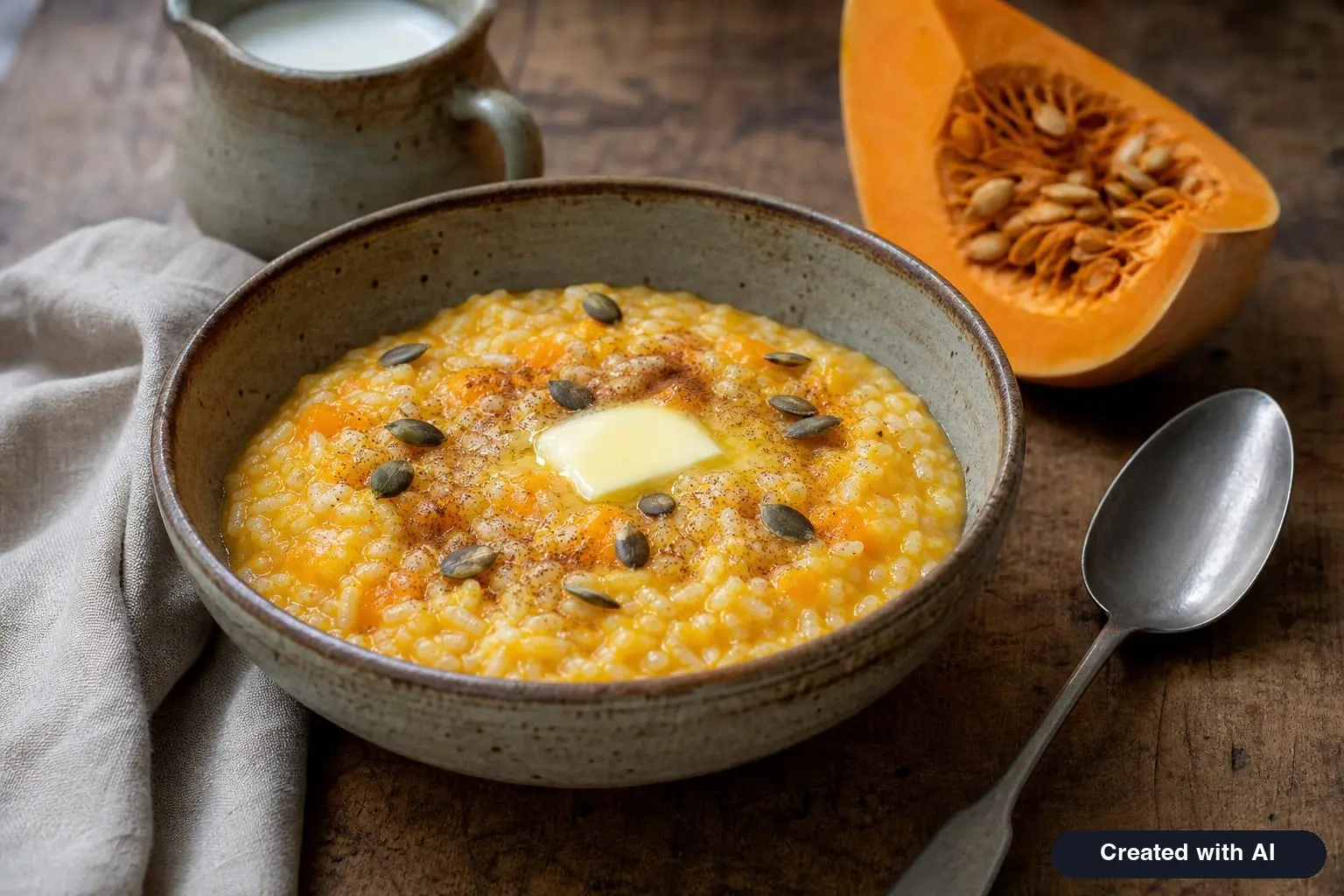
Pumpkin porridge is one of the simplest fall dishes: pumpkin, a handful of grains, milk, and a pat of butter. In the pot, the pumpkin cooks down and almost melts, making the porridge bright yellow, mildly sweet, and creamy even with very little sugar. It is usually cooked with rice—which is the main recipe here.
This version is different because the grains are first boiled in water with the pumpkin, and only then is the milk added. This way, the rice softens faster, the milk doesn't burn, and the porridge is done in half an hour. No separate purée is needed: the pumpkin cubes break down on their own, you just have to stir them.
The porridge is perfect for breakfast, a light dinner, and for kids—it is naturally sweet, soft, and filling. This recipe makes 4 large servings (about 12–14 oz / 350–400 g each), with about 330 calories per serving. In this same article, you will also find the other half of the topic—pumpkin purée: how to make it, how much yields from 2.2 lb (1 kg) of pumpkin, how to store and freeze it, and what to make with it.
The recipe is in the card below: you can recalculate quantities for a different number of servings, check off what you've already added, and print it. Below the card, each step is explained in more detail, followed by variations with semolina, millet, rolled oats, and potatoes.
Pumpkin Porridge with Rice
No ratings yet – be the firstIngredients
Directions
- Pumpkin. Halve the pumpkin, scoop out the seeds, peel, and cut into roughly 1/2-inch (1.5 cm) cubes. Rinse the rice once.
- Boiling in water. In a heavy-bottomed pot, bring the water to a boil with salt, add the pumpkin and rice. Once boiling, reduce the heat, cover, and simmer for 10 minutes.
- Milk. Pour in the warmed milk, add the sugar, stir, and let it come to a boil. Reduce the heat to the lowest setting.
- Simmering on low heat. Cook for 15–20 minutes, partially covered, stirring from the bottom every 3–4 minutes, until the rice is completely soft and the pumpkin cubes break down. For a smoother porridge, mash the cubes with a potato masher.
- Butter and resting. Remove from the heat, stir in the butter, taste, and sweeten if necessary. Cover and let sit for 10 minutes to allow the porridge to thicken. Serve warm, sprinkled with cinnamon.
- Calories
- 332 kcal
- Protein
- 8.3 g
- Fat
- 10.7 g
- of which saturated
- 6.3 g
- Carbohydrates
- 52.2 g
- of which sugars
- 16.9 g
- Fiber
- 1.2 g
Calculated with the Firmus Medicus calorie database (USDA, Fineli).
Ingredients and How to Choose Them
Pumpkin. The best pumpkins for porridge are sweet, dense-fleshed varieties: butternut, muscat (cheese pumpkin), or red kuri squash. Butternut squash porridge is the sweetest and smoothest because its flesh has almost no strings. Red kuri gives the brightest color and a slight chestnut flavor. Large yellow carving pumpkins also work, but they are more watery and bland—use 1/4–1/2 cup (50–100 ml) less water and you might need an extra tablespoon of sugar. The differences between varieties are detailed in the article on types of pumpkins. You will get 1.3 lb (600 g) of flesh from about 1.7–1.9 lb (800–850 g) of unpeeled pumpkin.
Rice. Choose short-grain rice—it releases a lot of starch, making the porridge thick and creamy without any thickeners. Long-grain or parboiled rice stays separate, and the dish will resemble rice with pumpkin pieces rather than porridge. Rinsing the rice once is enough: if you wash away all the starch, the porridge will be thinner.
Milk and water. Water is needed at the beginning—rice and pumpkin soften faster in it than in milk. Milk adds creaminess and richness; whole milk (3.25%) is great. Lower-fat milk will also work, but the porridge won't be as filling. Add warmed milk so the boiling doesn't stop.
Butter, sugar, salt. Butter is added at the end—this keeps its flavor and aroma prominent. You only need a little sugar because the pumpkin itself provides sweetness; taste first and then sweeten. A pinch of salt is mandatory even in sweet porridge: without it, the flavor falls flat. Cinnamon is optional.
How to Cook Pumpkin Porridge Step by Step
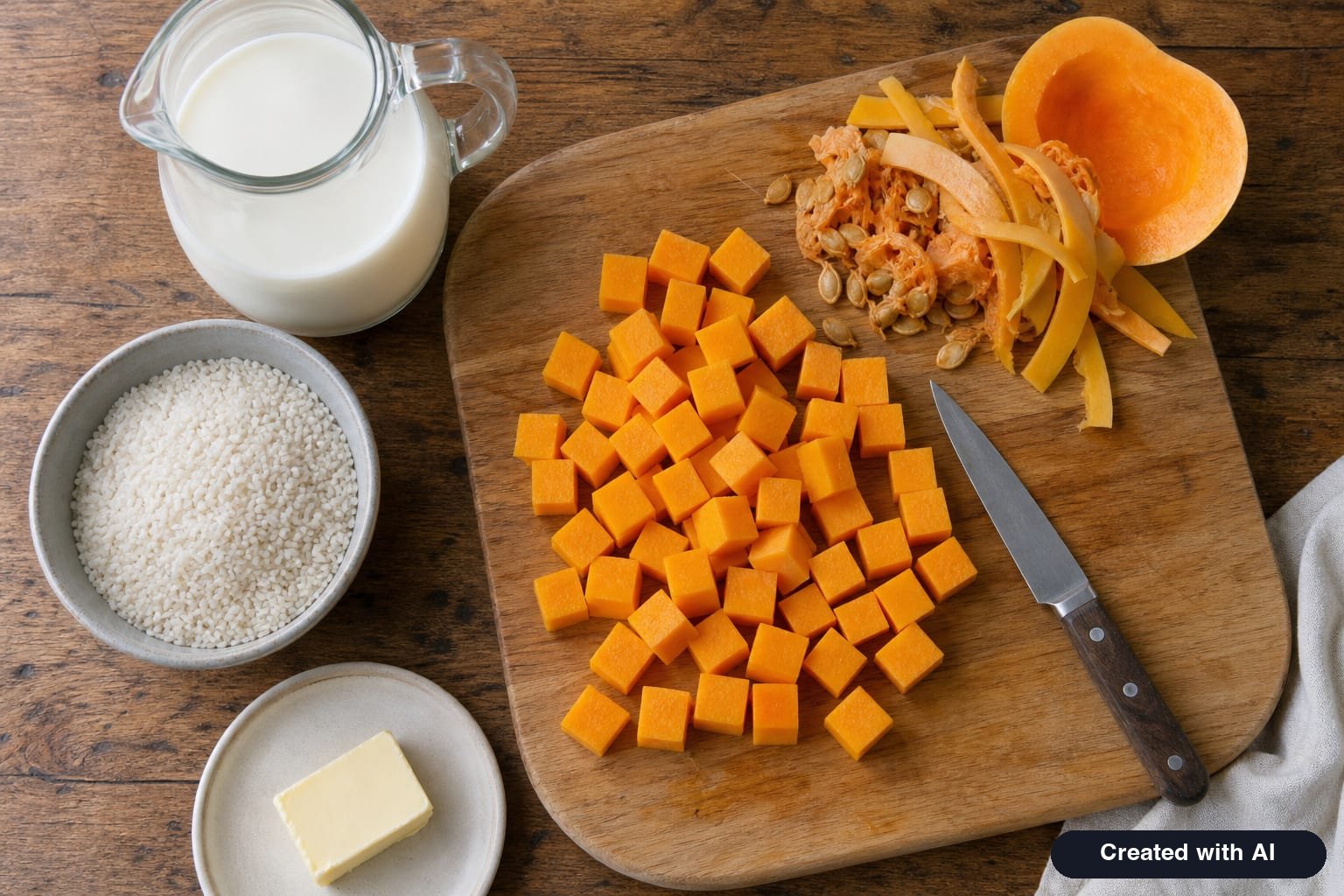
1. Prepare the pumpkin. Halve the pumpkin, scoop out the seeds and strings with a spoon, peel the skin, and cut into roughly 1/2-inch (1.5 cm) cubes. Size matters: cubes this size soften in 10 minutes and later break apart just from stirring. Large chunks would take longer to cook than the rice, leaving hard lumps in the porridge. Red kuri squash doesn't need to be peeled—the skin cooks down, though the porridge will be slightly more textured.
2. Boil the pumpkin and rice in water. In a heavy-bottomed pot, bring 1 1/4 cups (300 ml) of water to a boil, add salt, the pumpkin, and the rinsed rice. Once it returns to a boil, reduce the heat, cover, and simmer for 10 minutes. During this time, the rice will absorb almost all the water, and the pumpkin will release its juices. A heavy bottom is not a minor detail here: milk porridge burns in minutes in a thin-bottomed pot.
3. Add the milk. Warm the milk separately or in the microwave and pour it into the pot along with the sugar. Stir, let it come to a boil, and immediately reduce the heat to the lowest setting. Cold milk would stop the boiling process, and the surface of the rice would harden—so it's worth taking a minute to warm it up.
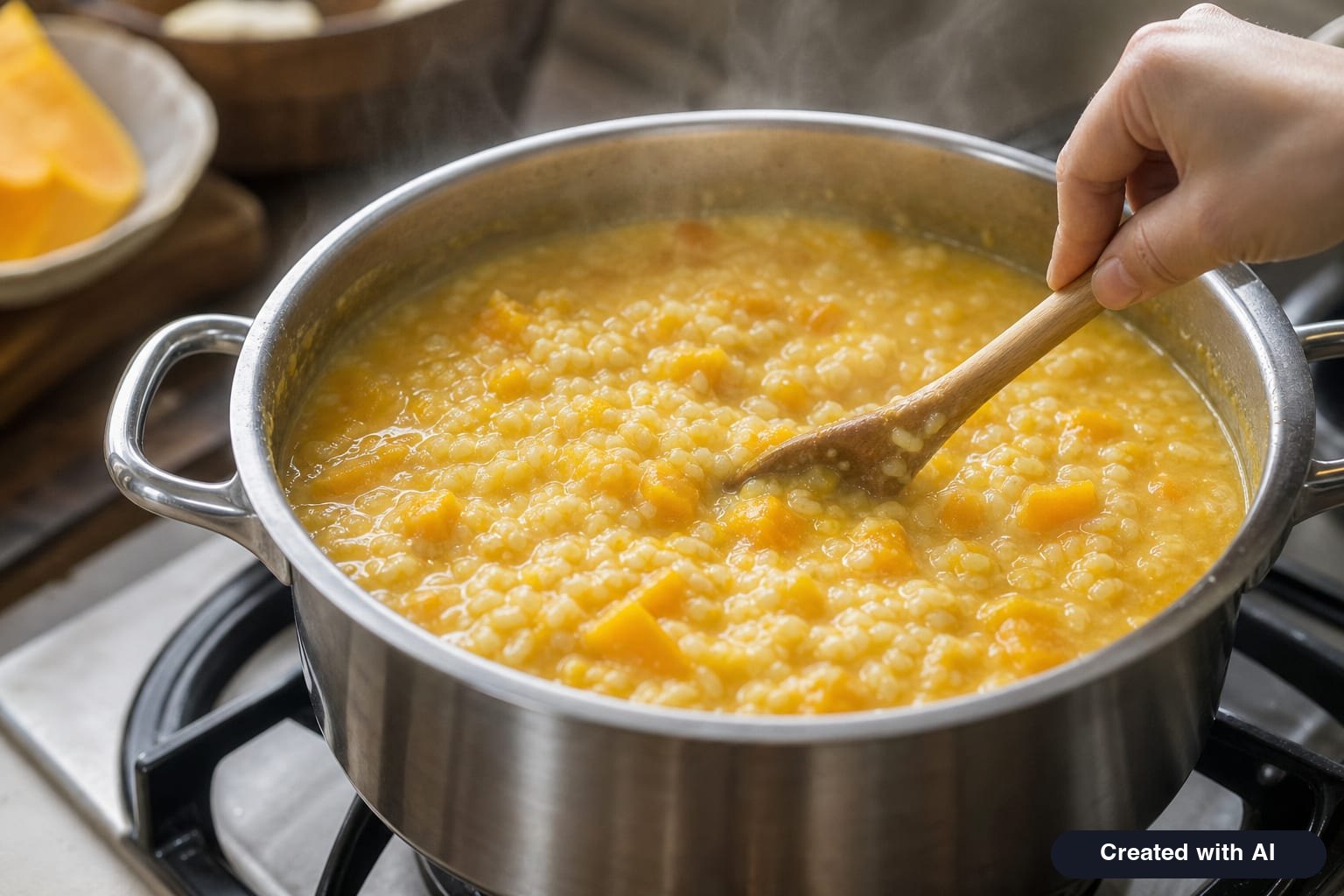
4. Simmer on low heat. Cook for 15–20 minutes, partially covered, stirring from the very bottom with a wooden spoon every 3–4 minutes. As you stir, the soft pumpkin cubes rub against the sides of the pot and turn into a purée. If you prefer a completely smooth porridge, mash the cubes a few times with a potato masher around the 12-minute mark. The porridge is done when the rice is completely soft and a spoon dragged across the bottom leaves a visible trail for a moment.
5. Stir in the butter and let it rest. Remove the pot from the heat, stir in the butter, taste, and sweeten if necessary. Cover and let sit for 10 minutes. This is not a formality: the rice continues to absorb liquid, so freshly cooked porridge should look slightly thinner than you'd want to eat. If the rested porridge is too thick, stir in a few tablespoons of hot milk.
Common Mistakes When Cooking Pumpkin Porridge
The porridge burned. The heat was too high or the pot's bottom was too thin. After adding the milk, cook on the lowest heat and stir from the bottom. If it burns—do not scrape the burnt layer; instead, transfer the porridge to another pot.
The porridge is watery. Usually, a watery carving pumpkin or too short a cooking time is to blame. Simmer for another 5 minutes uncovered and let it rest—porridge always thickens as it sits.
The rice is hard, even though the liquid is gone. The rice was covered with milk right away or cooked without a lid. Add 1/2 cup (100 ml) of hot water, cover, and simmer for another 5–7 minutes.
The porridge is bland. It lacks salt, not sugar. A pinch of salt and a few drops of lemon or orange juice enhance the pumpkin's sweetness better than an extra tablespoon of sugar.
The pumpkin chunks remained hard. They were cut too large or the pumpkin was added together with the milk. Next time, cut them smaller and start with water.
Pumpkin Porridge Recipes with Other Grains and Add-ins
The basic principle is the same everywhere: the pumpkin is cooked until soft, and the grains are chosen based on the texture you want and how much time you have. The table shows amounts for 1.3 lb (600 g) of pumpkin flesh (for 4 servings).
| Porridge with pumpkin | Amount of grains | Liquid | Cooking time | Note |
|---|---|---|---|---|
| With rice | 3/4 cup (150 g) short-grain | 1 1/4 cups (300 ml) water + 2 cups (500 ml) milk | 25–30 min. | Main recipe |
| With millet | 3/4 cup (150 g) | 1 1/4 cups (300 ml) water + 2 cups (500 ml) milk | 25–30 min. | Scald the millet with boiling water to remove bitterness |
| With semolina | 1/2 cup (80 g) | 3/4 cup (200 ml) water + 2 cups (500 ml) milk | 15 min. for pumpkin + 5–7 min. for semolina | Pour semolina in a thin stream while stirring |
| With rolled oats | 1 1/3 cups (120 g) | 3/4 cup (200 ml) water + 1 2/3 cups (400 ml) milk | 15 min. for pumpkin + 5–10 min. for oats | The fastest option for breakfast |
| With potatoes (savory) | 1.1 lb (500 g) potatoes, no grains | water for boiling + 2/3 cup (150 ml) milk | 20 min. | Side dish, use 1.1 lb (500 g) pumpkin |
Pumpkin porridge with rice. This is the classic described above. If you want the pumpkin and rice porridge to be even creamier, stir it constantly for the last 5 minutes, like risotto.
Pumpkin porridge with semolina. The softest and smoothest, which is why kids love it. Boil the pumpkin cubes in 3/4 cup (200 ml) of water for 15 minutes, mash with a masher or blender, add the milk, and bring to a boil. Then, pouring in a thin stream and whisking constantly, add 1/2 cup (80 g) of semolina and cook for 5–7 minutes. Only add semolina to a smooth purée: it will clump up among pumpkin chunks.
Pumpkin porridge with millet. Millet adds a nutty flavor and a fluffy, grainy texture. Before cooking, rinse the grains and pour boiling water over them for a minute—this removes the bitterness that older millet sometimes has. Continue cooking just like the rice porridge.
Pumpkin porridge with rolled oats. It's most convenient when you have prepared pumpkin purée: stir 3/4–1 cup (200–250 g) of purée into regular oatmeal (1 1/3 cups / 120 g oats, 2 1/2 cups / 600 ml liquid) near the end of cooking and heat for 2 minutes. If using raw pumpkin—first boil the cubes for 15 minutes, mash them, and only then add the oats.
Pumpkin porridge with potatoes. This is a savory side dish for roasts, patties, or fish. Cut 1.1 lb (500 g) of potatoes and 1.1 lb (500 g) of pumpkin into similar-sized pieces, but add the pumpkin 5–7 minutes later—it cooks faster. Boil in salted water until the potatoes are tender, drain very well, dry in the pot on the stove for 1–2 minutes, and mash with 2 tbsp (30 g) of butter and 2/3 cup (150 ml) of hot milk. Pumpkin and potato mash is light orange and lighter than regular mashed potatoes; it makes 4 servings at about 205 calories each. Nutmeg, black pepper, and roasted garlic go well with it.
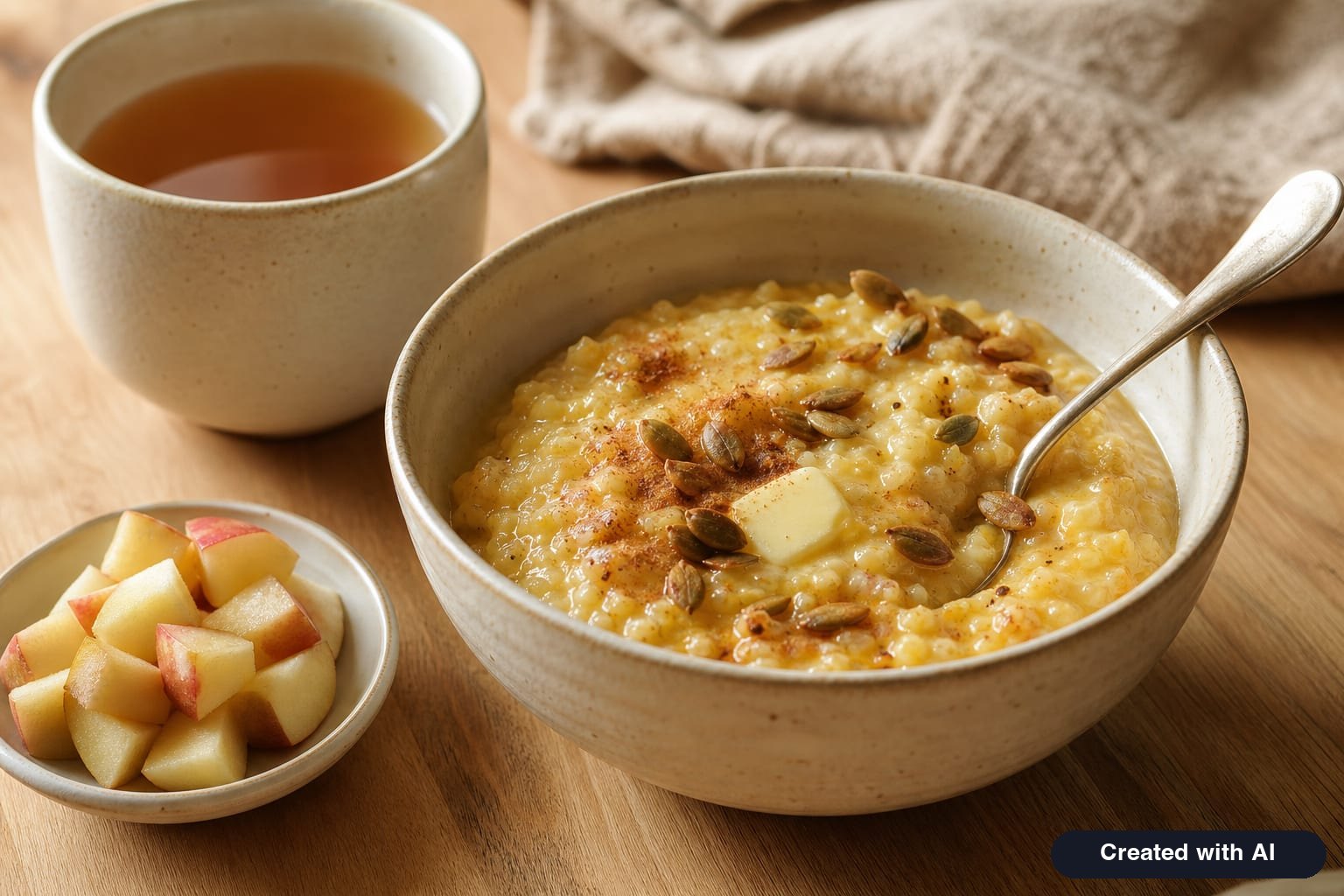
Sweet pumpkin porridge with apples. 10 minutes before the end of cooking, stir 1–2 diced apples and a pinch of cinnamon into the porridge. Tart baking apples such as Granny Smith balance the pumpkin's sweetness, so you might not need any sugar at all. Raisins, dried apricots, or a spoonful of honey right before serving are also great additions.
With oranges. Grate the zest of half an orange and squeeze in 2–3 tablespoons of juice into the almost-cooked porridge. Only add acid at the very end: juice added too early can curdle the milk.
With carrots. Replace a third of the pumpkin with finely grated carrots—the porridge will be sweeter and darker. Add the carrots at the very beginning with the pumpkin, as they take longer to cook.
Dairy-free. Milk can be replaced with water or a plant-based beverage; with coconut milk, the porridge takes on a dessert-like flavor. You can find this combination in a soup in the pumpkin coconut soup recipe.
Pumpkin Porridge for Breakfast and for Kids
For breakfast, it's convenient to cook the porridge the night before: it thickens overnight in the fridge, so in the morning you just need to add a splash of milk and heat it up. For kids, cook a milder porridge—with less sugar, no strong spices, and blend the pumpkin until completely smooth, as some children dislike chunks. The sweetness from the pumpkin itself, an apple, or a banana is enough. It's more fun to eat when there's something to "decorate" the top with: berries, crushed nuts, or a spoonful of yogurt.
Pumpkin Purée: Recipe and Making It at Home
Pumpkin purée is simply softened and smoothly blended pumpkin flesh with no additives. It is a base ingredient: used to bake pies, pancakes, and muffins, or to make soups and porridges. You can make pumpkin purée in three ways, and they yield different results.
| Method | How | Time | Purée from 2.2 lb (1 kg) unpeeled pumpkin | Best for |
|---|---|---|---|---|
| In the oven | Halves cut-side down, 375°F (190°C) | 40–60 min. | about 1.2–1.3 lb (550–600 g) | Baked goods – thickest and sweetest |
| Steamed | Cubes in a steamer | 15–20 min. | about 1.4–1.5 lb (650–700 g) | Porridges, baby food |
| Boiled in water | Cubes in a small amount of water | 12–15 min. | about 1.5 lb (700 g) | Soups, porridges |
How to make pumpkin purée in the oven. Halve the pumpkin, scoop out the seeds, and place the halves cut-side down on a baking sheet lined with parchment paper. Bake at 375°F (190°C) for 40–60 minutes—until a knife slides into the thickest part without resistance. Let it cool slightly, scoop out the flesh with a spoon, and blend it. During baking, some water evaporates and the sugars caramelize, making this purée thick and rich in flavor. You don't need to peel the raw pumpkin—that's the biggest convenience of this method.
Steamed or boiled. Cut the peeled pumpkin into 1-inch (2–3 cm) cubes. Steam for 15–20 minutes, or boil in water for 12–15 minutes, adding only enough water to barely cover the bottom (about 1/2 cup / 100–150 ml per 2.2 lb / 1 kg). Drain the cooked pumpkin, let it sit in a sieve for 10–15 minutes to drip dry, and only then blend it.
If the purée is too thin. Watery purée ruins baking batters, so it's worth thickening it: pour it into a wide skillet and heat for 5–10 minutes while stirring, until the trail left by the spatula no longer fills in. Good purée holds its shape on a spoon.
How much it yields. From 2.2 lb (1 kg) of unpeeled pumpkin, you get about 1.5–1.6 lb (700–750 g) of flesh, and 1.2 to 1.5 lb (550 to 700 g) of purée, depending on the method. Most baking recipes call for 3/4–1 cup (200–250 g), so 2.2 lb (1 kg) of pumpkin covers about three recipes. The purée itself is very light: pumpkin flesh has about 26 calories per 3.5 oz (100 g).
How to Store and Freeze Pumpkin Purée
In the fridge, purée keeps in an airtight container for 3–4 days. For longer storage, use the freezer, where it retains its qualities for up to 6 months. It's most convenient to freeze it in 3/4–1 cup (200–250 g) portions in zip-top bags: squeeze out the air and flatten the bag—this way it takes up little space and thaws in half an hour. For small portions, use ice cube trays: transfer the frozen cubes to a bag. Write the date and weight on the bag.
Thaw in the fridge overnight. Thawed purée releases a little water—pour it off for baked goods, but just stir it back in for soups and porridges. You shouldn't refreeze it. If you want to can the purée in jars, check out the pickled pumpkin guide section—it covers winter purée, juice, and other preserves.
Pumpkin for a Baby: General Recommendations
Pumpkin is often among the first vegetables babies taste: it has a mild flavor and is easily mashed. However, when to start solid foods and with which products is decided individually, in consultation with your pediatrician; this section is purely culinary, not medical information.
A few simple rules apply in the kitchen. Prepare purée for a baby using only pumpkin and water—no salt, sugar, or spices; honey is not given to babies under one year old. Steam or bake the pumpkin: baked pumpkin in the oven for babies is prepared as described above, just without oil and salt, and the flesh is blended until completely smooth and, if necessary, thinned with boiled water. Pumpkin porridge for babies is cooked with grains the child already eats, in water or with the milk or formula they already receive, stirring in 1–2 tablespoons of purée. Introduce a new product gradually and observe how the child accepts it. Keep fresh purée in the fridge for no longer than 1–2 days, and freeze the rest in cubes.
Recipes with Pumpkin Purée: What to Make with It
Having purée in the freezer makes most pumpkin dishes several times faster to prepare:
- pumpkin cake – a moist cake or an American pumpkin pie requires exactly this thick, oven-baked purée;
- pumpkin pancakes – use 3/4 cup (200 g) of purée instead of grated pumpkin, and the batter is ready in 5 minutes;
- pumpkin muffins, pumpkin bread, and cookies;
- quick pumpkin soup – 2 cups (500 g) of purée, 1 2/3 cups (400 ml) of broth, and a splash of heavy cream come to a boil in 10 minutes;
- porridge – 3/4–1 cup (200–250 g) of purée stirred into oatmeal, semolina, or rice porridge;
- pasta sauce – purée, garlic, a splash of heavy cream, and grated hard cheese.
Lighter Version
Pumpkin porridge is not a heavy dish, but the serving is large, and the calories mostly come from the rice, milk, and butter—not the pumpkin. Here is how much the most common adjustments change per serving:
| Change | How | kcal / serving | Difference |
|---|---|---|---|
| Main recipe | as written above | 332 | – |
| Sugar-free | omit sugar—the sweetness from butternut or muscat squash is enough | 308 | −24 |
| Honey instead of sugar | 1 tbsp (20 g) honey, stirred in before serving, instead of 2 tbsp (25 g) sugar | 323 | −9 |
| Lower-fat milk | 1% milk instead of whole milk | 308 | −24 |
| Half milk, half water | 1 cup (250 ml) milk and 2 1/4 cups (550 ml) water instead of 2 cups (500 ml) milk and 1 1/4 cups (300 ml) water | 293 | −39 |
| Less butter | 2 tsp (10 g) butter instead of 2 tbsp (30 g) | 297 | −35 |
| More pumpkin, less rice | 1.8 lb (800 g) pumpkin and 1/2 cup (100 g) rice instead of 1.3 lb (600 g) and 3/4 cup (150 g) | 300 | −32 |
Calculated with the Firmus Medicus calorie database, with the recipe divided into 4 servings.
The most—about 40 calories per serving—is saved by replacing half the milk with water; similarly (about 36 calories) comes from reducing the butter from 2 tbsp (30 g) to 2 tsp (10 g). A third less rice and more pumpkin cuts another 33 calories, and the serving size even increases. Skipping the sugar or choosing 1% milk lightens the serving by about 24 calories each. Honey instead of sugar barely changes the numbers (about 9 calories less)—it's a matter of taste, not calories. Combining several changes—1.8 lb (800 g) pumpkin, 1/2 cup (100 g) rice, 1% milk, 2 tsp (10 g) butter, and no sugar—brings a serving to about 215 calories instead of 330.
How Many Calories Are in Pumpkin Porridge
One serving according to the main recipe has about 330 calories, 8 g of protein, 11 g of fat, and 52 g of carbohydrates. The pumpkin, although it makes up the bulk of the porridge, only contributes about 40 calories per serving; about 137 calories comes from the rice, about 79 calories from the milk, and about 54 calories from the butter. Below is the exact contribution of each ingredient.
| Ingredient | Amount | kcal, whole recipe | Share |
|---|---|---|---|
| White rice, dry | 150 g | 548 | 41 % |
| Whole milk (3.25% fat) | 515 g | 314 | 24 % |
| Butter | 30 g | 215 | 16 % |
| Pumpkin, raw | 600 g | 156 | 12 % |
| Granulated sugar | 25 g | 97 | 7 % |
| Water | 300 g | 0 | 0 % |
| Table salt | 2 g | 0 | 0 % |
| Total | 1622 g | 1330 | 332 kcal / serving |
Ingredient values – Firmus Medicus calorie database.
What to Serve With and How to Store
Serve sweet porridge warm, with a pat of butter, cinnamon, honey, baked apples, or jam—pumpkin jam with oranges pairs especially well. Toasted pumpkin seeds or walnuts add crunch. Serve savory porridge with potatoes alongside meat, fish, or stewed vegetables.
Cooked porridge keeps in the fridge in an airtight container for 2–3 days. Reheat in a pot on low heat or in the microwave, adding 2–3 tablespoons of milk or water per serving—cooled porridge firms up. It can be frozen for up to 2 months, but thawed rice tends to be mushier, so it's better to freeze the purée and cook fresh porridge in a few minutes.
If you have leftover pumpkin after making porridge, you can use it to make pumpkin soup, bake pumpkin pancakes, or make roasted pumpkin in the oven—it works as both a side dish and a base for purée. More ideas on what to make with pumpkin are gathered in the pumpkin recipes overview.
Frequently asked questions
How do you cook pumpkin porridge?
Boil 1.3 lb (600 g) cubed pumpkin and 3/4 cup (150 g) short-grain rice in 1 1/4 cups (300 ml) water for 10 minutes. Add 2 cups (500 ml) hot milk and simmer on low for 15–20 minutes, stirring occasionally. Stir in 2 tbsp (30 g) butter and let sit covered for 10 minutes.
How do you make pumpkin purée?
Halve the pumpkin, scoop out seeds, and bake cut-side down at 375°F (190°C) for 40–60 minutes. Scoop out the flesh and blend. For a faster method, steam cubes for 15–20 minutes or boil in a little water for 12–15 minutes, drain, and blend.
How much pumpkin purée do you get from 2.2 lb (1 kg) of pumpkin?
From 2.2 lb (1 kg) of unpeeled pumpkin, you get about 1.5–1.6 lb (700–750 g) of flesh. Baked purée yields about 1.2–1.3 lb (550–600 g), while steamed or boiled yields about 1.4–1.5 lb (650–700 g).
How do you store and freeze pumpkin purée?
It keeps in an airtight container in the fridge for 3–4 days, or in the freezer for up to 6 months. Freeze in 3/4–1 cup (200–250 g) portions in flattened zip-top bags or ice cube trays. Thaw in the fridge overnight.
How do you make pumpkin porridge with potatoes?
Boil 1.1 lb (500 g) potatoes and 1.1 lb (500 g) pumpkin in salted water for about 20 minutes, adding the pumpkin 5–7 minutes later. Drain well and mash with 2 tbsp (30 g) butter and 2/3 cup (150 ml) hot milk to make 4 servings at about 205 calories each.
How do you make pumpkin porridge with semolina?
Boil pumpkin cubes in 3/4 cup (200 ml) water for 15 minutes and mash. Add 2 cups (500 ml) milk and bring to a boil. Gradually whisk in 1/2 cup (80 g) semolina and cook for 5–7 minutes.
How many calories are in pumpkin porridge?
One large serving with rice, milk, and butter has about 330 calories. Without sugar, it's about 310 calories, and with more pumpkin, low-fat milk, and less butter, it drops to about 215 calories.
What can you make with pumpkin purée?
Use it for pumpkin pies, pancakes, muffins, and cookies. You can also make a quick blended soup in 10 minutes or stir it into oatmeal or semolina porridge. Most baked goods require 3/4–1 cup (200–250 g) of purée.
Log in to comment
No comments yet. Be the first.