Pumpkin Cake: A Moist and Fluffy Grated Pumpkin Recipe
- Raw grated pumpkin—no purée or mixer needed
- Baking times for six pan sizes and 12 variations with calories
- Farmer cheese, chocolate, apple, flourless, sugar-free, and classic pumpkin pie
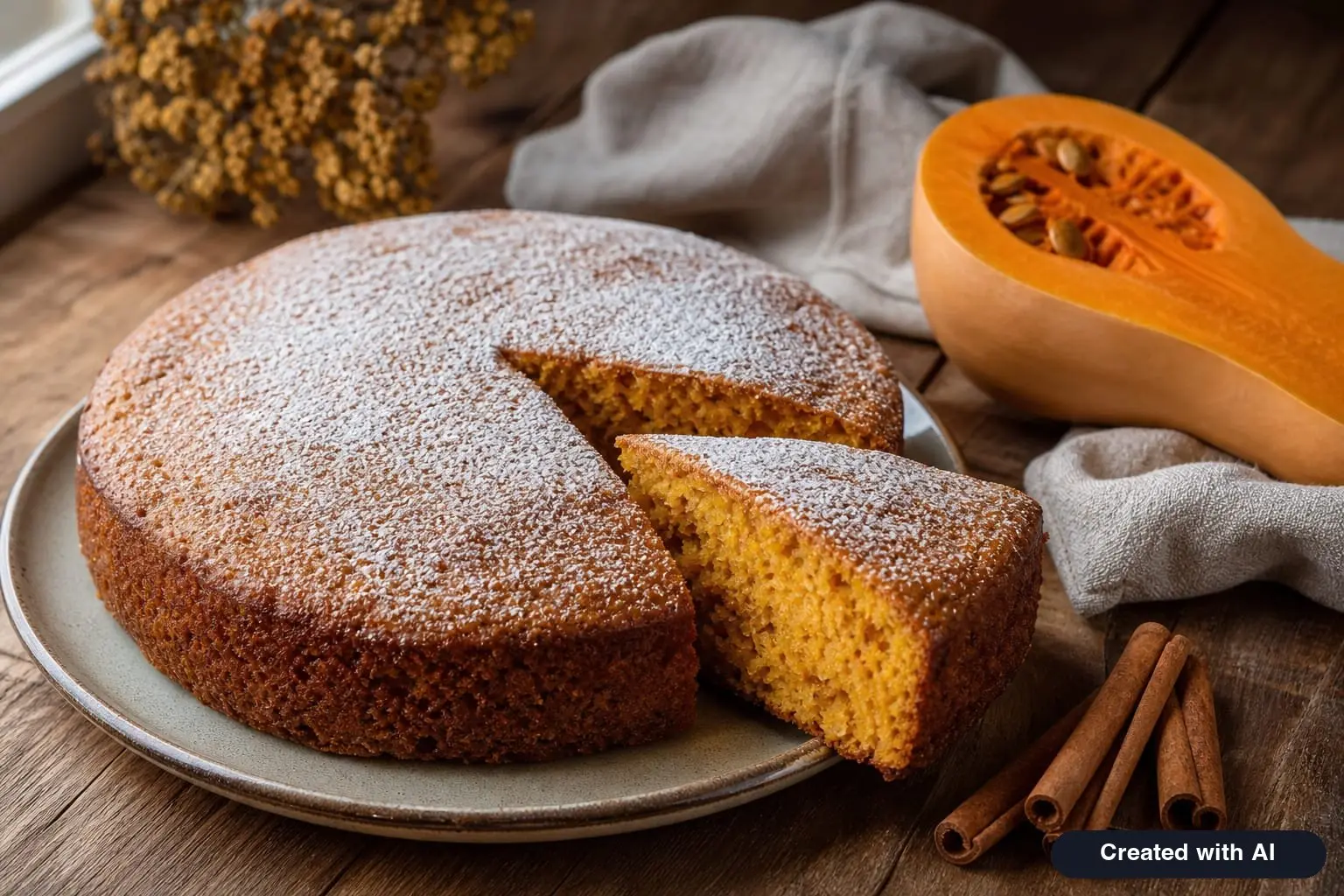
Pumpkin cake is a fall bake made almost exactly like carrot cake: raw pumpkin is grated and folded into a simple oil-based batter. As it bakes, it releases moisture, resulting in a cake that is moist, soft, and bright orange, while the pumpkin flavor remains mild—it's mostly driven by cinnamon, ginger, and orange zest. Most people who taste it never guess there's a vegetable inside.
This recipe gives you a moist yet fluffy pumpkin cake that requires neither a mixer nor pre-cooked purée. Everything is mixed in one bowl in 20 minutes, and the oven does the rest. There is no butter: oil doesn't solidify at room temperature, so the cake stays soft even on the third day. It's a simple and quick pumpkin cake, perfect even for those who rarely bake.
This recipe makes a 9-inch (24 cm) cake—12 slices of about 3.4 oz (95 g) each. It's great with coffee, in a kid's lunchbox, or for guests, and if layered with frosting, it turns into a festive pumpkin layer cake. Below you'll also find other pumpkin cakes: with farmer cheese, chocolate, apple, flourless, sugar-free, egg-free, and an American-style pumpkin pie with condensed milk.
The full recipe is in the card: you can adjust the quantities for a different pan size or number of slices, check off what you've already added, and print it. After the card, each step is explained in more detail.
Moist Pumpkin Cake
No ratings yet – be the firstIngredients
Directions
- Preparation. Preheat the oven to 350°F (180°C), or 325–340°F (165–170°C) for convection. Line the bottom of a 9-inch (24 cm) pan with parchment paper and grease the sides with oil.
- Pumpkin. Peel the pumpkin, scoop out the seeds, and grate on a fine or medium grater. If the mixture is very wet, gently squeeze it, but not completely dry.
- Eggs and sugar. Whisk the eggs with the sugar and salt for 2–3 minutes until the mixture lightens and becomes frothy. Pour in the oil in a thin stream, mix well, and grate in the orange zest.
- Dry ingredients. Mix the flour with the baking powder, cinnamon, ginger, and nutmeg. Sift into the egg mixture and fold with a spatula just until no dry flour remains.
- Folding in the pumpkin. Add the grated pumpkin and fold it in with a few strokes. The batter should be thick, falling slowly from the spatula; if it's runny, fold in 1–2 tablespoons of flour.
- Baking. Pour the batter into the pan, smooth the top, and bake on the middle rack for 50–55 minutes, until a toothpick inserted into the center comes out dry. Do not open the oven for the first 35 minutes.
- Cooling. Leave the cake in the pan for 15–20 minutes, then remove and cool on a wire rack. Once cooled, dust with powdered sugar.
- Calories
- 258 kcal
- Protein
- 4.5 g
- Fat
- 10.6 g
- of which saturated
- 1.4 g
- Carbohydrates
- 36.7 g
- of which sugars
- 16 g
- Fiber
- 1.1 g
Calculated with the Firmus Medicus calorie database (USDA, Fineli).
Ingredients and How to Choose Them
Pumpkin. Dense, sweet-fleshed pumpkins work best for this cake—such as butternut squash, Hokkaido, or muscat. Their flesh is drier, so the batter doesn't get too thin, and the color is rich. Large yellow field pumpkins also work, but they are more watery: grab handfuls of the grated flesh and gently squeeze it over the sink. You will get 14 oz (400 g) of grated pumpkin from about a 1.2–1.3 lb (550–600 g) piece with skin and seeds. The differences between varieties and their best uses are covered in the article on types of pumpkins.
Oil. Use a neutral-tasting sunflower or canola oil. A pumpkin cake made with oil is moister than one made with butter because oil is pure fat without water and doesn't harden as it cools. If you want a buttery flavor, you can replace half the oil with 4 tablespoons (60 g) of melted butter.
Sugar. 3/4 cup plus 2 tablespoons (180 g) makes a moderately sweet cake. It's worth replacing a portion (about a third) with brown sugar: it adds a caramel note and retains moisture. Don't use less than 1/2 cup plus 2 tablespoons (120 g) unless you're replacing the sugar with bananas or honey—more on that in the variations section.
Eggs should be at room temperature—they whip up better and blend more evenly with the oil. Three large eggs weigh about 5.3 oz (150 g) without the shell.
Flour and baking powder. Regular all-purpose flour works perfectly. You need 2 teaspoons (about 10 g) of baking powder: the batter with grated vegetables is heavy, and a smaller amount won't lift it.
Pumpkin cake spices. Pumpkin itself has a mild aroma, so spices are important here. The base is 2 teaspoons of cinnamon; it pairs well with 1/2 teaspoon of ground ginger, a pinch of nutmeg, and, if you like, a pinch of ground cloves or cardamom. Orange zest adds freshness. You can also use a prepared pumpkin pie spice blend—2 teaspoons instead of all the individual spices.
How to Bake Pumpkin Cake Step by Step
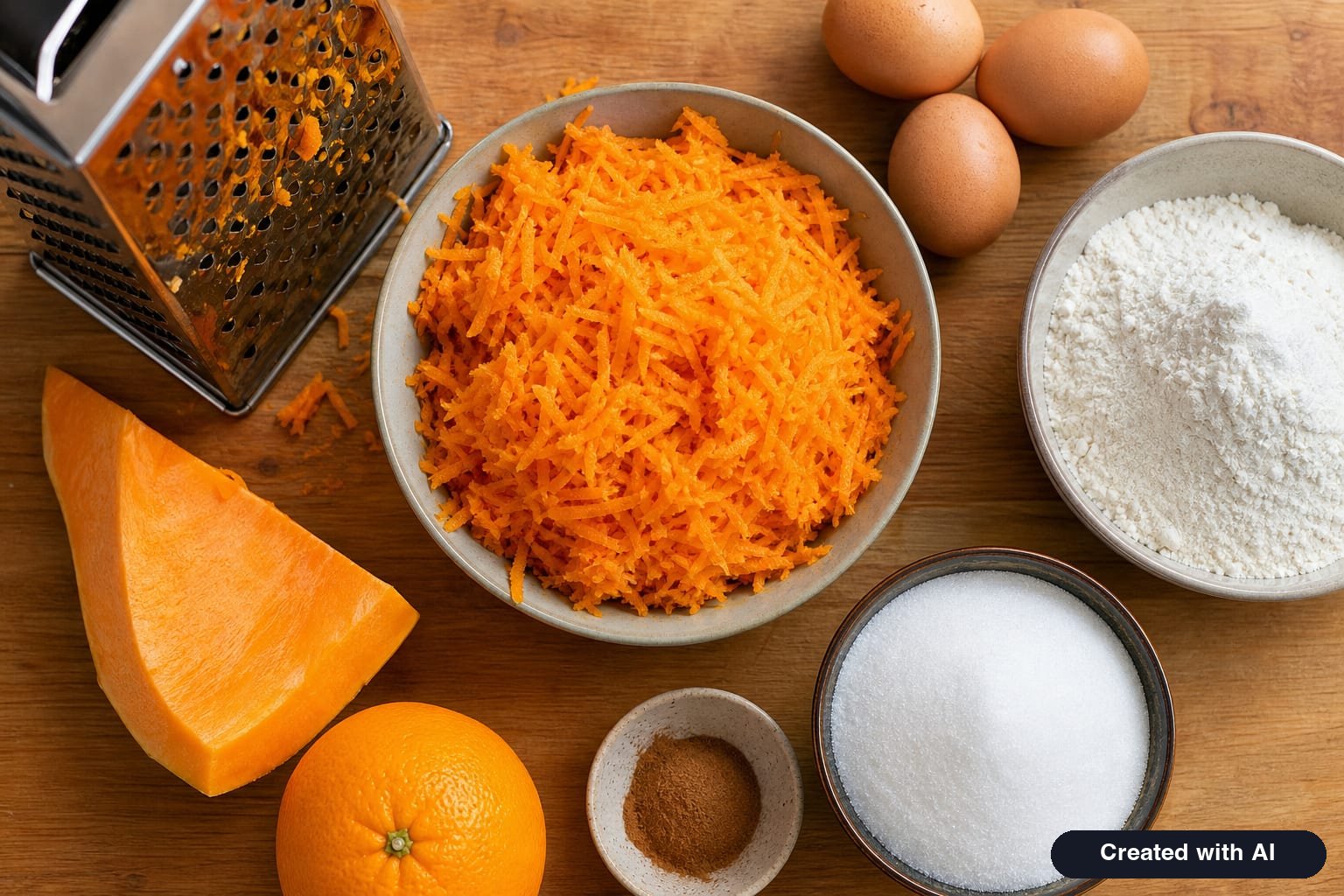
1. Preparation. Preheat the oven to 350°F (180°C), or 325–340°F (165–170°C) for convection. Line the bottom of a 9-inch (24 cm) pan with parchment paper and grease the sides with oil. Batter with baking powder needs to be baked immediately, so the oven and pan must be ready before the batter.
2. Pumpkin. Peel the skin, scoop out the seeds, and grate the flesh on a fine or medium grater. Finely grated pumpkin completely softens during baking and blends into the batter, while large shreds remain noticeable and slightly crunchy. If the mixture is wet and dripping with juice, gently squeeze it. You don't need to squeeze it completely dry—this juice is exactly what makes the cake moist.
3. Eggs and sugar. In a large bowl, whisk the eggs with the sugar and a pinch of salt for 2–3 minutes until the mixture lightens and becomes frothy. This is the only point where air gets into the batter, so don't cut this step short: if not whipped properly, the cake will be denser. Then pour in the oil in a thin stream, mix well, and grate in the orange zest.
4. Dry ingredients. Mix the flour with the baking powder and spices, sift into the egg mixture, and fold with a spatula just until no dry flour remains. Overmixing develops the gluten network in the flour, resulting in a rubbery cake rather than a fluffy one.
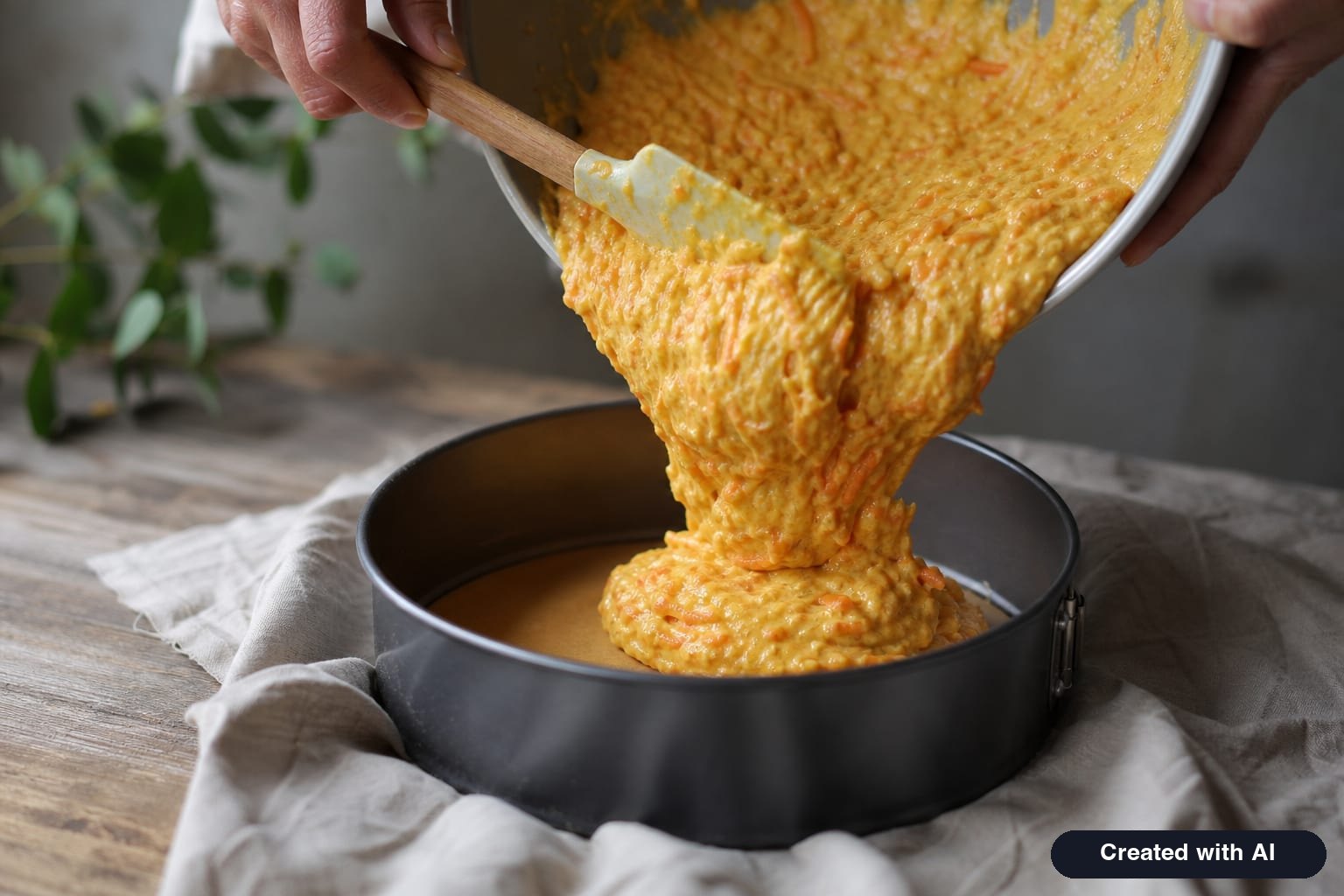
5. Folding in the pumpkin. Add the grated pumpkin and fold it in with a few strokes. The batter should be thick and fall slowly from the spatula. If it runs like pancake batter, the pumpkin was too watery—fold in 1–2 more tablespoons of flour.
6. Baking. Pour the batter into the pan, smooth the top, and bake on the middle rack of the oven for 50–55 minutes. Do not open the oven for the first 35 minutes—the cold air will cause the unset center to sink. The cake is done when the top is evenly browned, the edges have slightly pulled away from the pan, and a wooden toothpick inserted into the center comes out dry or with a few moist crumbs. If the top browns too quickly, cover it with foil after 35–40 minutes.
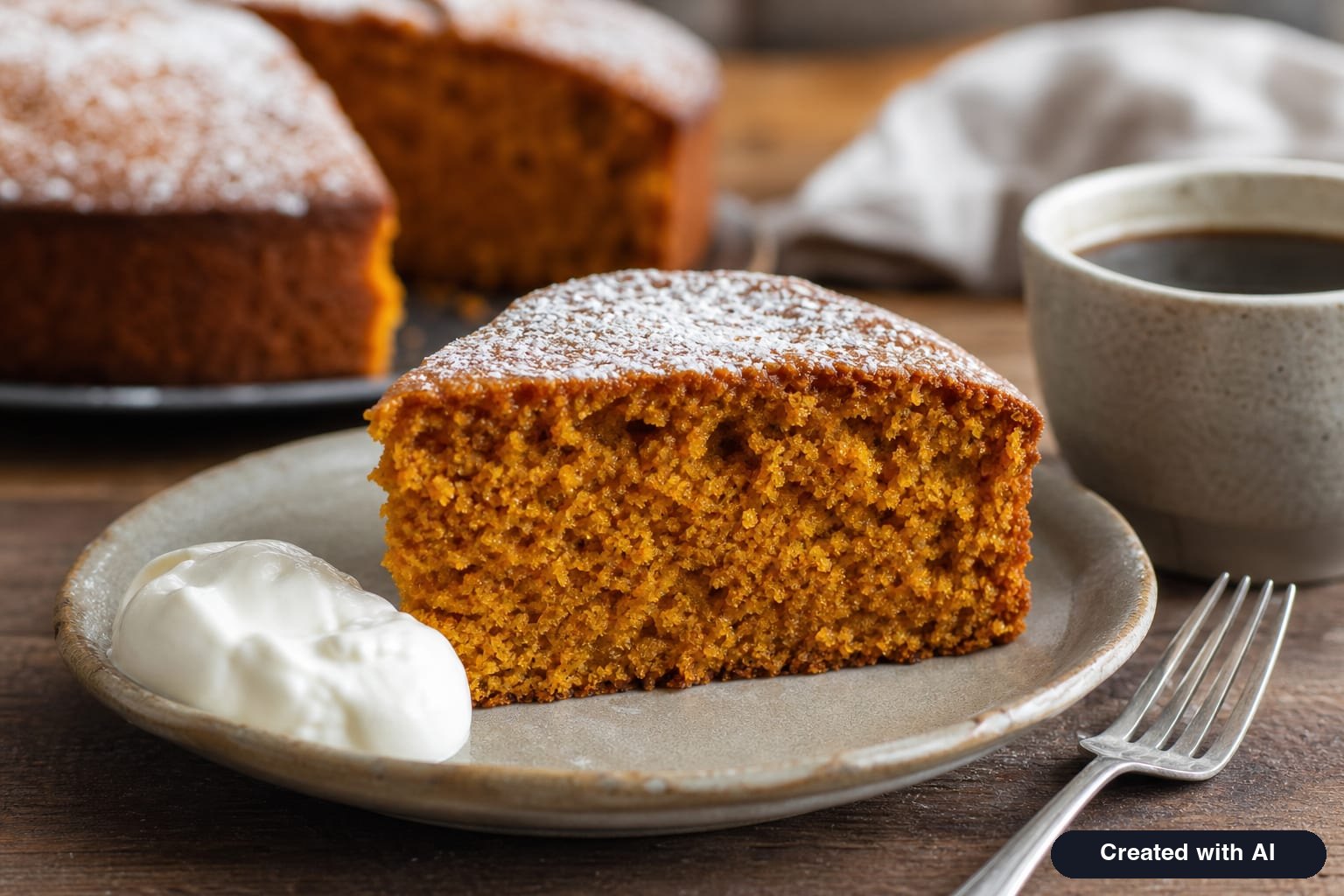
7. Cooling. Leave the cake in the pan for 15–20 minutes, then remove it and cool on a wire rack. When hot, it may seem underbaked and stick to the knife because the moisture hasn't distributed yet. Once completely cool, dust with powdered sugar or glaze it. This cake is even better the next day—the spices open up, and the crumb moistens evenly.
Baking Time by Pan Size
The same amount of batter works for several pan sizes—only the layer thickness and baking time change. All are baked at 350°F (180°C).
| Pan Size | Baking Time | Notes |
|---|---|---|
| 9-inch (24 cm) round | 50–55 min. | Main version, 12 slices |
| 10-inch (26 cm) round | 40–45 min. | Shorter cake, easy to layer with frosting |
| 4x12-inch (11x30 cm) loaf pan | 60–70 min. | Cover with foil after 40 min. |
| 8x12-inch (20x30 cm) rectangular | 35–40 min. | Cut into squares, about 15 pieces |
| 12x16-inch (30x40 cm) sheet pan (double batch) | 40–45 min. | For a larger crowd, about 30 squares |
| 12-cup muffin tin | 22–25 min. | See pumpkin muffins |
Common Mistakes When Baking Pumpkin Cake
Center is wet and sticky. The most common reason is overly watery pumpkin or a baking time that was too short. Squeeze watery pumpkin, and always check for doneness with a toothpick right in the center. If the edges are done but the center isn't, lower the temperature to 325°F (165°C) and bake for another 10 minutes covered with foil.
The cake sank. The oven was opened too early, or there was too much baking powder: the batter rises quickly and collapses before it has time to set. Stick to 2 teaspoons and don't open the door for the first 35 minutes.
Dense and rubbery. The batter was mixed for too long after adding the flour, or the eggs and sugar weren't whipped enough. Fold the flour in with a spatula, not a mixer.
Dry. The pumpkin was squeezed completely dry, too much flour was added, or the cake was overbaked. Weigh your flour with a scale—measuring with cups can result in an error of up to 1 oz (30 g).
Bland, "vegetal" flavor. Not enough spices or salt. A pinch of salt and citrus zest enhance the pumpkin flavor more than extra sugar.
Variations: Farmer Cheese, Chocolate, Apple, and More
The base batter is easily adaptable. The table shows the most popular variations and the calories per slice (out of 12); below the table, you'll find more details on those that require changes to the process.
| Variation | What to Change | Calories per Slice |
|---|---|---|
| Main recipe | – | about 258 |
| With farmer cheese layer | + 12.5 oz (360 g) farmer cheese, 1 egg, 3 tbsp (40 g) sugar | about 306 |
| Chocolate | 1/3 cup (40 g) flour → 1/4 cup (30 g) cocoa powder, + 3 oz (80 g) dark chocolate | about 291 |
| With apples | 10.5 oz (300 g) pumpkin + 9 oz (250 g) diced apples | about 266 |
| With walnuts | + 3/4 cup (80 g) chopped walnuts | about 301 |
| With raisins | + 1/2 cup (80 g) raisins | about 278 |
| With prunes | + 1/2 cup (80 g) chopped prunes | about 274 |
| Pumpkin and carrot | 7 oz (200 g) pumpkin + 7 oz (200 g) carrots | about 260 |
| With crumb topping | + 1/2 cup (60 g) flour, 3 tbsp (40 g) butter, 3 tbsp (40 g) sugar for the top | about 313 |
| Flourless (with almonds) | 2 1/2 cups (250 g) almond flour, 4 eggs, 3.5 tbsp (50 g) oil, 1/2 cup + 2 tbsp (120 g) sugar | about 230 |
| Gluten-free (oat) | 3 cups (280 g) oat flour instead of regular flour | about 255 |
| Sugar-free (with bananas) | 2 ripe bananas instead of sugar | about 214 |
Pumpkin Cake with Farmer Cheese
Pumpkin and farmer cheese cake is more filling, with a white layer in the middle. Blend 12.5 oz (360 g) of farmer cheese (or dry curd cottage cheese) with 1 egg, 3 tablespoons (40 g) of sugar, a tablespoon of cornstarch, and vanilla until smooth. Pour half the pumpkin batter into a 10-inch (26 cm) pan, spread the cheese mixture with a spoon, leaving a 1/2-inch (1 cm) border, and top with the remaining batter. Bake at 350°F (180°C) for 55–65 minutes. If you drop the cheese mixture by spoonfuls and swirl it with a skewer instead of layering, you'll get a marble pumpkin cheese cake.
Chocolate Pumpkin Cake
Pumpkin cake with cocoa resembles a moist chocolate pound cake: replace 1/3 cup (40 g) of flour with 1/4 cup (30 g) of unsweetened cocoa powder, and fold 3 oz (80 g) of coarsely chopped dark chocolate into the batter. Cocoa absorbs more liquid than flour, which is why you use less of it. Pumpkin chocolate chip cake without cocoa uses the same base batter and 3–3.5 oz (80–100 g) of chocolate chips. A chocolate pumpkin cake with farmer cheese combines both variations: a cocoa batter with a cheese layer in the middle (about 300 calories per slice).
Pumpkin Apple Cake
Pumpkin and apple cake is made by replacing a quarter of the pumpkin with apples: use 10.5 oz (300 g) of grated pumpkin and 2 tart baking apples such as Granny Smith (about 9 oz / 250 g peeled), cut into 1/2-inch (1 cm) cubes. Don't grate the apples—dicing them provides juicy chunks without making the batter too thin. Bake for 5 minutes longer. If you want a cake where apples are the main flavor, see our easy apple cake.
With Citrus, Nuts, and Dried Fruit
Lemon or orange pumpkin cake. Grate the zest of a whole lemon or orange into the batter and add 2 tablespoons of juice. Once the cake has cooled, drizzle it with a glaze made from 1 cup (100 g) of powdered sugar and 1 1/2–2 tablespoons of juice. The tartness balances the pumpkin's sweetness perfectly. With nuts. Toast 3/4 cup (80 g) of walnuts in a dry skillet for 5 minutes and chop them coarsely—toasting removes any bitterness. With raisins or prunes. Soak 1/2 cup (80 g) of the fruit in hot water or orange juice for 10 minutes, drain, and toss in flour so they don't sink to the bottom. Pumpkin banana cake—use one mashed banana instead of 1/4 cup (60 g) of sugar.
With Kefir, Semolina, or Rolled Oats
Pumpkin cake with kefir: reduce the oil to 4 tablespoons (60 g), add 1/3 cup (100 g) of kefir, and add 1/2 teaspoon of baking soda along with the baking powder—the acid in the kefir activates it, making the cake fluffier. With semolina: replace 3/4 cup (100 g) of flour with 1/2 cup plus 1 tbsp (100 g) of semolina and let the batter rest for 20 minutes before baking to allow the grains to swell; the cake will be more tender and slightly grainy. With rolled oats: replace 3/4 cup (100 g) of flour with 1 cup plus 2 tbsp (100 g) of quick oats—the calories stay the same, but you get more fiber.
Flourless, Gluten-Free, Egg-Free
Flourless pumpkin cake is baked with almond flour: 2 1/2 cups (250 g) of almond flour, 4 eggs, 1/2 cup plus 2 tbsp (120 g) of sugar, 3.5 tablespoons (50 g) of oil, 14 oz (400 g) of well-squeezed pumpkin, and the same spices and baking powder. Bake at 340°F (170°C) for 50–55 minutes. It's shorter, moist, and has a nutty flavor. Replacing the sugar with erythritol makes it a keto pumpkin cake, as almonds are low in carbs. Gluten-free on a budget: use 3 cups (280 g) of certified gluten-free oat flour and let the batter rest for 10 minutes. Egg-free pumpkin cake (also vegan): replace the 3 eggs with 1/2 cup plus 2 tbsp (150 g) of applesauce, add 1/2 teaspoon of baking soda, and 1 tablespoon of lemon juice. This cake is denser, so slice it only when completely cool.
From Pumpkin Purée or Roasted Pumpkin
Pumpkin purée cake is baked from the same batter: instead of 14 oz (400 g) of grated pumpkin, use 1 1/2 cups (350 g) of thick purée. The crumb will be uniform, without pumpkin shreds, and the color will be even brighter. The purée should be as thick as mashed potatoes; if it's runny, cook it in a skillet for 5–10 minutes until the water evaporates. You can also use oven-roasted pumpkin mashed with a fork—a roasted pumpkin cake is sweeter because the sugars caramelize during baking. For how to make and store purée, see the article on pumpkin porridge and purée.
American Pumpkin Pie with Condensed Milk
American pumpkin pie is a completely different bake: a shortcrust pastry shell and a creamy, pudding-like filling. For the crust, rub 1 1/2 cups plus 1 tbsp (200 g) of flour with 1 stick (about 110 g) of cold butter, a tablespoon of sugar, and a pinch of salt. Add 3 tablespoons of ice water, press into a ball, and chill for 30 minutes. Roll it out, line a 9-inch (24 cm) pie pan, prick with a fork, and blind bake for 15 minutes at 375°F (190°C) with parchment paper and pie weights on top—otherwise, the bottom will get soggy from the filling. For the filling, whisk 2 cups (450 g) of thick pumpkin purée, 10.5 oz (300 g) of sweetened condensed milk, 2 eggs, 1 1/2 teaspoons of cinnamon, and 1/2 teaspoon each of ginger and nutmeg. Pour into the crust and bake at 340°F (170°C) for 45–50 minutes until the edges are set but the center still slightly jiggles. Cool for at least 3 hours—the creamy pumpkin pie only sets once cooled. One of 8 slices has about 365 calories, or 290 calories if cut into 10. Serve with whipped cream.
Pumpkin Layer Cake, Cheesecake, and Savory Cake
Pumpkin layer cake. Bake the main cake in a 10-inch (26 cm) pan, cut it horizontally once cooled, and fill with frosting: 9 oz (250 g) of mascarpone, 2/3 cup (150 g) of heavy cream, and 1/2 cup (50 g) of powdered sugar whipped together. A pumpkin cake with mascarpone frosting must be kept in the fridge. A simpler option is to spread the cake with 5 oz (150 g) of dulce de leche and sprinkle with nuts.
Pumpkin cheesecake. A graham cracker crust (7 oz / 200 g crushed crackers and 5.5 tbsp / 80 g melted butter), and for the filling: 21 oz (600 g) of cream cheese, 1 1/4 cups (300 g) of pumpkin purée, 3/4 cup (150 g) of sugar, 3 eggs, and spices. Bake at 320°F (160°C) for 55–60 minutes and leave in the fridge overnight. A no-bake pumpkin cheesecake is made similarly, but without eggs, and the filling is set with 1 tablespoon (10 g) of gelatin.
Yeast pumpkin cake. 4 cups (500 g) of flour, 1 cup (250 g) of pumpkin purée, one 1/4-oz packet (7 g) of active dry yeast, 1/4 cup plus 1 tbsp (60 g) of sugar, 4 tablespoons (60 g) of soft butter, 1 egg, and 1/3 cup (80–100 ml) of warm milk. Let the dough rise for 1 hour, shape into a braid or rolls, let rise for another 30 minutes, and bake at 350°F (180°C) for 30–35 minutes.
Savory pumpkin cake. Leave only one tablespoon of sugar in the base batter, omit the cinnamon, add 1/2 teaspoon of salt and some thyme, and fold in 1 1/2 cups (150 g) of grated cheese or crumbled feta. Sprinkle the top with pumpkin seeds. For more hearty dishes, including a pumpkin bake, see the article on pumpkin stew.
Lighter Version: Healthy Pumpkin Cake
Most of the calories in this cake come from the flour, oil, and sugar, while 14 oz (400 g) of pumpkin contributes only about 100 calories to the entire bake. Therefore, a healthy pumpkin cake is achieved not by adding more vegetables, but by reducing the fat and sugar. Here is how much each step actually changes things, calculated per slice (out of 12):
| Change | How | kcal / slice | Difference |
|---|---|---|---|
| Main recipe | as written above | 258 | – |
| Less sugar | 1/2 cup plus 2 tbsp (120 g) of sugar instead of 3/4 cup plus 2 tbsp (180 g) (works well with sweet muscat or butternut squash) | 238 | −20 |
| Part oil, part yogurt | 5 tbsp (70 g) of oil instead of 1/2 cup (110 g) + 1/3 cup (80 g) of plain yogurt | 232 | −26 |
| Less sugar and oil | 1/2 cup plus 2 tbsp (120 g) of sugar, 5 tbsp (70 g) of oil, and 1/3 cup (80 g) of plain yogurt | 213 | −45 |
| With kefir | 4 tbsp (60 g) of oil + 1/3 cup (100 g) of kefir and 1/2 tsp of baking soda | 224 | −34 |
| Sugar-free, with bananas | 2 ripe bananas (about 7 oz / 200 g) instead of sugar | 214 | −44 |
| Half whole wheat flour | 1 1/4 cups (150 g) all-purpose + 1 1/4 cups (150 g) whole wheat flour | 254 | −4 |
Calculated with the Firmus Medicus calorie database, with the recipe divided into 12 slices.
Reducing the sugar from 3/4 cup plus 2 tbsp (180 g) to 1/2 cup plus 2 tbsp (120 g) cuts about 19 calories per slice, and replacing some of the oil with yogurt cuts about 25 calories. Both changes together lighten the cake to about 213 calories—almost a sixth less—and the flavor suffers little if the pumpkin is sweet. The kefir variation (about 224 calories) is also fluffier. A sugar-free cake sweetened with two bananas has about 214 calories, though the banana flavor is distinctly noticeable. Replacing half the flour with whole wheat flour barely changes the calories (about 254 calories)—its benefit is fiber, not lower energy content. A light pumpkin cake is still a dessert, just a more modest one.
How Many Calories Are in Pumpkin Cake
One slice (when divided into 12, about 3.4 oz / 95 g) has about 258 calories, 4.5 g of protein, 11 g of fat, and 37 g of carbohydrates, of which 16 g are sugars. If you divide the cake into 16 smaller slices, each will have about 193 calories. Saturated fat is low (about 1.4 g) because oil is used instead of butter. Below is how many calories each ingredient contributes.
| Ingredient | Amount | kcal, whole recipe | Share |
|---|---|---|---|
| White wheat flour | 300 g | 1092 | 35 % |
| Sunflower oil | 110 g | 972 | 31 % |
| Granulated sugar | 180 g | 697 | 23 % |
| Egg | 150 g | 215 | 7 % |
| Pumpkin, raw | 400 g | 104 | 3 % |
| Cinnamon, ground | 5 g | 12 | 0 % |
| Table salt | 1 g | 0 | 0 % |
| Total | 1146 g | 3092 | 258 kcal / slice |
Ingredient values – Firmus Medicus calorie database.
How to Serve, Store, and Freeze
A fall pumpkin cake is best served with a dollop of sour cream, Greek yogurt, or whipped cream—the tangy dairy balances the sweet spices. It pairs well with black coffee, ginger tea, or a hot apple cider with cinnamon. For a festive table, frost the top with cream cheese frosting and sprinkle with toasted pumpkin seeds.
At room temperature, covered or in an airtight container, the cake keeps for 2–3 days; in the fridge, up to 5 days. If it has a farmer cheese layer or frosting, keep it only in the fridge and consume within 3 days. An unfrosted cake can be frozen for up to 3 months: once cooled, slice it, wrap the pieces in parchment paper, and place them in a freezer bag. Thaw at room temperature for 1–2 hours or warm in the microwave for 30–40 seconds.
Frozen grated pumpkin also works for this cake—thaw it, squeeze out the released liquid, and use it just like fresh. How to prepare a stash for the whole season is covered in the article on preserving pumpkins for winter.
If you have leftover pumpkin after making the cake, you can use the same grated mixture to whip up pumpkin pancakes in half an hour, or bake pumpkin muffins and cookies for smaller portions. A leftover chunk can also be used for creamy pumpkin soup, and you can find all these ideas in one place in our roundup of pumpkin recipes.
Frequently asked questions
How do you bake a moist pumpkin cake?
Use raw, finely grated pumpkin (14 oz/400 g of pumpkin to 2 1/3 cups/300 g of flour) and oil instead of butter. Don't squeeze the pumpkin completely dry. Bake in a 9-inch (24 cm) pan at 350°F (180°C) for 50–55 minutes and avoid overbaking—a toothpick should come out with a few moist crumbs.
How long do you bake pumpkin cake?
In a 9-inch (24 cm) round pan at 350°F (180°C), bake for 50–55 minutes. In a 10-inch (26 cm) pan, 40–45 minutes. In a 4x12-inch (11x30 cm) loaf pan, 60–70 minutes. For convection ovens, reduce the temperature to 325–340°F (165–170°C).
What kind of pumpkin is best for cake?
Dense, sweet-fleshed varieties like butternut squash, Hokkaido, or muscat pumpkins work best. Large yellow field pumpkins are more watery, so you'll need to gently squeeze the grated flesh.
Can you make pumpkin cake with purée?
Yes. Instead of 14 oz (400 g) of grated pumpkin, use 1 1/2 cups (350 g) of thick pumpkin purée or mashed roasted pumpkin. If the purée is watery, cook it in a skillet for 5–10 minutes to evaporate the excess moisture.
How do you make pumpkin cake with farmer cheese?
Blend 12.5 oz (360 g) of farmer cheese with 1 egg, 3 tablespoons (40 g) of sugar, and a tablespoon of cornstarch. Spread it between two layers of pumpkin batter in a 10-inch (26 cm) pan and bake at 350°F (180°C) for 55–65 minutes. One of the 12 slices has about 306 calories.
Can you make pumpkin cake without flour?
Replace the flour with 2 1/2 cups (250 g) of almond flour, use 4 eggs, 1/2 cup plus 2 tbsp (120 g) of sugar, 3.5 tbsp (50 g) of oil, and 14 oz (400 g) of well-squeezed pumpkin. Bake at 340°F (170°C) for 50–55 minutes. For a gluten-free version, you can also use 3 cups (280 g) of certified gluten-free oat flour.
What spices go well with pumpkin cake?
The base is 2 teaspoons of cinnamon, 1/2 teaspoon of ground ginger, and a pinch of nutmeg. Cloves, cardamom, and orange or lemon zest also pair well. You can also use 2 teaspoons of a prepared pumpkin pie spice blend.
How many calories are in a pumpkin cake?
In this recipe, one of the 12 slices (about 3.4 oz/95 g) has about 258 calories. If you reduce the sugar to 1/2 cup plus 2 tbsp (120 g) and replace some oil with yogurt, it drops to about 213 calories. A sugar-free version sweetened with bananas has about 214 calories.
Log in to comment
No comments yet. Be the first.