Pumpkin Soup: Creamy Blended Recipe with Potatoes and Carrots
- Sauté the vegetables in butter first—this ensures the soup won't taste bland
- Use just enough liquid to cover the vegetables: 3 1/3 cups (800 ml) for 2.6 lbs (1.2 kg) of veggies
- Variations without potatoes, without cream, with processed cheese, mushrooms, or for kids
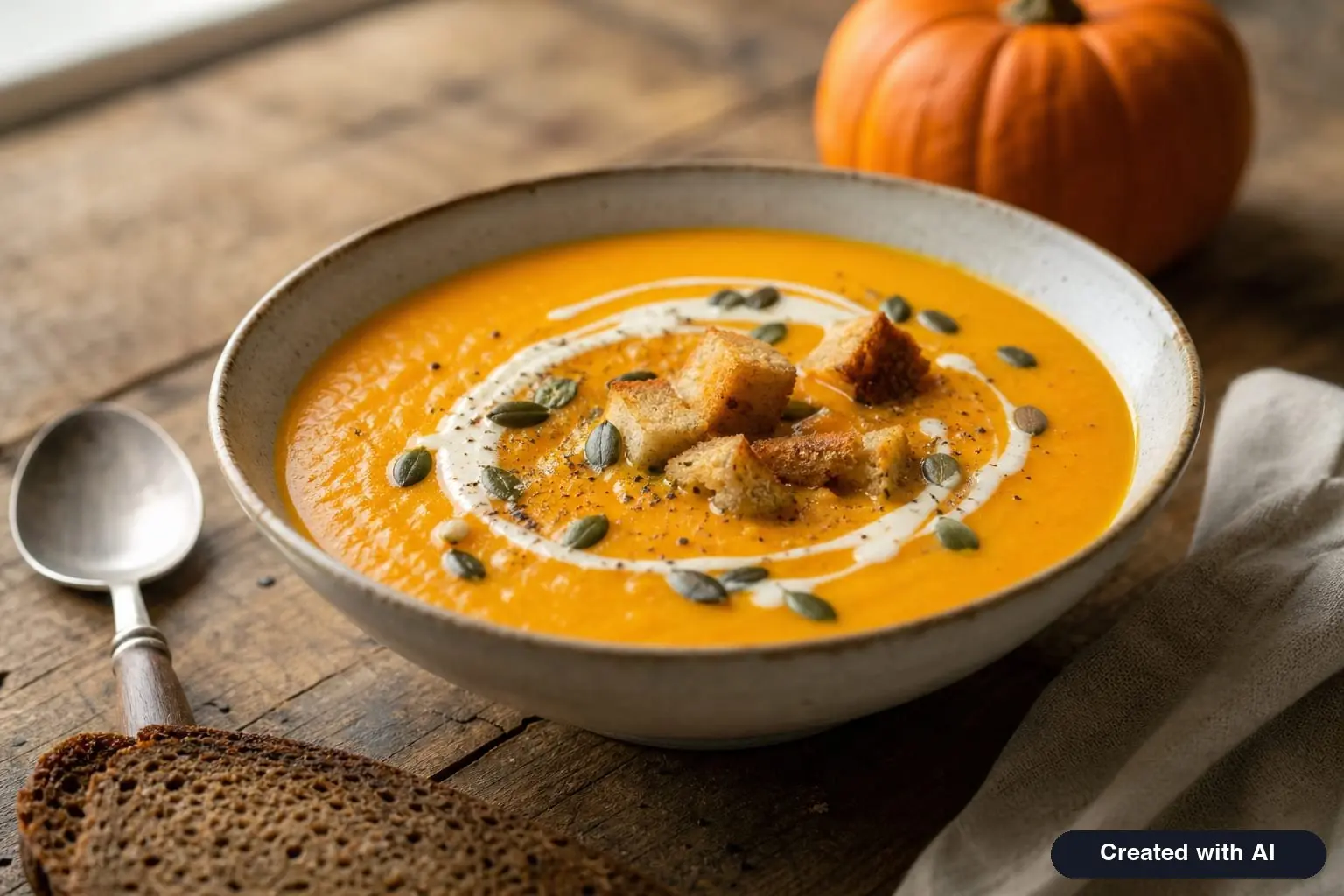
Pumpkin soup is a fall classic that's worth knowing how to make without a recipe: pumpkin, a couple of potatoes, a carrot, an onion, a pot, and a blender. This recipe is a classic blended pumpkin soup with potatoes and carrots, finished with heavy cream: thick, creamy, bright orange, and mildly sweet. From chopping to the bowl takes about 45 minutes, with only ten minutes of active time at the stove.
This recipe differs from many others in two ways. First, the vegetables are sautéed in butter for 5–7 minutes before adding liquid—this gives the soup a deeper, slightly caramelized flavor rather than the blandness of boiled pumpkin. Second, just enough liquid is added to barely cover the vegetables: it's hard to thicken a watery soup, but thinning a thick one takes only seconds.
The recipe is simple and perfect for beginners: there isn't a single step you can ruin beyond repair. The soup is great for everyday lunches, kids (without spicy seasonings), and, when beautifully garnished, for dinner guests. The quantities listed yield about 2.2 quarts (2.1 l) of soup—6 servings of about 1.5 cups (350 ml) or 4 large bowls.
Below is the full recipe in one card: you can adjust the number of servings and the quantities will recalculate, and you can check off the ingredients you've added. After the card, each step is explained in detail, followed by common mistakes, variations with other add-ins, calories, and other pumpkin recipes.
Creamy Blended Pumpkin Soup with Potatoes and Carrots
No ratings yet – be the firstIngredients
Directions
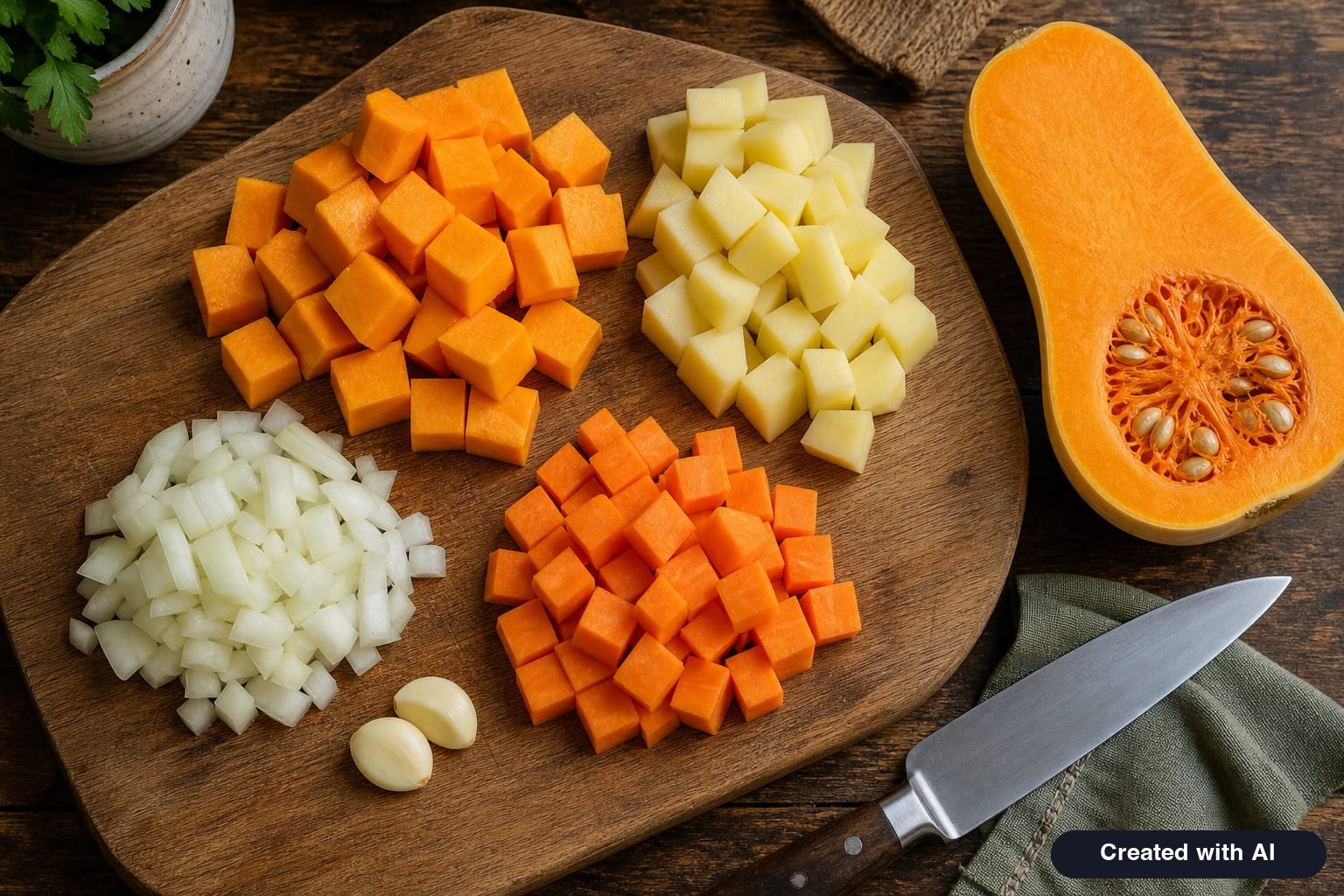
- Vegetables. Peel the pumpkin, scoop out the seeds, and cut into 1-inch (2–3 cm) cubes. Cut the potatoes and carrot smaller—3/4-inch (1.5–2 cm) pieces—so they cook at the same time as the pumpkin. Chop the onion and mince the garlic.
- Onion. In a 3–4 quart (3–4 l) heavy-bottomed pot, melt the butter with the oil over medium heat. Sauté the onion with a pinch of salt for 4–5 minutes until translucent, adding the garlic in the last minute.
- Sautéing. Add the pumpkin, potatoes, and carrot, stir to coat, and sauté for 5–7 minutes, stirring occasionally. If using nutmeg or other spices, add them now.
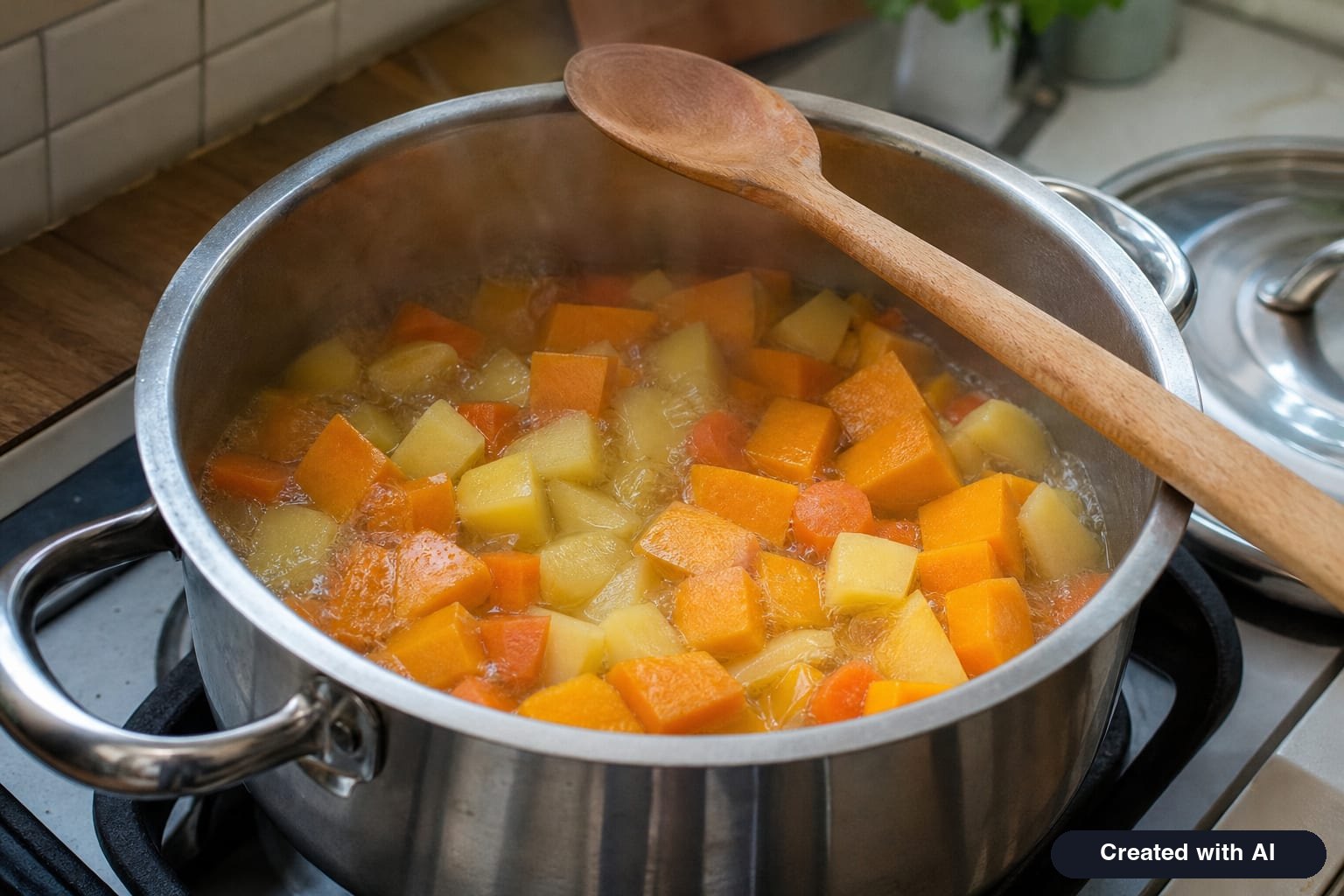
- Boiling. Pour in the hot broth or water—the liquid should barely cover the vegetables. Bring to a boil, reduce the heat, cover partially, and simmer for 18–20 minutes, until a piece of carrot is easily mashed with a spoon.
- Blending. Remove from the heat and blend with an immersion blender for 1–2 minutes until the soup is smooth. If using a stand blender, fill it only halfway and leave the steam vent open.
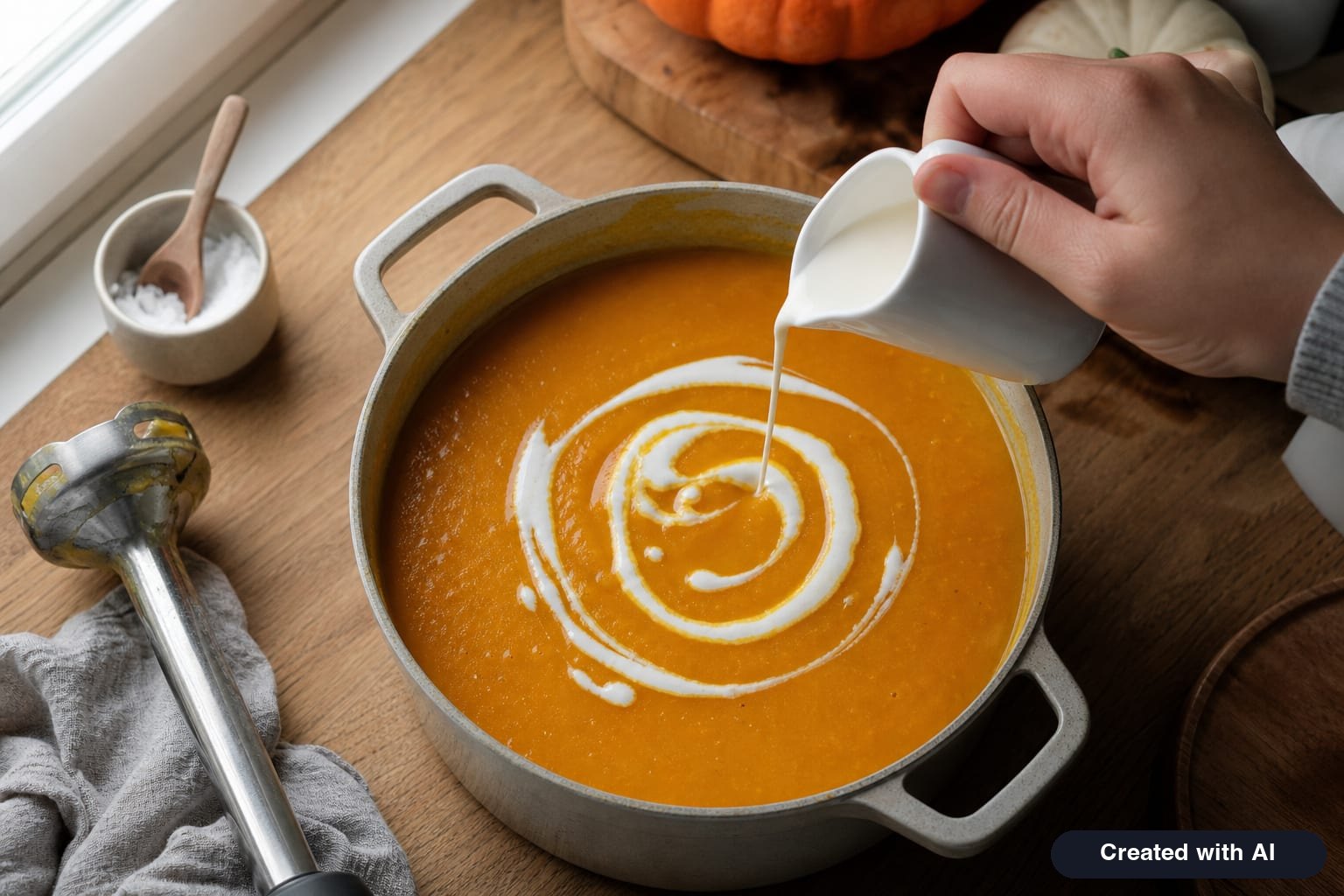
- Cream and seasoning. Pour in the heavy cream, stir, and heat on low for 2–3 minutes. Taste: add salt, pepper, and a squeeze of lemon juice; if the soup is too thick, thin it with 1/4–2/3 cup (50–150 ml) of hot water.
- Serving. Ladle into bowls, top with roasted pumpkin seeds, croutons, and a drizzle of heavy cream.
- Calories
- 206 kcal
- Protein
- 3.3 g
- Fat
- 13.2 g
- of which saturated
- 7 g
- Carbohydrates
- 21.3 g
- of which sugars
- 6.7 g
- Fiber
- 2.7 g
Calculated with the Firmus Medicus calorie database (USDA, Fineli).
Ingredients and How to Choose Them
Pumpkin. You need 1.75 lbs (800 g) of peeled flesh—that's about a 2.4–2.6 lb (1.1–1.2 kg) pumpkin with skin and seeds. The tastiest soup comes from dense, sweet varieties: butternut, muscat, or red kuri squash. Their flesh is drier, so the soup is naturally thick and richly colored. Large orange carving pumpkins are more watery and bland—you can use them, but add 1/2 cup (100–150 ml) less liquid and don't skimp on the carrots.
| Pumpkin | Flavor and texture | What to change in the recipe |
|---|---|---|
| Butternut | sweet, nutty, very creamy | nothing; peel the skin with a peeler |
| Red Kuri | dense, chestnut flavor, bright orange | no need to peel—it cooks and blends smoothly |
| Muscat | aromatic, sweet, juicy | 1/4–1/2 cup (50–100 ml) less liquid |
| Large orange (carving) | mild, watery | 1/2 cup (100–150 ml) less liquid, 7 oz (200 g) carrots |
| Frozen cubes | depends on variety, softer | do not thaw, 1/2 cup (100 ml) less liquid |
Butternut squash soup is usually the mildest and sweetest, while red kuri squash soup is the thickest. You can read more about the differences between varieties in our article about types of pumpkins.
Potatoes and carrots. Potatoes (9 oz or 250 g, two medium) give the soup body: their starch binds the liquid, so the blended soup doesn't separate in the bowl. Choose starchy potatoes, such as russets, that fall apart when boiled. The carrot (5 oz or 150 g, one large or two small) adds sweetness and enhances the color. It's not worth adding more than 7 oz (200 g)—the soup will start tasting like carrot soup.
Onion and garlic are the flavor base. One medium onion and two garlic cloves; the garlic is added later than the onion so it doesn't burn and turn bitter.
Fat. Butter (2 tbsp or 25 g) provides flavor, while a tablespoon of oil prevents it from burning. The soup will also work with just oil, but the flavor will be flatter.
Liquid. 3 1/3 cups (800 ml) of vegetable broth or water. With water, the soup has a cleaner pumpkin flavor and is great for young children; with broth, it's richer and saltier, so only add salt after tasting. We calculated the calories using water.
Heavy cream. 1/2 cup (120 ml) of heavy cream (30–36%). Heavy cream won't curdle in hot soup and gives it a velvety texture. Lighter cream or half-and-half (10–12%) works too, just don't let it boil.
Spices. Salt, black pepper, and a pinch of grated nutmeg—that's enough. Ginger, coriander, cumin, smoked paprika, thyme, sage, and curry powder also go well with pumpkin soup. Pick one or two: pumpkin has a delicate flavor, and three strong spices will overpower it.
How to Make Pumpkin Soup: Step by Step
1. Prepare the vegetables
Cut the pumpkin in half, scoop out the seeds and stringy bits with a spoon, and peel the skin. Cut the flesh into roughly 1-inch (2–3 cm) cubes. Peel the potatoes and carrots and cut them smaller—about 3/4-inch (1.5–2 cm) pieces. Why the difference: carrots and potatoes take longer to cook than pumpkin, so cutting them smaller ensures everything softens at the same time. Chop the onion and halve the garlic cloves.
2. Sauté the onion
In a 3–4 quart (3–4 l) heavy-bottomed pot, melt the butter with the oil over medium heat. Add the onion, a pinch of salt, and sauté for 4–5 minutes until translucent and soft, but not browned. The salt draws moisture out of the onion, so it sweats rather than burns. Add the garlic in the last minute.
3. Sauté the pumpkin, carrots, and potatoes
Add all the vegetables, stir to coat them in the fat, and sauté for 5–7 minutes, stirring occasionally. This is the most important flavor step: in the hot pot, the sugars in the pumpkin and carrots begin to caramelize, and the fat extracts aromatic compounds that water cannot. If you want to use nutmeg, curry, or smoked paprika—add them now, as spices bloom best in fat.
4. Add liquid and simmer
Pour in 3 1/3 cups (800 ml) of hot broth or water—the liquid should barely cover the vegetables. Bring to a boil, reduce the heat, cover partially leaving a small gap, and simmer for 18–20 minutes. The soup should bubble gently, not boil vigorously: a rolling boil evaporates the liquid and causes the vegetables at the bottom to burn. It's ready when a piece of carrot is easily mashed against the side of the pot with a spoon—the carrot is the last to soften.
How long to boil pumpkin soup depends on the size of the pieces and the pumpkin:
| What is cooking | Cooking time after boiling |
|---|---|
| Pumpkin 1-inch (2–3 cm) cubes, potatoes and carrots 3/4-inch (1.5–2 cm) | 18–20 min |
| All vegetables in large 1.5-inch (4 cm) chunks | 25–30 min |
| Only pumpkin and carrots, no potatoes | 15–18 min |
| Frozen pumpkin (unthawed) | 12–15 min from the second boil |
| Pre-made pumpkin purée | 5–7 min (after first boiling the potatoes and carrots for 15 min) |
| In a pressure cooker | 6–7 min under pressure |
5. Blend
Remove the pot from the heat. Using an immersion blender, blend for 1–2 minutes directly in the pot, keeping the blender head submerged so the hot soup doesn't splash. Blend only until the mixture is smooth. If using a stand blender, fill the pitcher no more than halfway and hold the lid slightly open with a towel over the vent—otherwise, the hot steam will blow the lid off. For a completely silky, restaurant-quality texture, you can pass the soup through a fine-mesh sieve.
6. Add cream and adjust seasoning
Pour the heavy cream into the blended soup, stir, and heat on low for 2–3 minutes until the first bubbles appear. Now—taste it. If the soup is too thick, add 1/4–2/3 cup (50–150 ml) of hot water or broth. If it tastes flat, it usually lacks salt and acid, not spices: add a pinch of salt and squeeze in a teaspoon of lemon juice. The acidity balances the pumpkin's sweetness and makes the soup brighter.
Common Mistakes and How to Fix Them
The soup is too thin. Too much liquid was added, or the pumpkin was watery. Simmer the blended soup uncovered for 5–10 minutes, stirring occasionally—the excess liquid will evaporate. A faster method: boil one potato separately, blend it with a ladle of soup, and stir it back in.
The soup is bland. The vegetables weren't sautéed, it was boiled in water, and not enough salt was used. Salt, a teaspoon of lemon juice, a pinch of nutmeg, and a pat of butter at the end will save it. Next time, don't skip the third step.
The soup is grainy or stringy. The vegetables weren't fully cooked, or the pumpkin was fibrous. Simmer for another 5 minutes and blend longer; passing it through a sieve will remove any fibers.
The soup is gummy, like glue. Too many potatoes and blended too long with a powerful blender—the potatoes released too much starch. Stick to the ratio: potatoes should be no more than a third of the pumpkin's weight.
The cream or sour cream curdled. This happens to low-fat cream, sour cream, or yogurt if the soup is boiled afterward. Always mix low-fat dairy products with a ladle of hot soup first, then pour it into the pot and do not let it boil.
The soup is too sweet. Sweet butternut squash and lots of carrots can sometimes give a dessert-like flavor. Fix it with lemon juice, black pepper, a spoonful of sour cream, or a pinch of chili flakes.
The bottom burned. Thick soup burns quickly, especially when reheated the next day. Reheat on low heat, stirring constantly, and add a splash of water.
Variations
Other pumpkin soups
The three most popular variations have their own separate recipes:
- Pumpkin soup with coconut milk – with ginger and curry, mildly exotic; you'll also find a spicy pumpkin soup, variations with shrimp, red lentils, chickpeas, and a vegan version there.
- Chicken pumpkin soup – hearty, for a filling lunch; blended and chunky, as well as with bacon, ground meat, or meatballs.
- Roasted pumpkin soup – the pumpkin and vegetables are roasted in the oven first, giving it the richest flavor of all.
Without potatoes, without cream, with milk
Blended pumpkin soup without potatoes. Replace the potatoes with an equal amount of pumpkin (2.3 lbs or 1,050 g total) and use 3 cups (700 ml) of liquid—without starch, the soup will be thinner. The flavor will be purer and the color brighter. If you use only pumpkin and carrots (9–10.5 oz or 250–300 g of carrots), you'll get a sweeter blended pumpkin and carrot soup—ginger and orange juice go especially well with this.
Pumpkin soup without cream. You can simply skip the heavy cream—the potatoes will keep the soup creamy anyway. Drizzle some olive or pumpkin seed oil into the bowl instead. For a dairy-free version, replace the butter with oil.
Pumpkin soup with milk. Instead of heavy cream, pour in 2/3 cup (150 ml) of milk and reduce the broth by the same amount. Add the milk after blending and just heat it through. This is a common variation for kids.
With cheese: processed cheese, feta, hard cheese
Blended pumpkin soup with processed cheese. Instead of heavy cream, stir 3.5 oz (100 g) of processed cheese (cream cheese works too) cut into pieces into the hot, already blended soup, and stir on low heat for 2–3 minutes until completely melted. Use less salt—the cheese is salty. The soup will be thicker, more filling, and perfect for those who find pumpkin too sweet.
With feta – about 3/4 oz (20–25 g) of crumbled feta on each bowl: the saltiness and tanginess beautifully balance the sweetness. With hard cheese – a spoonful of grated hard cheese in the bowl or a grilled cheese sandwich on the side. Cottage cheese can be spooned into the center of the bowl as a protein-rich topping.
With other vegetables
Blended vegetable soup with pumpkin works with almost anything sitting in the fridge. The rule is simple: pumpkin should make up at least half the weight of all the vegetables, otherwise its flavor will disappear.
| Addition | How much and when to add | What changes |
|---|---|---|
| Zucchini | 10.5 oz (300 g) instead of potatoes, with the pumpkin | lighter, thinner – 1/2 cup (100 ml) less liquid |
| Tomatoes | 10.5 oz (300 g) fresh or 7 oz (200 g) canned, 10 min before the end | tangier, redder; basil goes well |
| Red bell pepper | 1–2 pieces, sautéed with the onion | sweeter, with smoky notes – smoked paprika goes well |
| Cauliflower or broccoli | 9 oz (250 g) instead of potatoes | milder, lighter; broccoli overpowers the color |
| Beets | 5 oz (150 g) boiled, before blending | dark pink, earthier flavor |
| Apple | 1 tart baking apple, peeled, with the pumpkin | fresher, slightly tart |
| Red lentils or white beans | 3 oz (80 g) dry lentils or 7 oz (200 g) cooked beans; +3/4 cup (200 ml) liquid | more filling, more protein |
| Green peas | 3.5 oz (100 g) into the already blended soup, 3 min | do not blend – adds a pop of color and texture |
With mushrooms
Pumpkin soup with button mushrooms: slice 9 oz (250 g) of button mushrooms and sauté them in a separate pan over high heat until golden. Half can be blended into the soup, and the other half used as a topping. Chanterelles are prepared the same way. With dried mushrooms: soak 0.5–0.7 oz (15–20 g) of dried porcini mushrooms in hot water for 20 minutes, chop them, and boil them with the vegetables. Count the strained soaking water as part of your liquid—it provides the most aroma.
More filling: with rice or pasta
Boil rice or small pasta separately and add them to the bowl (2–3 tablespoons per serving). If boiled directly in the blended soup, they will absorb the liquid, and by the next day, the soup will turn into porridge.
For kids and babies
Pumpkin soup for kids is made using the same recipe: in water, without pepper and nutmeg, with a little salt, and finished with milk or a spoonful of sour cream. Kids usually love the sweet flavor and smooth texture. For babies starting solid foods, the soup is made only from vegetables and water—without salt, broth, or cream—and blended thicker, like a purée. We write about how to prepare and freeze it in portions in our article on pumpkin porridge and purée.
From frozen pumpkin and purée
Do not thaw frozen pumpkin—toss the cubes straight into the pot after sautéing the onion, carrots, and potatoes, and use 1/2 cup (100 ml) less liquid, as the pumpkin will release water as it thaws. For soup made from pumpkin purée, first boil the potatoes and carrots in the broth (for 15 minutes), then stir in 1.5–1.75 lbs (700–800 g) of purée, simmer for 5 minutes, and blend.
Quick, French, and in a pumpkin
Quick pumpkin soup: cut the vegetables into 1/2-inch (1 cm) cubes and pour boiling water from a kettle over them—the cooking time drops to 10–12 minutes. French pumpkin soup (velouté) is made without potatoes, with leeks instead of onions, passed through a fine sieve, and generously enriched with heavy cream and nutmeg. For holidays, the soup can be served in a hollowed-out pumpkin: bake a small red kuri squash in a 350°F (180°C) oven for 20 minutes to warm it up, and pour the soup in right before bringing it to the table. If you have leftover flesh after Halloween pumpkin carving, it works for soup too, though it will be blander.
Other pumpkin recipes in this guide
If you have more pumpkin left than you need for the soup, you can use the rest in other ways—each recipe has its own article:
- Pumpkin cake – moist and fluffy, with farmer cheese, chocolate, apples, as well as an American pie made from purée.
- Pumpkin pancakes – made from grated pumpkin, fluffy with kefir, with farmer cheese, or savory with cheese.
- Pumpkin muffins and cookies – muffins, loaf cake, cookies, and other desserts, including pumpkin spice latte.
- Pumpkin jam – with oranges, lemon, apples, cranberries, or ginger.
- Pumpkin porridge and purée – porridge with rice, millet, semolina, or oats, and purée that can be frozen.
- Pumpkin stew – with chicken, ground meat, or chickpeas, as well as casserole, salad, and lasagna.
- Roasted pumpkin – in the oven, pan, or air fryer, and stuffed pumpkin.
- Pickled pumpkin – pickled pumpkin, salads, juice, candied pumpkin, and freezing.
- Types of pumpkins and their benefits – the difference between butternut, muscat, and red kuri, and how many calories are in a pumpkin.
- All pumpkin recipes – an overview of what to make with pumpkin when you have a lot of it.
Lighter Version: How Many Calories Each Change Saves
Pumpkin soup isn't a heavy dish to begin with, and almost all of its calories come from three ingredients: heavy cream, butter, and potatoes. Below is how many calories remain in one serving when you substitute each of them. The numbers are calculated based on the actual amounts of ingredients used.
| Change | How | kcal / serving | Difference |
|---|---|---|---|
| Main recipe | as written above | 206 | – |
| Without heavy cream | omit heavy cream; add a few drops of oil to the bowl | 138 | −68 |
| Milk instead of cream | 2/3 cup (150 ml) 2% milk instead of 1/2 cup (120 ml) heavy cream | 150 | −56 |
| Greek yogurt instead of cream | 4 oz (120 g) Greek yogurt, stirred in off the heat | 157 | −49 |
| Lighter cream | 1/2 cup (120 ml) half-and-half instead of heavy cream; do not boil | 164 | −42 |
| Without potatoes | 2.3 lbs (1,050 g) pumpkin instead of 1.75 lbs (800 g), no potatoes, 3 cups (700 ml) liquid | 185 | −21 |
| Without potatoes and cream | 2.3 lbs (1,050 g) pumpkin, no potatoes or cream, 3 cups (700 ml) liquid | 117 | −89 |
Calculated with the Firmus Medicus calorie database, with the recipe divided into 6 servings.
Heavy cream makes the biggest difference: skipping it entirely leaves about 138 kcal per serving instead of 206 kcal—a third less. Replacing it with milk yields about 150 kcal, with Greek yogurt about 157 kcal, and with half-and-half about 164 kcal. Skipping the potatoes saves less than most people expect: about 185 kcal instead of 206 kcal, because they are replaced by extra pumpkin. Diet pumpkin soup—without potatoes and without cream—has about 117 kcal per serving. Coconut milk and processed cheese don't make the soup lighter (about 195 and 199 kcal, respectively)—those are flavor choices, not calorie choices.
How Many Calories Are in Pumpkin Soup?
One serving of this blended pumpkin soup (about 13.5 oz or 380 g, dividing the soup into 6 portions) has about 206 kcal: 3.3 g of protein, 13 g of fat, and 21 g of carbohydrates, including 2.7 g of fiber. 3.5 oz (100 g) of soup has about 54 kcal. If you eat a large bowl and divide the soup into 4 servings, one will have about 310 kcal. Toppings are calculated separately: a tablespoon of pumpkin seeds and a handful of croutons add about 30–40 kcal each per serving.
Is pumpkin soup healthy? It's a vegetable dish: more than half the pot is made up of pumpkin, carrots, and onions, which are high in beta-carotene and fiber, and low in calories. Whether pumpkin soup is healthy depends on what you garnish it with: the fat and salt come from the cream, butter, broth, and cheese, not the pumpkin. Beta-carotene is absorbed with fat, so a splash of oil or a spoonful of cream in the soup makes nutritional sense.
| Ingredient | Amount | kcal, whole recipe | Share |
|---|---|---|---|
| Heavy cream | 120 g | 408 | 33 % |
| Pumpkin, raw | 800 g | 208 | 17 % |
| Potatoes, raw | 250 g | 193 | 16 % |
| Butter | 25 g | 179 | 14 % |
| Canola oil | 14 g | 124 | 10 % |
| Carrot | 150 g | 62 | 5 % |
| Onion | 120 g | 48 | 4 % |
| Garlic, raw | 8 g | 12 | 1 % |
| Black pepper, ground | 1 g | 3 | 0 % |
| Water | 800 g | 0 | 0 % |
| Table salt | 7 g | 0 | 0 % |
| Total | 2295 g | 1237 | 206 kcal / serving |
Ingredient values – Firmus Medicus calorie database.
What to Serve With, How to Store and Freeze
Blended soup needs contrast—something crunchy and something tangy or salty. Tried-and-true combinations:
- pumpkin seeds toasted in a dry pan and a few drops of pumpkin seed oil;
- croutons: drizzle bread cubes with oil and toast them in a 350°F (180°C) oven for 8–10 minutes; garlic rye bread also works well;
- a spoonful of sour cream, Greek yogurt, or a swirl of heavy cream;
- crispy baked bacon or crumbled feta;
- fresh herbs—parsley, cilantro, scallions, thyme leaves;
- red pepper flakes for those who like it spicy.
In an airtight container in the fridge, the soup lasts 3–4 days. It thickens as it sits, so add a splash of water and stir when reheating—thick soup burns quickly. If using a microwave, heat it covered, stirring every minute.
In the freezer, the soup lasts up to 3 months. It's best to freeze it before adding the heavy cream: thawed cream sometimes separates, making the soup grainy. Pour the cooled soup into containers or bags in portions, leaving 3/4 inch (2 cm) of headspace because it expands as it freezes. Thaw in the fridge overnight or simply in a pot over low heat, and pour in the cream while reheating. If you froze it with the cream and the soup separated—blend it again with an immersion blender, and the texture will return.
Next time, try the richer roasted pumpkin soup or soup with coconut milk and ginger, and if you need a more filling lunch—chicken pumpkin soup. Leftover pumpkin is easy to use up in pumpkin pancakes or pumpkin cake.
Frequently asked questions
How long do you boil pumpkin soup?
Once boiling, 18–20 minutes if the pumpkin is cut into 1-inch (2–3 cm) cubes and potatoes/carrots into 3/4-inch (1.5–2 cm) pieces. Large chunks need 25–30 minutes, frozen pumpkin 12–15 minutes. It's ready when a carrot is easily mashed with a spoon.
How much liquid do you add to blended pumpkin soup?
Just enough to barely cover the vegetables: 1.75 lbs (800 g) pumpkin, 9 oz (250 g) potatoes, and 5 oz (150 g) carrots need about 3 1/3 cups (800 ml) of broth or water. For watery field pumpkins, use 1/2 cup (100–150 ml) less – a soup that's too thick is easy to thin after blending.
How do you thicken watery pumpkin soup?
Simmer the blended soup uncovered for 5–10 minutes, stirring occasionally, until the excess liquid evaporates. A faster way is to boil one potato separately, blend it with a ladle of soup, and stir it back in.
Can you make pumpkin soup without potatoes?
Yes. Replace the potatoes with an equal amount of pumpkin (about 2.3 lbs or 1,050 g total) and use 3 cups (700 ml) of liquid, as the soup will be thinner without starch. A serving will have about 185 kcal instead of 206 kcal.
What can I substitute for heavy cream in pumpkin soup?
Milk (2/3 cup or 150 ml), Greek yogurt, half-and-half, coconut milk, or 3.5 oz (100 g) of processed cheese. You can also skip the cream entirely—the potatoes will keep it creamy, and a serving will have about 138 kcal.
How many calories are in pumpkin soup?
Following this recipe, one 13.5 oz (380 g) serving with heavy cream has about 206 kcal, or 54 kcal per 3.5 oz (100 g). Without cream, it's about 138 kcal per serving; without potatoes and cream, about 117 kcal.
What spices go well with pumpkin soup?
The base is salt, black pepper, and a pinch of nutmeg. Ginger, curry powder, coriander, cumin, smoked paprika, thyme, and sage also work well, but stick to one or two so you don't overpower the pumpkin. A bland soup usually just needs more salt and a teaspoon of lemon juice.
Which pumpkin is best for soup?
Dense, sweet-fleshed varieties: butternut, red kuri, or muscat squash. Red kuri doesn't need peeling. Large orange carving pumpkins are more watery, so use 1/2 cup (100–150 ml) less liquid and add more carrots.
Can you freeze pumpkin soup?
Yes, for up to 3 months. It's best to freeze it without the heavy cream and add it when reheating, as thawed cream can separate. In the fridge, the soup lasts 3–4 days.
Log in to comment
No comments yet. Be the first.