Pumpkin Jam with Oranges: Recipe, Sugar Ratio, and Storage
- 2.2 lb (1 kg) of pumpkin and 4 cups (800 g) of sugar yields about 2.8 lb (1.3 kg) of jam, or four 8-oz (250 ml) jars
- Step-by-step guide to sterilizing jars, checking jam thickness, and storing based on sugar content
- Flavor variations including lemon, apples, cranberries, peaches, pears, and fresh ginger
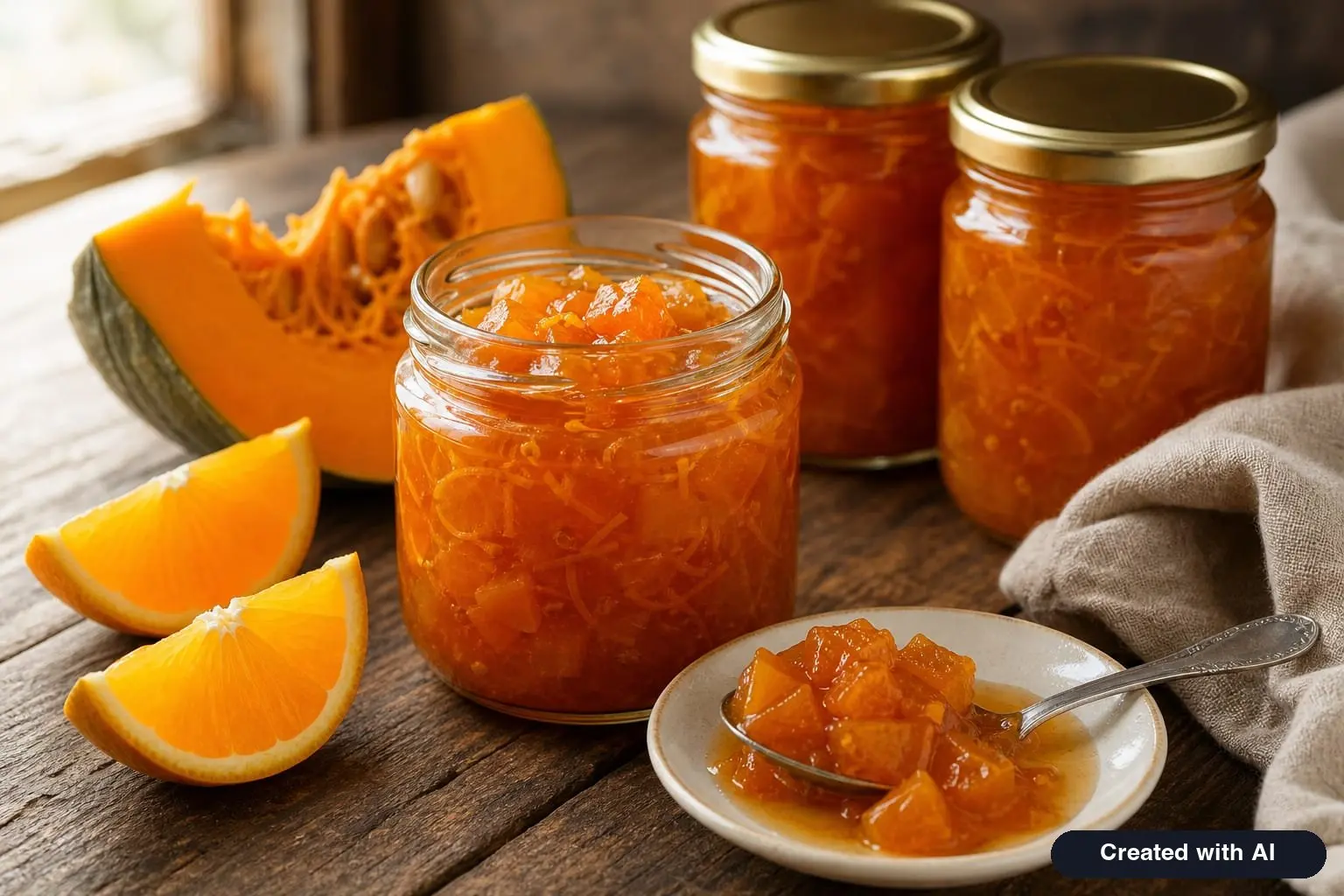
Pumpkin jam is one of the few fall preserves you can make long after berry season ends: pumpkins keep in the cellar or sit in stores right into winter. The pumpkin itself has a mild, almost neutral flavor, so it always needs a tarter, more fragrant partner in jam. Citrus fruits are the most common choice, and pumpkin jam with oranges is the most popular variation for good reason.
This recipe is for pumpkin jam with oranges and lemon. The orange provides aroma and a sweet-tart flavor, while the lemon juice adds the necessary acidity—without it, the jam would be bland and wouldn't keep as well. As they cook, the pumpkin cubes become translucent and amber-colored, holding their shape, while the syrup thickens enough that the jam doesn't run off the spoon. No water is added at all; the pumpkin releases plenty of its own juice.
From 2.2 lb (1 kg) of peeled pumpkin and 4 cups (800 g) of sugar, you get about 2.8 lb (1.3 kg) of jam—roughly 4 cups (1 liter), or four 8-oz (250 ml) jars. In the recipe card, the yield is calculated in tablespoons: one tablespoon is about 0.7 oz (20 g), and the whole batch makes about 65 tablespoons. One tablespoon has about 54 calories.
Since this is a preserve you'll keep for months, this recipe pays close attention to safety: how much sugar is necessary, how to sterilize jars, and where and how long to store it. The recipe is in the card: you can recalculate the amounts for a different pumpkin weight, check off completed steps, and print it. Below, each step is explained in more detail.
Pumpkin Jam with Oranges
No ratings yet – be the firstIngredients
Directions
- Pumpkin. Peel the pumpkin, scoop out the seeds and stringy bits, and cut the flesh into uniform ½-inch (1 cm) cubes.
- Oranges. Wash one orange and grate the zest (orange layer only). Peel both oranges, remove the white pith and seeds, and chop the flesh into pieces.
- Sugar. In a wide, heavy-bottomed pot, combine the pumpkin, oranges, zest, lemon juice, and sugar. Cover and let sit for 3–4 hours (or overnight in the fridge) until the pumpkin releases its juices. Do not add water.
- Jars. Wash four 8-oz (250 ml) jars, place them wet in a cold oven, heat to 250°F (120°C), and leave for 15 minutes. Boil the lids for 5 minutes.
- Boiling. Cook over medium heat, stirring, until the sugar dissolves and the mixture comes to a boil. Skim off any foam and add the cinnamon stick if using.
- Cooking. Cook uncovered over low heat for 45–55 minutes, stirring occasionally from the bottom, until the cubes are translucent and the syrup thickens.
- Checking thickness. Drop some syrup onto a plate chilled in the freezer: if after a minute a path drawn with your finger doesn't fill in, the jam is done (219–221°F / 104–105°C).
- Jarring. Pour the boiling jam into the hot jars, leaving ¼ to ½ inch (0.5–1 cm) of headspace. Wipe the rims and seal tightly immediately.
- Cooling and storage. Let cool completely. Store in a dark, cool place for up to 12 months. Once opened, keep in the fridge for 3–4 weeks.
- Calories
- 54 kcal
- Protein
- 0.2 g
- Fat
- 0 g
- of which saturated
- 0 g
- Carbohydrates
- 13.9 g
- of which sugars
- 13.2 g
- Fiber
- 0.2 g
Calculated with the Firmus Medicus calorie database (USDA, Fineli).
Ingredients and How to Choose Them
Pumpkin. The best pumpkins for jam are those with dense, bright orange flesh—such as butternut squash, muscat, or Hokkaido (Red Kuri) pumpkins. Their flesh is sweeter and contains less water, so the cubes don't fall apart and the jam thickens faster. Large, watery pumpkins (including carving pumpkins) work, but you'll have to cook them 10–15 minutes longer, and the flavor will be milder. The differences between varieties are described in the types of pumpkins guide. Weigh the pumpkin after peeling: you'll get 2.2 lb (1 kg) of flesh from about 3 lb (1.4 kg) of whole pumpkin with skin and seeds.
Oranges. You need two medium oranges: the zest and flesh of one, and just the flesh of the other. Since the zest goes into the jam, wash the orange with hot water and scrub it with a brush to remove any wax. Grate only the orange layer: the white pith underneath is bitter, and that bitterness only intensifies in the jam. For the same reason, remove all the seeds.
Lemon. The juice of one lemon (about 3.5 tbsp / 50 ml) is an essential ingredient here, not just a flavoring. Pumpkin is a low-acid vegetable, so without added acid, the jam will be bland, crystallize faster, and won't store as well. The acid also helps the cubes hold their shape.
Sugar. 4 cups (800 g) of sugar per 2.2 lb (1 kg) of pumpkin is the ratio that ensures the finished jam is sweet and thick enough to last in sealed jars in a cool place. Sugar acts as a preservative here: it "binds" the water, leaving none for microorganisms. You can reduce the sugar, but the storage rules will change—more on that in the "Lighter Version" section. Regular granulated sugar works best; brown sugar will add a caramel note but will overpower the orange aroma.
Spices. Optional. A cinnamon stick, a couple of cloves, or a star anise pair well, but add just one, not all at once, and remove it before jarring.
How to Sterilize Jars
Prepare the jars while the jam is cooking—they must be hot when you pour the jam into them. Wash four 8-oz (250 ml) jars (and one spare) with hot water and dish soap or baking soda, and rinse well. Place the wet jars on a wire rack in a cold oven, turn it to 250°F (120°C), and once the oven is hot, leave them for 15 minutes. Do not put cold jars into a hot oven, as they may crack.
Boil the lids in a pot for 5 minutes and leave them in the hot water until ready to use. It's best to use new twist-off lids: if the inner coating is scratched, rusty, or the lid is dented, it won't seal properly. Do not touch the inside of the sterilized jars or lids with your hands, and pour boiling water over your ladle and funnel.
Step-by-Step Instructions
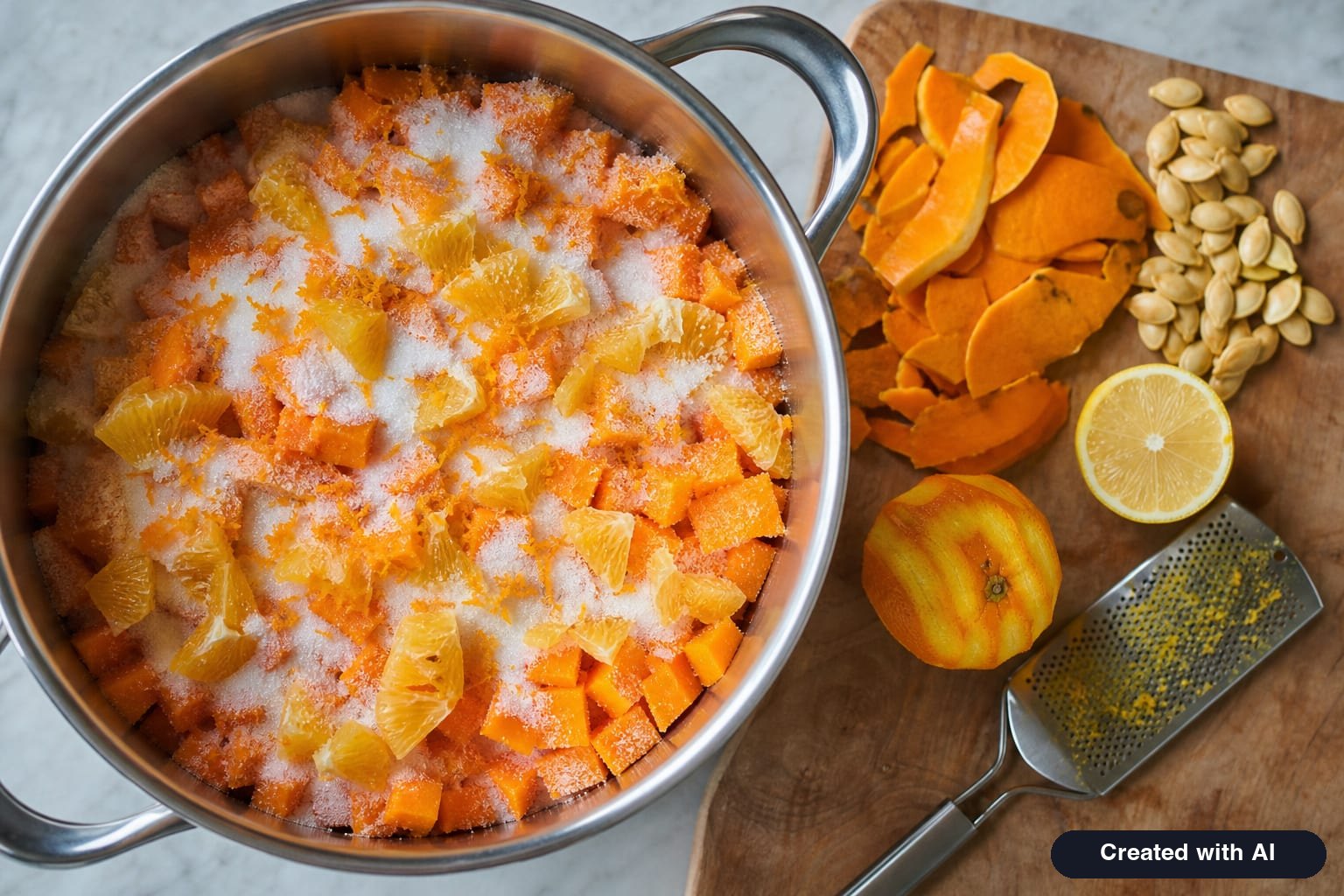
- Dice the pumpkin. Peel the skin, scoop out the seeds and stringy bits, and cut the flesh into roughly ½-inch (1 cm) cubes. Try to keep them uniform: small ones will turn to mush before the large ones soften.
- Prepare the oranges. Finely grate the zest from one orange. Peel both oranges, cut away the white pith, chop the flesh into pieces, and remove the seeds. Add any juice that runs out, too.
- Cover with sugar. In a wide, heavy-bottomed pot, combine the pumpkin, oranges, zest, lemon juice, and sugar. Cover and let sit for 3–4 hours at room temperature or overnight in the fridge. The sugar draws out the juices, so the pumpkin cooks in its own syrup, and the cubes firm up and break down less during cooking.
- Bring to a boil. Place the pot over medium heat and cook, stirring, until all the sugar dissolves and the mixture comes to a boil. Skim off any foam with a spoon—it can make the jam cloudy.
- Cook uncovered. Reduce the heat so the jam simmers steadily, and cook for 45–55 minutes, carefully stirring from the bottom with a spatula every few minutes. No lid is needed: the water needs to evaporate. Stir more frequently toward the end, as the thickening jam can easily burn.
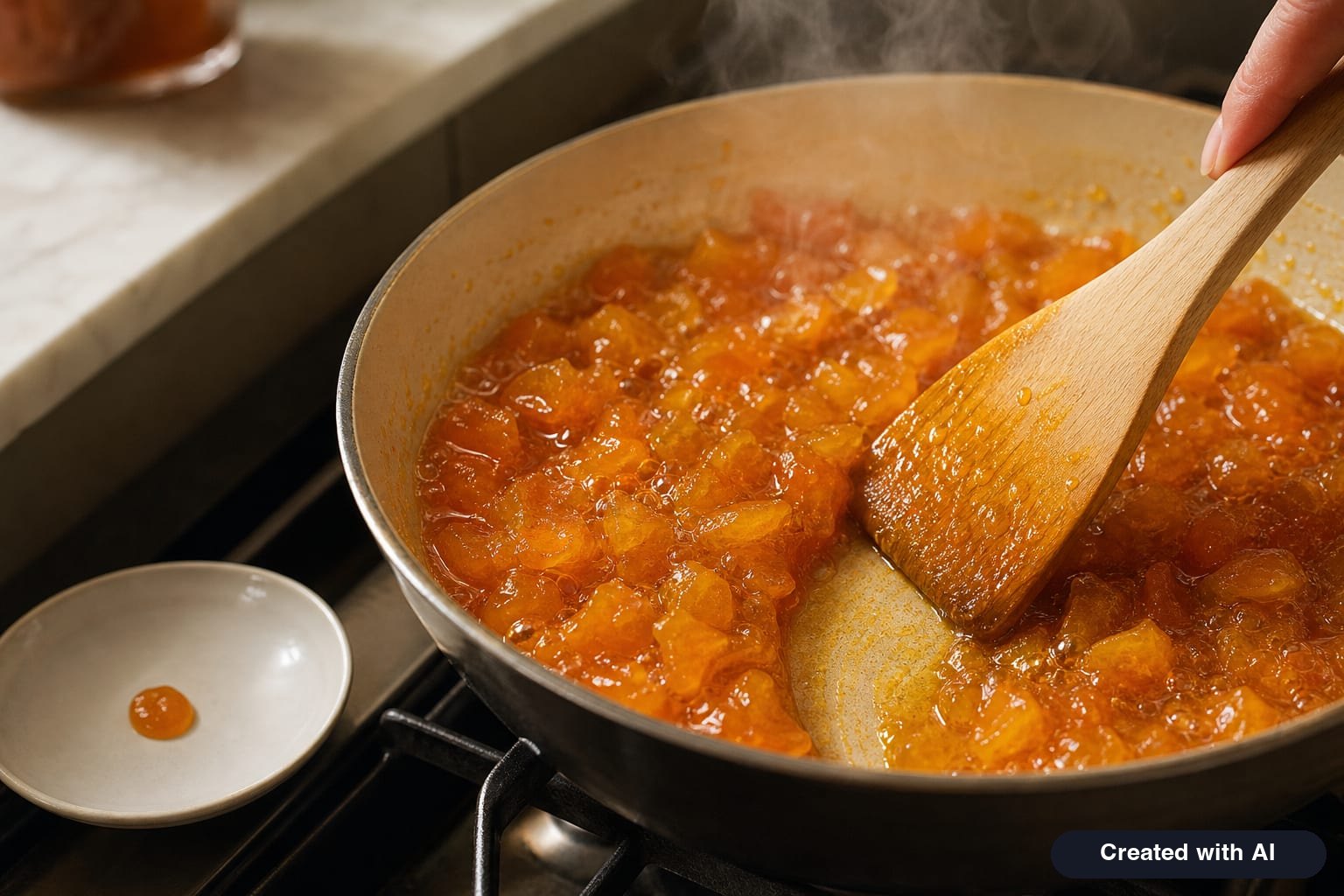
- Check the thickness. Before you start cooking, place a small plate in the freezer. Drop a teaspoon of syrup onto the cold plate, wait a minute, and run your finger through it: if the path remains and the surface wrinkles slightly, it's done. If you have a thermometer, the jam is ready when it reaches 219–221°F (104–105°C). Remember that it will thicken considerably as it cools, so it should look runnier in the pot than you want it in the jar.
- Jar while hot. Remove the cinnamon stick if you used one. Pour the boiling jam immediately into the hot jars, leaving ¼ to ½ inch (0.5–1 cm) of headspace. Wipe the rim of the jar with a clean paper towel—any syrup left on it will prevent the lid from sealing tightly—and screw the lid on firmly right away.
- Cool. Place the jars on a towel away from drafts and leave them undisturbed until completely cool. As they cool, the center of the lid will pop down—a sign that the jar has sealed properly. If the lid clicks when pressed, store the jar in the fridge and use it first.
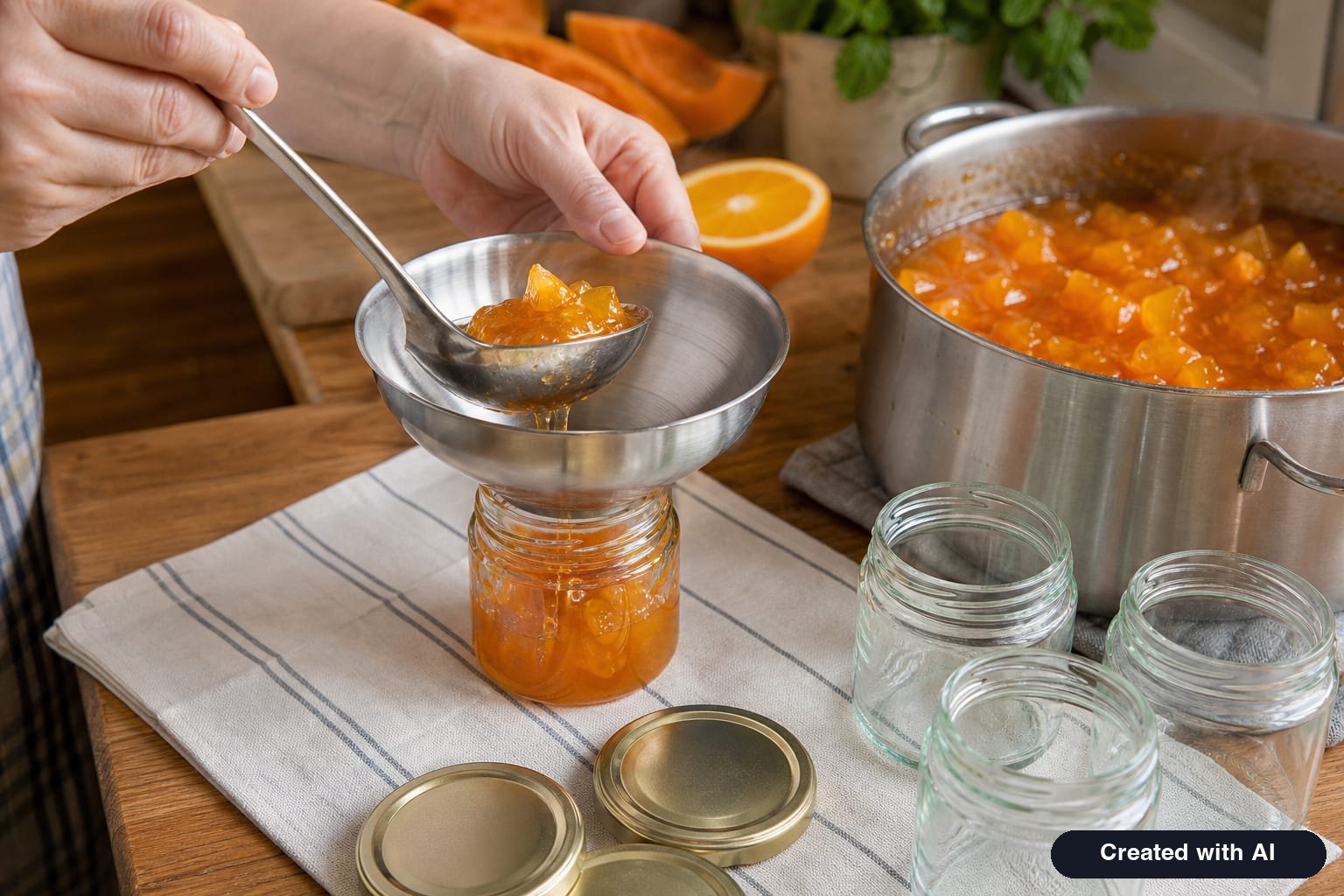
If you want a smooth, spreadable jam, blend the mixture with an immersion blender after 30 minutes of cooking (remove the pot from the heat first—hot syrup splatters) and cook for another 10–15 minutes. Blended jam thickens faster and burns more easily, so stir constantly.
Cooking time depends mostly on the quantity and the width of the pot: the wider the surface, the faster the water evaporates.
| Peeled Pumpkin | Sugar | Oranges and Lemons | Pot Diameter | Cooking Time | Yield |
|---|---|---|---|---|---|
| 1.1 lb (0.5 kg) | 2 cups (400 g) | 1 orange, ½ lemon | 8–9 inches (20–22 cm) | 30–35 min. | about 1.4 lb (650 g) – two 8-oz (250 ml) jars |
| 2.2 lb (1 kg) | 4 cups (800 g) | 2 oranges, 1 lemon | 9.5–11 inches (24–28 cm) | 45–55 min. | about 2.8 lb (1.3 kg) – four 8-oz (250 ml) jars |
| 4.4 lb (2 kg) | 8 cups (1.6 kg) | 4 oranges, 2 lemons | two pots or 12+ inches (30+ cm) | 60–75 min. | about 5.7 lb (2.6 kg) – eight 8-oz (250 ml) jars |
It's not worth cooking more than 4.4 lb (2 kg) of pumpkin in one pot: by the time the water evaporates, the cubes will turn to mush and the color will darken.
Common Mistakes
Jam is too runny. Cooked for too short a time, covered, or in a narrow, tall pot. If you notice this before jarring, keep cooking and check on a cold plate. If it has already cooled in the jars, pour it back into the pot, boil for 10–15 minutes, and pour into freshly sterilized jars.
Too thick, crystallized. The jam was overcooked or lacked acidity. Do not reduce the lemon juice, and start checking for doneness at the 40-minute mark. Crystallized jam can be reheated with a tablespoon of water and a teaspoon of lemon juice, but then it must be stored in the fridge.
Slightly bitter. The white pith of the orange peel or seeds got into the pot. You can't fix cooked jam, so be sure to grate the zest shallowly.
Cubes turned to mush. The pumpkin was watery, diced too small, didn't sit with the sugar, or the jam was stirred too vigorously. If intact cubes are important to you, cook in three stages: bring to a boil, simmer for 10 minutes, let cool completely, and repeat this three times. It takes all day, but the pieces remain whole and translucent.
Burned. Thin bottom and heat too high. Don't scrape the burned part—transfer the jam to another pot, otherwise the burnt taste will spread throughout the whole batch.
Moldy or fermenting. Too little sugar, a loose lid, or a wet/dirty spoon. Don't just scoop off the mold—discard the entire jar. Do the same if the lid is bulging, hisses when opened, or the jam smells like alcohol.
Pumpkin Jam Variations
The base is always the same—2.2 lb (1 kg) of peeled pumpkin, covered with sugar and cooked until thick. Only the add-ins and sometimes the amount of sugar change. The table shows amounts per 2.2 lb (1 kg) of pumpkin.
| Variation | What to Add | Sugar | When to Add |
|---|---|---|---|
| With oranges and lemon (base) | 2 oranges, juice of 1 lemon | 4 cups (800 g) | immediately |
| With lemon | 2 lemons: juice of both and zest of one | 4–4¼ cups (800–850 g) | immediately |
| With apples | 1.5 lb (700 g) pumpkin and 14 oz (400 g) tart apples, juice of 1 lemon | 3½ cups (700 g) | apples – after 15 min. of cooking |
| With oranges and apples | 2 oranges, 10.5 oz (300 g) apples, juice of 1 lemon | 4½ cups (900 g) | apples – after 15 min. of cooking |
| With cranberries | 7 oz (200 g) cranberries, 1 orange | 4 cups (800 g) | 15 min. before the end |
| With peaches | 14 oz (400 g) peaches, juice of 1 lemon | 4 cups (800 g) | after 20 min. of cooking |
| With dried apricots | 5.3 oz (150 g) apricots, juice of 1 lemon | 3½ cups (700 g) | immediately, with the sugar |
| With pears | 14 oz (400 g) firm pears, juice of 1 lemon | 4 cups (800 g) | after 20 min. of cooking |
| With pineapple | 10.5 oz (300 g) pineapple, juice of 1 lemon | 4 cups (800 g) | immediately |
| With quince | 9–10.5 oz (250–300 g) seeded quince | 4½ cups (900 g) | immediately |
| With ginger | 0.7–1 oz (20–30 g) grated fresh ginger to the base recipe | 4 cups (800 g) | immediately |
Pumpkin jam with lemon. Without oranges, the jam is tarter, more refreshing, and lighter in color. Use two lemons: the juice of both and the zest of one. Some people add the lemon sliced into thin half-moons with the rind—if so, boil it first for 2 minutes in water, otherwise the pumpkin and lemon jam will be bitter. Still, do not add water to the jam itself.
Pumpkin jam with apples. Apples are high in pectin, so pumpkin and apple jam thickens faster and has a more spreadable texture. Choose tart, firm apples and add them later than the pumpkin, as they cook down in 20–25 minutes. If you want a citrus aroma too, make pumpkin jam with oranges and apples: add 10.5 oz (300 g) of apples and ½ cup (100 g) of sugar to the base recipe.
Pumpkin jam with cranberries. Cranberries add acidity, pectin, and a red tint. Toss them in at the end so some berries stay whole. Frozen ones work too—no need to thaw. With cranberries, one orange is enough, and you can skip the lemon entirely.
Pumpkin jam with peaches and apricots. In late fall, fresh peaches are gone, so frozen or canned (drained, and reduce sugar to 3½ cups / 700 g) are usually used. Dried apricots are even easier: cut them into strips and cover with sugar along with the pumpkin—they'll plump up in the juices in a few hours. Apricots provide tartness and a thick, almost marmalade-like syrup.
Pumpkin and pear jam. Pears are sweet and low in acid, so lemon juice is essential here, and ginger or cinnamon pairs beautifully. Use firm, slightly underripe pears—soft ones will turn to mush.
With pineapple. Fresh pineapple gives the jam a tropical aroma and acidity; if using canned, drain it and use ½ cup (100 g) less sugar, as the syrup is sweet.
With quince. Quinces are very tart and fragrant, easily replacing both lemon and orange. Cut into slices, remove the seeds, and use more sugar—4½ cups (900 g).
With ginger. Adding 0.7–1 oz (20–30 g) of grated fresh ginger to the base recipe provides warmth and a spicy kick. This jam is especially good with cheese or stirred into tea.
Pumpkin jelly. If you want a firm, jiggly consistency, boil the pumpkin and oranges for 20 minutes without sugar but with ½ cup (100 ml) of water. Blend it, stir in jam sugar (sugar with added pectin) according to the package ratio (usually 2½ cups / 500 g of sugar per 2.2 lb / 1 kg of mixture), and boil for the time specified by the manufacturer—usually 4–5 minutes. There is significantly less sugar here, and pumpkin is low in acid, so keep the jelly only in the fridge and use within 3–4 weeks, or freeze it—it's not suitable for the pantry.
Other pumpkin preserves—pickled pumpkin, juice with oranges, candied pumpkin, puree for winter—are covered in the pickled pumpkin guide.
Lighter Version: Less Sugar
You can reduce the sugar, but the storage method changes along with it: the less sugar, the shorter the jam's shelf life. Here is what each change means for one tablespoon (0.7 oz / 20 g). Calculated based on actual ingredient amounts, assuming the yield remains the same—about 65 tablespoons.
| Change | How | kcal / tablespoon | Difference |
|---|---|---|---|
| Main recipe | as written above | 54 | – |
| Less sugar | 3 cups (600 g) of sugar instead of 4 cups (800 g) – keep only in the fridge, use within 4–6 weeks | 42 | −12 |
| Least sugar | 2½ cups (500 g) of sugar – 2–3 weeks in the fridge or freeze | 36 | −18 |
| With apples | 1.5 lb (700 g) pumpkin + 14 oz (400 g) tart apples, 3½ cups (700 g) sugar | 50 | −4 |
| With dried apricots | + 5.3 oz (150 g) dried apricots, 3½ cups (700 g) sugar | 54 | 0 |
| With cranberries | + 7 oz (200 g) cranberries 15 min. before the end of cooking | 55 | +1 |
Calculated with the Firmus Medicus calorie database, with the recipe divided into 65 tablespoons.
With 3 cups (600 g) of sugar, a tablespoon has about 42 calories instead of 54 calories; with 2½ cups (500 g), it has about 36 calories, which is a third less. However, this jam is no longer a true preserve: with 3 cups (600 g) of sugar, keep it only in the fridge and use within 4–6 weeks; with 2½ cups (500 g), use within 2–3 weeks, or freeze it for longer storage. Replacing some of the pumpkin with apples reduces calories slightly (about 50 kcal per tablespoon), but the jam is thicker and requires less sugar. Variations with dried apricots (about 54 kcal) and cranberries (about 55 kcal) barely change the calorie count—choose them for flavor, not for the numbers.
| Sugar per 2.2 lb (1 kg) of pumpkin | Where to store | Shelf life unopened | Once opened |
|---|---|---|---|
| 4 cups (800 g) or more | cool, dark place (pantry, cellar up to 60°F / 15°C) | up to 12 months | in the fridge for 3–4 weeks |
| 3 cups (600 g) | fridge only | 4–6 weeks | in the fridge for 2 weeks |
| 2½ cups (500 g) | fridge or freezer | 2–3 weeks in fridge, 6 months in freezer | in the fridge for 1 week |
How Many Calories Are in Pumpkin Jam
One tablespoon (about 0.7 oz / 20 g) of pumpkin jam with oranges has about 54 calories and 13 g of sugar; 3.5 oz (100 g) has about 270 calories. Almost all the calories come from sugar: out of 3,508 kcal in the whole pot, 3,096 kcal are from sugar, while a kilogram of pumpkin adds only 260 kcal, and the oranges 141 kcal. There is practically no fat or protein in the jam.
| Ingredient | Amount | kcal, whole recipe | Share |
|---|---|---|---|
| Granulated sugar | 800 g | 3096 | 88 % |
| Pumpkin, raw | 1000 g | 260 | 7 % |
| Orange | 300 g | 141 | 4 % |
| Lemon juice, raw | 50 g | 11 | 0 % |
| Total | 2150 g | 3508 | 54 kcal / tablespoon |
Ingredient values – Firmus Medicus calorie database.
The portion weight in the recipe card is calculated from the raw ingredients, so it is larger than 0.7 oz (20 g): during cooking, about 1¾ lb (800 g) of water evaporates. The calorie count per tablespoon doesn't change from this—the calories don't disappear, they just concentrate.
How to Store and What to Serve It With
Store tightly sealed jars in a dark, cool place—a cellar, pantry, or bottom cabinet away from the radiator. Jam cooked according to the base recipe will keep this way for up to a year, though it tastes best and has the brightest color for the first 6–8 months. If you don't have a cool pantry and your home is warm, you can pasteurize the jars additionally: place the sealed jars in a pot on a towel, pour in warm water up to the lids, heat to 185–195°F (85–90°C), and hold for 10 minutes.
Keep an opened jar in the fridge and consume within 3–4 weeks. Always scoop the jam with a clean, dry spoon: crumbs, butter, or a drop of water are the most common reasons an opened jam gets moldy. You can freeze it in plastic containers, leaving 1 inch (2 cm) of headspace at the top; thaw in the fridge.
Pumpkin jam with oranges is delicious with cottage cheese, plain yogurt, oatmeal, or pumpkin porridge, and on buttered toast. You can use it to layer a sponge cake or pumpkin cake, or serve it with pumpkin pancakes or cottage cheese pancakes. Thanks to the citrus acidity, it also pairs well with aged or blue cheese, and a spoonful stirred into hot water stands in for tea.
If you have leftover pumpkin after making jam, you can use it to make a creamy pumpkin soup, prepare winter stores from the pickled pumpkin guide, or choose another dish from the pumpkin recipes roundup.
Frequently asked questions
How much sugar do I need for pumpkin jam?
For 2.2 lb (1 kg) of peeled pumpkin, use 4 cups (800 g) of sugar. This ratio allows the jam to last up to 12 months in sealed jars in a cool place. With 3 cups (600 g), store it in the fridge and use within 4–6 weeks.
How long do you cook pumpkin jam?
For 2.2 lb (1 kg) of pumpkin, cook uncovered in a wide pot for 45–55 minutes until the cubes are translucent and a drop of syrup on a cold plate holds its shape. Half the amount takes 30–35 minutes.
Do you add water to pumpkin jam?
No. When covered with sugar, the pumpkin releases enough juice in 3–4 hours to cook in its own syrup. Adding water would require a longer cooking time, turning the cubes to mush.
How do you make pumpkin jam with lemon instead of oranges?
For 2.2 lb (1 kg) of pumpkin, use two lemons (the juice of both and the zest of one) and 4 to 4¼ cups (800–850 g) of sugar. Cook for 45–55 minutes; the jam will be tarter and lighter in color.
How do you make pumpkin jam with apples?
Mix 1.5 lb (700 g) of pumpkin with 3½ cups (700 g) of sugar and the juice of one lemon. Bring to a boil, and after 15 minutes, add 14 oz (400 g) of diced tart apples. Cook for another 30 minutes. Apple pectin thickens the jam faster.
When do you add cranberries to pumpkin jam?
Add 7 oz (200 g) of fresh or frozen cranberries 15 minutes before the end of cooking so some berries remain whole. With cranberries, one orange is enough, and you can skip the lemon.
How many calories are in pumpkin jam?
One tablespoon (about 0.7 oz / 20 g) of this recipe has about 54 calories and 13 g of sugar. 3.5 oz (100 g) has about 270 calories. With 3 cups (600 g) of sugar, a tablespoon has about 42 calories.
How long does pumpkin jam last?
Made with 4 cups (800 g) of sugar and poured hot into sterilized jars, it lasts up to 12 months in a dark, cool place. Once opened, keep it in the fridge and consume within 3–4 weeks. Discard the entire jar if mold appears.
Log in to comment
No comments yet. Be the first.