Types of Pumpkins: Butternut, Hokkaido, Muscat, and Their Uses
- Comparison table: six types, whether to peel them, and which recipe they suit best
- 3.5 oz (100 g) of pumpkin has 26 kcal, butternut squash has 45 kcal, and seeds have 559 kcal
- How to tell when a pumpkin is ripe, how long it stores, and how to prepare the seeds
- Types of pumpkins: how they differ and what they are best for
- Butternut squash: recipes it is best suited for
- Is a pumpkin a fruit or a vegetable?
- How many calories are in a pumpkin and its nutritional value
- When is a pumpkin ripe and how to choose one
- How to store a pumpkin
- Pumpkin seeds: preparation and how to use them
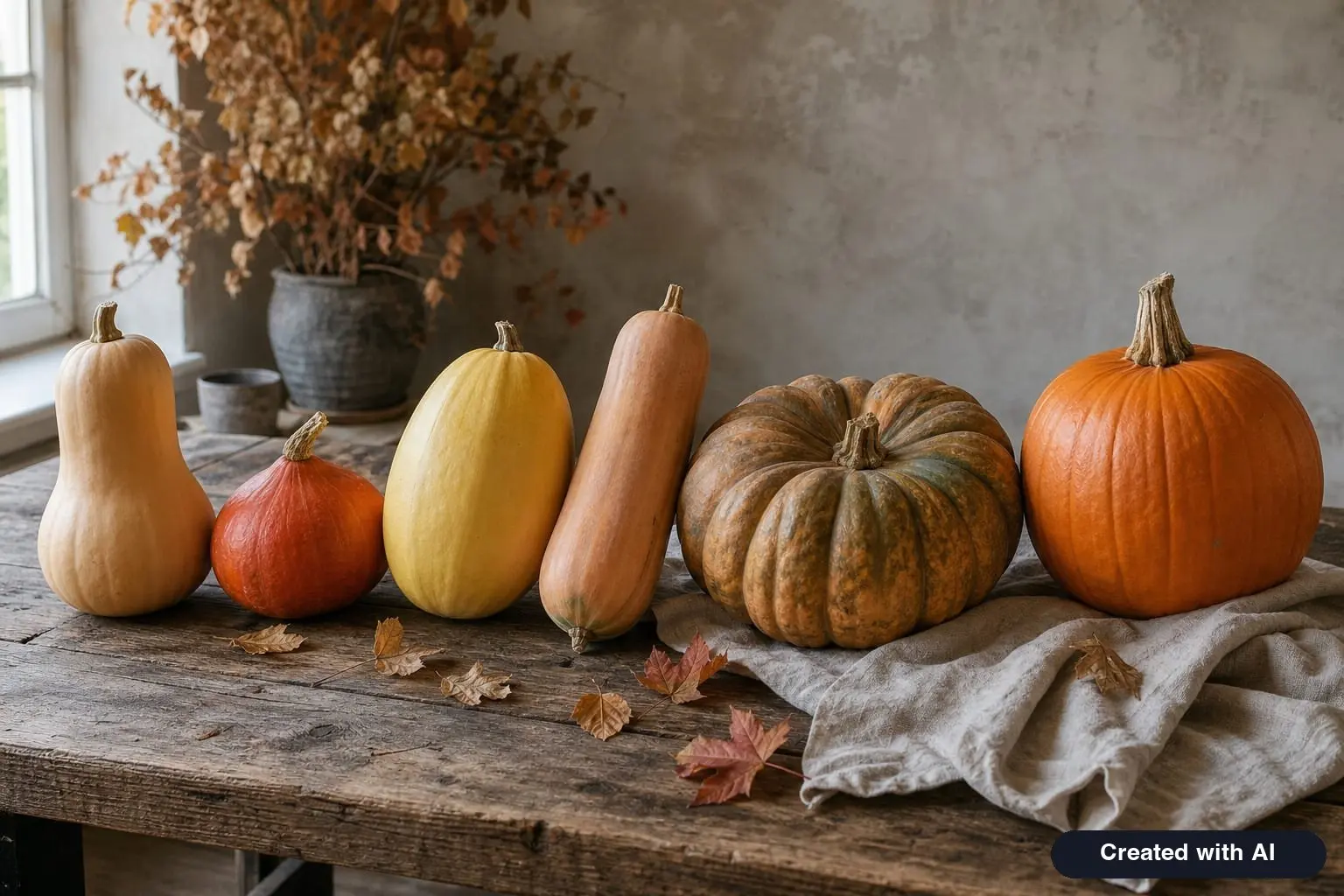
Types of pumpkins differ more than it seems when looking at the produce stand: one has dense, sweet flesh like a chestnut, another is watery and only good for soup, and a third breaks down into pasta-like strands when baked. That's why the same recipe can either shine or disappoint, depending on the pumpkin you use. Butternut squash, muscat, Hokkaido, spaghetti squash, banana squash, and giant pumpkins are six groups you will encounter most often, and each has its own best uses.
Botanists divide all edible pumpkins and squashes into several species. The three most important are: the giant pumpkin (which includes Hokkaido, banana, and record-breaking giants), the muscat or fragrant squash (which includes butternut), and the common pumpkin (spaghetti, oilseed, Halloween pumpkins, as well as zucchini and pattypan squash). All of them are annual plants: sown in the spring, they mature their fruit in the fall and die off, so the question of whether a pumpkin is an annual or a biennial has a clear answer—it is an annual.
Below you'll find how the types differ and which one to choose for which dish, how many calories a pumpkin has, whether it is a fruit or a vegetable, how to tell when it is ripe, how to store it, and what to do with the seeds.
Types of pumpkins: how they differ and what they are best for
When choosing a pumpkin for a dish, three things matter: how much water is in the flesh, how sweet it is, and whether the skin needs to be peeled. Dense, drier pumpkins (butternut, Hokkaido) are great for roasting, blending into thick soups, and adding to batter. Watery, large pumpkins are better suited for porridge, jam, and pickling.
| Type | Appearance | Flesh and taste | Peel? | Best for |
|---|---|---|---|---|
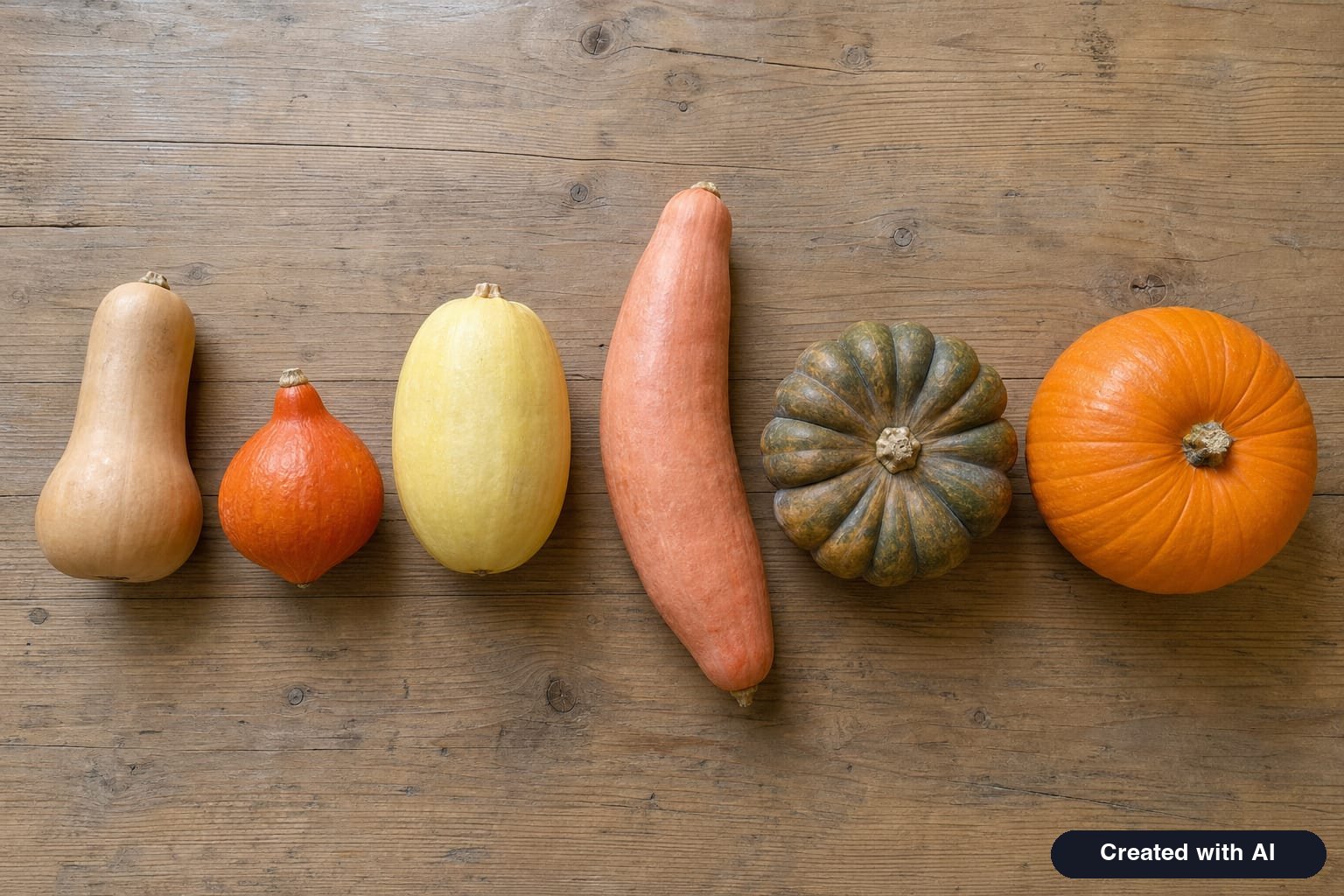
| Butternut squash | Pear-shaped, beige, 2–4 lb (1–2 kg) | Dense, bright orange, sweet, nutty flavor | Yes, but the skin is thin—a peeler is enough | roasted pumpkin, creamy pumpkin soup, pie, purée |
| Muscat squash | Large, flat, deeply ribbed, green turning brown as it ripens; 11–33 lb (5–15 kg) | Juicy, aromatic, sweet | Yes | soup with coconut milk, jam, juice |
| Hokkaido | Small, round, bright orange, 2–4 lb (1–2 kg) | Dry, starchy, chestnut flavor | No—the skin softens when baked | roasted pumpkin soup, stew, roasting in wedges |
| Spaghetti squash | Oval, light yellow, 2–5.5 lb (1–2.5 kg) | Neutral, breaks into strands when baked | No—strands are scraped out with a fork | side dish instead of pasta, stuffed squash |
| Banana squash | Elongated, cylindrical, pinkish or yellowish, 6.5–22 lb (3–10 kg) | Orange, sweet, without coarse fibers | Yes | porridge and purée, pancakes, muffins |
| Giant pumpkin | Large, round or flat, orange, yellow, gray; from 11 lb (5 kg) | More watery, mild flavor | Yes, the skin is thick | porridge, pickled pumpkin and juice for winter, jam |
If you are buying one pumpkin for "everything," choose butternut or Hokkaido: both are great for soup, roasting, and sweet baked goods. A large watery pumpkin is worth buying when you plan to make porridge, jam, or prepare preserves for winter.
Butternut squash
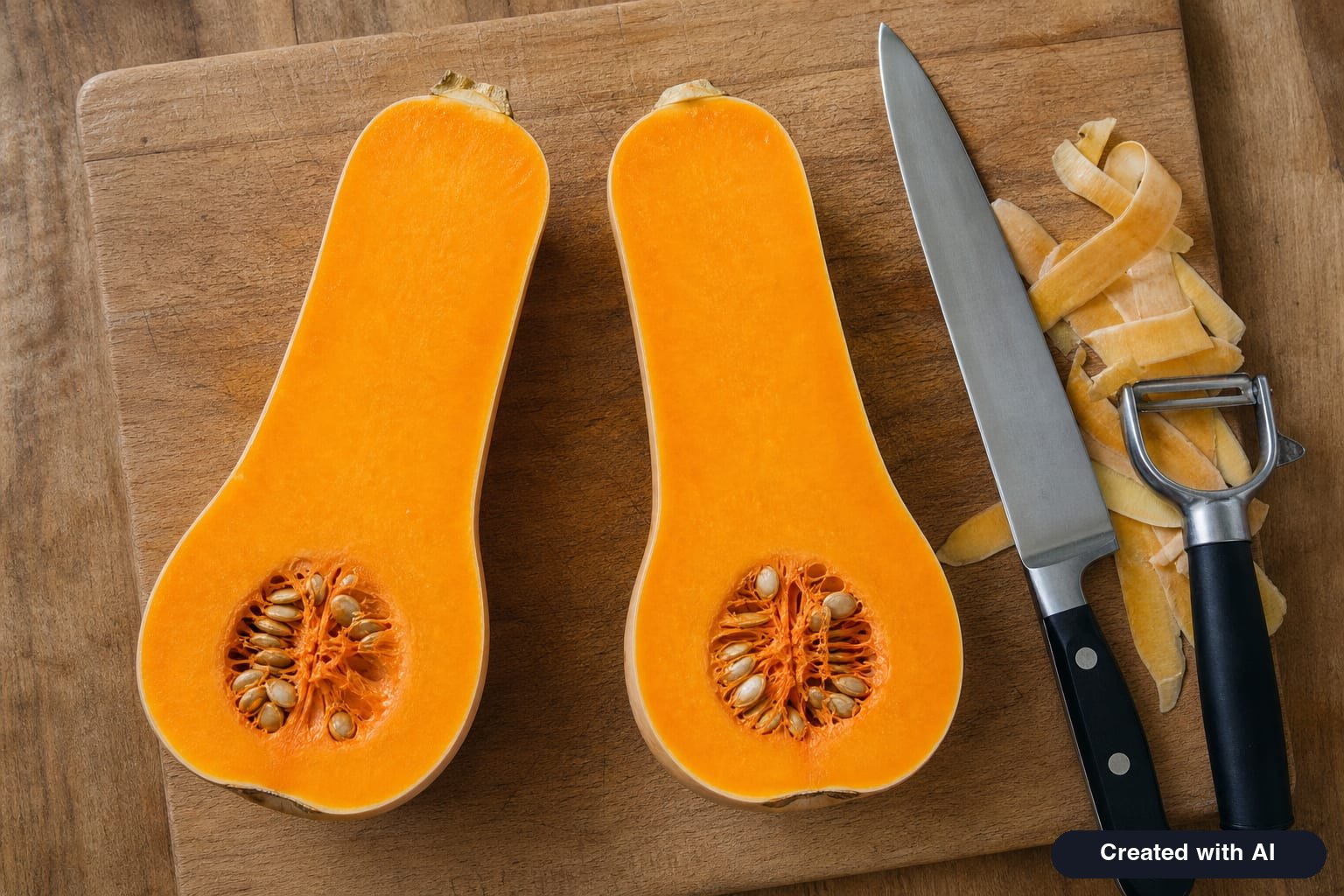
It is hard to confuse the appearance of a butternut squash: it resembles an elongated pear with a thick neck and a bulbous end, and its skin is smooth and beige or cream-colored. Botanically, butternut squashes are a cultivar group of the muscat squash.
Its biggest advantage is minimal waste. The seeds only fit in the bottom, bulbous part, while the entire neck is solid flesh, so a 2 lb (1 kg) squash yields about 1.75 lb (800 g) of peeled flesh. The skin is thin and can be removed with a simple vegetable peeler. The flesh is dense, not watery, caramelizes when roasted, and becomes as smooth as cream when blended—hence the "butter" in its name.
Muscat squash
In stores, muscat usually refers to a large, flat, deeply ribbed pumpkin that resembles a cushion. Its skin is initially dark green, turning brownish-orange with a bluish bloom as it ripens and is stored. Because of its size, it is often sold cut into pieces—revealing a bright, rich orange flesh color.
Muscat squash is juicier than butternut and very aromatic, making it especially suitable for soups, juices, and jams. It is a heat-loving variety: in cooler climates during a chilly summer, the fruits do not always have time to fully ripen outdoors and finish ripening after being harvested.
Hokkaido pumpkin
Hokkaido (also known as red kuri squash) is a small Japanese pumpkin belonging to the giant pumpkin species. Its shape resembles an onion or a teardrop, the skin is bright orange, and the flesh is dry, starchy, and tastes like chestnuts. There are also green-skinned varieties.
The most important feature of Hokkaido is that it doesn't need to be peeled. The thin skin softens when boiled or baked and is blended along with the flesh, so preparation takes just a few minutes: wash, cut in half, and scoop out the seeds. One 2–3 lb (1–1.5 kg) pumpkin is enough for a pot of soup for 4 people. Because the flesh has little water, it requires slightly more liquid for soup than butternut squash.
Spaghetti squash
Spaghetti squash is an oval, light yellow relative of the common pumpkin. Its raw flesh looks normal, but when boiled or baked, it breaks down into long, thin strands resembling pasta. The flavor is mild, almost neutral, so it is eaten with sauces.
The simplest spaghetti squash recipe: cut the squash in half lengthwise, scoop out the seeds, rub the cut side with a tablespoon of oil, salt it, and place it cut-side down on a baking sheet. Bake in a 400°F (200°C) oven for 35–45 minutes until the skin yields when pressed with a finger. Then scrape with a fork from the edge to the center—the flesh will separate into strands. Serve with tomato sauce, butter, and grated cheese, or with stewed meat. This type is not suitable for soup or porridge: the strands do not blend into a smooth mass.
Banana squash
Banana squash is elongated and cylindrical, with a smooth pinkish, yellowish, or bluish-gray skin. It grows to 20–30 inches (50–80 cm) in length and weighs from 6.5 to 22 lb (3 to 10 kg), sometimes more. The flesh is thick, orange, sweet, without coarse fibers, and the seed cavity is narrow.
Because of its sweetness and smooth texture, banana squash is primarily suited for sweet dishes: porridge, purée, pancakes, and baked goods. The elongated squash is easy to slice into rounds one by one—the remaining part, with the cut wrapped in plastic wrap, will keep in the fridge for a few days. You don't need a specific banana squash recipe: it works anywhere a recipe calls for sweet orange pumpkin.
Giant pumpkin
The giant pumpkin is both a botanical species name and what we usually imagine when we hear the word "pumpkin": a large, round or flattened, orange, yellow, or gray fruit from the garden. It's the old-fashioned everyday pumpkin grown for porridge and canning. Its flesh is more watery and less sweet, so it is worth using less liquid when making soup with it, and squeezing out the grated mass before frying pancakes.
This species also includes giant varieties grown for competitions. At growers' contests the biggest fruits weigh hundreds of kilograms (well over 400 lb), and world record holders top a metric ton (2,200 lb). For food, such giants are of little value—the flesh is watery and bland.
Other types and names
- Oilseed pumpkin – a variety of the common pumpkin whose seeds do not have a hard shell. It is grown for its seeds and dark green seed oil; the flesh is not tasty.
- Malabar gourd (fig-leaf gourd) – green with white spots, resembling a watermelon, with black seeds. The flesh is white and fibrous, mostly used for jam.
- Wax gourd (winter melon) – an Asian vegetable that is only a distant relative of true pumpkins; the elongated fruit is covered with a waxy bloom.
- Sugar and pineapple pumpkins – commercial variety names indicating sweetness or aroma. When buying seeds or fruit, it is worth checking which species the variety belongs to.
- White, yellow, orange pumpkin. The color of the skin says little about the taste: a white pumpkin can be orange inside, and a yellow one can be pale. A more reliable indicator is the color of the flesh: the richer it is, the sweeter the pumpkin usually is.
Butternut squash: recipes it is best suited for
Butternut squash recipes rely on the fact that the flesh is dense and sweet. Here is where it works best:
- Roasting in the oven. 1-inch (2–3 cm) cubes tossed with oil and salt bake at 400°F (200°C) in 25–30 minutes and brown beautifully. The full method with garlic, cheese, and feta is in the article on roasted pumpkin. The neck part is easy to slice into rounds, while the bottom can be cut in half and stuffed.
- Soup. Blended butternut squash becomes creamy even without heavy cream. Both classic creamy pumpkin soup and roasted pumpkin soup work well, where its sweetness is most pronounced.
- Purée for baking. Because it has little water, the purée comes out thick—exactly what is needed for pumpkin pie and muffins. How to make it is described in pumpkin porridge and purée.
- Stews. The cubes do not fall apart when stewed, making it perfect for pumpkin stew with chicken or chickpeas.
Where butternut squash works less well is for grated pumpkin pancakes (the mixture is a bit dry and needs more buttermilk or kefir) and jam, where a juicier fruit is desired.
Is a pumpkin a fruit or a vegetable?
Both answers are correct, they just refer to different things. Botanically, a pumpkin is a fruit: it develops from a flower and contains seeds inside. More precisely, it is a hard-rind berry—cucumbers and watermelons have the same type of fruit. So to those asking if a pumpkin is a berry, a botanist would say "yes".
In the kitchen and grocery store, a pumpkin is considered a vegetable: it is grown in a garden, usually boiled or baked, and eaten as soup, a side dish, or stew. The pumpkin plant itself is an annual creeping or climbing vine with large leaves and yellow flowers. The flowers, by the way, are also edible: pumpkin blossoms can be battered and pan-fried or stuffed with ricotta or farmer cheese and baked in the oven.
How many calories are in a pumpkin and its nutritional value
Pumpkin is one of the lowest-calorie fall vegetables. According to the Firmus Medicus calorie database, 3.5 oz (100 g) of raw pumpkin has 26 kcal. Butternut squash is denser and sweeter, so its energy value is higher—45 kcal per 3.5 oz (100 g). Pumpkin seeds are a completely different product: 3.5 oz (100 g) has 559 kcal.
| 3.5 oz (100 g) of product | Calories | Carbs | Of which sugars | Fiber | Protein | Fat |
|---|---|---|---|---|---|---|
| Pumpkin | 26 kcal | 6.5 g | 2.8 g | 0.5 g | 1 g | 0.1 g |
| Butternut squash | 45 kcal | 11.7 g | 2.2 g | 2 g | 1 g | 0.1 g |
| Pumpkin seeds | 559 kcal | 10.7 g | 1.4 g | 6 g | 30.2 g | 49 g |
The table shows that pumpkin has almost no fat or protein—its energy comes from carbohydrates. Butternut squash has almost twice as many carbs as a regular pumpkin, but also four times as much fiber. The calories in a dish depend mostly not on the pumpkin, but on what is added to it: heavy cream, butter, sugar, and oil matter much more than the chosen variety.
Benefits of pumpkin
The benefits of pumpkin for the body are primarily linked to the fact that it is filling but low in calories: a large portion of soup or roasted pumpkin fills the plate while providing little energy. The orange color of the flesh comes from beta-carotene, which the body converts into vitamin A; pumpkin also contains vitamin C, potassium, and fiber. The richer the color of the flesh, the more carotenoids it contains—which is why the benefits of butternut squash are often mentioned separately. Carotenoids are fat-soluble, so a spoonful of oil or sour cream with your pumpkin isn't just a matter of taste.
However, pumpkin is food, not medicine. It fits well into a varied, vegetable-rich diet, but it does not cure any diseases.
- Pumpkin and cholesterol. Pumpkin itself has no cholesterol, almost no fat, and contains fiber. It is a suitable product for a heart-healthy diet, but it will not regulate blood cholesterol levels on its own—discuss this with a doctor.
- Pumpkin and diabetes. There are few carbs in pumpkin—6.5 g per 3.5 oz (100 g), and 11.7 g in butternut squash. The glycemic index of cooked pumpkin is reported as quite high in sources, but a typical serving has few carbs. Whether pumpkin is suitable for diabetics and in what portions is decided individually with a doctor or dietitian; sweet pumpkin dishes with sugar are another matter.
- Does pumpkin cause bloating or constipation? For most people, cooked pumpkin is easily digestible. Due to the fiber, a large portion, especially of raw pumpkin, can cause bloating for a sensitive gut. Pumpkin generally does not cause constipation.
- Pumpkin for kids. Mild-tasting puréed pumpkin is one of the most common first vegetable foods. How to prepare it for children and babies is covered in the article on pumpkin porridge and purée; coordinate the timing of introducing solids with your pediatrician.
- Pumpkin for dogs. A small amount of boiled or baked pumpkin without salt, spices, or sugar is generally safe for dogs. Do not give them the skin, stem, raw pumpkin, or sweet baked goods, and consult a vet before changing your pet's diet.
When is a pumpkin ripe and how to choose one
In the garden, pumpkins are harvested in September or early October, strictly before the first frost: a frostbitten fruit spoils quickly. A ripe pumpkin shows several signs:
- The stem is dry, woody, and corky. A green and juicy stem means the fruit was picked too early.
- The rind is hard—it doesn't dent when pressed with a fingernail. The color is uniform and typical of the variety, and the surface is matte.
- The sound when tapped is hollow, and the pumpkin itself feels heavy for its size.
When harvesting, leave a 2–4 inch (5–10 cm) stem: without it, rot enters through the wound and the pumpkin won't store long. At the store, choose a fruit without soft spots, cracks, or mold near the stem.
What does a green pumpkin mean? If it's a green-skinned variety (some Japanese pumpkins, young muscat), the green color is normal, and the flesh inside is orange. If an orange variety pumpkin is still green, it is unripe: keep it in a warm, bright place for 2–3 weeks—it usually colors up and sweetens. An unripe pumpkin can be used like zucchini: stewed, pan-fried, or added to soup, just don't expect sweetness from it. Raw pumpkin recipes often just mean uncooked pumpkin: sweet butternut or Hokkaido can be finely grated into a salad with apple and lemon juice.
Pre-cut pumpkin is convenient when you don't need a whole large fruit. Make sure the cut is bright and moist, not dried out or slimy, and use it within a few days. Organic pumpkin doesn't necessarily taste different—variety and ripeness matter more—but if you eat Hokkaido with the skin, scrub it well with a brush either way.
How to store a pumpkin
A healthy, ripe winter squash with a thick stem is one of the longest-lasting harvest fruits. It needs a dry, ventilated, cool but not cold place: 50–60°F (10–15°C) is ideal. In a cellar where it is damp and colder than 46°F (8°C), pumpkins spoil faster than in an unheated room or pantry.
| Pumpkin | Where to store | How long it lasts |
|---|---|---|
| Hokkaido, spaghetti | 50–60°F (10–15°C), dry | 2–4 months |
| Butternut, muscat | 50–60°F (10–15°C), dry | 4–6 months |
| Giant, banana | 50–60°F (10–15°C), dry | 3–6 months |
| Cut, with skin | In the fridge, cut covered with plastic wrap | 4–5 days |
| Peeled, cubed | In the fridge, in an airtight container | 2–3 days |
| Cubes or purée | In the freezer, 0°F (-18°C) | 8–10 months |
Place stored pumpkins in a single layer so they don't touch, and check them every couple of weeks—use the ones with a broken stem or damaged skin first. Butternut and muscat squashes even get sweeter in storage. How to freeze, pickle, and otherwise prepare preserves is detailed in the article on pickled pumpkin.
Pumpkin seeds: preparation and how to use them
It's not worth throwing away pumpkin seeds—they are edible from all types, though the seeds of giant pumpkins are larger and their shells are harder. The seeds are calorie-dense: 3.5 oz (100 g) has 559 kcal, 30.2 g of protein, and 49 g of fat, so a 1 oz (30 g) handful is about 168 kcal. It's a filling snack, and you only need a little.
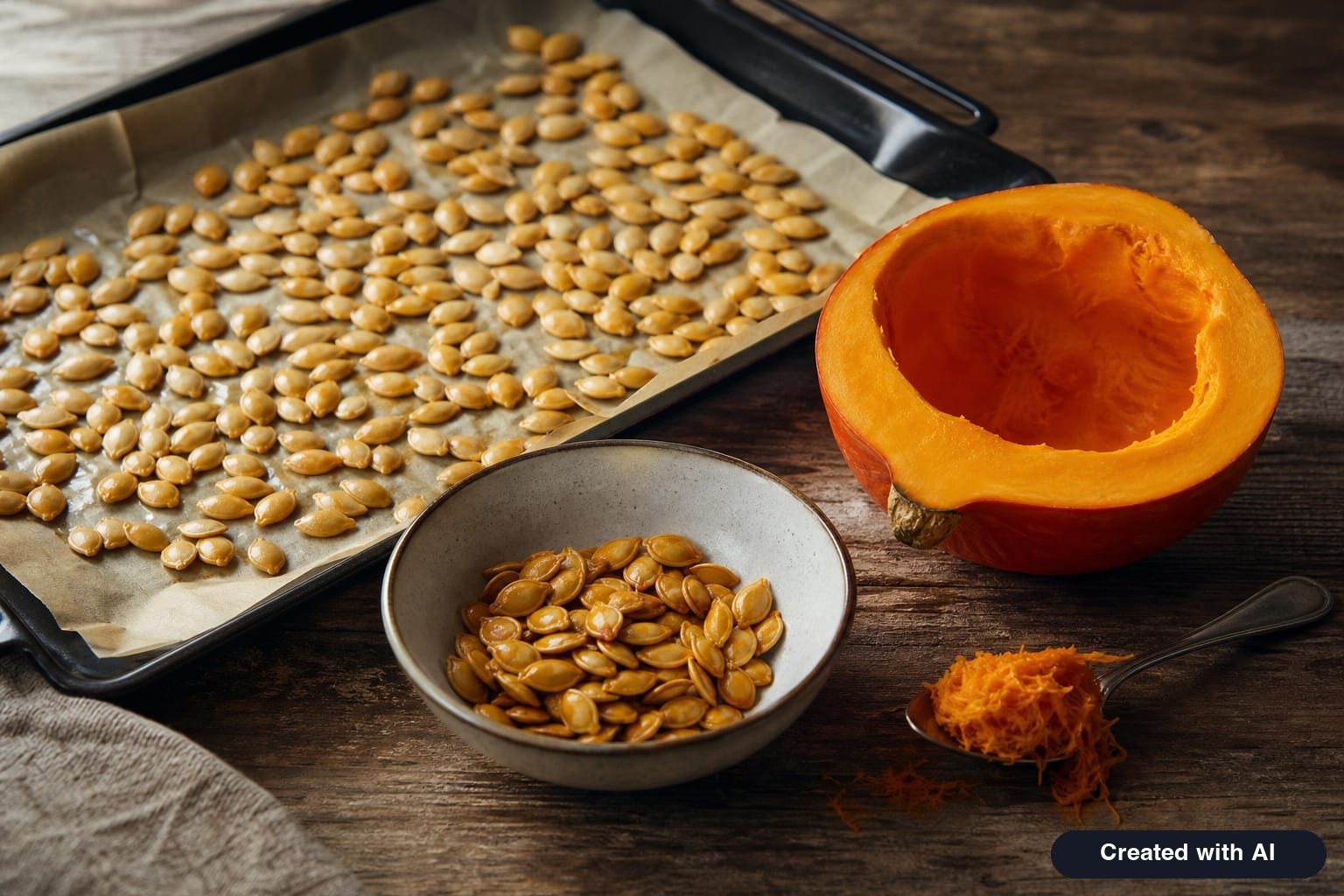
Preparing pumpkin seeds is simple:
- Put the scooped-out seeds in a bowl of water and separate them from the pulp with your fingers—the seeds will float to the top.
- Rinse in a colander and spread them on a towel. Dry for at least an hour, preferably overnight.
- Toss 7 oz (200 g) of seeds with a teaspoon of oil and half a teaspoon of salt, and spread them in a single layer on a baking sheet.
- Roast in a 320°F (160°C) oven for 15–20 minutes, stirring once. The seeds are ready when they turn golden and start popping. At higher temperatures, they quickly become bitter.
Seeds with the shell are crunchy and eaten whole; if you want raw kernels without the shell, it's easier to buy them hulled or grow an oilseed pumpkin. Pumpkin seed recipes are usually very simple: roasted seeds are sprinkled on pumpkin soup, salads, and porridge, and they are added to bread dough and granola.
Pumpkin seed oil is dark green with a nutty scent. It is not suitable for frying: when heated, it becomes bitter and loses its aroma. In recipes, it is used cold—drizzled by the teaspoon over soup, salads, boiled potatoes, or cottage cheese. Pumpkin seed flour is made by grinding the pressed seeds; it is high in protein and gluten-free, so it doesn't bind dough. In baked goods, it replaces no more than 10–20% of all-purpose flour—for example, 1/4 cup (30–40 g) out of 1 1/2 cups (200 g)—in pancakes, muffins, or bread.
Once you've chosen a pumpkin, all that's left is to decide what to make with it. The easiest way to start is with creamy pumpkin soup or roasted pumpkin, and for sweet lovers—with pumpkin pie. You can find all the ideas in one place in the overview of pumpkin recipes.
Frequently asked questions
Is a pumpkin a fruit or a vegetable?
Botanically, a pumpkin is a fruit—specifically, a hard-rind berry—because it develops from a flower and contains seeds. In the kitchen and grocery store, it is considered a vegetable since it is grown in a garden and usually cooked or baked.
How many calories are in a pumpkin?
A 3.5 oz (100 g) serving of raw pumpkin has 26 kcal and 6.5 g of carbs. Butternut squash is denser, with 45 kcal and 11.7 g of carbs per 3.5 oz (100 g). Pumpkin seeds have 559 kcal per 3.5 oz (100 g), so a 1 oz (30 g) handful is about 168 kcal.
What is the difference between butternut squash and Hokkaido pumpkin?
Butternut squash is pear-shaped and beige with a thin peel, and its flesh is dense and sweet. Hokkaido is small, round, bright orange, drier, and tastes like chestnuts; its skin doesn't need peeling as it softens when cooked.
What recipes are best for butternut squash?
Butternut squash is best for roasting (1-inch/2–3 cm cubes bake at 400°F/200°C in 25–30 minutes), creamy soups, thick purées for pies and muffins, and stews because the cubes hold their shape. A 2 lb (1 kg) squash yields about 1.75 lb (800 g) of peeled flesh.
How do you prepare spaghetti squash?
Cut it in half lengthwise, scoop out the seeds, rub the cut side with oil, salt it, and bake cut-side down at 400°F (200°C) for 35–45 minutes. Then scrape with a fork from the edge to the center—the flesh will separate into strands you can eat with sauce instead of pasta.
When is a pumpkin ripe?
A ripe pumpkin has a dry, woody stem and a hard rind that can't be pierced with a fingernail. The color is uniform, and it sounds hollow when tapped. In the garden, pumpkins are harvested in September or early October, before the first frost, leaving a 2–4 inch (5–10 cm) stem.
What should I do if my pumpkin is green?
If it's a green-skinned variety, the color is normal and the flesh inside is orange. If an orange variety is unripe, keep it in a warm, bright place for 2–3 weeks to color up, or use it like zucchini—stew it, fry it, or add it to soup.
How do you prepare pumpkin seeds?
Wash the seeds, separate them from the pulp, and dry them for at least an hour. Toss 7 oz (200 g) of seeds with a teaspoon of oil and half a teaspoon of salt, and roast in a 320°F (160°C) oven for 15–20 minutes, stirring once.
Log in to comment
No comments yet. Be the first.