Roasted Pumpkin with Garlic: Recipe and Roasting Times
- Baking time chart based on piece size and pumpkin variety—from cubes to a whole pumpkin
- Garlic is roasted in its skin, and honey is added only after flipping—nothing burns or turns bitter
- Variations with feta, cheese, pan-fried, air-fried, and a stuffed pumpkin with ground meat
- Ingredients and How to Choose Them
- How to Roast Pumpkin in the Oven: Step by Step
- How Long to Roast Pumpkin: Times by Piece Size and Variety
- Common Mistakes
- Variations: With Cheese, Feta, Butternut Squash
- Pan-Fried Pumpkin
- Air Fryer Pumpkin
- Oven-Stuffed Pumpkin
- Boiled and Steamed Pumpkin: How Long to Cook
- Lighter Version: What Each Change Does
- How Many Calories Are in Roasted Pumpkin
- What to Serve With, How to Store and Freeze
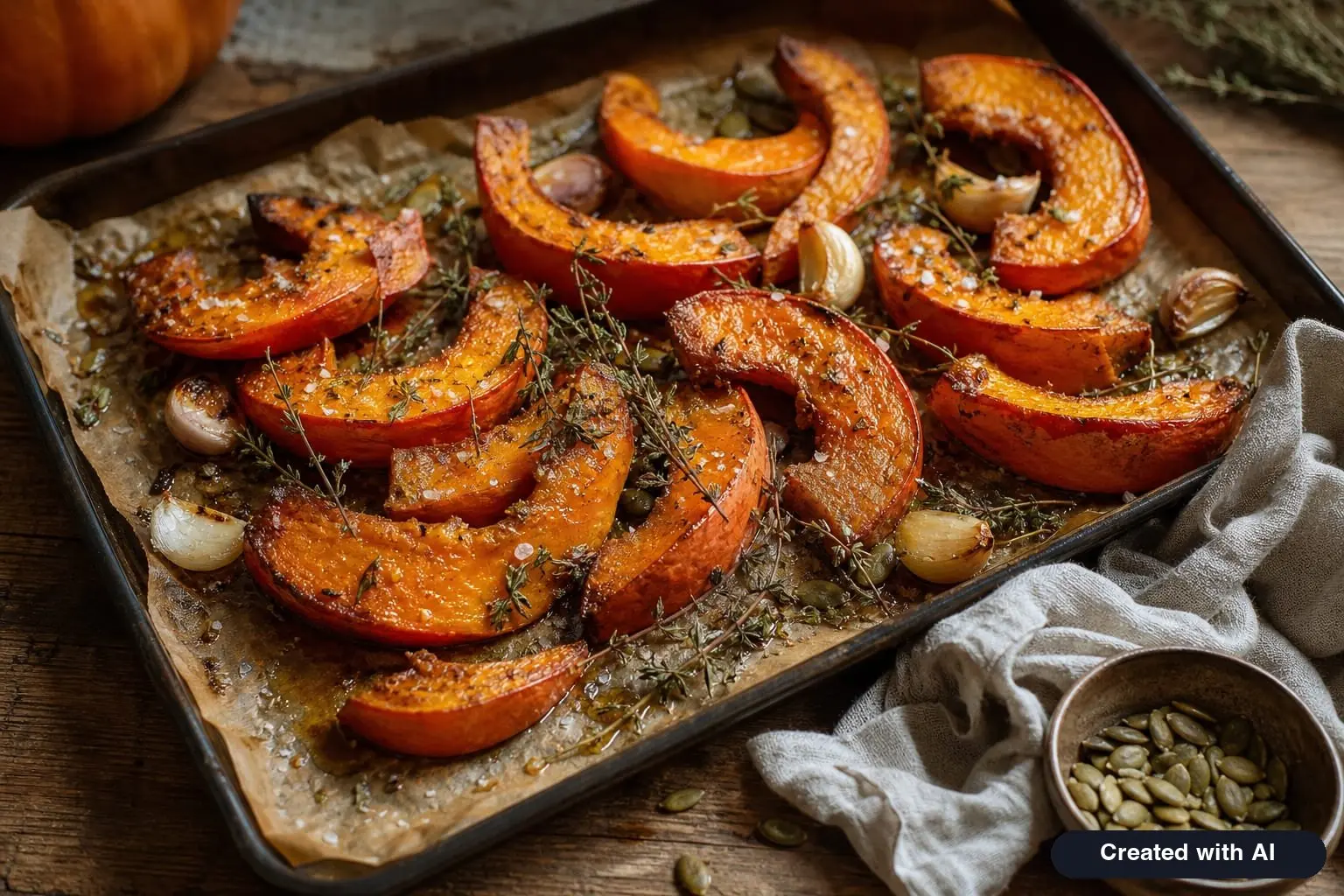
Roasted pumpkin is the easiest way to taste just how sweet this fall harvest truly is. In the heat of the oven, some of the water evaporates from the pieces, the sugars on the surface caramelize, the edges turn brown, and the inside remains as soft as chestnut purée. This doesn't happen when boiling: water dilutes the flavor, while roasting concentrates it.
Of all oven-roasted pumpkin recipes, this is the basic one: roasted pumpkin with garlic, olive oil, thyme, and a drop of honey. It requires no flour, no eggs, and no special skills—only three things matter: evenly sized pieces, a hot enough oven, and an uncrowded baking sheet. Everything else—cheese, feta, seeds, or heat—is added according to your mood.
From 2.2 lb (1 kg) of peeled pumpkin, you get 4 servings of a side dish for meat, fish, or grains, or 2 hearty servings if you eat the roasted pumpkin as a main course with cheese and a salad. One serving has about 135 kcal. Prep takes 15 minutes, and baking takes 30–35 minutes. These same roasted pumpkin pieces are also great for later: in salads, pasta, stews, or roasted pumpkin soup.
The recipe is in the card below: you can adjust the quantities for a different number of servings, check off what you've already added, and print it out. Below that, you'll find a baking time chart based on piece size and pumpkin variety, as well as how to cook pumpkin in a pan, in an air fryer, and how to make stuffed pumpkin.
Oven-Roasted Pumpkin with Garlic
No ratings yet – be the firstIngredients
Directions
- Oven. Preheat the oven to 400°F (200°C) (or 375°F / 190°C for convection) and preheat an empty baking sheet at the same time.
- Pumpkin. Cut the pumpkin in half and scoop out the seeds. Leave the skin on red kuri squash; cut the skin off other varieties. Cut into uniform 1- to 1¼-inch (2.5–3 cm) thick wedges or cubes.
- Spices. In a bowl, toss the pumpkin with oil, salt, pepper, and thyme, and add the unpeeled, lightly crushed garlic cloves.
- Baking sheet. Spread the pieces on the hot, parchment-lined baking sheet in a single layer, cut side down, leaving at least ½ inch (1 cm) of space between them.
- Baking. Bake on the middle rack for 20 minutes, until the bottom side is browned.
- Flipping. Flip the pieces, drizzle with honey, and bake for another 10–15 minutes, until a knife easily pierces the thickest part and the edges turn dark golden.
- Serving. Squeeze the roasted garlic out of its skins over the pumpkin. Serve hot or warm, optionally with feta, cheese, or seeds.
- Calories
- 135 kcal
- Protein
- 2.7 g
- Fat
- 7 g
- of which saturated
- 1.1 g
- Carbohydrates
- 18.8 g
- of which sugars
- 8.4 g
- Fiber
- 1.4 g
Calculated with the Firmus Medicus calorie database (USDA, Fineli).
Ingredients and How to Choose Them
Pumpkin. All edible pumpkins and squashes are suitable for roasting, but the results vary. Red kuri squash has a thin skin that softens during baking, so it doesn't need peeling—just wash it and remove the seeds. Butternut squash is sweeter, denser, less watery, and holds its shape best. Large orange and muscat pumpkins are more watery: their skin needs to be cut off, and the pieces should be cut larger so they don't fall apart. You can read more about the differences between varieties and what each is best for in our article on types of pumpkins. The recipe calls for a 2.8 lb (1.3 kg) pumpkin—after removing the seeds and skin, you're left with about 2.2 lb (1 kg) of flesh.
Oil. Two tablespoons of olive oil are enough for 2.2 lb (1 kg) of pumpkin: the pieces should be glossy, but there shouldn't be a puddle in the pan. The oil transfers heat to the surface and helps it brown; completely without fat, the pumpkin dries out and remains bland. Canola oil or melted butter also works well.
Garlic. Add the cloves unpeeled, just lightly crushed with the side of a knife. In its skin, the garlic roasts into a soft, sweet purée in half an hour without burning. Minced garlic burns at 400°F (200°C) in 10–15 minutes and turns bitter—this is the most common reason why roasted pumpkin with garlic tastes bitter.
Honey and spices. A teaspoon of honey doesn't sweeten the dish; it helps the edges caramelize. It's added only after flipping the pieces, because honey baked from the very beginning will burn. Thyme can be replaced with rosemary, sage, or oregano. Don't skimp on the salt—unsalted roasted pumpkin tastes bland, no matter how sweet it is.
How to Roast Pumpkin in the Oven: Step by Step
Preheat the oven to 400°F (200°C) (or 375°F / 190°C for convection) and preheat an empty baking sheet at the same time. Pieces placed on a hot baking sheet start roasting on the bottom immediately instead of steaming, so they brown on both sides.
Cut the pumpkin in half and scoop out the seeds and stringy bits with a spoon. Leave the skin on red kuri squash; cut the skin off other varieties with a sharp knife or vegetable peeler. Cut into 1- to 1¼-inch (2.5–3 cm) thick wedges or cubes of the same size. The most important thing is uniformity: if the pieces are different sizes, the small ones will burn before the large ones soften.
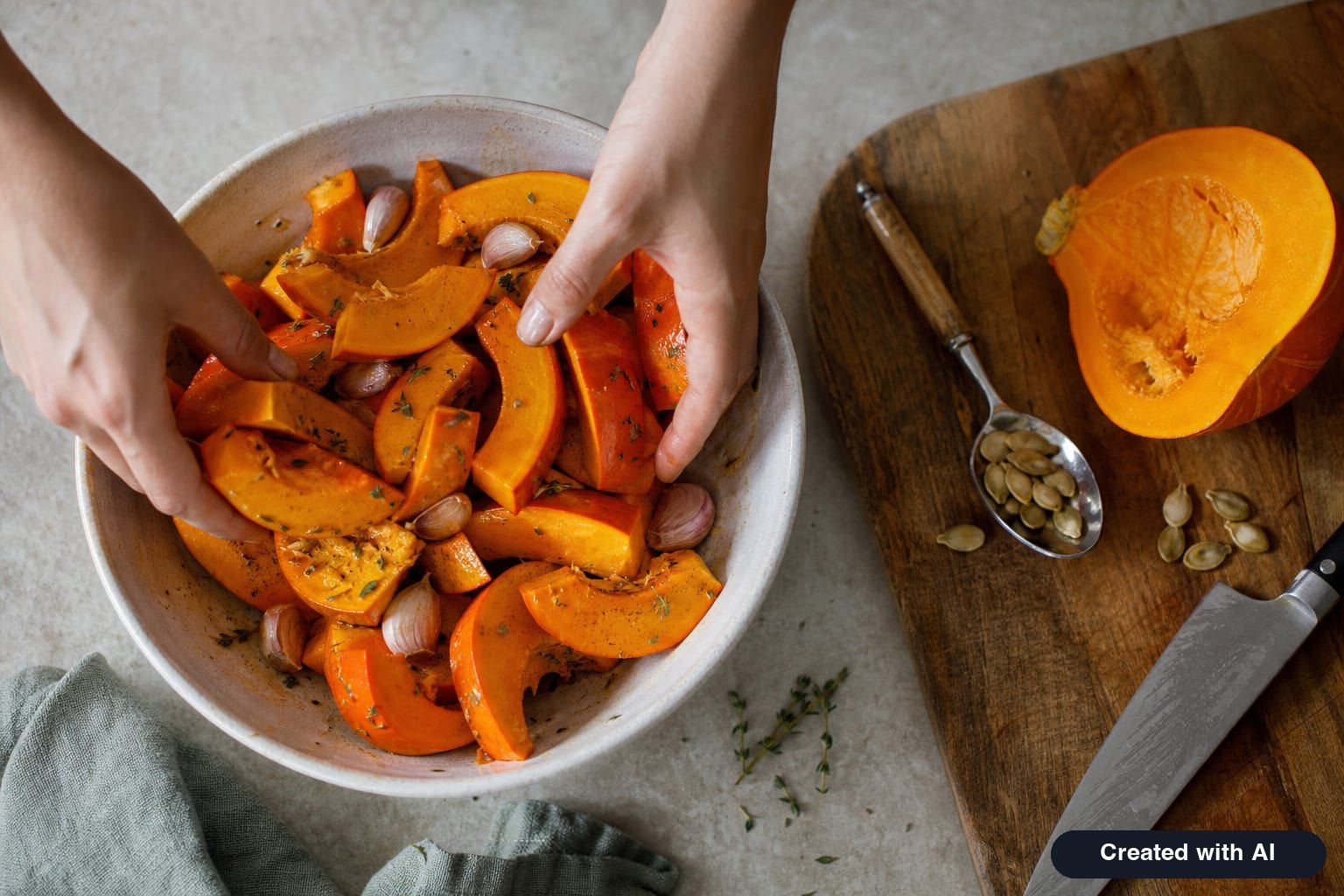
In a bowl, toss the pumpkin with oil, salt, pepper, and thyme, and toss in the unpeeled garlic cloves. Mix with your hands until every piece is glossy. This is easier to do in a bowl than on a baking sheet, and it uses less oil.
Spread the pieces on the hot, parchment-lined baking sheet in a single layer, cut side down, leaving at least ½ inch (1 cm) of space between them. This is the second most important rule: crowded pieces steam each other, moisture builds up in the pan, and the pumpkin boils instead of roasting. If you are baking more than 2.2 lb (1 kg), use two baking sheets.
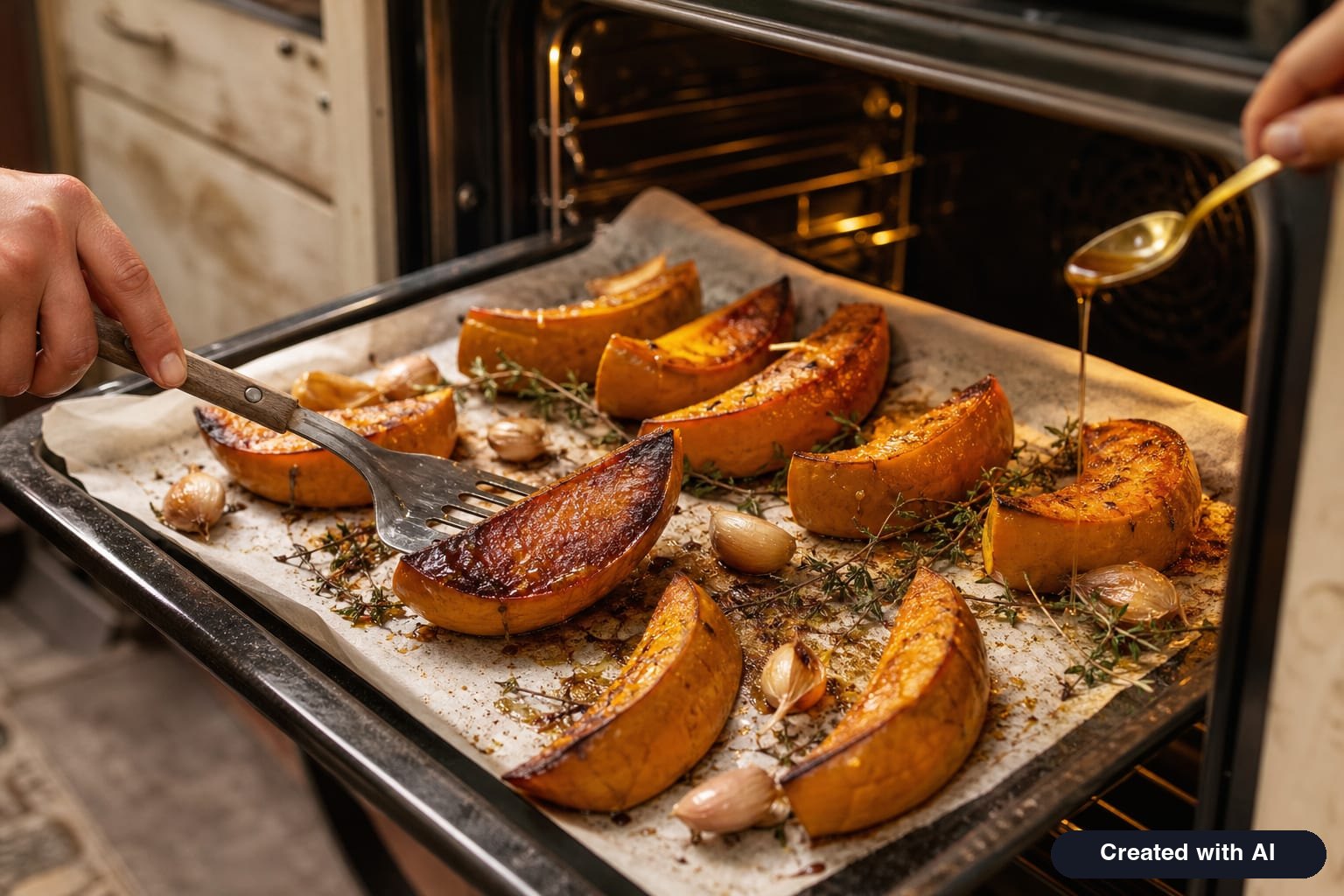
Bake for 20 minutes, then flip the pieces, drizzle with honey, and bake for another 10–15 minutes. The pumpkin is done when the tip of a knife slides into the thickest part without resistance, and the edges are dark golden. Pale yellow, soft pieces without brown edges aren't quite ready: leave them in for 5 minutes longer.
Squeeze the roasted garlic cloves out of their skins over the pumpkin or mash them with a fork and mix with a tablespoon of oil for a quick sauce. Serve hot or warm.
How Long to Roast Pumpkin: Times by Piece Size and Variety
Baking time depends mostly on the thickness of the pieces, and less on the variety. The times in the table are for a preheated oven with the pieces arranged in a single layer. Check with a knife: the time is a guideline, not a rule, because pumpkins of the same size can vary in density.
| Cut type | Pumpkin variety | Temperature | Time |
|---|---|---|---|
| ½–¾ inch (1.5–2 cm) cubes | all varieties | 400°F (200°C) | 20–25 min. |
| 1–1¼ inch (2.5–3 cm) cubes | butternut, red kuri | 400°F (200°C) | 30–35 min. |
| 1–1¼ inch (2.5–3 cm) wedges with skin | red kuri | 400°F (200°C) | 30–40 min. |
| 1¼–1½ inch (3–4 cm) wedges without skin | muscat, large orange | 400°F (200°C) | 40–50 min. |
| Halves, cut side down | red kuri (2.2–2.6 lb / 1–1.2 kg) | 375°F (190°C) | 40–50 min. |
| Halves, cut side down | butternut (2.2–3.3 lb / 1–1.5 kg) | 375°F (190°C) | 45–60 min. |
| Halves, cut side down | spaghetti squash | 400°F (200°C) | 40–50 min. |
| Whole, uncut | small red kuri (about 2.2 lb / 1 kg) | 350°F (180°C) | 60–75 min. |
| Stuffed, with lid | red kuri, 2.6–3.3 lb (1.2–1.5 kg) | 350°F (180°C) | 70–80 min. |
Pumpkin baked in halves is perfect for purée, porridge, and soup: simply scoop out the baked flesh with a spoon. You can find out how to make purée from it and what to do with it in our article on pumpkin porridge and purée.
Common Mistakes
The pumpkin is soft but bland and wet. The baking sheet was overcrowded or the oven was too cool. Bake in a single layer with space between the pieces, at a temperature no lower than 400°F (200°C), and pat the pieces of watery varieties dry with a paper towel before baking.
The edges are burnt, but the inside is hard. The pieces are too large or the baking sheet was placed too high. Cut them no thicker than 1¼ inches (3 cm), bake on the middle rack, and if the top is browning too quickly, reduce the temperature to 350°F (180°C) and bake for 10 minutes longer.
Bitter taste. Minced garlic or honey burned. Roast the garlic in its skin, and pour the honey only during the second half of baking.
The pieces turned to mush. A watery variety was cut too small or stirred too often. Flip only once, using a wide spatula.
Variations: With Cheese, Feta, Butternut Squash
Roasted Pumpkin with Cheese
Don't sprinkle hard cheese at the beginning, but rather 8–10 minutes before the end of baking, when the pieces have already been flipped. 1.4 oz (40 g) of finely grated Parmesan melts into a crispy crust in that time; baked longer, it burns. If you want stringy cheese, sprinkle 2.8 oz (80 g) of grated melting cheese (like Gouda or mozzarella)—then a serving will have about 206 kcal.
Roasted Pumpkin with Feta
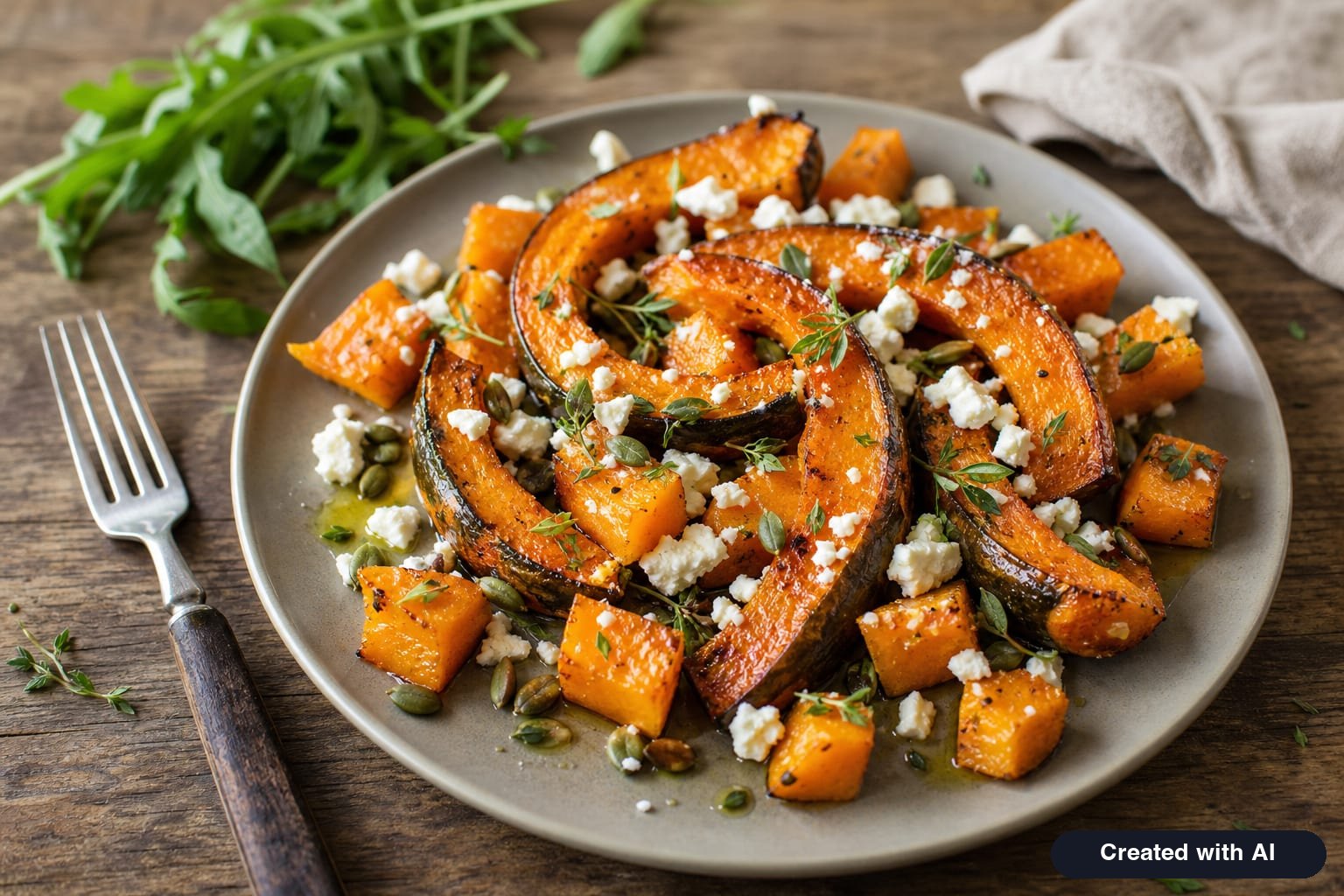
Feta doesn't melt, so you can use it in two ways. The first is to crumble 3.5 oz (100 g) of feta over the already baked, hot pumpkin: the cheese remains fresh and salty, contrasting with the sweet flesh. The second is to place a block of feta in the middle of the baking sheet for the last 10 minutes: it softens and becomes spreadable. In both cases, use half the amount of salt on the pumpkin, because feta is salty.
Roasted Pumpkin with Blue Cheese
Blue cheese pairs well with the sweetest varieties—butternut and red kuri. Crumble 2.8 oz (80 g) of cheese over the freshly baked pumpkin, sprinkle a handful of walnuts, and drizzle with an extra teaspoon of honey. Don't bake the blue cheese: heat makes it break down into a puddle of fat.
Roasted Butternut Squash
Butternut squash roasts in the oven just as described in the recipe, but it needs to be prepped differently. Cut off both ends, cut it where the narrow neck meets the bulb, and peel both parts with a vegetable peeler. The neck is solid flesh without seeds, so it yields neat cubes; scoop the seeds out of the round part and cut it into half-moons. 1-inch (2.5 cm) cubes bake in 30–35 minutes. Oven-roasted butternut squash is sweeter and denser, so honey isn't necessary, but sage, chili flakes, or a pinch of cinnamon go very well with it. If you want to bake it in halves, don't peel it: cut it lengthwise, scoop out the seeds, brush the cut side with oil, salt it, and bake cut side down for 45–60 minutes.
Other Spice Combinations
- Spicy: ½ tsp smoked paprika, a pinch of chili flakes, and a squeeze of lime or lemon juice when serving.
- Sweet: instead of garlic and thyme, use ½ tsp cinnamon, 1 tbsp honey or maple syrup, and a handful of nuts; great with oatmeal or yogurt.
- With balsamic vinegar: pour 1 tbsp of vinegar along with the honey—the acidity balances the sweetness.
- With seeds: add 1 oz (30 g) of pumpkin seeds for the last 5 minutes so they toast but don't burn.
Pan-Fried Pumpkin
Pumpkin cooks faster in a skillet than in the oven, but this method is only suitable for small amounts—14–18 oz (400–500 g) at a time in an 11-inch (28 cm) skillet. Cut into ½-inch (1.5 cm) cubes: larger ones will burn on the outside before softening inside. Heat 1½ tablespoons of oil over medium-high heat, add the pumpkin in a single layer, and don't stir for the first 3 minutes so the bottom side browns. Continue cooking for 8–10 minutes, stirring every couple of minutes. Add minced garlic, salt, and spices for the last 2 minutes.
If the cubes brown but remain hard, add 2 tablespoons of water, cover, and let sit for 2–3 minutes—the steam will finish the job. Another option is pan-fried pumpkin slices: salt ½-inch (1 cm) thick slices, dredge them in flour, and fry for 3–4 minutes on each side. This is usually how large orange pumpkins are cooked, as their cubes tend to fall apart in a pan.
Air Fryer Pumpkin
An air fryer is the fastest method for 1–2 servings. Cut 1 lb (500 g) of pumpkin into ¾-inch (2 cm) cubes, toss with 1 tablespoon of oil, salt, and spices. Air fry at 375°F (190°C) for 14–18 minutes, shaking the basket twice. ¾-inch (2 cm) thick wedges need 18–22 minutes. Don't load the basket with more than a single layer with slight overlapping—otherwise, the roasted pumpkin in the air fryer will be steamed, not crispy. Add honey and cheese for the last 3 minutes.
Oven-Stuffed Pumpkin
For a stuffed pumpkin, choose a round 2.6–3.3 lb (1.2–1.5 kg) red kuri squash—its skin is edible, and the walls are thick enough to hold the filling. For four servings, you need 14 oz (400 g) of ground meat, 3.5 oz (100 g) of rice, 1 onion, 2 garlic cloves, 2.8 oz (80 g) of grated melting cheese, 1 tablespoon of oil, and ½ cup (100 ml) of broth or water.
- Cut the top of the pumpkin off like a lid, and scoop out the seeds and stringy bits with a spoon. Salt and pepper the inside—otherwise, the flesh next to the filling will be bland.
- Boil the rice for 8 minutes and drain: it should remain undercooked, as it will finish cooking inside the pumpkin, absorbing the meat juices.
- Sauté the onion and garlic in oil for 3 minutes, add the ground meat, and cook for 6–8 minutes until no longer pink. Mix with the rice, broth, 1 tsp of salt, and your favorite spices.
- Spoon the filling into the pumpkin without packing it down, cover with the lid, place in a baking dish, and bake at 350°F (180°C) for 60–70 minutes, until a knife easily pierces the wall.
- Remove the lid, sprinkle with cheese, and bake for another 10 minutes. Slice into wedges like a cake so everyone gets both filling and pumpkin.
Stuffed pumpkin with ground pork has about 527 kcal per serving. With chicken—replacing the ground meat with 14 oz (400 g) of finely chopped chicken breast, sautéed for 5 minutes—it has about 384 kcal. For a meatless filling, buckwheat or quinoa with mushrooms and cheese works well. If the pumpkin is larger than 4.4 lb (2 kg), don't bake it whole; bake it in halves or thick rings: the walls will cook more evenly, and the time will be reduced to 45–50 minutes. You can find more hearty dishes—casseroles and stews—in our article on pumpkin stew.
Boiled and Steamed Pumpkin: How Long to Cook
If you need pumpkin for porridge, purée, or baby food, it's faster to boil it. ¾- to 1¼-inch (2–3 cm) cubes soften in boiling salted water in 10–15 minutes, while ½-inch (1.5 cm) cubes take 7–10 minutes. Steamed pumpkin takes a little longer—12–18 minutes—but it doesn't absorb water, making the purée thicker and sweeter. Boiled pumpkin is always blander in flavor than roasted, so for soup or pie, it's worth choosing roasting.
Lighter Version: What Each Change Does
Pumpkin itself is very light—almost half the calories in the dish come from the oil. Here is how each substitution or addition changes the calories per serving.
| Change | How | kcal / serving | Difference |
|---|---|---|---|
| Main recipe | as written above | 135 | – |
| Less oil | 1 tbsp (15 g) olive oil instead of 2 tbsp | 109 | −26 |
| Less oil and no honey | 1 tbsp oil, omit honey (suitable for sweet butternut or red kuri squash) | 103 | −32 |
| Butternut squash | 2.2 lb (1 kg) butternut squash flesh instead of regular pumpkin—sweeter, more fiber | 183 | +48 |
| With Parmesan | +1.4 oz (40 g) grated Parmesan for the last 8–10 min. | 174 | +39 |
| With feta | +3.5 oz (100 g) feta on the baked pumpkin, half the salt | 201 | +66 |
| With blue cheese | +2.8 oz (80 g) blue cheese on the hot pumpkin | 206 | +71 |
Calculated with the Firmus Medicus calorie database, with the recipe divided into 4 servings.
By reducing the oil to 1 tablespoon, a serving drops from 135 to about 109 kcal, and if you also skip the honey, it drops to 103 kcal; it's not worth using less oil, as the pumpkin will start to dry out. Add-ons weigh more: 3.5 oz (100 g) of feta increases a serving to about 201 kcal, 2.8 oz (80 g) of blue cheese to 206 kcal, 1.4 oz (40 g) of Parmesan to 174 kcal, and 1 oz (30 g) of pumpkin seeds to 177 kcal. Butternut squash is naturally higher in calories, so a serving with it has about 183 kcal, but it also has more fiber—about 5 g instead of 1.4 g.
How Many Calories Are in Roasted Pumpkin
One serving according to this recipe (a quarter of a baking sheet, about 9 oz / 260 g of raw ingredients; it weighs less after baking because water evaporates) has about 135 kcal, 7 g of fat, 19 g of carbohydrates, and almost 3 g of protein. Raw pumpkin has just 26 kcal per 3.5 oz (100 g), while butternut squash has 45 kcal. Below is how many calories each ingredient contributes.
| Ingredient | Amount | kcal, whole recipe | Share |
|---|---|---|---|
| Pumpkin, raw | 1000 g | 260 | 48 % |
| Olive oil | 27 g | 239 | 44 % |
| Honey | 7 g | 21 | 4 % |
| Garlic, raw | 12 g | 18 | 3 % |
| Black pepper, ground | 1 g | 3 | 1 % |
| Table salt | 4 g | 0 | 0 % |
| Total | 1051 g | 541 | 135 kcal / serving |
Ingredient values – Firmus Medicus calorie database.
Roasted pumpkin has more calories than raw not because of the roasting itself but because of what goes on it: water evaporates during baking, so there are more calories in the same weight, but the total calories for the whole baking sheet remain the same. You can read more about the nutritional value and benefits of pumpkin in our article on types of pumpkins and their benefits.
What to Serve With, How to Store and Freeze
As a side dish, roasted pumpkin pairs well with roasted chicken, pork, duck, fish, buckwheat, or pearl barley. As a standalone meal, serve it with feta, arugula, pomegranate seeds, and toasted seeds, or with a yogurt and garlic sauce. Cooled pieces hold up well in salads, and when mashed with a fork, they turn into a great spread for bread.
In the refrigerator, in an airtight container, roasted pumpkin keeps for 3–4 days. Reheat in the oven or a pan for 5–8 minutes—in the microwave, it softens and loses its crispy edges. It can be frozen for up to 3 months: freeze the cooled pieces in a single layer on a tray, and only then transfer them to a bag. Thawed pieces will be softer, making them best suited for soup, purée, and stews. How to freeze raw pumpkin and prepare it for storage is described in our article on preserving pumpkin.
If you have more left on the baking sheet than you ate, the leftovers can be turned into roasted pumpkin soup in 15 minutes, and you can find the classic stovetop version in the pumpkin soup recipe. For other ideas for your whole harvest—pancakes, pie, stew—check out our roundup of pumpkin recipes.
Frequently asked questions
How long do you roast pumpkin in the oven?
1- to 1¼-inch (2.5–3 cm) cubes or wedges bake in 30–35 minutes at 400°F (200°C), while smaller ½- to ¾-inch (1.5–2 cm) cubes take 20–25 minutes. A halved butternut squash bakes for 45–60 minutes, and a whole small red kuri squash takes 60–75 minutes at 350°F (180°C).
Do you need to peel pumpkin before roasting?
Red kuri squash doesn't need peeling—its skin softens during baking and is edible. For butternut, muscat, and large orange pumpkins, it's best to cut off the skin for cubes or wedges, but if baking in halves, you can leave it on and scoop out the flesh with a spoon.
How do you cook pumpkin in a skillet?
Cut 14–18 oz (400–500 g) of pumpkin into ½-inch (1.5 cm) cubes and fry in 1½ tablespoons of oil over medium-high heat for 10–12 minutes, without stirring for the first 3 minutes. If the cubes remain hard, add 2 tablespoons of water and cover for 2–3 minutes.
How long do you cook pumpkin in an air fryer?
Air fry ¾-inch (2 cm) cubes at 375°F (190°C) for 14–18 minutes, shaking the basket twice; ¾-inch (2 cm) thick wedges take 18–22 minutes. 1 lb (500 g) of pumpkin only needs 1 tablespoon of oil.
How do you make stuffed pumpkin in the oven?
Cut the top off a 2.6–3.3 lb (1.2–1.5 kg) red kuri squash, scoop out the seeds, fill with browned ground meat or chicken and parboiled rice, and bake covered with its lid at 350°F (180°C) for 60–70 minutes. Then top with cheese and bake for another 10 minutes.
How many calories are in roasted pumpkin?
A serving according to this recipe (a quarter of a baking sheet made from 2.2 lb / 1 kg of pumpkin with 2 tablespoons of oil) has about 135 kcal. With 3.5 oz (100 g) of feta, it's about 201 kcal per serving, and if the oil is reduced to 1 tablespoon, it's about 109 kcal.
Why is roasted pumpkin with garlic bitter?
Minced garlic usually burns—at 400°F (200°C), it turns bitter in 10–15 minutes. Roast the cloves unpeeled and lightly crushed, then squeeze them out over the pumpkin once baked.
How long does it take to boil pumpkin?
¾- to 1¼-inch (2–3 cm) cubes soften in boiling salted water in 10–15 minutes, while ½-inch (1.5 cm) cubes take 7–10 minutes. Steamed pumpkin is ready in 12–18 minutes and doesn't absorb water.
Log in to comment
No comments yet. Be the first.