Hunter's Moon 2026: October Full Moon Date, Time and Meaning
- The Hunter's Moon reaches full phase on October 26, 2026, at 04:12 UTC, which is 12:12 a.m. EDT and 9:12 p.m. PDT on October 25.
- It is not a supermoon: at about 368,900 km it falls just outside the usual 90-percent-of-perigee threshold.
- It is the Hunter's Moon because it is the first full moon after the September 26 Harvest Moon, the full moon closest to the equinox.
- Astrologically it is a full moon in Taurus, with Venus retrograde and Mercury turning retrograde on October 24.
- The two remaining full moons of 2026, on November 24 and December 23–24, are both supermoons.
- When is the Hunter's Moon 2026? Exact time around the world
- Is the October 2026 full moon a supermoon?
- Why is it called the Hunter's Moon?
- Other names for the October full moon
- Best time to see the Hunter's Moon rise
- Full moon in Taurus: Hunter's Moon 2026 astrology
- Full moon rituals and intention-setting for the Hunter's Moon
- Remaining full moons of 2026
- What comes next
The Hunter's Moon, the full moon of October 2026, reaches its exact full phase on Monday, October 26, 2026, at 04:12 UTC. That is 12:12 a.m. Eastern Daylight Time on October 26 in New York and Toronto, but still the evening of Sunday, October 25, across the Central, Mountain and Pacific time zones, so most North Americans will see it rise at dusk on Sunday. It is not a supermoon this year, missing the usual threshold by a few thousand kilometers, and it sits in the zodiac sign of Taurus.
It is the last ordinary-sized full moon of the year: the November Beaver Moon and the December Cold Moon that follow are both supermoons. Below are exact times for the US, Canada, the UK and Australia, the story behind the name, the best evening to watch it rise, the astrology of a full moon in Taurus, common rituals, and the full moons left in 2026.
When is the Hunter's Moon 2026? Exact time around the world
A full moon is a single instant: the moment the Moon stands directly opposite the Sun as seen from Earth, measured along the ecliptic. For the Hunter's Moon 2026, that instant falls at 04:12 Coordinated Universal Time on Monday, October 26. The Old Farmer's Almanac and the Farmers' Almanac both list it as 12:12 a.m. EDT; some services round the same moment to 12:11 a.m.
Because the moment lands just after midnight on the US East Coast, the calendar date splits. Everyone west of the Eastern time zone gets the full moon on Sunday evening, October 25. In the United Kingdom, British Summer Time ends at 2 a.m. on Sunday, October 25, so the full moon arrives on Greenwich Mean Time, in the small hours of Monday. In eastern Australia, where daylight saving time has already begun, it falls on Monday afternoon.
| Location | Time zone | Full moon time |
|---|---|---|
| UTC (universal time) | UTC | Mon, Oct 26, 04:12 |
| New York, Miami, Toronto | EDT | Mon, Oct 26, 12:12 a.m. |
| Chicago, Dallas, Winnipeg | CDT | Sun, Oct 25, 11:12 p.m. |
| Denver, Calgary | MDT | Sun, Oct 25, 10:12 p.m. |
| Los Angeles, Seattle, Vancouver | PDT | Sun, Oct 25, 9:12 p.m. |
| Honolulu | HST | Sun, Oct 25, 6:12 p.m. |
| London, Dublin, Edinburgh | GMT | Mon, Oct 26, 4:12 a.m. |
| Sydney, Melbourne, Canberra | AEDT | Mon, Oct 26, 3:12 p.m. |
| Auckland | NZDT | Mon, Oct 26, 5:12 p.m. |
You do not need the exact minute: the Moon looks full from October 25 to 27, and NASA's October 2026 skywatching guide marks the full moon on October 25. For the full year at a glance, our full moon calendar for 2026 and 2027 lists every phase in Eastern Time.
Is the October 2026 full moon a supermoon?
No. The Hunter's Moon 2026 is neither a supermoon nor a micromoon. NASA explains that "supermoon" is not an official astronomical term; it is generally used for a full moon that falls within about 90 percent of perigee, the closest point of the Moon's elliptical orbit around Earth. In this orbit the Moon swings between roughly 404,600 kilometers at apogee on October 16 and roughly 364,400 kilometers at perigee on October 28. The 90 percent mark therefore sits at about 368,400 kilometers. At the moment of full phase on October 26 the Moon is about 368,900 kilometers (229,200 miles) away, just outside that line.
It is still slightly larger and brighter than an average full moon, because perigee is only about two and a half days away. The Farmers' Almanac counts the November Beaver Moon as the first of three supermoons in a row, followed by the December Cold Moon and the January 2027 Wolf Moon. The December 23–24 full moon, at about 356,700 kilometers, is the closest full moon of 2026. The year's micromoon, the farthest full moon, was the Blue Moon of May 31.
Why is it called the Hunter's Moon?
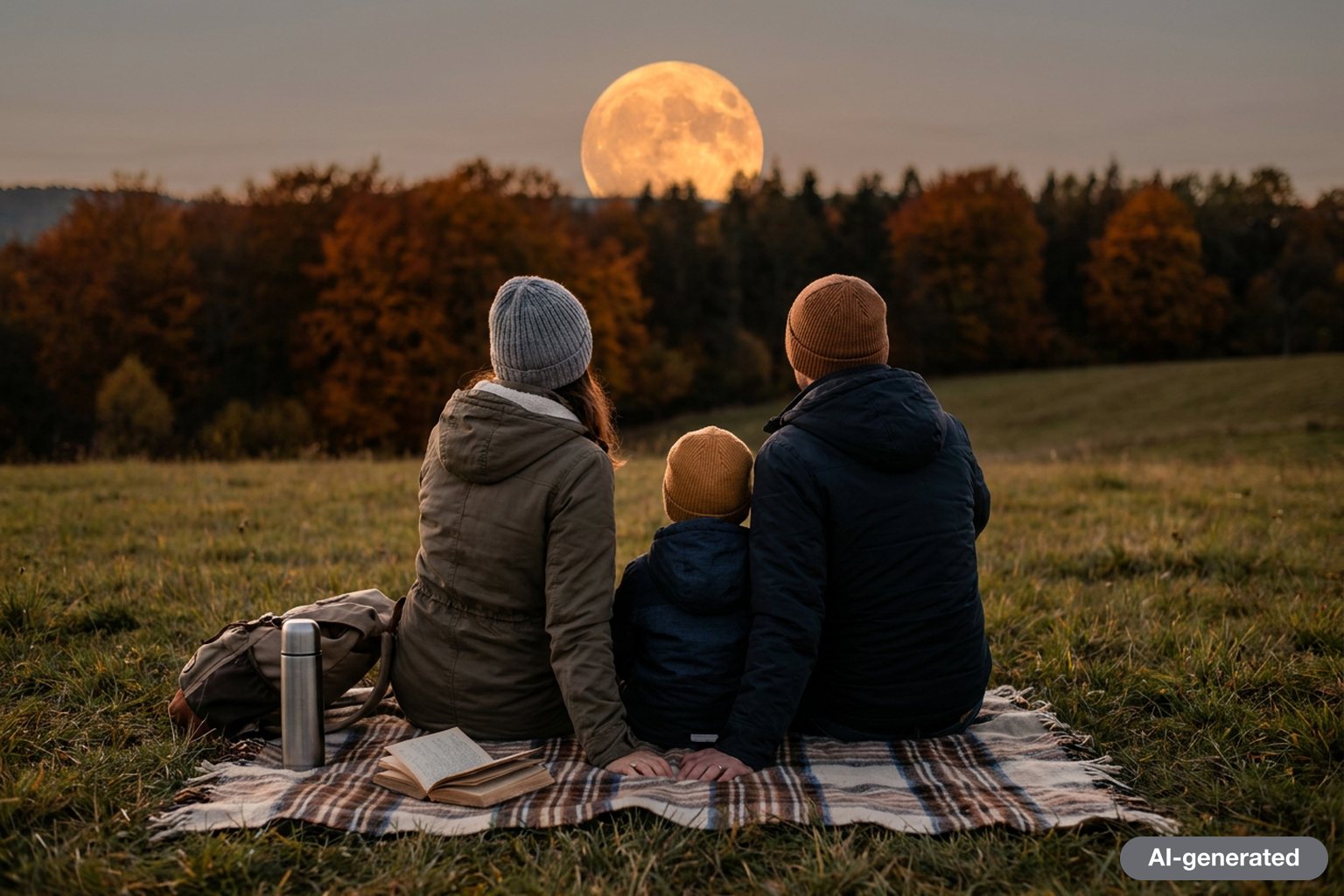
The name comes from the farming and hunting calendar of the Northern Hemisphere. By late October the harvest was in, fields had been cut, and leaves were coming off the trees. Deer and other game had fattened over the summer and early autumn, and in open, stubbled fields they were easier to spot. The Old Farmer's Almanac describes this as the season when households shifted from gathering crops to laying in meat for winter: hunting, salting, smoking and storing provisions before the cold set in. Time and Date traces the name to Anglo-Saxon usage.
The Harvest Moon rule
Unlike most traditional moon names, the Hunter's Moon is not tied to a calendar month. It is defined by its position after another moon: the Harvest Moon, which is the full moon closest to the September equinox. The Hunter's Moon is simply the next full moon after that.
In 2026 the September equinox fell on September 23 at 00:05 UTC, and the full moon of September 26 was the nearest to it, so September's moon was the Harvest Moon and October 26 is the Hunter's Moon. In some years the full moon closest to the equinox lands in early October. Then October's moon is the Harvest Moon and the Hunter's Moon slides into November. That happened in 2025, when the October 7 full moon was the Harvest Moon.
Why it rises so early, night after night
The Harvest Moon and Hunter's Moon share a piece of orbital geometry. On an average night the Moon rises about 50 minutes later than the night before. Around the autumn equinox in the Northern Hemisphere, however, the Moon's path meets the eastern horizon at a shallow angle, so that delay shrinks. For New York this year, moonrise on October 25 comes at about 5:26 p.m. EDT and on October 26 at about 5:58 p.m., only 32 minutes later. That is what made the Hunter's Moon useful: bright light soon after sunset for several evenings in a row.
Other names for the October full moon
American almanac names blend Indigenous North American, colonial American and European traditions, and names varied from one nation and region to the next. The Old Farmer's Almanac, the Farmers' Almanac and Time and Date list these names for the October moon:
- Drying Rice Moon – a Dakota name linked to preparing the wild rice harvest.
- Falling Leaves Moon – an Anishinaabe name for the turn into autumn.
- Freezing Moon or Ice Moon – Ojibwe and Haida names marking the first hard frosts.
- Migrating Moon – a Cree name for the season when birds fly south.
- Travel Moon and Dying Grass Moon – names listed by the Farmers' Almanac for the same season of movement and fading meadows.
- Seed Fall Moon – listed by Time and Date for the time when plants drop their seed.
- Blood Moon or Sanguine Moon – older European-tradition names, often linked to the hunt and to the autumn slaughter of livestock. There is no lunar eclipse at this full moon; for those dates, see our eclipse guide.
In the Southern Hemisphere, where October is spring, these seasonal names do not fit, and many skywatchers there apply Harvest Moon and Hunter's Moon to the full moons after the March equinox.
Best time to see the Hunter's Moon rise
The best moment to watch any full moon is moonrise, when it lifts out of the eastern horizon as the Sun sets in the west. The Old Farmer's Almanac recommends Sunday evening, October 25, for North American viewers: find a spot with a clear, low view to the east and start watching around sunset. No telescope or binoculars are needed.
Approximate moonrise times for the evening closest to the full phase:
- New York: Sunday, October 25, about 5:26 p.m. EDT (sunset about 6:02 p.m.); Monday, October 26, about 5:58 p.m.
- Los Angeles: Monday, October 26, about 6:17 p.m. PDT, just after sunset.
- London: Monday, October 26, about 4:20 p.m. GMT, shortly before the 4:45 p.m. sunset, with the clocks now back on winter time.
- Sydney: Monday, October 26, about 7:32 p.m. AEDT, roughly 15 minutes after sunset.
Times shift by a few minutes with your exact location. A few tips:
- Watch for color. Near the horizon the Moon's light passes through more atmosphere, which scatters blue light and leaves a yellow or orange disk. Autumn haze and smoke can deepen the effect.
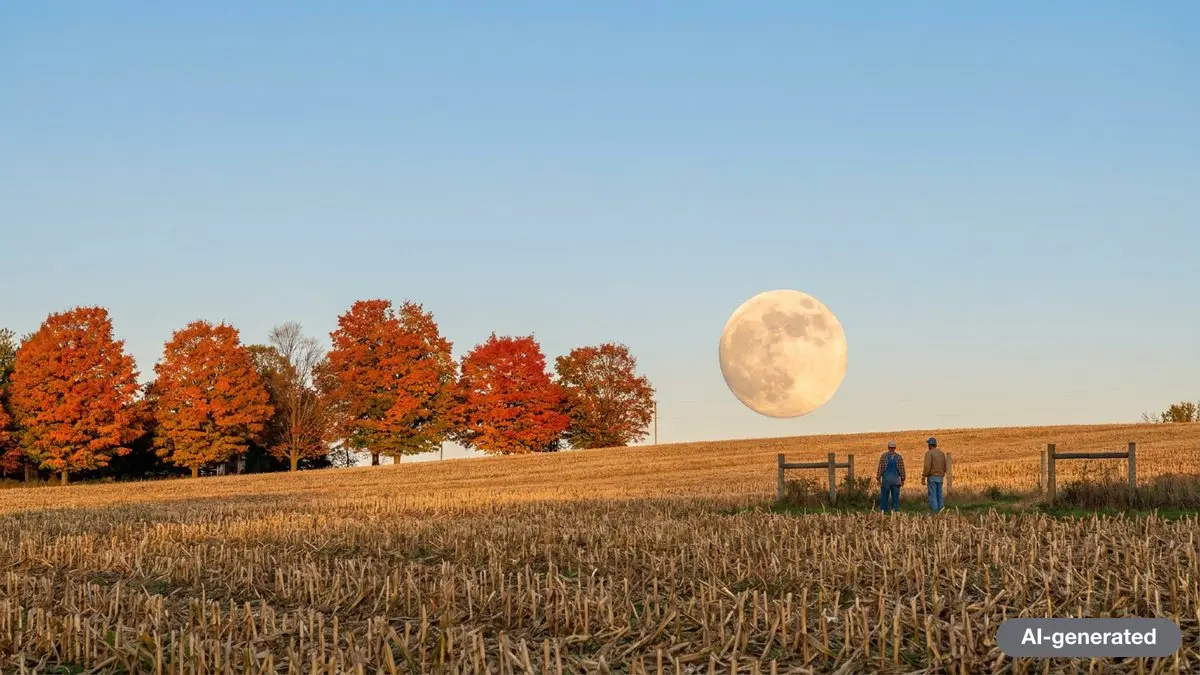
- Use the foreground. Trees, buildings and hills strengthen the moon illusion that makes a rising moon look huge, and give photos scale.
- Stay out a few nights. NASA notes that on the night of October 27 into October 28 the Moon passes close to the Pleiades star cluster, the Seven Sisters, in the eastern evening sky. Binoculars show the cluster beside the bright lunar disk.
Moonlight will brighten the sky for several nights, which is worth knowing if you hope to see faint meteors or the aurora. Our night sky guide covers what else is visible this season.
Full moon in Taurus: Hunter's Moon 2026 astrology
Astronomers and astrologers place this full moon in different spots, and both are right on their own terms. Astronomically, the Moon sits in front of the stars of the constellation Aries. Western astrologers use the tropical zodiac, measured from the March equinox rather than the constellations, and in that system the Hunter's Moon falls at about 3 degrees of Taurus, with the Sun opposite at about 3 degrees of Scorpio.
The Taurus–Scorpio axis
Astrologers describe every full moon as a peak of light and a moment of culmination, when something begun around the previous new moon becomes visible. The Taurus–Scorpio axis is read as the axis of resources: what is mine and what is shared. Taurus, an earth sign ruled by Venus, is associated with the body, comfort, money, possessions, steadiness and the senses. Scorpio, a water sign, is associated with intimacy, debts and joint finances, trust, power and transformation. A full moon here is linked to questions of what you value, what you owe and are owed, and what you are ready to let go of.
Venus retrograde, a Pluto square and Mercury turning back
Astrologers are paying particular attention to the backdrop of this full moon. Venus, the ruler of Taurus, is retrograde from October 3 to about November 14, 2026, moving back from Scorpio into Libra. A full moon in a sign whose ruler is retrograde is usually interpreted as a time to revisit rather than launch: old relationships, past spending habits, unfinished questions of self-worth. At the same time, Pluto at about 3 degrees of Aquarius forms a near-exact square to both the Sun and the Moon, a pattern astrologers call a T-square, read as pressure around control, power and the need to change structures that no longer work.
Mercury also stations retrograde in Scorpio on October 24, two days before the full moon, and moves backward until November 13. Our Mercury retrograde 2026 guide has the full dates and shadow periods.
What it may mean for each sign
Astrologers read the full moon by the area of life it lights up in a chart. By Sun or rising sign, the usual shorthand is: Aries, money and self-worth; Taurus, identity and health; Gemini, rest and endings; Cancer, friendships and long-term hopes; Leo, career and reputation; Virgo, study and travel; Libra, shared money and intimacy; Scorpio, partnerships; Sagittarius, work and daily routines; Capricorn, creativity and romance; Aquarius, home and family, with Pluto in your sign; Pisces, conversations and the local neighborhood.
People in the middle of a major life transit, such as a Saturn return, often read full moons as checkpoints along a longer story rather than isolated events.
Full moon rituals and intention-setting for the Hunter's Moon
Full moon practices draw on folk customs, modern witchcraft and simple mindfulness. In the common modern framework, the new moon is for setting intentions and the full moon is for gratitude, review and release. The Hunter's Moon adds a seasonal flavor: it is a moon of storing up and preparing, so many practitioners use it to take stock of what they have gathered over the year and what they want to carry into winter.
Practices people commonly use around this full moon include:
- A gratitude and harvest list. Write down what you have achieved, earned or learned since spring. With the Moon in Taurus, many focus on tangible results.
- A release ritual. Write what you want to let go of, such as a habit, a grudge or a fear around money, on paper and safely burn it, tear it up or bury it. With the Sun in Scorpio and Pluto active, release is the theme astrologers emphasize most for this moon.
- Charging crystals or water. Stones are left on a windowsill overnight; Taurus favorites include rose quartz, green aventurine and jade.
- A grounding walk. Taurus is linked to the senses, so an evening walk under the rising moon or a slow meal fits the theme.
- Journaling prompts. What makes me feel truly secure? What do I owe myself? What am I holding on to that has finished its job?
Step outside at sunset on October 25 or 26 and watch the Moon clear the eastern horizon. Then write three things you are grateful for from this year's "harvest" and one thing you are ready to release. Keep the gratitude list and dispose of the release note safely. Fifteen minutes is enough.

Remaining full moons of 2026
After the Hunter's Moon, two full moons remain this year, and both are supermoons.
| Full moon | Date and time (ET) | UTC | Zodiac sign | Distance and status |
|---|---|---|---|---|
| Hunter's Moon | Mon, Oct 26, 12:12 a.m. EDT | Oct 26, 04:12 | Taurus | about 368,900 km; not a supermoon |
| Beaver Moon | Tue, Nov 24, 9:53 a.m. EST | Nov 24, 14:53 | Gemini | about 360,800 km; supermoon |
| Cold Moon | Wed, Dec 23, 8:28 p.m. EST | Dec 24, 01:28 | Cancer | about 356,700 km; supermoon, closest full moon of 2026 |
| Wolf Moon (2027) | Fri, Jan 22, 2027, 7:17 a.m. EST | Jan 22, 12:17 | Leo | about 357,600 km; supermoon |
The Beaver Moon recalls trapping season before rivers froze; the Cold Moon, or Long Nights Moon, rises near the winter solstice and stays up longer than any other full moon. Note the date split for December: on the East Coast the Cold Moon is full on the evening of December 23, while in the UK and Australia it falls on December 24.
What comes next
The Moon reaches perigee on October 28, and the alignment of full moon and perigee keeps improving into December, when the Cold Moon will look roughly 3 percent wider than October's moon.
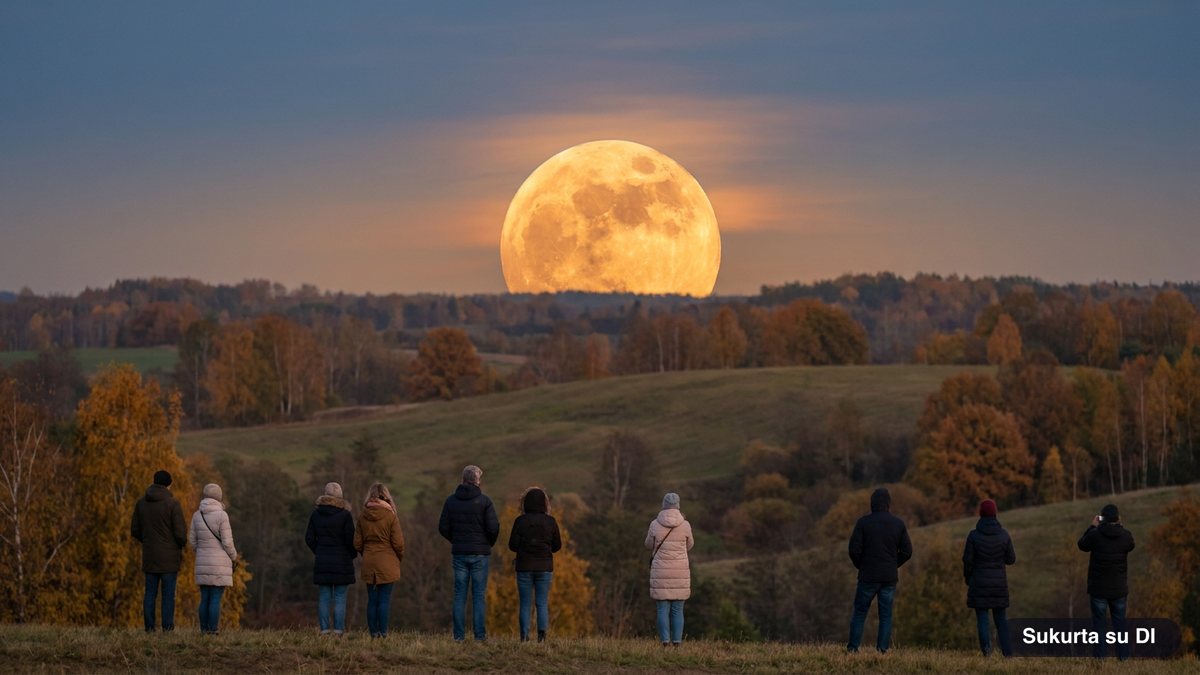
For astrologers, the next turning points are the end of Mercury retrograde on November 13, the end of Venus retrograde about a day later, and the November 24 Beaver Moon in Gemini. For everyone else, the plan is simple: step outside at sunset on October 25 or 26, face east and watch the Hunter's Moon come up over the trees.
Frequently asked questions
What time is the Hunter's Moon in 2026?
The Hunter's Moon reaches its exact full phase on Monday, October 26, 2026, at 04:12 UTC. That is 12:12 a.m. EDT in New York, 11:12 p.m. CDT and 9:12 p.m. PDT on Sunday, October 25, 4:12 a.m. GMT in London and 3:12 p.m. AEDT in Sydney. The Moon looks full to the eye from October 25 to 27.
Is the October 2026 full moon a supermoon?
No. A supermoon is usually defined as a full moon within about 90 percent of perigee, the Moon's closest point to Earth. On October 26 the Moon is about 368,900 kilometers away, just outside that threshold, with perigee arriving on October 28. The November and December 2026 full moons are supermoons.
Why is it called the Hunter's Moon?
The name comes from the Northern Hemisphere's autumn calendar. After the harvest, fields were cleared and game was fat and easy to spot, so this was the season to hunt and store meat for winter. The bright moon rising soon after sunset gave hunters extra evening light. The name is traced to Anglo-Saxon usage.
What is the difference between the Harvest Moon and the Hunter's Moon?
The Harvest Moon is the full moon closest to the September equinox. The Hunter's Moon is the next full moon after it. In 2026 the Harvest Moon was on September 26, so the October 26 full moon is the Hunter's Moon. In years when the October full moon is closer to the equinox, it becomes the Harvest Moon and the Hunter's Moon moves to November.
What are other names for the October full moon?
Almanacs list several traditional names, including the Drying Rice Moon (Dakota), Falling Leaves Moon (Anishinaabe), Freezing Moon or Ice Moon (Ojibwe and Haida), Migrating Moon (Cree), Travel Moon, Dying Grass Moon and Seed Fall Moon. Older European-tradition names include Blood Moon and Sanguine Moon, linked to the hunt rather than to an eclipse.
When is the best time to see the Hunter's Moon?
Watch at moonrise, around sunset, facing a clear eastern horizon. In North America the best evening is Sunday, October 25; in New York the Moon rises at about 5:26 p.m. EDT. In the UK and Australia, Monday evening, October 26, is best. Near the horizon the Moon often looks large and orange.
What zodiac sign is the October 2026 full moon in?
In the tropical zodiac used by Western astrologers, the Hunter's Moon falls at about 3 degrees of Taurus, opposite the Sun at about 3 degrees of Scorpio. Astronomically, the Moon is in front of the constellation Aries, because the zodiac signs and the constellations no longer line up.
What does a full moon in Taurus mean spiritually?
Astrologers associate a Taurus full moon with values, money, the body, comfort and security, set against Scorpio themes of intimacy, shared resources and transformation. In 2026 Venus, the ruler of Taurus, is retrograde and Pluto squares the full moon, so astrologers frame it as a time to review, release and rebuild rather than start new projects.
What should you do on the Hunter's Moon?
Common full moon practices include writing a gratitude or harvest list for the year, a release ritual in which you write down what you want to let go of and safely burn or tear up the note, leaving crystals in the moonlight, journaling and taking a grounding evening walk to watch the moon rise.
When is the next full moon after the Hunter's Moon?
The next full moon is the Beaver Moon on Tuesday, November 24, 2026, at 9:53 a.m. EST (14:53 UTC), a supermoon in Gemini. It is followed by the Cold Moon on December 23 at 8:28 p.m. EST (December 24, 01:28 UTC), the closest full moon of 2026.
Sources
- The Old Farmer's Almanac: Full Hunter's Moon October 2026: Date, Meaning, and Folklore
- Farmers' Almanac: Full Moon Calendar 2026: Next Full Moon, Dates, Times & Names
- NASA Science: What's Up: October 2026 Skywatching Tips from NASA
- NASA Science: Supermoons
- Time and Date: Hunter's Moon or Harvest Moon in October
- NASA Science: Skywatching Tips From NASA




Log in to comment
No comments yet. Be the first.