Apple Cottage Cheese Pancakes: Recipe and Add-In Guide
- Squeeze grated apples dry – you'll only need ¾ cup (100 g) of flour for the batter.
- Add-in chart: raisins, berries, pumpkin, carrots, zucchini, potatoes, spinach, cheese, and ham.
- One pancake is about 125 kcal; a serving of three is about 375 kcal.
- Ingredients and how to choose them
- How to fry apple cottage cheese pancakes step by step
- Common mistakes
- Add-in chart: how much to add to 2¼ cups (500 g) of farmer cheese and how to adjust flour
- Sweet variations: raisins, berries, pumpkin, carrots
- Savory pancakes: with zucchini, potatoes, spinach, cheese, and ham
- Lighter version
- How many calories are in apple cottage cheese pancakes
- What to serve with, how to store and freeze
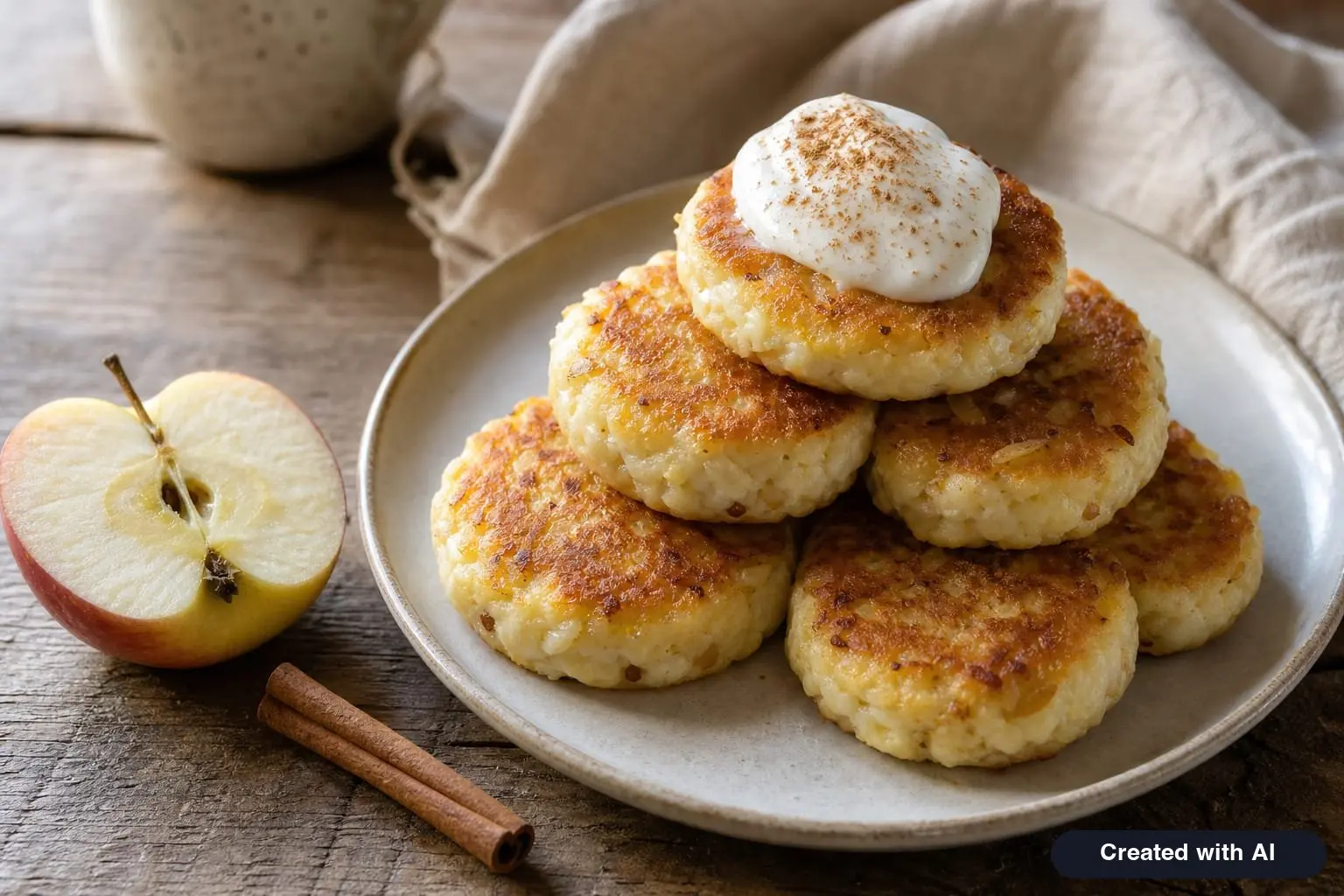
Apple cottage cheese pancakes are just like regular fried cottage cheese pancakes, but with grated apples and cinnamon in the batter. Apples add juiciness and tartness, so you need less sugar, and the inside stays soft even when cooled. However, it's a fussier variation: apples release juice, the batter thins out, and the pancakes can spread or fall apart in the pan. The whole trick to this recipe is managing moisture, not adding handfuls of flour.
The same principle applies to every add-in. Raisins absorb moisture, berries release it while cooking, and pumpkin and zucchini have the most of it. That's why below you'll find not only the main recipe but also a chart: exactly how much of each add-in to use for 2¼ cups (500 g) of farmer cheese and how to adjust the flour accordingly—for sweet pancakes with raisins, berries, pumpkin, and carrots, as well as savory ones with zucchini, potatoes, spinach, cheese, and ham.
The specified amount makes 12 pancakes—4 servings of 3. They are slightly larger than usual because 7 oz (200 g) of apples are added to the same amount of cheese: each one takes about 2.6 oz (75 g) of batter. One cooked pancake has about 125 kcal, and a serving has about 375 kcal. If you are making these for the first time, start with the basic cottage cheese pancakes recipe—it details what kind of cheese to choose and how to fry them; here we rely on the same basics.
The recipe is in the card: you can recalculate quantities for a different number of servings, check off what you've already added, and print it. Below the card, each step is explained in more detail.
Apple Cottage Cheese Pancakes
No ratings yet – be the firstIngredients
For the batter
For frying
Directions
- Farmer cheese. Mash the farmer cheese with a fork, beat in the egg, and add the sugar, cinnamon, and salt. Mix with a fork—do not use a mixer, as the mixture will thin out.
- Apples. Peel the apples, remove the cores, and grate them on the large holes of a box grater. Squeeze the juice out tightly by the handful—you should have about 7 oz (200 g) of shreds left. Stir into the cheese.
- Flour. Mix ¾ cup (100 g) of flour with the baking powder, add it to the mixture, and mix only until no dry flour remains. The batter should be soft, slightly sticky, but shouldn't run off a spoon.
- Rest. Let sit for 5–10 minutes so the flour absorbs the moisture. Do not let it sit longer—the apples will continue to release juice.
- Shaping. Divide the batter into 12 pieces of about 2.6 oz (75 g) each. Dredge in flour and use floured hands to form patties about 2¾ inches (7 cm) in diameter and ½ inch (1.5 cm) thick. Shake off excess flour.
- Frying. Heat a skillet with a tablespoon of oil over medium heat. Add 4–6 pancakes and fry for 4 minutes until the bottom turns dark golden. Flip, reduce the heat, cover with a lid, and fry for another 4–5 minutes.
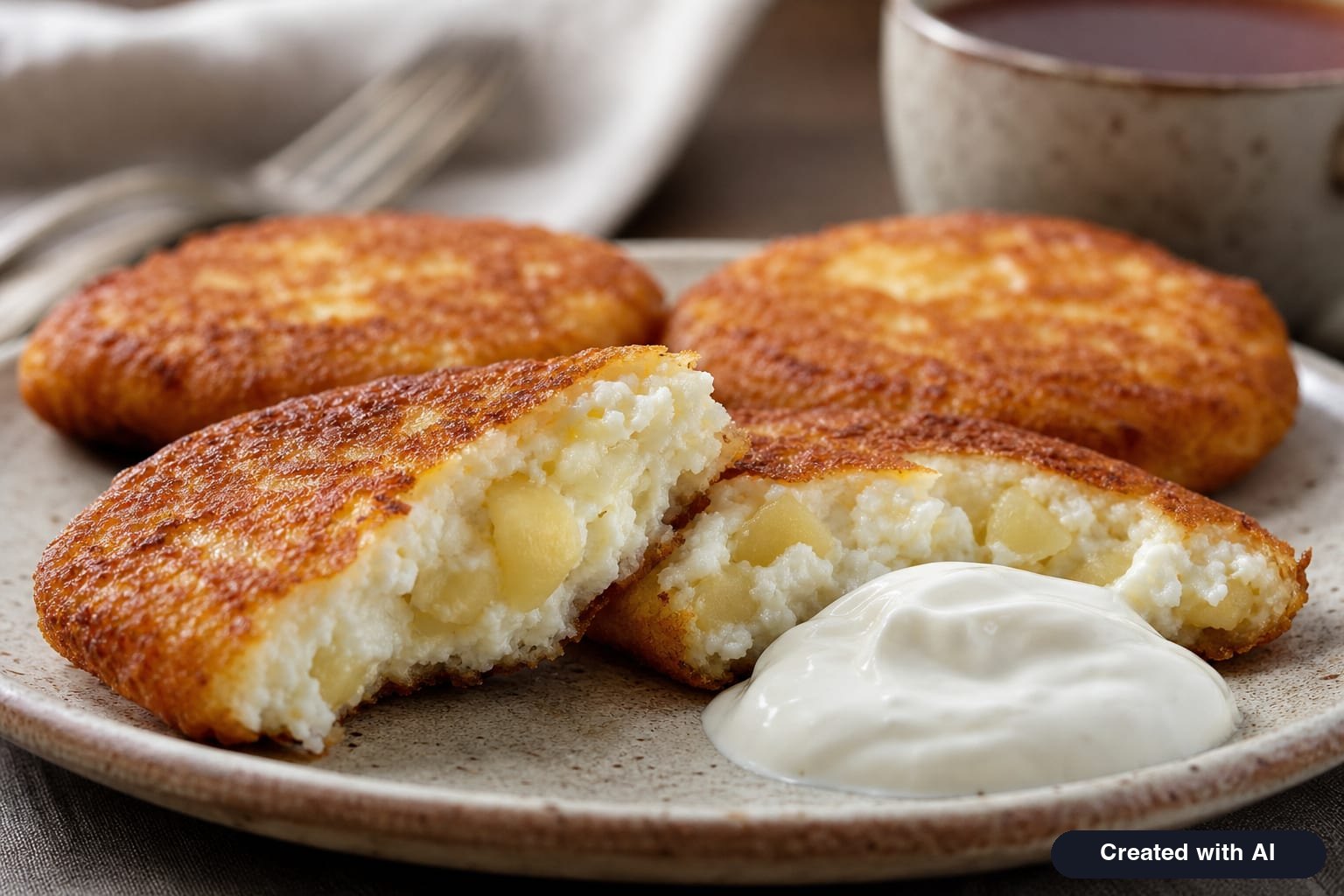
- Subsequent batches and serving. Wipe the skillet with a paper towel, add fresh oil, and fry the rest. Drain the cooked pancakes on a paper towel for a minute and serve warm with sour cream or yogurt.
- Calories
- 125 kcal
- Protein
- 6.3 g
- Fat
- 4.9 g
- of which saturated
- 1.1 g
- Carbohydrates
- 14.1 g
- of which sugars
- 5.4 g
- Fiber
- 0.8 g
Calculated with the Firmus Medicus calorie database (USDA, Fineli).
Ingredients and how to choose them
The cheese. You need dry, crumbly curd cheese (tvorog) – in the US, buy farmer cheese or dry-curd cottage cheese, ideally whole-milk; Eastern European delis also sell it as tvorog. With add-ins, this matters even more than usual: if both the cheese and the apples are wet, no amount of flour will save the mixture. Regular cottage cheese from a tub, or any cheese with visible whey, has to be drained in cheesecloth or a fine-mesh sieve for 20–30 minutes and pressed dry beforehand. Mash it with a fork—some curds can remain, but there shouldn't be large lumps.
Apples. Firm, tart, or sweet-and-tart apples work best—such as Granny Smith, Honeycrisp, or any firm supermarket apple. Mealy, soft apples turn into mush in the pan and lose almost all their flavor. Two medium apples weigh about 10.5 oz (300 g); after peeling, coring, and squeezing out the juice, about 7 oz (200 g) remains—which is exactly what you need. Do not add more: when apples make up more than about 40% of the cheese's weight, the pancakes won't hold their shape.
Flour. We add ¾ cup (100 g) to the batter—about 2.5 tbsp (20 g) more than for plain pancakes. This is only enough if the apples are squeezed dry. Flour here acts as a binder, not a flavor, so an excess is immediately noticeable: the pancakes become tough and resemble rolls.
Sugar and cinnamon. Apples are naturally sweet, so 2.5 tbsp (30 g) of sugar is enough. For tart apples, you can add 3 tbsp (40 g); for sweet ones, 1.5 tbsp (20 g). A teaspoon of cinnamon is a classic pairing; apple cottage cheese pancakes with cinnamon smell like apple pie but cook in just a few minutes. Mix the cinnamon into the batter, not on top: it burns quickly in the pan and turns bitter.
Egg and baking powder. One large egg is enough—a second one would only thin out the mixture. Half a teaspoon of baking powder helps the heavier apple batter rise; the pancakes will still work without it, but they will be flatter and denser.
How to fry apple cottage cheese pancakes step by step
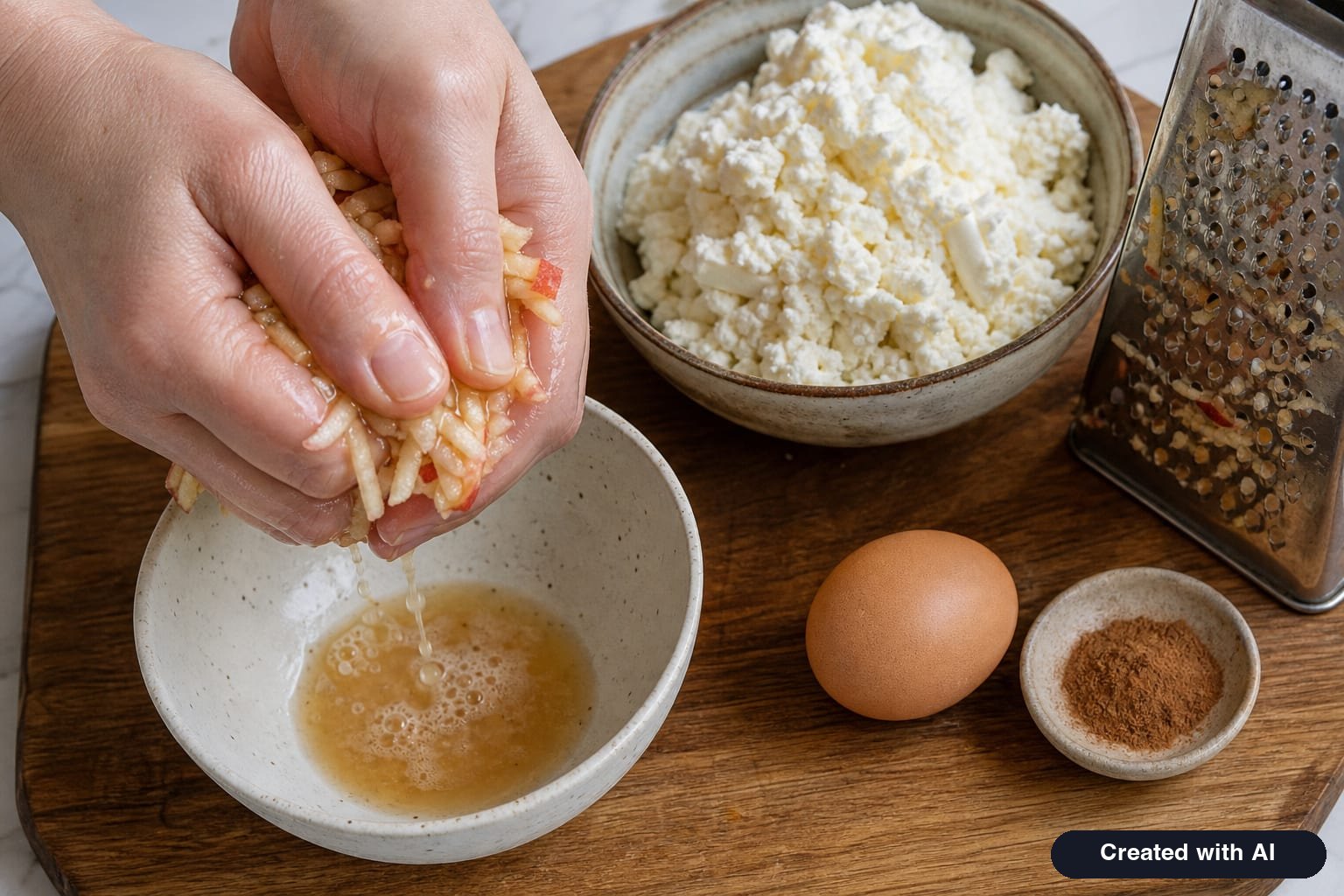
1. Farmer cheese. Mash the farmer cheese with a fork, beat in the egg, and add the sugar, cinnamon, and a pinch of salt. Mix with a fork or spoon. Do not use a blender or mixer: they break down the cheese curds, the mixture thins out, and then it will definitely demand extra flour.
2. Apples. Peel the apples, remove the cores, and grate them on the large holes of a box grater. A fine grater won't work—it turns the apples into a puree that releases all its juice. Take handfuls of the grated apples and squeeze them tightly over a bowl. Two apples will yield about 3 tbsp (40–50 ml) of juice; drink it, do not pour it into the batter. Only grate the apples when the cheese mixture is already prepared: as they sit, they brown and continue to release juice.
3. Batter. Stir the squeezed apples into the cheese. Mix the flour with the baking powder, add it in, and mix only until no dry flour remains. The batter should be soft and slightly sticky, but shouldn't run off a lifted spoon. If it is clearly runny, add one more tablespoon of flour—no more.
4. A short rest. Let the batter sit for 5–10 minutes so the flour absorbs the moisture. Do not let it sit longer: sugar draws juice from the apples, and after half an hour, the batter will be runnier than it was at the start. For the same reason, it's not worth making apple cottage cheese pancake batter the night before.
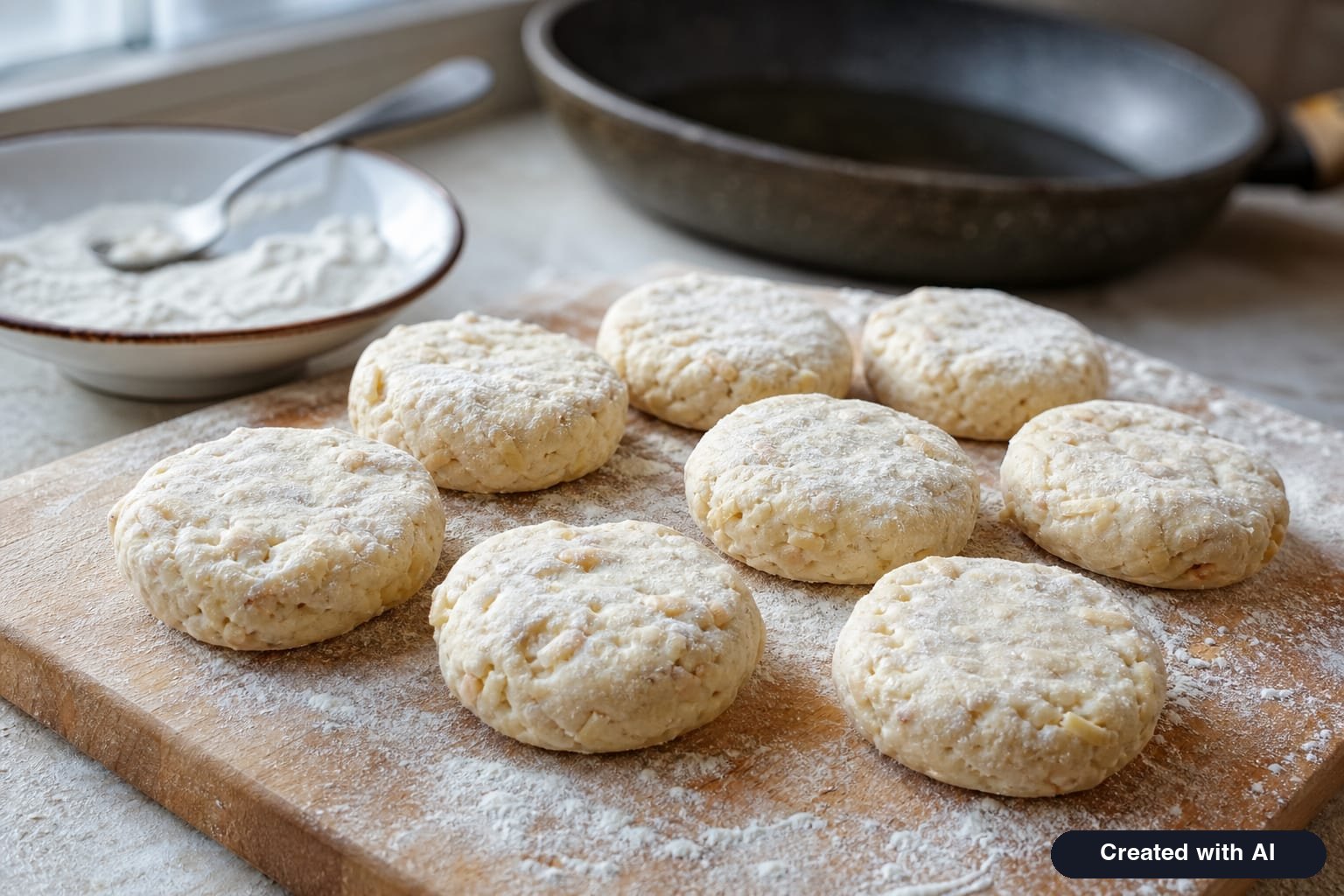
5. Shaping. Divide the batter into 12 pieces of about 2.6 oz (75 g) each—it's easiest to scoop with a heaping tablespoon. Place each piece on a plate with flour, dredge it, and use floured hands to form a patty about 2¾ inches (7 cm) in diameter and ½ inch (1.5 cm) thick. Shake off excess flour, otherwise it will burn in the pan. Thicker pancakes won't cook through the middle, and thinner ones will dry out.
6. Frying. Heat a skillet with a tablespoon of oil over medium heat. Add 4–6 pancakes at a time, leaving space between them, and fry for 4 minutes until the bottom turns dark golden. Flip, reduce the heat, cover with a lid, and fry for another 4–5 minutes. The steam trapped under the lid cooks the inside and softens the apples; without a lid, the surface browns faster than the middle heats up. Apple cottage cheese pancakes brown faster than plain ones because the apple sugar caramelizes, so the heat shouldn't be too high.
7. Subsequent batches. Before adding the next batch, wipe the skillet with a paper towel and add fresh oil—leftover flour and apple crumbs will burn and turn bitter. Let the cooked pancakes rest on a paper towel for a minute and serve warm.
Common mistakes
Batter is too runny, pancakes spread. The apples weren't squeezed or the batter sat for too long. Stir in a tablespoon of flour or a tablespoon of semolina and wait 5 minutes—semolina absorbs moisture better than flour and doesn't make them tough.
Falling apart when flipping. The pancakes were flipped too early or the pan wasn't hot enough. A sturdy crust must form on the bottom—that's what holds the shape. Flip with a wide spatula in one motion.
Dark on top, raw inside. The heat is too high or the patties are too thick. Fry over medium heat and always cover with a lid for the second side.
Tough, "floury". You tried to fix wet cheese or unsqueezed apples with flour. Moisture needs to be removed at the beginning, not bound up at the end.
Bitter aftertaste. Flour or cinnamon burned in the pan. Wipe the pan clean between batches.
Add-in chart: how much to add to 2¼ cups (500 g) of farmer cheese and how to adjust flour
The base for all variations is the same: 2¼ cups (500 g) of farmer cheese, 1 egg, a pinch of salt, and ⅔ cup (80 g) of flour for the batter. For sweet ones, add 2.5–3 tbsp (30–40 g) of sugar; for savory ones, omit the sugar and add half a teaspoon of salt. The chart shows how much flour to add to that ⅔ cup (80 g) and how many calories are in one of the 12 pancakes (including flour for dredging and oil for frying).
| Add-in | Amount per 2¼ cups (500 g) cheese | How to prep | Flour for batter | Kcal per pancake |
|---|---|---|---|---|
| Apples | 7 oz (200 g) (2 medium) | coarsely grate, squeeze dry | +2.5 tbsp (20 g) (total 100 g) | ~125 |
| Raisins | 2.5 oz (70 g) | steep in boiling water, pat dry | no change (80 g) | ~128 |
| Blueberries & other berries | 4.5 oz (130 g) | fresh – dry; frozen – unthawed | +1 tbsp (10 g) (total 90 g) | ~122 |
| Pumpkin | 7 oz (200 g) | finely grate, squeeze dry | +2.5 tbsp (20 g) (total 100 g) | ~124 |
| Carrots | 5.3 oz (150 g) | finely grate | +1 tbsp (10 g) (total 90 g) | ~122 |
| Jam (for filling) | 2 oz (60 g) | half a teaspoon in the center | no change (80 g) | ~121 |
| Zucchini | 9 oz (250 g) raw (5.3 oz / 150 g squeezed) | grate, salt, squeeze after 10 min | +2.5 tbsp (20 g) (total 100 g) | ~109 |
| Mashed potatoes | 7 oz (200 g) | cooled, thick | +1 tbsp (10 g) (total 90 g) | ~122 |
| Spinach | 3.5 oz (100 g) | wilt in a pan, squeeze, chop | +1 tbsp (10 g) (total 90 g) | ~105 |
| Hard cheese | 3 oz (80 g) | grate | no change (80 g) | ~124 |
| Ham and cheese | 3 oz (80 g) + 2 oz (60 g) | finely chop ham, grate cheese | no change (80 g) | ~129 |
| Bacon (bits) | 3 oz (80 g) cooked | fry, drain fat | no change (80 g) | ~132 |
| Smoked salmon | 3.2 oz (90 g) | finely chop | no change (80 g) | ~109 |
| Cooked rice | 5.3 oz (150 g) | cooled, fluffy | no change (80 g) | ~117 |
The rule is simple: dry add-ins (raisins, cheese, ham, poppy seeds) don't change the flour amount, while every 3.5 oz (100 g) of juicy vegetables or fruits requires about 1 tbsp (10 g) more flour. For comparison, a regular pancake without add-ins has about 113 kcal.
Sweet variations: raisins, berries, pumpkin, carrots
Pancakes with raisins. Pour boiling water over the raisins, drain after 5 minutes, and pat completely dry with a towel. Dry raisins harden in the pan, and any sticking out will burn, so press any exposed ones back into the batter when shaping. Fried pancakes with raisins are sweet even without extra sugar—1.5–2.5 tbsp (20–30 g) is plenty.
Pancakes with berries. Do not mix berries into the batter—they will get crushed and dye the mixture. After forming a patty, press 5–6 berries into it and smooth the batter over them. Pancakes with blueberries turn out best because these berries are firm and release less juice; raspberries and strawberries only work if chopped into large chunks. Do not thaw frozen berries: toss them frozen in a tablespoon of cornstarch or flour and add them straight to the batter.
Pancakes with jam and other fillings. Jam is not mixed into the batter—it's too runny. Flatten half a portion of batter in your palm, place half a teaspoon of thick jam in the center, cover with the other half, and seal the edges. You can also make stuffed pancakes with a filling of diced apples sautéed in butter or raisins. Runny jam is better just served on the side.
Pancakes with pumpkin. Butternut or muscat squash works best for pumpkin pancakes—it's sweeter and drier. Grate 7 oz (200 g) of the flesh on a fine grater and squeeze it just like apples. Pumpkin pancakes love cinnamon, nutmeg, and orange zest. Instead of raw, you can use 5.3 oz (150 g) of roasted pumpkin purée—then you'll need ¾ cup plus 1 tbsp (110 g) of flour. If you want more pumpkin than cheese, make pumpkin pancakes.
Pancakes with carrots. Grate the carrots finely, as coarse shreds won't soften in the pan in 8 minutes. No need to squeeze—carrots don't release much juice. Fried carrot pancakes are bright orange and slightly sweet; they pair well with raisins and a splash of lemon juice.
With poppy seeds. Add 3 tbsp (30 g) of dry poppy seeds to the batter—they add crunch and don't change the moisture level. Fluffy apple cottage cheese pancakes with poppy seeds are one of the best combinations.
Savory pancakes: with zucchini, potatoes, spinach, cheese, and ham
Savory fried pancakes are made the same way, just without sugar and vanilla: add half a teaspoon of salt, pepper, and chopped dill or scallions to the batter. They are great for lunch or dinner with sour cream, a yogurt-garlic sauce, or alongside soup.
Pancakes with zucchini. Zucchini is the most watery add-in, so it requires the most careful prep. Grate 9 oz (250 g) of zucchini on a coarse grater, add a quarter teaspoon of salt, let sit for 10 minutes, and squeeze tightly—you should have about 5.3 oz (150 g) left. Only then mix it with the cheese, egg, and ¾ cup (100 g) of flour. Fried zucchini pancakes are soft with a mild flavor; adding a garlic clove and dill makes them punchier. For zucchini and cheese pancakes, grate in an extra 2 oz (60 g) of hard cheese (about 126 kcal each). For a sweet version—soft zucchini apple pancakes—use 5.3 oz (150 g) of zucchini and one apple, squeezing both. If you want a runnier batter that you can pour with a spoon, see the cottage cheese and zucchini version in cottage cheese kefir pancakes.
Pancakes with potatoes. Leftover boiled potatoes or thick mashed potatoes work perfectly—7 oz (200 g). Mash the potatoes while they aren't completely cold yet, and mix well with the cheese. Mashed potato cottage cheese pancakes resemble soft potato patties; they are best with crispy bacon and a sour cream sauce.
Pancakes with spinach. Heat fresh spinach in a dry skillet for a minute until wilted, cool, squeeze, and chop. Thaw frozen spinach and squeeze it even harder. Spinach pancakes pair beautifully with crumbled feta and garlic.
Pancakes with cheese, or ham and cheese. Grated hard cheese binds the batter, so no extra flour is needed. Chop the ham as finely as possible—large chunks will break the patty apart. Salty add-ins have their own salt, so only add a pinch to the batter.
Pancakes with bacon or bacon bits. Dice the bacon, fry until crispy, and drain the fat—only add the cooled bacon bits to the batter.
Savory pancakes with salmon. Finely chop 3.2 oz (90 g) of smoked salmon and mix it in along with dill and lemon zest. Do not add any salt.
Pancakes with rice. 5.3 oz (150 g) of cooked, cooled rice makes the pancakes more filling; they work well both sweet and savory.
A few more related variations are described in other parts of the guide: banana pancakes and sugar-free ones in the healthier pancakes recipe, and those who don't want to stand by the stove can bake their apple cottage cheese pancakes in the oven.
Lighter version
Apples make the pancakes bigger, but not heavier—most of the calories still come from the cheese, flour, and oil. Here is how much the most common swaps change things, calculated for one of the 12 pancakes:
| Change | How | kcal / pancake | Difference |
|---|---|---|---|
| Main recipe | as written above | 125 | – |
| Less oil | non-stick skillet and 1 tablespoon of oil (about 12 g) for all batches | 112 | −13 |
| Low-fat cheese | 2¼ cups (500 g) of low-fat farmer cheese instead of whole-milk | 115 | −10 |
| No sugar | omit sugar entirely – works well with sweet apples | 116 | −9 |
| Low-fat cheese, no sugar, less oil | all three swaps combined | 92 | −33 |
| More apples | 3 apples (10.5 oz / 300 g squeezed) and ¾ cup plus 1 tbsp (110 g) of flour for the batter – pancakes will be larger | 133 | +8 |
| With sour cream | +1 tablespoon (15 g) of sour cream on each pancake | 155 | +30 |
Calculated with the Firmus Medicus calorie database, with the recipe divided into 12 pancakes.
Oil saves the most: frying in a non-stick pan with just one tablespoon of oil means one pancake has about 112 kcal instead of 125. Low-fat cheese cuts about 11 kcal, and skipping sugar cuts about 10 kcal; with sweet apples, you barely notice it's missing. All three swaps together yield about 92 kcal per pancake, which is roughly 275 kcal per serving. Adding more apples doesn't reduce the calories—the pancake just gets bigger (about 133 kcal), but it contains more fruit. Meanwhile, a tablespoon of sour cream on each adds about 30 kcal.
How many calories are in apple cottage cheese pancakes
One apple cottage cheese pancake made according to this recipe has about 125 kcal, 6 g of protein, 5 g of fat, and 14 g of carbohydrates, of which about 5 g are sugars. A serving of three pancakes has about 375 kcal and 19 g of protein. That's about 12 kcal more than a plain pancake (113 kcal), but only because it's larger: the apples and the extra 2.5 tbsp (20 g) of flour add mass. Below is how many calories each ingredient contributes.
| Ingredient | Amount | kcal, whole recipe | Share |
|---|---|---|---|
| Cottage cheese | 500 g | 490 | 33 % |
| White wheat flour | 100 g | 364 | 24 % |
| Canola oil | 30 g | 265 | 18 % |
| Granulated sugar | 30 g | 116 | 8 % |
| Apple | 200 g | 104 | 7 % |
| Egg | 60 g | 86 | 6 % |
| White wheat flour | 20 g | 73 | 5 % |
| Cinnamon, ground | 3 g | 7 | 0 % |
| Table salt | 1 g | 0 | 0 % |
| Total | 944 g | 1505 | 125 kcal / pancake |
Ingredient values – Firmus Medicus calorie database.
What to serve with, how to store and freeze
Sweet apple cottage cheese pancakes are best warm, with a spoonful of sour cream or plain yogurt and a pinch of cinnamon. Honey, applesauce, or maple syrup also work well; apple jam is often too sweet. For savory versions, choose sour cream with dill, a yogurt-garlic sauce, or a fresh vegetable salad.
Cooked pancakes will keep in an airtight container in the fridge for up to 2 days. Reheat them in a covered skillet over low heat for 2–3 minutes per side, or in a 325°F (160°C) oven for 8–10 minutes; in the microwave, they soften and lose their crust.
It's better to freeze them already cooked. Raw pancakes with apples, zucchini, or berries will release juice as they thaw and turn to mush, but cooked ones keep in the freezer for up to 2 months. Cool them, freeze in a single layer on a board, then transfer to a bag. Reheat straight from frozen—in a 350°F (180°C) oven for about 12–15 minutes.
If you want even more add-ins but less time at the stove, you can put the same cheese, apples, and raisins into a cottage cheese casserole. Those avoiding all-purpose flour will find the "Flourless cottage cheese pancakes" section useful—semolina and cornstarch bind juicy add-ins even better. And savory add-ins also work for lazy vareniki: they are boiled in water and served with a bacon or butter sauce.
Frequently asked questions
How should I prep apples for cottage cheese pancakes – grated or diced?
It's best to grate them on the large holes of a box grater and squeeze them tightly in your hands: 2 apples (about 10.5 oz / 300 g) will yield about 7 oz (200 g) of squeezed shreds. Finely grated apples turn into mush and thin out the batter, while diced apples need to be sautéed in butter to soften before adding.
How much flour do I need for apple cottage cheese pancakes?
For 2¼ cups (500 g) of farmer cheese and 7 oz (200 g) of squeezed apples, you need ¾ cup (100 g) of flour for the batter—about 2.5 tbsp (20 g) more than plain pancakes—plus another 2 tbsp (20 g) for dredging. If the batter is still runny, stir in a tablespoon of semolina rather than more flour.
Why do apple cottage cheese pancakes fall apart or spread in the pan?
Usually due to excess moisture: wet cheese, unsqueezed apples, or batter that sat for more than 10 minutes. Also, don't flip them too early—cook the first side for 4 minutes until a sturdy crust forms.
How do I make zucchini cottage cheese pancakes?
Grate 9 oz (250 g) of zucchini, salt it, wait 10 minutes, and squeeze it dry (leaving about 5.3 oz / 150 g). Mix with 2¼ cups (500 g) of farmer cheese, an egg, ¾ cup (100 g) of flour, salt, and dill. Cook for 4 minutes per side, covering the pan for the second side; one pancake has about 109 kcal.
How do I make savory cottage cheese pancakes?
Omit the sugar and vanilla from the batter, add half a teaspoon of salt, pepper, herbs, and your chosen add-in: 3 oz (80 g) of grated cheese, ham and cheese, cooked bacon, smoked salmon, 3.5 oz (100 g) of spinach, or 7 oz (200 g) of mashed potatoes. Serve with sour cream or a yogurt-garlic sauce.
Can I add frozen berries to cottage cheese pancakes?
Yes—about 4.5 oz (130 g) of berries per 2¼ cups (500 g) of farmer cheese. Do not thaw the berries; toss them in a tablespoon of cornstarch and press them into the already formed patties, adding an extra 1 tbsp (10 g) of flour to the batter. Blueberries work best because they are firm and release less juice.
How many calories are in apple cottage cheese pancakes?
Using this recipe, one pancake has about 125 kcal, and a serving of three has about 375 kcal and 19 g of protein. With low-fat farmer cheese, no sugar, and less oil, it drops to about 92 kcal per pancake.
Can I freeze apple cottage cheese pancakes?
Yes, but only freeze them after cooking: raw ones will release apple juice as they thaw and turn into mush. Cooked pancakes keep in the freezer for up to 2 months; reheat them straight from frozen in a 350°F (180°C) oven for 12–15 minutes.
Log in to comment
No comments yet. Be the first.